

Smart glasses production capacity works as a chain of queues rather than as a single number, and that is the whole explanation for why two factories quoting the same figure can deliver on completely different dates. Each stage of a production run holds its own queue, each queue has its own service rate, and your order passes through all of them in sequence. The figure a supplier calls capacity is usually the service rate of one stage — the assembly line — which is the stage most visible and frequently not the one that sets the date. This page walks the chain stage by stage, shows where the constraint usually sits in a product like ours, and explains what a capacity statement has to include before it can be checked.

Smart glasses production capacity works as a chain of queues
The conclusion, and the reader it is written for
Every stage in a production run is a queue with its own arrival rate and its own service rate, and the whole run is a chain of them. The total time your order takes is the sum of the waiting time and the work time at each stage, which is why two factories with identical line capacity can be weeks apart on the same order. The buyer who understands this stops asking "how much can you make" and starts asking "which queue is longest for my configuration", because that is the only question whose answer changes the schedule.
The reader is a brand-side sourcing manager, a channel buyer or an importer. They are holding quotations and need to know which of them describes a plan and which describes a capability. What they are managing is not the production rate itself — it is the date their order gets built, and the risk that the date is a function of something they never asked about.
Why the assembly rate is the wrong thing to compare
Assembly capacity is quoted because it is easy to quote and it is reassuring. It is also the stage where a factory has the least differentiation and the most flexibility, because assembly capacity can usually be expanded with overtime or a second shift faster than any other stage can. The stages that cannot be expanded quickly are the ones with a physical queue in front of them: purchased parts waiting to arrive, lots waiting for incoming inspection, units waiting for a programming slot, units waiting for a test station.
This is also why the product scope changes the answer so dramatically. A camera model has a camera module that must arrive before it can be built, a firmware integration step that a Bluetooth audio product does not have, and a different defect profile at the end. Quoting one rate for the whole range means quoting the audio case, because the audio case is the one with the shorter chain — and in practice the two differ by considerably more than the buyer expects.
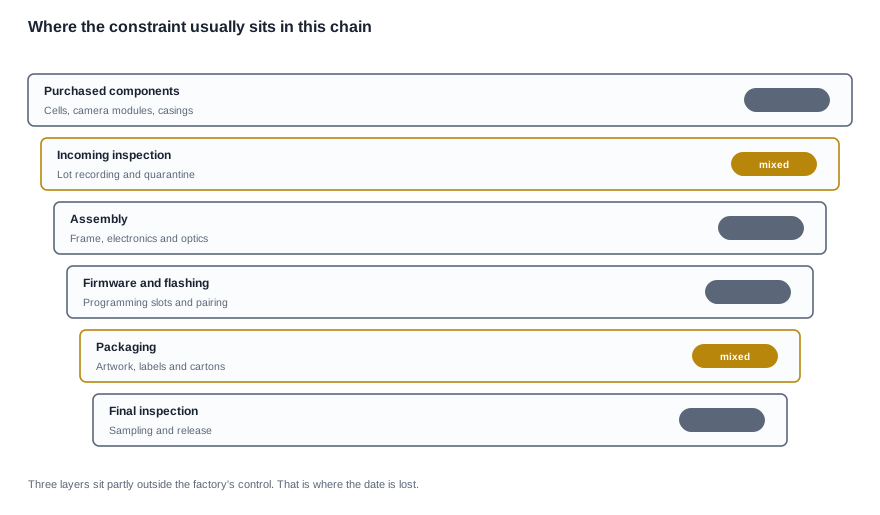

The stages a smart glasses production run goes through
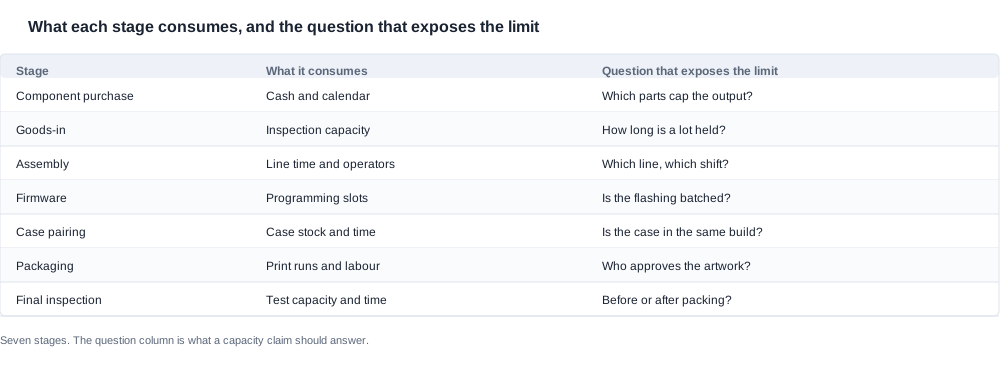
Seven stages, and what each one consumes
The flow above is the sequence. The third column of the table below is the part that matters most, because it names the question that exposes each stage's limit.
| Stage | What it consumes | Question that exposes the limit |
|---|---|---|
| Component purchase | Cash and calendar | Which parts cap the output? |
| Goods-in | Inspection capacity | How long is a lot held? |
| Assembly | Line time and operators | Which line, which shift? |
| Firmware | Programming slots | Is the flashing batched? |
| Case pairing | Case stock and time | Is the case in the same build? |
| Packaging | Print runs and labour | Who approves the artwork? |
| Final inspection | Test capacity and time | Before or after packing? |
The stages a buyer controls
Three of the seven stages are partly the buyer's, and a buyer who treats them as the factory's is missing the levers. Component purchase begins with a forecast the buyer controls: how firmly a forecast is committed determines how much of the cell and the module supply the factory is willing to hold on your behalf. Packaging begins with artwork, and artwork approval sits on the buyer's side of the line with more approvers than anyone expects — a stage that is trivially compressible by agreeing a review deadline in advance.
Case pairing is the third, and it is the one buyers rarely consider at all. Whether the case is packed into the same build as the glasses or supplied separately changes the bill of materials, the packing sequence and the number of units the line has to handle. Our catalogue makes the scale of this visible: the L1 Pro and the CY05, and the CY03 are published with a 1400 mAh case, the L2 Utral with either a 900 or a 1400 mAh case, the MT6 with a foldable 1200 mAh case, the KY06 and the MT5 with a case whose capacity is not published, and the V03 Pro with no case at all. A programme that mixes a case build with a no-case build has two bill-of-material routes, not one.
Why the stages are not the same length
The seven stages are not comparable in duration and the temptation to treat them as such produces bad schedules. Component purchase is measured in weeks and is outside the factory's control. Goods-in is measured in hours but is frequently a queue rather than a work time. Assembly is measured in minutes per unit and is the stage most likely to be quoted as a rate. Firmware is batched, so a small order waits for a batch rather than being programmed individually. Final inspection is measured in test-station minutes, and the position of the sampling point — before or after packing — determines whether a defect is caught at a point where it can still be fixed or at a point where it can only be recorded.
The consequence is that the stage with the best rate is usually the one with the least influence on the date, and the stage with the worst rate is usually the one nobody quotes. A buyer who has spent two rounds negotiating the assembly rate has optimised the one term that was never binding. The substitution of effort is easy to fall into because the assembly rate is the one number both sides can talk about without naming a supplier, a sub-supplier or a component, and the questions that would locate the real constraint require naming those things.

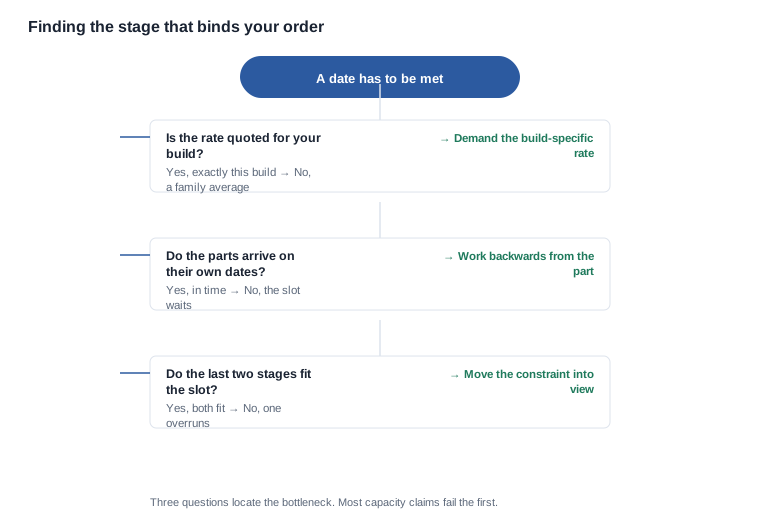
Finding the binding constraint
The criteria for evaluating a capacity claim
Before you can locate the constraint you need criteria that a claim can be marked against, because a claim that is going to be challenged later has to be evaluated against something written down in advance rather than against an impression. Five criteria are enough, and each one is answerable with a document rather than a conversation. The first is whether the rate is quoted for the exact build on the order. The second is whether the rate describes assembled units or finished, packed units. The third is whether the period the rate covers is a peak or an average. The fourth is whether the set-up cost of each build on the order is stated. The fifth is whether the claim has been derived from the production system or arrived at another way.
Those five are the basis of the shortlist. Two factories can both be credible and still be unsuitable, and the way that happens is that one of them quoted a rate that applies to a different configuration while the other quoted a rate that applies to yours. Comparing them on price then rewards the wrong answer, which is a trade-off worth naming before you start rather than after.
The questions to ask, and the red flags to record
Four questions locate the constraint, and the decision chart gives the sequence. The first is the one most capacity claims fail, because a rate quoted for a product family rather than for your build cannot be re-derived for your build. The third is a production-planning question about the back end of the chain, and it catches the common case where the build finishes and the goods still cannot ship.
The red flags worth recording against each claim are these: a rate that does not move when the configuration changes, which suggests it was not derived from the line; a unit of output that is not stated; a period that is described as typical rather than named; and a figure that is presented as a site total when the question was about one line. None of these is proof that the supplier is unreliable. Each of them is a reason to ask one more question, and a supplier who answers it plainly is demonstrating exactly the capability you are trying to buy.
Three questions that locate it
The decision chart gives the sequence. The first question is the one most capacity claims fail, because a rate quoted for a product family rather than for your build cannot be re-derived for your build. The second locates the constraint in the supply chain rather than in the factory, and it is worth asking because the answer tells you whether the schedule risk is shared or entirely yours. The third is a production-planning question about the back end of the chain, and it is the one that catches the common case where the build finishes and the goods still cannot ship.
The output of all three is a single sentence you can put in the order: for this configuration, on this quantity, the binding stage is this one, and here is what would have to change for it to be a different one. That sentence is the most useful thing a capacity conversation produces, and it is worth more than any rate.
Reading a claim back to its inputs
A capacity statement that came from a line count, a shift pattern and a cycle time can be checked against your own order. A statement that came from a sales target cannot be checked at all — it can only be believed. The difference is visible in what the supplier volunteers. If the derivation is available, you will get the number of lines, the number of shifts and the cycle time for your build, and you can recompute the rate for your quantity and your variant count. If it is not, you will get a figure that does not move when you change the configuration, which is the clearest available signal that the figure is not derived from the production system at all.
There is a second reading skill worth having. Ask for the rate for the same configuration at two different quantities. A factory running a stable line will show a rate that is broadly flat, because the same cycle time applies. A factory quoting an average will show a rate that changes with volume, because the average has moved. The first is a rate; the second is a blend of several rates with the weighting hidden.

Reading a capacity statement back to its inputs
What a complete statement contains
A complete capacity statement, for this category, names the product scope, the unit, the position in the chain the rate refers to, the effect of your configuration on the rate, and the period the rate covers. A statement that omits the third of those — whether the figure describes assembled units or finished, packed units — is the most common gap, and it is a large one, because packaging, programming and inspection all sit after assembly and all consume capacity.
The fifth is the one that determines whether a figure can be planned with at all. A peak-week figure and an average-month figure are different numbers, and only the second is a plan. Most capacity statements are given at the moment when the factory is busiest, because that is the moment the number sounds best, and a buyer who takes it at face value is planning against a figure that will not recur.
The trap of the comparable-looking number
One warning applies across the whole category. Two numbers that look identical may be describing different things, and the most common version of this in a product specification is the unit of measure. A cell capacity quoted for a pack and a cell capacity quoted for a cell are the same figure in the same unit and are not the same quantity, because the pack adds a protection circuit and a housing. The same applies to capacity figures: an assembled rate and a finished rate are the same unit and are not the same number. Whenever two suppliers offer a figure in the same unit, establish what level each one describes before you compare them, or the comparison will show a specification gap where there is only a difference in what is being counted.
There is a related trap in the duration figures. A lead time, a cycle time and a queue time are all measured in days and none of them is interchangeable with another. A cycle time describes the work; a queue time describes the waiting; the lead time is the sum. Quoting all three with one word — duration — is how a factory that is honest about its work ends up being compared on a number that excludes the waiting, and the waiting is usually the larger of the two.
The production facts our catalogue does and does not carry
How a buyer should evaluate a factory without seeing the line
The chapters above describe the chain. There is a second way to learn where a supplier's constraint sits, and it costs a supplier who is honest nothing and a supplier who is not quite so honest quite a lot: ask what they would do if your order arrived in the middle of their busiest week. A factory whose chain has slack at the front will describe a priority rule and a slot. A factory whose chain is already full will describe how the queue works, who is ahead of you, and what would have to change.
That answer is more informative than any rate, because it reveals the shape of the constraint rather than its size. It also produces the two documents you want to have in the file. The first is the allocation rule, written down, naming who wins a constrained period and how that is decided. The second is the notice period, because a slot without a notice period is a slot that can move without telling you.
The practical test of a supplier's answer is whether it is specific. "We would do our best" is not an allocation rule. "Your build would run in the first window after the current campaign ends, and we would confirm the slot within three working days of the deposit" is. The difference between the two is the difference between a supplier who has scheduled this before and one who has not.
One further question belongs in the same round, and it is the one that separates a manufacturer from a trading company without either party having to make a claim about itself. Ask which stages of the sequence are performed at the site that is quoting, and which are performed elsewhere. A supplier who answers "all of them, here" is making a statement about its own operation that a buyer can check later by asking for the run record and the goods-in log. A supplier who answers honestly and names two or three stages that sit with a sub-supplier is telling you something equally useful, because those stages are the ones you should not expect to be covered by the quote's lead time.
That answer also settles the question of where the risk sits. A stage performed in-house is a stage the factory can re-plan around; a stage performed by somebody else is a stage that arrives when it arrives. It is not a criticism of the supplier — sub-supply is ordinary in this category and often the only commercially sensible arrangement for a specialised module — but it does change which questions are worth asking. The question moves from "how long does it take" to "what happens when it is late", which is a question with a much more useful answer.
Where our own documentation settles
Everything our documentation states is something we will stand behind, and everything it does not state is a question that belongs in the supplier's own file. The published rows are reproduced as the catalogue gives them, the open ones are labelled as open, and no open row is filled from a supplier's general data. A buyer who builds a claim on an estimated number finds the error in the field rather than in the quotation, and the correction always costs more than the question would have.
The rows our published data does settle are these. The catalogue carries twenty-eight models: eleven camera models, eight audio models, three sport models and six further entries — the AR frame, the three children's models, the electrochromic model and the bone conduction model. Camera resolution is published across eleven models, with eight megapixel on eight of them and thirteen megapixel on three. The ingress marking IP54 appears on the V06 and the S7 only. The published cell capacities run from 40 mAh to 290 mAh, and each tier is a separate purchase with its own availability, so the purchase stage follows the cell tier rather than the model. Charge time is published for every model: twenty-six at two hours or less, and the D17 and the ZH12 at around one hour. The unit weight is published for one model only, the MT6 at 158 grams for the glasses body including the cell and the camera and excluding the foldable 1200 mAh case, whose own weight is not published.
The rows we leave open on purpose
The rows we do not publish are these:
-
Line counts, daily output, stage durations and the capacity they add up to are not published. A standing figure would be wrong for most of the orders a reader compared it against, and the assessment reads the stages of your own build instead.
-
The unit weight is published for one model only; no bare frame weight is published for any model in the range.
-
Sensor part numbers, ingress test report numbers and certification numbers are not published. Our product catalogue contains a company-level export certification page, but it does not carry a per-model certification row.
-
The Bluetooth version for the camera models is not published on their rows, so the configuration for those builds has to be established rather than assumed.
Send the models, the quantities and the target market, and we will tell you which configurations exist, which stages each of them depends on, and which parts of the chain the published data settles for your build.
Related reading


