
Sport smart glasses troubleshooting follows the same logic as any other device in this range — check the charge, check the storage, reset the connection, test the camera in isolation, separate the application from the device, rule out the environment — but the order of the first three steps is different, and two faults exist only because the product is sold into sport. Both of those facts are commercial, not technical: they decide what a distributor's return rate actually turns out to be, and they decide whether a support desk is run by people or by a replacement budget.
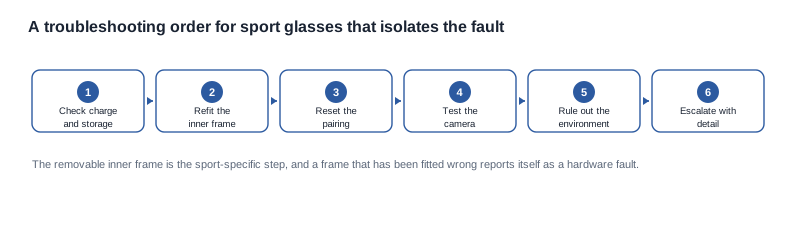
This article is written for the person who owns the returns number, not for the person who owns the device. The sequence below is the one that resolves most sport returns at the counter without a unit ever being replaced, followed by what a supplier has to supply in writing before that sequence can work at all.
The commercial reason to care about the sequence is that the return rate is a contract number. A warranty period agreed at the purchase order, a replacement threshold agreed at the quotation, a refund policy agreed with the channel — all of them convert into money through the same door, and that door is a support desk. A distributor that resolves four symptoms out of eight at the counter and a distributor that resolves none of them will report the same product at wildly different rates, and only one of them is measuring the product. When the two numbers are compared at the next negotiation, the better-run operation is usually the one that looks like it has a worse product.
There is a second commercial reason, and it is more uncomfortable. The cost of a bad return is not the replacement unit; it is the second shipment, the freight, the customer relationship, and the listing review that follows a wave of complaints. Sport products concentrate that risk because the use case involves water, heat, cold and impact, all four of which a customer will experience in the first month and none of which the product was designed to survive indefinitely. The counter procedure below is what stands between that first month and a claim.
The two faults that only exist in a sport product
The removable inner frame
The V06 and the S7 publish a removable inner frame, and it is the most useful physical feature in this group and the most common cause of a fault report that is not a fault at all. A detached or rotated inner frame produces exactly the symptoms of a hardware failure: the product is uncomfortable, the camera points somewhere unexpected, the microphones pick up the wrong sound, and the customer concludes the unit is broken.
So the refit comes before anything is reset or replaced. It takes a minute, it costs nothing, and it should be the first thing a distributor's staff do with every sport return on those two models. The size range behind the inner frame is not published, which is why the sport fit and sizing analysis covers how to build the matrix yourself and what happens when the sizes are left undefined. A brand selling three sizes on a guess will generate refit returns indefinitely, and no amount of after-sales service will reduce them.
Water and sweat
The V06 and the S7 carry an IP54 marking, with no test report number attached to it. A 4 in the second position is a splash figure, not an immersion figure and not a sustained-rain figure, so the practical boundary is narrower than a customer reading "water resistant" on a box will assume. No third-party test report number is published for any model in this range, so the marking is a catalogue statement rather than an evidenced rating.
A unit that has been soaked rather than splashed presents with several faults at once: the speakers sound thin, the microphone is quiet, the charging contacts corrode and the unit will not charge. None of those is a manufacturing defect, and replacing them inflates the failure rate while hiding the real pattern behind a support cost. The sport water resistance options covers what the marking means, and the IP rating testing notes set out how to verify a rating before printing it on a listing.
It is worth being precise about which models are affected. The IP54 marking belongs to the V06 and the S7. The sport group's camera models — the YKC02, the D17 and the ZH12 — carry no published ingress marking at all, so a distributor handling those units has even less to go on and must not extend the V06 and S7 position to them.

Sport smart glasses troubleshooting: the counter sequence

1. Check the charge state and the storage first. A cell that has been flat in a warehouse for two months reads as dead, and a magnetic contact pressed against another magnet may not have seated. Confirm the indicator lights, then leave the unit for the full published charge time — two hours or less for the YKC02 and the ZH12, about one hour for the D17 — and check again. Then check the storage, because exhaustion is the single most common cause of a returned camera product and it reads exactly like a fault. Nothing about the storage arrangement is published for any model in this range, which is why it appears on the list of things to demand from a supplier.
2. Refit the inner frame. On the models that have one. Confirm the orientation, confirm the frame is seated, and confirm the size in the unit is the size the customer intended to buy.
3. Dry the unit before diagnosing it. For anything that has been wet, the drying step comes before any electrical conclusion. A unit that is still damp will pass a power test and fail every other test, and diagnosing it produces a fault that does not exist.
4. Reset the connection only after the physical checks pass. Clear the device from the phone's list, power the frame down and back up, and connect again. This destroys the diagnostic state of the unit, which is exactly why it sits fourth rather than first. Our published documentation does not contain a reset procedure for these models, and that is a gap worth closing with the supplier — a documented sequence is a support-cost item and it belongs in the manual you ship.
5. Test the camera with the application out of the loop. Capture a clip and check for physical evidence: a black frame, a frozen frame, an image that shakes or distorts at the edges. None of the camera specification is published for these models, so a support team has no reference for a normal result. That is not a documentation annoyance; it is the reason image-quality complaints cannot be adjudicated, and it is another reason to obtain the specification for the model you actually sell rather than the model you heard about.
6. Rule out the environment. Water and sweat affect the speakers and the microphone. Cold affects battery performance, and a cold-soaked unit behaves as though it is flat. A device left in a parked vehicle may hold a protection circuit that will not release until it warms. A dropped device may have a displaced internal microphone that still connects and still records.
7. Escalate with detail attached. Include the model, the batch, the charge state, the storage state, the refit result, the drying time, the connection behaviour, the camera test result, the application and firmware versions, and the environmental description. A return without that information comes back as "no fault found" and the cycle restarts, which is the most expensive way to lose a customer. The after-sales support warranty policy covers how to structure the arrangement, and packaging for returns covers what to ask a customer to send back.

What the sequence actually resolves
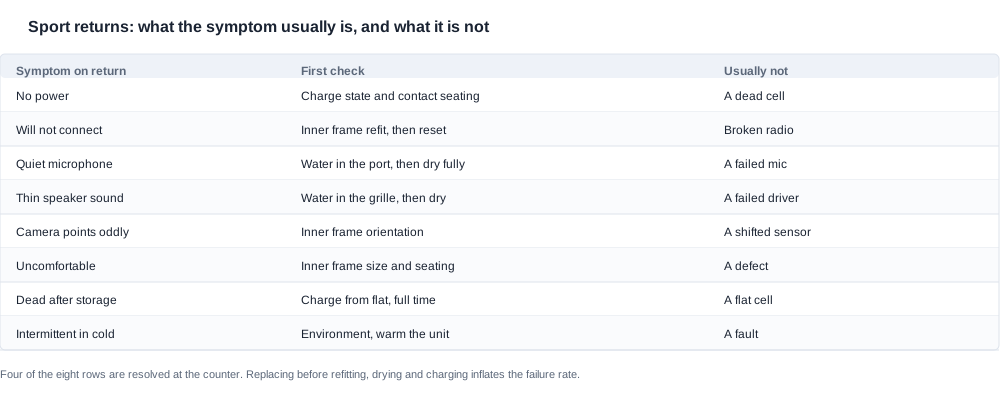
The point of the order above is that four of the eight most common sport return symptoms are resolved without a replacement at all, provided the counter has the time and the instruction. Uncomfortable, camera pointing oddly, quiet microphone and will-not-connect are, in the large majority of cases, an inner frame that has rotated or an inner frame that is the wrong size. No power and dead-after-storage are a charge state and a contact-seating problem. Thin speaker sound is water in the grille. Intermittent behaviour in cold is the environment.
That matters commercially because a distributor who replaces before refitting, drying and charging carries a failure rate the product does not have, and that number becomes the basis of the next negotiation. A buyer who shows a 6% return rate on a product whose real hardware failure rate is under 1% has a service problem, not a product problem, and the fix is a counter procedure plus a printed instruction rather than a change of supplier.
The counter procedure itself is simple: no unit is opened, no unit is charged and no unit is replaced until three things have been done and recorded — refitted, dried if wet, and charged to the published ceiling. It costs minutes and it is the single highest-return intervention available to a distributor in this category.
The order is not negotiable, and it is worth writing it down as a numbered procedure rather than a paragraph:
- Record the symptom in the customer's own words before touching the unit.
- Refit the removable inner frame; confirm orientation and seating.
- If the unit is wet, rinse and dry it, then leave it before any power test.
- Charge to the published ceiling — two hours or less, or about one hour for the D17.
- Check the storage and the charge state together, not separately.
- Reconnect the unit and attempt a capture with the application out of the loop.
- Only now decide: resolve at the counter, or escalate with the seven fields attached.
Making it stick takes three things a counter rarely has by default. The first is a printed instruction the customer can read while the unit is in front of them, because most refit returns happen because the customer put the inner frame back the wrong way round and never checked. The second is a drying step with a stated time, because a unit that is powered on while still damp will fail three tests and generate a fault report against a working product. The third is a charging window that matches the published ceiling, because a distributor who charges for thirty seconds because the customer is in a hurry is manufacturing the dead-on-arrival return.
One practical addition to that list pays for itself immediately. Ask the customer what the unit was doing at the moment it failed, and record the answer verbatim. "It was raining and I took a photo" and "it was on the bench all afternoon" are two different fault reports with the same symptom, and only one of them belongs to the product. Distributors that capture that field consistently can separate an environmental cluster from a manufacturing one within a few weeks, which is exactly the evidence a buyer needs before arguing a warranty claim or accepting a replacement at the next bulk order.
The measurement side matters just as much. A distributor who resolves these symptoms should be recording what fraction of returns fall into each of the eight rows in the table above, because that distribution is the only evidence available about how the product is actually being used in the field. Three months of that data is a better input to the next purchase order negotiation than any supplier claim about durability, and it is the same data that tells a brand whether its listing is overstating the protection the product has. Neither of those outputs requires the supplier to publish anything: both are built entirely from the buyer's own returns.

What a supplier has to hand over in writing
None of the seven steps above is difficult. All of them are hard to do properly without documentation the supplier holds, and that is where the negotiation sits. A support desk working from guesswork will either over-replace, under-diagnose, or both.
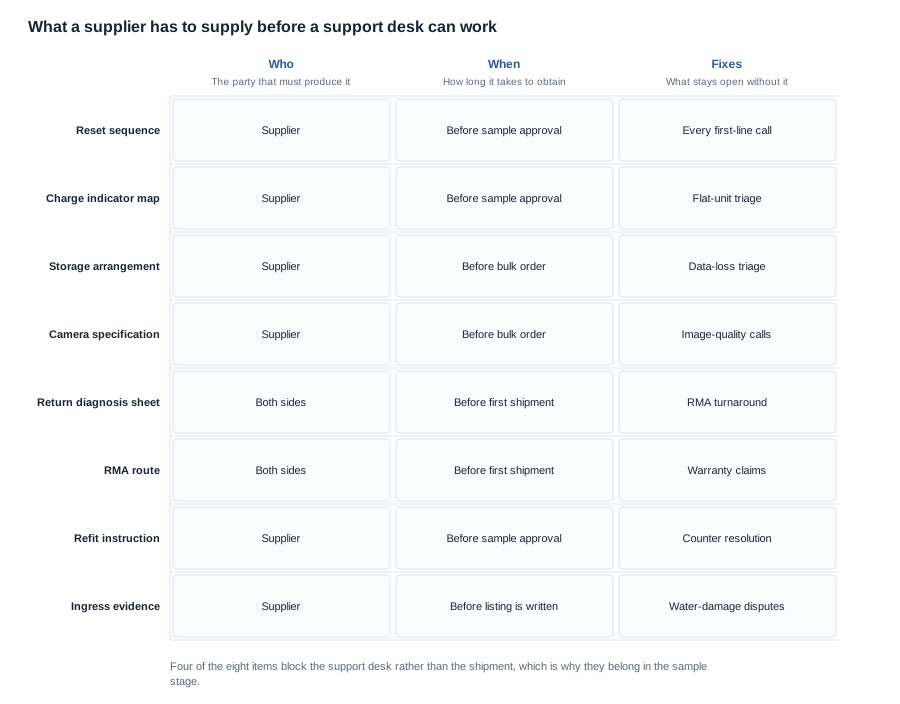
The requests split into three groups, and the split matters because they are bought at different stages. Four of the items block the support desk rather than the shipment, which is why they belong in the sample stage rather than after the first bulk order: a documented reset and re-connection sequence per model, the charging indicator behaviour including how a flat unit presents, the refit instruction for the models with a removable inner frame, and the camera specification for the model you actually sell. Two block the shipment: the storage arrangement — capacity, format and overwrite behaviour — and the ingress evidence for any protection claim you intend to print. Two block the first return: a return diagnosis sheet carrying the agreed field list, and the RMA route with its turnaround and the evidence needed to claim a replacement.
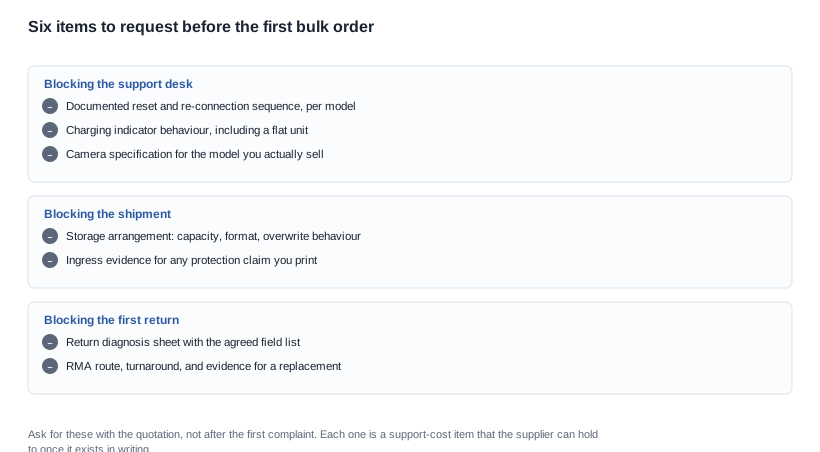
Two of those deserve a negotiation rather than a request. The return diagnosis sheet is a shared document, and the fields on it are the ones your support desk will have to fill in for every unit that comes back — agreeing them in advance is worth more to you than the supplier's version, because the supplier's version is written to minimise returns. The RMA route is where the warranty becomes operational: ask for the turnaround, who pays the freight, what evidence a replacement claim needs, and whether a disputed unit is held or scrapped. A warranty term without an RMA route is a promise the supplier cannot keep and you cannot rely on.
The negotiation on the other six items is not about getting them, it is about getting them at the right stage. A supplier that can produce a reset sequence will produce it for a sample approval; the same supplier asked for it six months after the first bulk order will tell you it is a documentation task that takes time. Ask for the four items that block the support desk with the sample order, and put them in writing as conditions of approving the sample. That is a small request, it costs the supplier almost nothing, and it converts an open documentation gap into a closed one at the cheapest possible point in the programme.
Two further items are worth raising even though they are not on the list. The first is a spare-parts route for the removable inner frame, since that is the single part most likely to be needed on its own, and the published documentation says nothing about whether the part can be ordered separately or at what lead time. The second is the storage arrangement, which is not an after-sales item at all in principle — it is a product specification that happens to become an after-sales item the first time a customer reports lost footage. A supplier that publishes both capacity and overwrite behaviour removes an entire class of dispute before it starts.
Where our documentation stops, stated plainly
A large share of sport returns in this category are refit, water or charge issues rather than manufacturing defects, and a distributor who replaces first will carry a failure rate the product does not have.
We will not publish a reset procedure for a model where our documentation does not contain one. We will not present the IP54 marking as a tested rating, or extend it to the sport camera models that carry no published marking. We will not describe a camera behaviour, a storage rule or a transfer path that is not published. And we will say plainly where our own documentation is thin: no frame weight, no ingress evidence, no case capacity and no camera specification is published for these models, so any supplier who tells you otherwise is telling you something the catalogue does not support.
What is published, and what can be checked on delivery, is set out in the sport smart glasses quality checks, and the camera and audio equivalents of this sequence are in AI camera glasses troubleshooting.
Two boundaries are worth naming, because they are where a support script goes wrong. The first is that a diagnosis is not a test. A distributor can establish that a unit is not powering, cannot connect and cannot record, and that is a genuine finding; it is not a measurement of the camera, the microphone or the battery, and a claim built on it should not be presented as one. The second is that a counter resolution is not a warranty repair. Refitting a frame that was assembled correctly and returned incorrectly resolves a customer problem, but it must not be counted as a product fault in a return-rate statistic, or the statistic stops describing the product.
If you are assembling this programme now, the practical order is worth stating plainly: agree the counter procedure and the diagnosis fields before the first shipment, request the four support-blocking documents as conditions of sample approval, and put the RMA route into the purchase order rather than into a conversation afterwards. All three are cheaper to settle on paper than in a claims cycle, and none of them requires the supplier to publish a figure that our catalogue does not carry.
Send us the models, the volume and the markets you support, and we will tell you which of the six items we can supply directly and which have to come from the factory. The group is listed on our sport smart glasses range page.


