

A buyer running an incoming inspection on smart glasses does not need a brochure. They need to know which numbers the supplier has actually printed, which numbers are still missing, and how to turn the published row into a checklist that a line auditor can hold in one hand. The sport group at CYNRIN — YKC02, D17 and ZH12 — is the part of the range where this matters most, because the three models sit close together on the shelf and differ in ways that only show up in a specification table.
This article works through what the catalogue publishes for that group, what it leaves open, how to convert the published row into an inspection checklist, and how a batch gets accepted. It is written for importers and OEM buyers who already know they want an AI camera glasses programme and now need the quality control layer to run it. The broader buying sequence for this group is set out in the sport smart glasses buying guide, and this article picks up at the point where a purchase order is about to be issued.
What the sport group publishes and what it leaves open
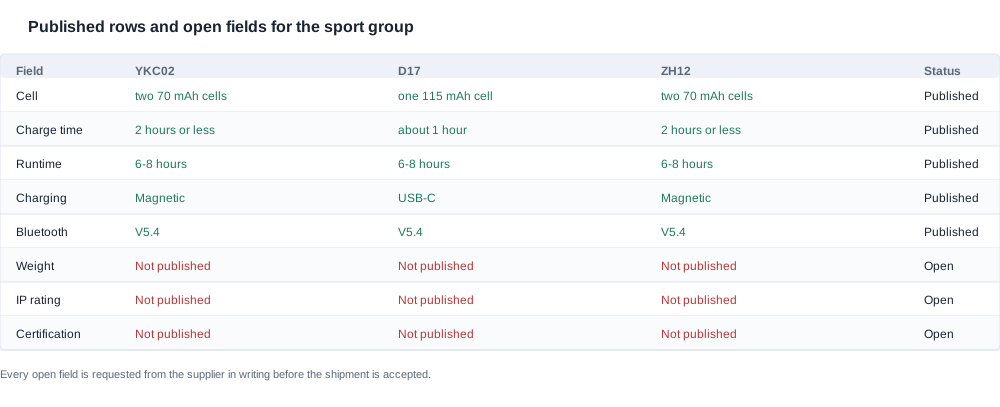
The published rows for the sport group carry the following fields. These are the facts a buyer can put on a purchase order specification sheet and expect to receive.
| Model | Name | Cell | Battery life | Charge time | Charging method | Bluetooth |
|---|---|---|---|---|---|---|
| YKC02 | YKC02 AI sport glasses | 70 mAh × 2 | 6~8 hours | 2 hours or less | Magnetic | V5.4 |
| D17 | D17 AI sport glasses | 115 mAh | 6~8 hours | about 1 hour | USB-C | V5.4 |
| ZH12 | ZH12 AI sport glasses | 70 mAh × 2 | 6~8 hours | 2 hours or less | Magnetic | V5.4 |
Three differences are visible immediately, and each of them is worth checking on delivery.
First, D17 is the only model in the group with a charge time printed as about 1 hour. The other two are published as 2 hours or less. That is a ceiling, not an average, and a ceiling is the number a buyer should hold the supplier to. If a batch of YKC02 or ZH12 arrives taking more than two hours from empty to full, the delivery does not match the published row and the discrepancy has to be raised before the shipment is accepted. A 115 mAh cell against a pair of 70 mAh cells is the most likely mechanical explanation for the different charge time, and it is worth confirming that the cell format in the delivered unit matches the row rather than assuming it does.
Second, YKC02 and ZH12 share an identical cell configuration of 70 mAh × 2, while D17 uses a single 115 mAh cell. That difference shows up in charge behaviour and in how a unit is opened for a cell-level check. Before you order a mixed programme, ask whether the two 70 mAh cells in YKC02 and ZH12 are wired in series or in parallel, and whether the enclosure is the same in both. The catalogue does not print the answer, so it belongs in the written question set rather than in an assumption. How to evaluate that answer is a negotiation with the factory, not a data question, and the sport smart glasses battery during activity discussion covers how cell configuration shows up in use.
Third, all three models publish Bluetooth V5.4. That is useful for a buyer assembling a companion-app or controller ecosystem: no model in the sport group needs to be treated as a Bluetooth outlier, so the connection behaviour can be standardised across the group while the physical and battery differences are handled model by model.
Now the fields that are not published, and which the buyer therefore has to request in writing.
Weight is unpublished across all three sport models. The only weight figure printed anywhere in the range is 158 g for MT6, and that figure refers to the glasses body rather than the folding 1200 mAh charging case. That means no weight figure can be borrowed from the catalogue for YKC02, D17 or ZH12. Weight matters in a sport context — it decides whether the user keeps the glasses on during a session or takes them off — but the honest position is that it is not published. Any supplier who quotes a weight should quote it for the specific model and version, and the buyer should ask for the method used to measure it, with and without a populated lens, because those two numbers are frequently different and both are commercially relevant. Sizing consequences of that weight are covered in sport smart glasses fit and sizing.
IP rating is unpublished for the sport group. The catalogue prints an IP54 rating for two models only, V06 and S7. YKC02, D17 and ZH12 carry no published IP rating at all. This is a distinction that buyers repeatedly get wrong, so it is worth stating plainly: an IP rating exists in the range, but it does not belong to these three models. A buyer who needs a water-resistance claim for a sport line must request the specific rating and the specific test evidence for the sport model, and must treat any blanket claim about "the sport glasses being IP54" as unsupported. The general method for asking that question is described in how to test before ordering IP rating smart glasses, and the available options are set out in sport smart glasses water resistance options.
Certification status is not published per model. The catalogue text does not contain FCC, CE, RoHS or RED for any row, and the export certification material is presented as an image page without a per-model certification line. Nothing in this article should be read as a claim that any sport model holds any of those approvals, and no certificate number, test report number, laboratory name or report date should be written into a purchase order or a technical file unless the supplier has issued the document itself. Certification is a compliance obligation on the importer, and the way to satisfy it is a written request for the document plus a due diligence step that checks the document against the actual product, not an assumption carried over from a neighbouring model.
Lens material, colour options, camera resolution, weight, MOQ, lead time, sample order terms, warranty, tooling cost, bulk order price, capacity and payment terms are all unpublished. Each of those is a question for the supplier rather than a fact from the catalogue. The same applies to the whole commercial side: there is no price, no minimum order quantity, no lead time, no sample policy and no warranty term printed anywhere in the range. A quotation request is the only way to obtain them, and a buyer who writes the request as a structured list will get a usable answer faster than one who asks for "a quotation and your best price".
The remaining gaps are smaller but still real: the field of view and camera resolution for the sport models are not printed, the ingress protection status is absent, and the charge-case arrangement is not described for the sport group the way it is for the 158 g MT6 reference. The table below separates the published row from the open row for each of the three models, so it can be lifted directly into a purchase order specification sheet.
Turning a published row into an inspection checklist
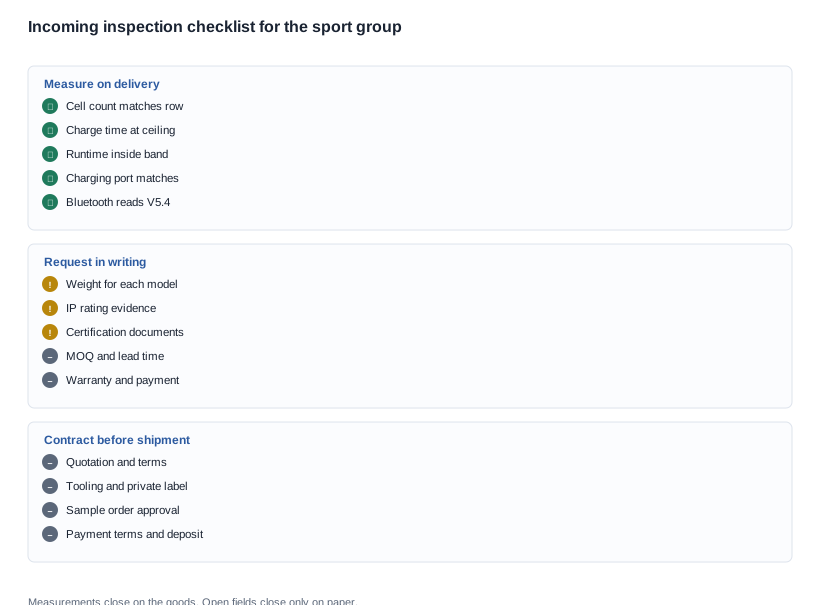
An inspection checklist is only useful if it separates what will be measured from what will be asked for. The distinction is not pedantic: a measurement that a line auditor can repeat without a supplier present is a quality control activity, while a figure that only the supplier can produce is a documentation request. Mixing the two produces checklists that fail on the first batch because nobody owns the open items.
The published row converts into measurements directly, because every value in it is checkable on the delivered units.
1. Cell configuration check. Count the cells visible through any service access and confirm the configuration matches the row. YKC02 and ZH12 should show two cells of 70 mAh; D17 should show one cell of 115 mAh. Where the enclosure prevents visual confirmation, request a teardown photograph or a supplier statement of the cell format used in the production batch.
2. Charge time check. Measure empty-to-full on at least three units per model. D17 is the model with the about 1 hour figure in the row, so it is the one where a pass is a close call and worth measuring carefully under a fixed protocol: same adapter, same ambient temperature, same state of charge at start. YKC02 and ZH12 must come in at 2 hours or less, and that ceiling is the acceptance threshold.
3. Battery runtime check. Run the published 6~8 hours band on each model. The band has a floor and a ceiling, so a unit that delivers under six hours under the agreed test condition fails the published row, and a unit that delivers more than eight hours is a data point worth recording but not a defect against the row.
4. Charging method check. Confirm the physical interface rather than the marketing phrase. YKC02 and ZH12 use a magnetic charging connection and D17 uses USB-C. This is a fast check for an auditor, but it matters commercially: the charging cable and the charging dock are part of the bill of materials a buyer will quote to a customer, and an interface mismatch at delivery means a tooling conversation later.
5. Bluetooth version check. Confirm V5.4 is reported by the device itself on all three models, using a connection log rather than a printed box label.
6. Basic functional pass. Confirm the camera records, the AI function responds, and the glasses pair with a phone. These are not printed specifications, but they are the minimum functional gate before any dimensional or cosmetic question is worth asking.
The open row converts into a written request, and it should be issued as one document rather than as a stream of messages.
7. Weight in writing. Ask for the weight of YKC02, D17 and ZH12 individually, with the measurement method stated and with the case excluded unless the case is sold as part of the configuration.
8. IP rating request. Ask for the ingress protection rating and the test evidence for the sport model specifically, and ask the supplier to confirm in writing if the model has no rating. A written "no rating" is a useful answer; an assumption is not.
9. Certification package request. Ask for the certification documents that apply to the destination market, including the technical file and the declaration of conformity, and ask the supplier to state explicitly which documents exist and which do not.
10. Commercial terms request. Ask for the quotation structure: MOQ, lead time, sample order cost and timing, bulk order pricing tiers, tooling cost and ownership, warranty period and terms, payment terms, deposit percentage, incoterms, shipment method, and the contract format used for repeat business.
The reason to put this in a single written request is contractual. A structured list also tells the supplier what to ask of its own factory, which is why the same list works as the starting point for a supplier audit and a pre-shipment inspection plan. Every field in the open list is a field that a supplier can be held to once it exists in writing, and none of them can be held to at all while they live in a conversation. A buyer running a private label programme with a factory needs the written record anyway, because the label artwork, the packaging and the manual will all be built on the same assumptions as the quotation. The quality control clauses that belong in that contract are drawn out in oem ready platforms warranty setup.
The reverse also holds. A supplier who answers item 10 clearly and promptly has told the buyer something about how the relationship will work: whether the factory will take on a custom label, whether the tooling is amortised across the first bulk order, and whether the quality control expectations are understood before the first shipment rather than after it. The quote is a first due diligence signal.
We will not publish a specification the catalogue does not print, so a buyer running an incoming inspection should work from the published row and ask for the remaining fields in writing before the first shipment is accepted.

Sampling, inspection and the batch acceptance step
Sampling decides whether an inspection is a measurement or an opinion. For a first bulk order the sensible structure is a defined sample per model, drawn from the packed carton rather than from the front of the production line, with the remainder held as the reference batch.
Three rules make the sample meaningful.
Draw across cartons. Units taken from a single carton carry that carton's history. A buyer who wants to know about the batch wants units from several cartons, at least one from the middle of the run, because a supplier that assembles and packs in one pass tends to produce a slowly drifting quality curve across a run rather than a uniform one.
Keep the reference. Retain a defined number of accepted units from the batch as the golden sample. When a dispute arises six months later — a field complaint, a warranty case, a customer question about weight — the reference sample is the only evidence that exists and it cannot be recreated after the fact.
Write the acceptance rule before the sample is opened. A pre-agreed rule is what makes an inspection binding rather than advisory. The rule should state the sample size, the measurements, the pass threshold, the fail threshold, and what happens in between. It should also state the consequences, because a threshold without a consequence is a discussion rather than a criterion.
The acceptance flow below is the sequence most first orders follow. It is worth noting that the acceptance step is last, and that is deliberate.
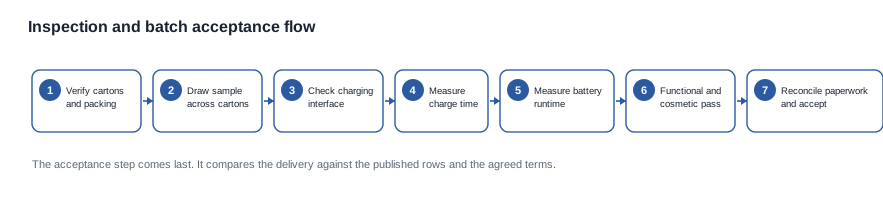
A first-batch inspection typically runs in this order:
- Carton and packing verification. Confirm the carton count against the packing list, check the model designation on the cartons matches the purchase order, and verify the accessories are present in the stated quantity.
- Sample draw and reference retention. Draw the agreed sample across cartons and seal the reference units in a marked box.
- Charging interface check. YKC02 and ZH12 magnetic, D17 USB-C.
- Charge time measurement. D17 against about 1 hour; YKC02 and ZH12 against 2 hours or less.
- Battery runtime measurement. Against the published 6~8 hours band, under a stated and repeatable test condition.
- Functional pass. Camera capture, AI response, Bluetooth connection at V5.4.
- Cosmetic and dimensional pass. Scratches, lens marks, hinge play, temple alignment, marking legibility.
- Documentation reconciliation. Compare what arrived against the written quotation, the technical file, the declaration and the contract, and reconcile any variance.
- Batch acceptance and release decision. Sign the acceptance record, release the balance against the agreed incoterms, and open the non-conformance record for anything that failed.
The documentation reconciliation step is the one most inspections compress, and it is the one that protects the buyer longest. It is the point where the MOQ, lead time, sample order terms, warranty, tooling, payment terms, deposit and incoterms that were agreed in writing are checked against what was actually shipped. A unit that passes every physical measurement can still be non-conforming against the contract if the wrong accessories shipped, if the private label artwork differs from the approved proof, or if the payment and shipment terms were not the ones that were agreed.
Nothing in that sequence requires the buyer to accept a published claim about the sport models that the catalogue does not make. It requires the buyer to check the delivered unit against what the supplier promised, in writing, for the fields the catalogue left open.

What a quality check cannot tell a buyer
A quality check is a narrow instrument, and the most common mistake with one is to expect it to answer questions it was never built to answer. It can confirm that a delivered unit matches a published row. It cannot tell a buyer whether the unit will survive a season of real use, whether the published runtime holds in cold weather or at low volume, whether the camera output is good enough for the use case the buyer sold it for, or whether the shipment will clear the destination market without a problem.
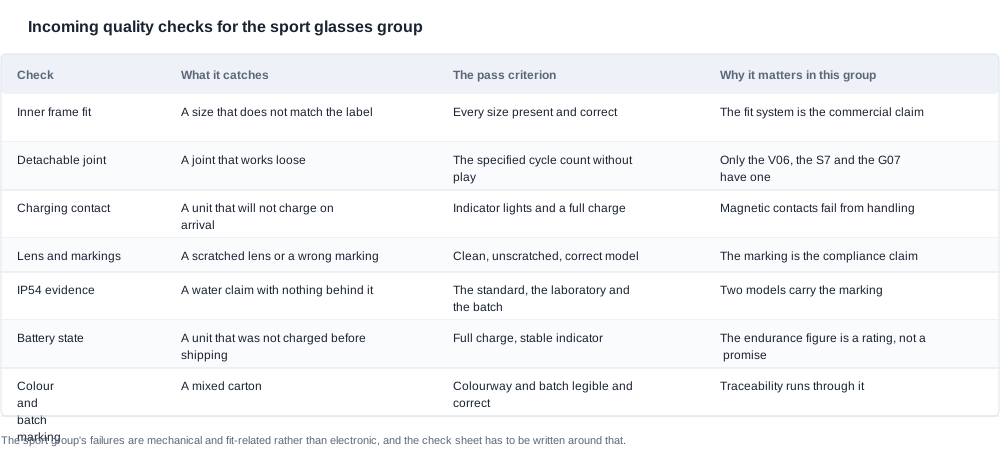
Durability is not covered by the published rows. There is no ingress marking on the sport group to carry that argument, and the only IP54 marking in the range belongs to V06 and S7. The buyer who wants durability confidence for YKC02, D17 or ZH12 has to commission it, and the tests worth commissioning are described in sport smart glasses durability testing. A check against published rows will never produce that answer.
Compliance is a document, not a measurement. An audit of the hardware tells the buyer nothing about whether the conformity file exists, whether it matches the shipped configuration, or whether the declaration of conformity names the right standards for the destination market. The catalogue export material is an image page and carries no per-model certification row, so the buyer must obtain the technical file and the declaration from the supplier and review them directly. That review is part of due diligence on the factory, and it is described in oem ready platforms export documentation. The rule is simple: a certification claim that arrives without a document is not a certification claim.
Commercial readiness is not an inspection result. An inspection can confirm that the right units arrived. It cannot tell the buyer whether the MOQ they accepted is the right MOQ for their channel, whether the lead time quoted will hold through the next bulk order, whether the warranty terms match the promise the buyer made to their own customers, or whether the deposit and payment terms leave the buyer exposed if the second shipment is late. Those are the questions to ask, and they belong in the quotation and the contract rather than in the inspection report. The bulk order mechanics are covered in sport smart glasses bulk ordering.
Sizing and the on-face experience are not in the row. Weight is unpublished for all three sport models, and the only published weight in the range is the 158 g of MT6, which does not transfer. A buyer who wants to know how the glasses sit during a session has to hold one, which is an argument for ordering a sample order early rather than deferring it until after the first bulk order.
Long-run behaviour is invisible to a first inspection. Battery degradation, hinge fatigue and coating breakdown appear over months, not over a receiving session. The realistic mitigation is not a better inspection but a better agreement: negotiate the inspection criteria, the golden sample, the warranty period, the rework route and the non-conformance process into the contract, so that what the first inspection cannot show is covered by the terms afterwards.
There is one further limit worth naming. A quality check run by the buyer's own team measures the buyer's sample. It does not measure the factory's process. If a buyer wants to know whether the process that produced the sample is stable, that requires examining the process itself — and the honest trade-off is time against certainty. Most first buyers in this line take the sample-based route and cover the residual risk contractually, which is a reasonable position precisely because the published rows are narrow enough for a sample to be representative.
Two closing points on how to evaluate a supplier's answers to the questions in this article. First, a written answer that says "this model has no IP rating" is worth more than a vague assurance, because it can be checked against the delivered unit; a written answer that declines to answer at all is a data point about the factory, not about the glasses. Second, the questions to ask are the same questions for all three sport models, with one exception — the charge-time criterion differs, because D17 carries the about 1 hour figure and the other two carry the 2 hours or less ceiling. A buyer who runs one combined inspection across the group and one model-specific check is not cutting corners; they are matching the inspection to the published rows.
The comparison with the wider range is useful here too. The same discipline applied to the ai camera glasses quality checks and the kids smart glasses quality checks shows that a published-row inspection is a reusable method rather than a one-off task, and that the fields a buyer leaves open are usually the same fields in every family: weight, ingress rating, certification and commercial terms. Field problems that appear after delivery are addressed separately in sport smart glasses troubleshooting.
So the honest summary of sport smart glasses quality checks is narrow but useful. The catalogue publishes three rows for this group, and each row supports a real set of measurements on delivery. Everything a buyer needs beyond those measurements — weight, ingress rating, certification, compliance, MOQ, lead time, sample order terms, warranty, tooling, payment terms, deposit, incoterms and shipment terms — has to be obtained in writing from the supplier, checked against the delivered goods, and written into the contract so that it can be enforced. That is not a weakness in the catalogue. It is an accurate description of where a product-row catalogue ends and a supplier relationship begins.


