

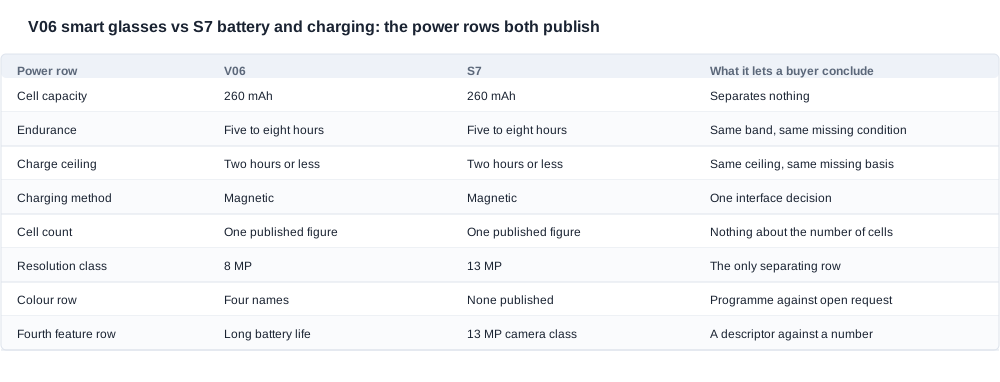
On the battery and charging axes, the catalogue treats the V06 and the S7 as the same product. Both pages carry a cell of 260 milliampere-hour, an endurance figure running from five to eight hours, a charge that completes in two hours or less, and a magnetic charging contact. There is no row on either page that separates them on power: not the capacity, not the endurance, not the charge time, not the charging method, and not the cell count. A comparison written on these four rows therefore has nothing to compare, and a buyer who wants to know whether one of these two will run longer than the other has to go and ask, because the documentation does not say.
That sameness is the finding, and it has two halves that pull in opposite directions. It makes this the least informative comparison in the range, because nothing on the power axis distinguishes the two. It also makes this the most useful comparison in the range for a procurement team, because when four rows, a feature row and a colour row all collapse into one, the variables that remain can be seen clearly. What follows sets out what is genuinely shared, what genuinely differs, what the catalogue leaves unseparated even where the rows look identical, and the accessory decision that follows from two models sharing one charging interface.
V06 smart glasses vs S7 battery and charging: the same cell and the same interface
The shared block is worth setting out precisely, because a precise statement of it is what makes the rest of this comparison usable.
| Power row | V06 | S7 | What it lets a buyer conclude |
|---|---|---|---|
| Cell capacity | 260 mAh | 260 mAh | One capacity comparison, and it separates nothing |
| Endurance | Five to eight hours | Five to eight hours | The same band, with the same missing condition |
| Charge ceiling | Two hours or less | Two hours or less | The same ceiling, with the same missing basis |
| Charging method | Magnetic | Magnetic | One interface decision for the range |
| Cell count | One published figure | One published figure | Nothing about the number of cells behind the figure |
Read down that table and the conclusion is not "these models are the same". It is that the four rows which would normally drive a power comparison are identical, which means the question of endurance cannot be settled from the catalogue for either model separately or for the two together. The band is published without a condition in both cases. The ceiling is published without a starting state in both cases. And neither of those gaps is closed by the fact that the two models agree, because agreement between two catalogue entries is not evidence about either one.
There is a second point here that has to be stated plainly, because it is the sort of inference that gets made from a table like the one above. Two models publishing the same rows is not a statement about a shared firmware branch, a shared application, a shared accessory family or a shared production platform. None of that is published for any model in this catalogue, and none of it can be inferred from the fact that two specification pages agree on four rows. What can be said is that the published rows are the same; what cannot be said is anything about the engineering behind them.
The useful consequence of the shared block is a different one. If two models in a range publish the same charging method, then the accessory decision for the range is made once rather than twice — provided, and this is the condition, that a single charger actually serves both models. That is not published, and it is the first question in the final section below. If it turns out that one charger serves both, then the accessory programme, the charging instruction and the customer-facing guidance are single items for the range. If it turns out that two chargers are needed, the accessory cost is doubled and the range is carrying two charging experiences rather than one. The identical row is what makes the question worth asking.
There is one more consequence of the shared block that sits on the logistics side rather than the accessory side. A cell of 260 milliampere-hour travelling in a consignment produces a battery transport document, and a document is prepared against a cell specification rather than against a model name. Two models publishing the same capacity do not necessarily carry the same cell — the chemistry behind the figure is not published for either of them — so the transport file for the two has to be established rather than assumed, even though the capacity is identical on both pages.

Where the two models differ, and where the catalogue does not separate them
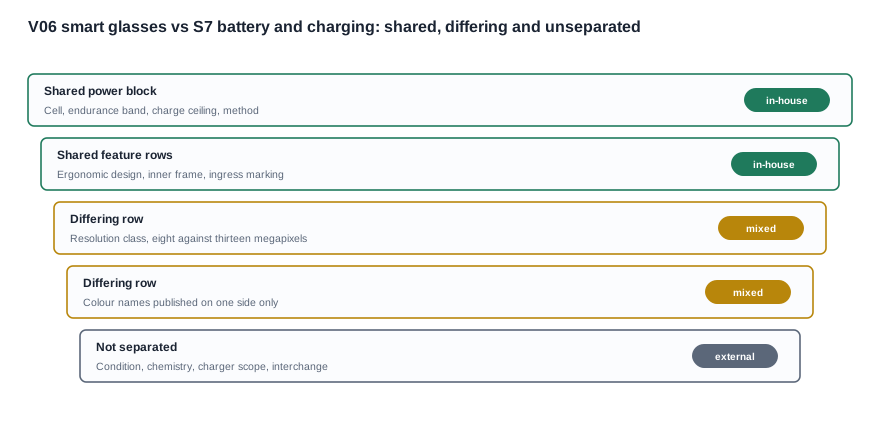
Three rows separate the two models, and only three.
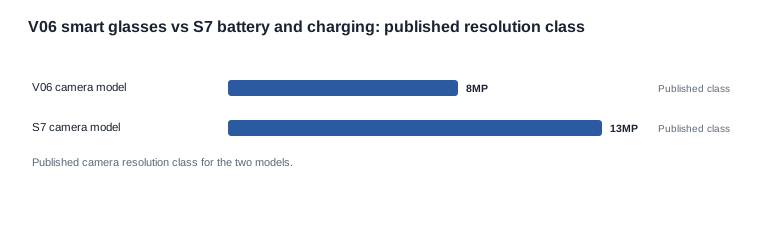
The camera resolution class. The V06 is published in the eight-megapixel class and the S7 in the thirteen-megapixel class. This is the row that carries the whole difference between the two entries.
The colour row. Four colour names are published for the V06: orange, white ice blue, black and black ice blue. The S7 publishes no colour row at all. That is not a shorter list; it is an absent row, and it means a colour programme on the S7 is an open request to the factory while a colour programme on the V06 is a set of four options to plan against. Across the whole catalogue only two models publish a colour row, this one and the V03 Pro with three names.
The fourth feature row. The V06's four feature rows cover the ergonomics of the frame, the endurance in general terms, a removable inner frame, and an IP54 ingress marking. The S7's four feature rows cover the ergonomics of the frame, a numeric row carrying the thirteen-megapixel camera class, a removable inner frame, and an IP54 ingress marking. Three rows are common to the two, the fourth is a descriptor on one side and a number on the other, and the two lists are therefore similar in length while differing in kind. This is worth noticing because feature lists are written page by page rather than generated from a shared template, and a buyer who assumes a uniform structure across a range will read the fourth row as a difference in value when it is a difference in type.
Against those three rows, the catalogue leaves a number of things unseparated, and the phrase that matters is unseparated rather than identical. For both models, and for neither of them:
- The endurance condition is unpublished. The band runs from five to eight hours on both pages, and neither page states what produced either end of it. The method for establishing what a band of that shape rests on is described in the battery comparison method procedure, and this model's own figures are worked through in the V06 battery life record.
- The cell itself is unpublished. Capacity is published; chemistry, cycle life and the weight of the cell are not, for either model.
- The charger scope is unpublished. Whether one magnetic contact serves both models, whether a pad or a case is supplied, and what the part reference is, are all unpublished.
- The inner frame is not separated between the two models. Both publish a removable inner frame row, and neither publishes how many frames the carton contains, which sizes are produced, how the part is taken off, or whether a frame from one model will fit the other. A buyer stocking spares has to ask the interchangeability question explicitly, because the row is shared and the answer might not be.
- The camera detail is unpublished on both sides. Resolution class only, with no sensor model, field of view, frame rate, video format or storage arrangement for either.
- The radio version is unpublished on both sides. No camera model in this catalogue publishes one, so the radio for either of these two has to be established from an assessment.
- The weight is unpublished on both sides. The single weight published anywhere in the catalogue belongs to a different model — the MT6 glasses body at 158 grams, and a figure that excludes the folding charging case which that model carries — and a weight published for another model cannot be used as a proxy for either of these.
How to evaluate a range built around these two. The criteria are short and they are structural rather than commercial. Does a range need two entries at all, and if it does, what separates them on published rows? Is that separation one a customer can be told about in a sentence, given that the only published separation is the camera class? Does a shared charging interface mean a shared accessory programme, and has that been established rather than assumed? Is the endurance band being published in customer-facing copy at a level the documentation can defend? A buyer who runs those four criteria before designing the range will avoid the two red flags this pair invites: splitting a range on a difference the catalogue does not record, and planning an accessory programme around an interface that has not been confirmed to be common.
What to ask, and in what order. The charger scope question comes first, because it decides whether the accessory programme is one line or two, and because it can be answered in a single reply. The carton question comes second, because the freight calculation and the customer instruction both depend on the answer. The inner frame interchangeability question comes third, because a spare-part line shared across the range is worth more to a buyer than any single specification answer. The endurance condition comes last in the sequence and first in the schedule, because it is the answer that takes longest to produce and the one that governs what can be written in a listing.
One piece of housekeeping applies to both entries rather than to one. The catalogue's page annotation for both the V06 and the S7 is placed oddly among the surrounding entries, so anyone identifying a product by its page number rather than by its name can end up comparing the wrong entry. It is an internal tidiness issue rather than a product issue, and it is cheaper to resolve internally than to explain to a customer who received a different model from the one on the quotation.
The 13-megapixel row against the 8-megapixel one
The resolution class is the only row that separates these two models, and it is worth being exact about what it does and does not establish.
What it establishes. It places each model on the resolution axis. Eight models in the catalogue are published in the eight-megapixel class — the MT5 and the V06, the V03 Pro and the CY05, and the V03 and the KY06, and the CY03 and the MT6 — and three are published in the thirteen-megapixel class — the L2 Utral and the S7, and the L1 Pro. So a decision between eight and thirteen megapixels is a decision between a group of eight published entries and a group of three, and the choice of the S7 over the V06 is a choice of the smaller group rather than of a single alternative.
What it does not establish. A resolution class is a count of the pixels in a frame and nothing more. It is not a camera specification, and it says nothing about the sensor, the field of view, the frame rate, the video format, the behaviour in low light, the stabilisation, or the storage arrangement. The camera imaging material sets out which of those parameters actually decide whether a camera product suits its purpose, and a listing built from a pixel count alone will lose to a competitor who has written from a field of view. The S7 common questions record works through the same gaps from the buyer's side.
And what it establishes about the power rows, which is nothing. This is the point that matters in a battery-and-charging comparison. The camera class is the only row that differs between the two models, and the endurance band is identical on both pages. The catalogue therefore provides no published link in either direction between the camera class and the endurance figure, and a buyer cannot argue that the higher-resolution model runs for a different length of time, nor that it runs for the same length of time. The same argument applies to the charge ceiling: it is published identically for both, so nothing about the resolution class explains the charging behaviour of either.
The reason for that silence is worth stating as a question rather than as a criticism. A camera module draws more power than an idle device, and a higher pixel count is not a measure of the draw. Without the camera specification and without the endurance condition, the relationship between the two cannot be established from the catalogue at all, and the honest position for a buyer is to treat both figures as ratings of unknown conditions and to design the operating plan around the lower end of the band.
There is a commercial consequence here that runs the other way, and it is the reason the shared rows matter for a range decision. Both models publish the removable inner frame and the IP54 ingress marking. A channel proposition built on the protection story or the fit story therefore cannot be split between these two models on the basis of published rows, because both of them carry those rows. The only published basis for splitting them is the camera class. That is a narrow basis for a range structure, and it is the reason a buyer who wants a protection story and a resolution story in the same range should think about whether one model can carry both rather than assuming that two models are required.

The accessory question that follows from a shared interface
Two models that charge magnetically raise one accessory programme for the range, and the question is whether that programme is one programme or two. Nothing published settles it, so it has to be asked, and the question is worth putting in writing because the answer determines several lines at once.
The question set for the shared interface. Whether a single magnetic charger serves both models or each requires its own contact; what the part reference is for the lead, the pad and the case; whether a charger is supplied in the carton for either model, given that the published rows for these two include no charging-case line at all; what the loss rate on the accessory is; and whether the interface accepts a power bank directly.
The question set for the carton. Two camera models in the range publish no charging-case line, along with a third, and that silence leaves the question open rather than settling it as a published absence. So for both of these models the carton contents have to be specified separately, and the specification has to say what the customer receives in the box as well as what they can buy separately. The distinction matters for the freight calculation, for the customer instruction and for the attachment rate that a channel will eventually measure.
The question set for the removable part. Both models publish a removable inner frame, so the spare-part programme has to be built for two part references or for one. The questions are how many frames ship with each model, which sizes are produced, how the part comes off, whether a replacement can be bought on its own, and — the one that is specific to this pair — whether a frame from one model fits the other. Interchangeability would let a single spare-part line serve the range; the absence of it would mean two lines, two minimum order quantities and two sets of packaging artwork.
The question set for the logistics side. Neither model publishes a weight, so the packed weight and the freight class have to come from the supplier before any landed-cost arithmetic is done. The parcel arithmetic that follows from an accessory strategy is set out in the AI camera glasses shipping weight material, and the battery transport file for a cell of this size is a request that has to be made early, because it is prepared against a cell record rather than against a product record.
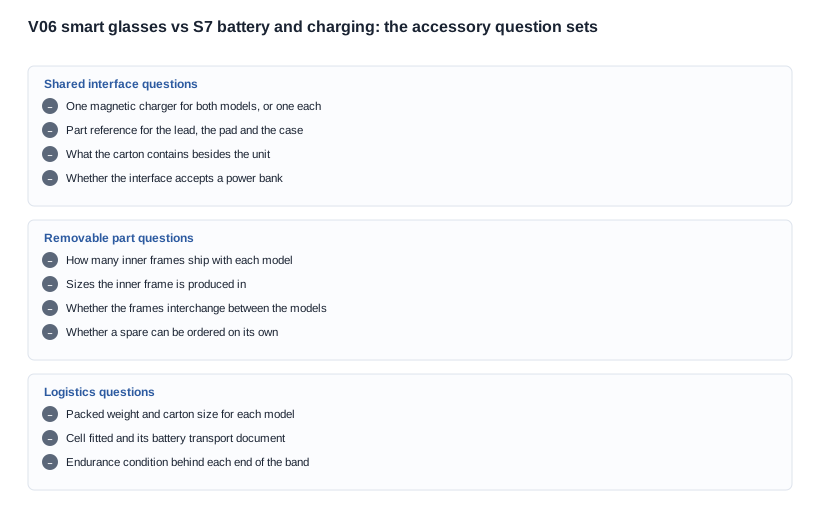

The list below is the version a buyer can send as it stands.
- Does one magnetic charger serve both the V06 and the S7, or does each need its own contact?
- What is the part reference for the charging lead, the pad and the case?
- Is a charger included in the carton for either model, and what does the carton contain besides the unit?
- Does the interface accept a power bank directly, and what current does it draw?
- How many inner frames ship with each model, and in which sizes?
- Do the inner frames interchange between the two models?
- Is a replacement inner frame sold on its own, and how few can be ordered?
- What is the packed weight and the carton size for each model?
- What cell is fitted, and what battery transport document covers it?
- What endurance condition produced each end of the five-to-eight-hour band on both models?
What we can and cannot state about this comparison is narrow, and we say so here rather than leave it to be assumed. We publish the power rows, the feature rows and the colour names exactly as the catalogue records them for the V06 and the S7, and we publish no commercial term for either. We do not present an identical published band as a guarantee that two models behave the same way, we do not present a resolution class as a camera specification, we do not print the ingress marking as a tested rating, and we do not give out a weight, a case capacity or any certificate number that the record does not carry. The row-by-row reading of the V06's own rows is set out in the V06 specifications and features record, the parallel rows for the other model are in the S7 specifications and features article, and the way to read an endurance band that carries no stated condition is covered in the battery life note.


