

What is the fastest possible delivery is usually not a production question at all, and recognising that is what saves a buyer a month. It is a question about whether the thing already exists, and the honest answer is that we do not publish stock levels, so what is the fastest possible delivery has to be established per enquiry rather than read off a page. There are three separate questions hiding inside the phrase, and they have three separate answers: how fast something can ship if it is already built, how fast a standard configuration can be built, and how fast a customised configuration can be built. Only the first of the three has a short answer, and even that one depends on a stock check run against the current schedule rather than against a number anyone has published.
The distinction matters because the three routes fail differently. A stock route fails when the configuration does not exist and has to be built, which turns a three-day conversation into a production plan. A standard-build route fails when the binding component is later than the build slot, which turns a delivery date into a forecast. A customised route fails when a tool or a print run or a component minimum has not been identified, which turns a delivery date into a negotiation. A buyer who asks one question gets one answer and applies it to all three, and the mispricing shows up later as a missed launch window rather than as a complaint about the supplier.
What is the fastest possible delivery, and why the answer is not a number
Ex-stock is the only genuinely fast route. The relevant figure is not a lead time at all — it is a count of finished units of one specific configuration, and that count changes as orders are filled. It is also a count at configuration level rather than model level, because the same model in a different colour or with a different charging interface is a different unit. A buyer who asks for "the fastest delivery on the V06" and receives "we have stock" has been told almost nothing, because the V06 alone publishes four colour options and the charging method in this catalogue comes in three forms, so the V06 exists as several distinct units rather than as one.
We publish no stock position. There is no count of finished units on any page, and there is no ready-to-ship list, and the reason is a good one: both figures would be wrong the moment they were printed. A published stock number becomes a commitment the moment a buyer reads it, and it becomes a broken commitment the moment somebody else orders the same configuration. The wholesale stock discussion covers how we handle that question in practice, and the answer is a check rather than a figure.
The catalogue's published rows are not a delivery promise. Every entry in the range publishes a charge time, and that is the row buyers most often try to convert into a delivery estimate. It cannot be converted. The charge time is a ceiling rather than a precise duration, it describes the unit on the bench rather than the unit in the warehouse, and it says nothing about the state of the cell it started from or the point at which the unit is judged full. The same applies to the runtime row, which describes a duty cycle rather than a working day. Neither figure has anything to do with how long it takes to get a unit to a destination.
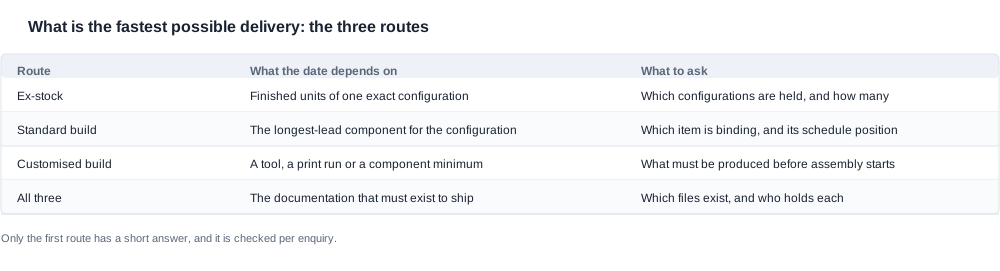
The table is the honest answer to the question, and it is worth reading the middle column first. The binding constraint is rarely the assembly step; it is whichever item or decision happens to be longest, and that item changes with the configuration.

The three clocks inside every delivery
Every delivery date is the maximum of several clocks, and the clocks do not run at the same speed. A buyer who wants to evaluate a delivery date needs to know which clock is binding, because that determines whether the date can be pulled in at all.
The component clock. The longest-lead item sets the date, not the sum of all items. Assembly, programming, packaging and inspection run largely in parallel once the parts are in hand, so a schedule built by adding the stages together is a number nobody can use. The binding item in this category is usually a battery cell, a lens, a camera module or a magnetic contact assembly, and which one it is depends on the configuration. This is also the clock with the least visibility from outside the supplier, because it depends on a purchase order the buyer may not know about.
The build clock. Once components are in hand, the remaining steps are assembly, programming, packaging and inspection, and they overlap. This clock is short and predictable in most configurations, and it is the one that buyers assume is the whole story. It is also the one that expands when a step is added — a bespoke print on the packaging, a firmware pre-load, a market-specific marking — and each addition is a change to a document as much as to a process.
The documentation clock. The slowest clock in this category, and the one most often left out of the plan entirely. A conformity file that has to be assembled for the destination market, a mark that has to be positioned on the product or the packaging, language files that have to be laid out rather than translated, and the shipping documents for a lithium consignment all sit on their own critical path. None of them is visible on a production schedule, and all of them can exceed the build.

The flow above shows the sequence, and the important thing about it is that the documentation clock runs in parallel with the component clock rather than after it. That is the mistake with the largest cost: a programme that waits for the production units before starting the documentation work has already chosen the slowest possible route, and it has done so for no reason.
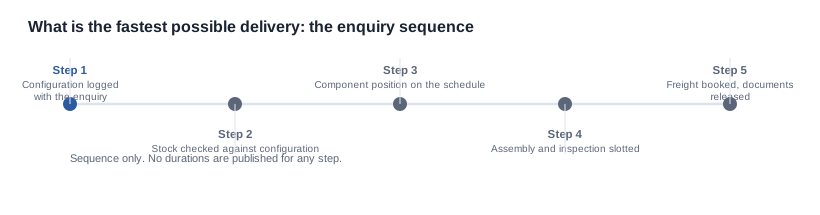
The enquiry sequence is worth following in this order for a reason that is not obvious. The stock question has to be asked first because it is the only one of the three whose answer can collapse the other two, and it is the only one that can be answered within a day. A buyer who asks about build and custom routes first will get a production plan, and the production plan will be used as the anchor even after the stock check comes back positive.
Why the configuration, not the model, is what has to be specified
Almost every ambiguous delivery question traces back to the same cause: a model name standing in for a configuration. The catalogue makes that substitution particularly easy to make by accident, because the published rows sit on the entry and the configuration dimensions are few enough to be overlooked.
Four dimensions multiply a model into a set of units in this range. Colour is published on two entries, with three options on one and four on the other, and a colour is a separate finished unit with its own packaging and its own artwork. The charging method arrives in three forms — magnetic on seventeen entries, Type-C on seven, and unpublished on four camera entries — and magnetic and Type-C products do not share a dock. The charging case comes in three published states: a capacity on five camera entries, a case mentioned without a figure on two more, and no case row at all on four, which leaves the case question open on those four. And the variant naming on one entry, where two variant names and two case capacities are printed without stating which capacity belongs to which name.
So the number of configurations a buyer is actually ordering is a calculation, and it is not the number printed in the catalogue's product list. It is the number of combinations that exist once the dimensions above are resolved, and each of them is a separate unit to be built, stocked, documented and shipped. A buyer who says "one thousand units of the V06" has specified a quantity that is distributed across four possible units, and a supplier is entitled to ask which four.
The practical method is to write the requirement as a set of dimensions with a quantity against each combination, rather than as a model with a total. That single change removes most of the ambiguity in delivery questions, because every answer you get back — stock position, binding component, documentation scope, price — becomes answerable per line rather than per model. It also makes the comparison between suppliers meaningful, since two suppliers quoting the same model against the same total are not necessarily quoting the same thing.
The freight clock, which is separate from the factory clock
The delivery date a buyer plans against ends at the factory gate, and the date the customer experiences ends at the door. Between those two points sits a movement that has its own constraints, and in this category the biggest constraint is the battery.
Every entry in the range is powered by a lithium cell, which means the consignment is subject to the dangerous-goods rules for transport. The consequence is not abstract: it decides which modes are available for a given destination, it decides what documentation the booking needs, and it decides how much of the transit can be planned and how much cannot. The battery transport material covers the charge limits that apply to air movement specifically, which is the constraint most often discovered late.
Four questions settle the freight side, and they are worth asking at the same time as the build questions rather than after them:
- Who books the movement, and against which terms? The cost of getting a unit from the factory to the customer's warehouse is a different number from the unit price, and the split between the two depends on the terms.
- Which mode is assumed in the date? The mode determines the transit time and therefore the total elapsed time from the order, and the date on the order confirmation usually covers only part of it.
- What documentation has to exist before the booking can be completed? The dangerous-goods paperwork is a gating item rather than a formality, and a booking that cannot be closed is a unit that is finished and cannot move.
- What is the cut-off point in the production plan? A unit that misses the cut-off waits for the next movement, which is where an apparently small production slip turns into a large delivery slip.
This is the point at which the three clocks — components, build and documentation — meet a fourth one, and it is the reason the delivery question has to be asked as a whole rather than as a factory date. The buyers who get this right treat the delivery date as four numbers rather than one, and they compare them as four numbers, which is why their forecasts survive the first programme where something slips.

What is the fastest possible delivery, in the three parts we publish
Published. Twenty-eight entries, seven categories, one row shape. Each entry carries the cells it uses and their capacity, the runtime, the charge ceiling and the charging interface. Eleven camera entries add a resolution class, five of them a charging-case capacity, two a case with no figure and four no case row at all. Two entries carry an ingress marking, two publish a colour range, three publish a removable part and five publish a surround-sound row. Fourteen publish a radio version, and one publishes a weight. The company-level export-certification page is images only, with ten patent certificates on it — eight appearance designs and two utility models — and nothing tying any of them to a model.
Not published. Stock levels, a ready-to-ship list, delivery times, capacity, line count, daily output, headcount, floor area, a price, a price tier, order minimums, warranty terms, tooling and sample charges, certificate identifiers. Those figures are published per enquiry because each of them depends on the configuration, the quantity, the documentation scope and the current schedule, and a figure printed on a page would be quoted back as a commitment nobody intended.
What to ask. Which configurations are held as finished units right now, and how many of each. Which component is the binding item for my configuration, and what is its position on the schedule. What has to be produced before assembly can start, and who approves it. Which documents have to exist before the first unit can ship, and who holds each file. Whether a sample can be supplied from stock, and how the sample is reconciled against the production order.
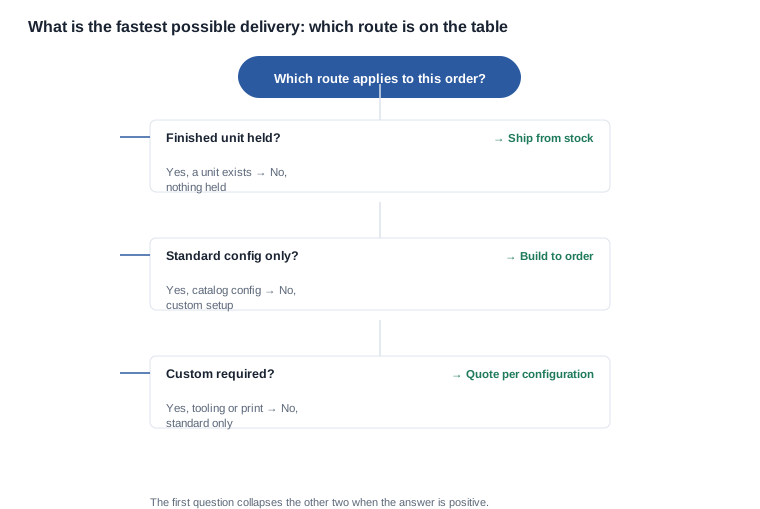
The decision chart is deliberately blunt because the first question is the one that determines everything else. If a specific configuration is held as a finished unit, the other two routes are irrelevant to that enquiry, and the rest of the discussion should be about which documentation the finished unit already carries.

How to read a lead time you have been given
A buyer is rarely short of lead times. What a buyer lacks is a way to read them, and the reading is not difficult once the structure is known. Five checks turn a number into something usable, and they work on any supplier's figure. The criteria below are the ones that decide whether a date can be planned against, and they are worth applying to every offer in the comparison rather than only to the one that looks attractive.
- Does the number start from a component position or from a purchase order? A date measured from the purchase order is a forecast, and a date measured from a confirmed component position is a plan. Both are legitimate; they are not comparable.
- Does it cover the documentation, or only the build? Ask what has to be true before the first unit can ship, beyond the unit being finished. A number that excludes the documentation is a number about a factory and not about a delivery.
- Is it quoted per configuration or per model? In this catalogue the configuration count is real: four colour options on one entry, three on another, two charging-case capacities on a third, and three forms of charging method across the range. A per-model date is usually a per-model average over configurations that do not behave alike.
- Does it assume a specific quantity band? A date quoted at the top of a quantity band is not a date quoted at the bottom, and the difference is often the difference between a component order and a component reorder.
- What happens if the binding item slips? A plan with no named contingency is a plan that will absorb the slip into somebody else's date. The useful answer names the item and the fallback.
The red flags are the mirror image of those five. A lead time quoted without a start condition. A single number offered for a model with several configurations. A date that excludes the documentation and the freight without saying so. An assurance about capacity in place of a schedule position. And a date quoted "approximately" with no band, which in this category usually means two very different numbers at two ends of the order book.
Applied to a quotation, these five checks take a few minutes and they change what the number means. Applied to a comparison between two suppliers, they change which of the two numbers can be used at all, which is usually the more valuable outcome.
The trade-offs behind them are worth naming, because the fastest option is rarely the cheapest one and the comparison is not a single-axis decision. A shorter date usually costs more, because the flexibility that shortens it — holding parts, prioritising a slot, splitting a shipment — is bought somewhere. A longer date with a documented schedule is often more valuable than a short date with an undocumented one, because the first can be planned around and the second cannot. That is the decision a buyer is actually making when the two routes are compared, and it is a total-cost decision rather than a price decision: the question is which combination of date, cost and certainty best fits a launch window, and the answer changes with the window rather than with the product.
Two of the most common pitfalls sit underneath this. The first is comparing dates that start from different points, which makes the shorter-looking number the wrong one. The second is treating the fastest route as the default and the slower route as a fallback, when the right route is frequently the one that matches the risk the programme is actually carrying. Before you order, the check that catches both is to write the launch window down first and then ask which of the three routes can be planned against it — not to ask which route is fastest and then see whether the window can be made to fit.
Filing the answers so they stay usable
A delivery answer that is not written down is a conversation, and a conversation does not survive the next enquiry, the next colleague and the next quarter. The discipline that makes delivery answers comparable is dull and worth stating precisely, because the value comes from doing it identically for every supplier rather than from doing it well once.
- Write the requirement set before the first enquiry. The configuration or configurations, the destination market, the documentation scope and the quantity band. A question set written after reading a supplier's material is a question set shaped by that supplier's material.
- Ask the stock question first and on its own. Keep it separate from the build questions, because a positive answer makes the rest of the enquiry a different enquiry.
- Send the remaining questions as one numbered message and ask for the answers in the same order. A supplier who can see the whole set has to answer the set, and the replies arrive in a shape that can be compared.
- Keep the reply unedited. Record the supplier's own words rather than a summary, because the difference between "the case comes with it" and "a case is available" is the difference being looked for.
- Write a non-answer as a non-answer. An empty cell reads as missing data; a cell reading "not confirmed" is a finding, and findings are what the file is for.
- Date every entry and note the channel. A figure given on a call and the same figure given in an email are not the same evidence.
- Give every open item an owner and a date. A gap with an owner is a manageable item; a gap with neither is a risk nobody has looked at.
Seven entries, kept in one place, and the file answers questions the original enquiry did not ask. It tells you which supplier actually checks their schedule rather than answering from a habit, it tells you which figures are stable and which move, and it gives the next buyer a starting point instead of a blank page. The most useful line in that file is usually the last one — the item nobody answered — because that is the one that will decide whether the delivery date holds.
The practical next step for the fastest delivery
Take the fastest date you have been quoted and apply the five checks to it before you plan around it. If it survives them, you have a usable date and the rest of the programme can be built on it. If it does not, you have learned that the number was about something other than what you needed, and you have learned it before the launch window rather than after it.
Then send us the configuration, the destination market, the documentation scope and the quantity band, and we will come back with the published rows for the entries that fit, whether a finished unit of that configuration is currently held, which component is likely to be the binding item, and which parts of the route sit on our side of the contract.
The longer treatments sit alongside this one: how long until the sample arrives covers the sample stage specifically, OEM-ready platform lead times covers the pre-production sequence, delivery and support across the development process covers the hand-over point, and stock and lead time for distributors and retailers covers the channel view of the same question.


