

The YK12 sits on the smallest twin-cell configuration in this range, with the shortest published endurance figure among the frames that publish a feature designation, and its differentiator is a design feature rather than a specification. That combination makes it a good product to understand and a hard product to sell on paper, and the comparison across the range explains why.
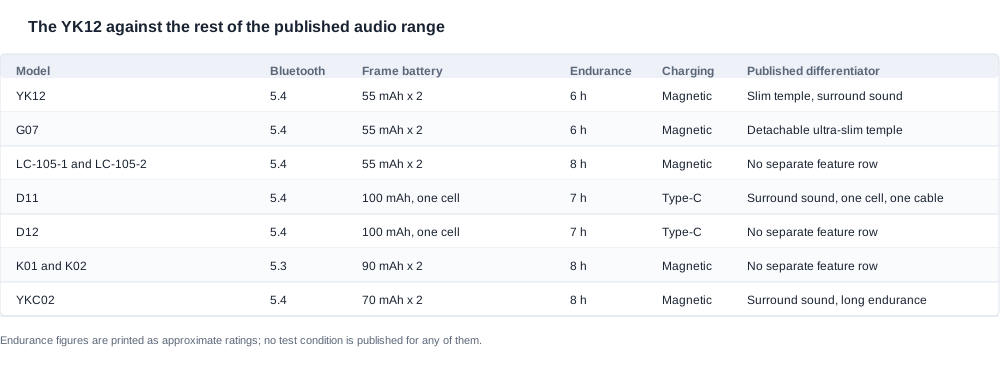
Where it sits
| Model | Bluetooth | Frame battery | Endurance | Charging | Published differentiator |
|---|---|---|---|---|---|
| YK12 | 5.4 | 55 mAh x 2 | About 6 h | Magnetic | Slim temple, surround sound |
| G07 | 5.4 | 55 mAh x 2 | About 6 h | Magnetic | Detachable ultra-slim temple |
| LC-105-1 and LC-105-2 | 5.4 | 55 mAh x 2 | About 8 h | Magnetic | No separate feature row published |
| D11 | 5.4 | 100 mAh, one cell | About 7 h | Type-C | Surround sound, one cell, one cable |
| D12 | 5.4 | 100 mAh, one cell | About 7 h | Type-C | No separate feature row published |
| K01 and K02 | 5.3 | 90 mAh x 2 | About 8 h | Magnetic | No separate feature row published |
| YKC02 | 5.4 | 70 mAh x 2 | About 8 h | Magnetic | Surround sound, long endurance |
Three things stand out.
The 55 mAh twin-cell group is not a performance tier. The YK12, the G07 and the LC-105 pair publish identical cell configurations, and the endurance figures split them: 6 hours, 6 hours and 8 hours. Same cells, three different numbers, which means the measurements were not taken under one shared protocol. Do not build a comparison table on those rows.
The K01 and the K02 are the only models on Bluetooth 5.3. Everything else in the audio range is on 5.4. That is a narrow difference in practice, but it is the one technical row on which the K-series is not the same as its neighbours, and it is worth checking what the supplier means by the version.
The D11 and the D12 are structurally different from the rest. One 100 mAh cell rather than two smaller ones, and a Type-C interface rather than magnetic. That is a different architecture, and it produces a different product: no charging accessory in the box, a lighter parcel, and a customer who can charge the product with a cable they already own. The D12 how it compares piece covers that group in more detail.
How to read the table without over-reading it
The table above is six models compressed into six rows, and the temptation with a table like this is to read it as a ranking. It is not one, and the reason is visible in the third column.
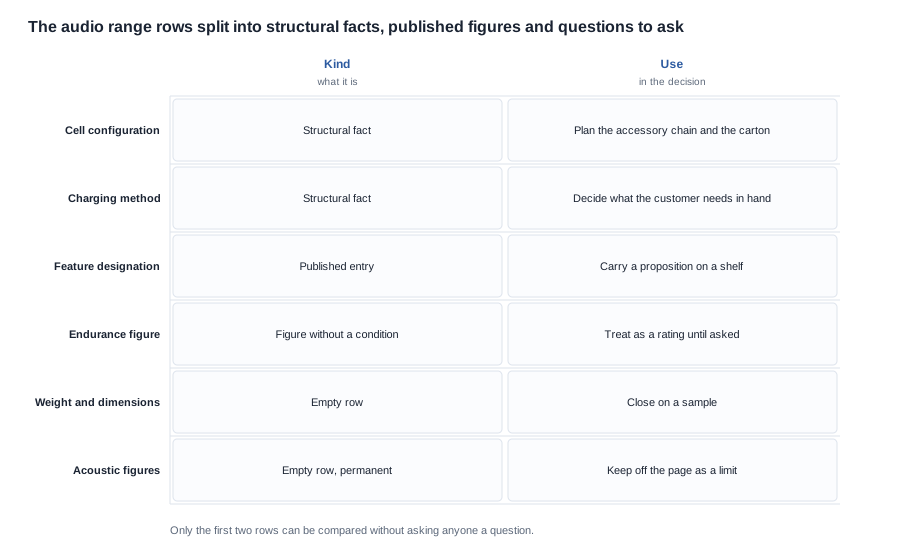
The cell configuration column is the only one that can be compared directly. One cell or two, 55, 70, 90 or 100 mAh, and the charging method that follows from it. Those are structural facts, printed on the sheet, and a buyer can plan an accessory chain and a carton around them without asking anyone a question.
The endurance column cannot be compared at all, as printed. Two frames with identical 55 mAh twin cells publish six hours and eight hours. Two frames with larger cells publish seven hours. Nothing published explains the spread, and the explanation that is usually reached for — that one model is a lower tier — is not supported by anything on the sheet, because the eight-hour figure sits on the same cell size as the six-hour figure.
The differentiator column mixes three different kinds of statement. A feature designation that a customer can hear or see (a surround-sound entry, a slim or detachable temple), an absence of a feature row, and a row that simply is not printed. Reading the three as equivalent is how a comparison table ends up claiming a difference that no document supports, and it is also how a real difference gets overlooked because it is in the same column as a blank.
What to take from the table. The structural rows, the charging method, and the presence or absence of a feature designation. Nothing else. The remaining columns are where the questions go, and the questions are what turns the table into a decision rather than a ranking.

What the YK12's differentiator is worth
A slim temple is a design decision with a commercial purpose. In a category where most open-ear frames share a profile, a visible difference is what lets a brand's product stand out on a shelf, and a narrower profile is what a buyer can be shown in three seconds without a measurement.
The problem is that none of that is quantified. The temple has no published dimensions, the frame has no published weight, and the slimness is a name. So the feature that makes the YK12 worth choosing cannot be used in an ergonomic claim, a weight claim or a comparison table. The open-ear sizing analysis covers why the way a frame sits on a head is the variable that decides whether the audio sounds acceptable at all.
Why a design row cannot carry a weight claim
A slim temple is the row a buyer can demonstrate in a shop, and it is also the row most likely to be turned into a claim nobody in the supply chain signed. That is worth unpacking, because the inference feels reasonable and the catalogue does not support it.
The inference. A narrower temple is usually a lighter temple, a lighter temple usually means a lighter frame, and therefore this frame is lighter. Each step is plausible in general and none of them is printed for this model.
Why the step breaks here. The frame weight is not published for any model in this range, so there is no figure to check the inference against, and the inference is about a frame that carries two 55 mAh cells. Another model in the same range publishes the same twin-cell configuration and a longer endurance figure, which means the cell format alone does not determine what a buyer feels. Nothing published says this frame is lighter than any other.
What the design row can carry. A shelf-level difference the customer can see and feel in the hand, a narrative about the temple profile in a product page, and a reason to choose this model over another with the same published rows. What it cannot carry is a weight claim, an ergonomic claim that depends on mass, or any comparison that puts this frame's weight against another model's.
The measurement that settles it. A scale and a set of calipers, on the unit that will actually ship, with the cells in the frame as configured. That is an afternoon, and it is the only way the claim becomes one that a buyer can print.
The commercial point. A weight claim made from a design row is a claim that has to be withdrawn the first time a customer weighs the product, and a withdrawal on a product page costs more than the feature was ever worth. The design row is stronger than a weight claim anyway, because it is the one thing about this model that a customer can verify without a document.

The endurance row, read carefully
About 6 hours is the lowest published figure in this range. For a customer who uses the frame for a working day, that is the number that matters, and it is the number a competitor will compare against.
Two honest readings. Either the YK12 is genuinely lower-end on endurance, or it is the same hardware as the LC-105 pair measured under different conditions. Nothing published settles it. Ask for the test condition, and if the answer is not clear, plan the product on 6 hours and describe it as a 6-hour rated figure. The YK12 battery life analysis covers the same ground in more detail.
The three questions that settle the six-hour figure
The six-hour figure is the most quoted number on this model and the least equipped one. It is worth deciding in advance what would make it usable, because a number that arrives without its condition is a liability in a listing rather than an asset.
First: what was running, and how loud. Playback at a stated volume on a stated content type is one product; playback at maximum is another. The same eight-hour figure appears on a frame with the same two 55 mAh cells, and the only published explanation available for a two-hour difference is that the conditions differed. Until the condition is stated, the two numbers cannot be compared, and the six-hour figure cannot be read as a lower tier.
Second: what the radio was doing, and from what start charge. A frame in standby and a frame in active use are different products, and a figure measured from a full cell and a figure measured from a part-charged cell are different claims. The second is the one a customer in the afternoon will experience, and it is the one a listing is quietly promising when it says "a full day".
Third: one unit or a batch. A single engineering sample and a production run are different populations. If the figure came from one unit, it is a measurement of that unit, and the honest treatment is to publish it as one measured figure with its condition attached. If it came from a batch, that is a stronger claim and it should be said so.
What each answer buys. A stated condition turns the figure into a claim a sample can confirm, and the listing can carry it with the condition printed next to it. A partial answer keeps it a rating, which is still publishable as long as the page says so. No answer keeps it a number nobody can defend, and a number nobody can defend is worse than no number on a page that has to survive a comparison.

What is not published
Frame weight, frame dimensions, whether any charging case exists for this model, the acoustic detail behind the surround sound label, the microphone specification, the endurance test condition, and the certification position for this model.
Turning the empty rows into a request
An empty row is not a wall. It is a line on a list, and the reason a list works is that every item on it has a named owner, a named artefact and a date.
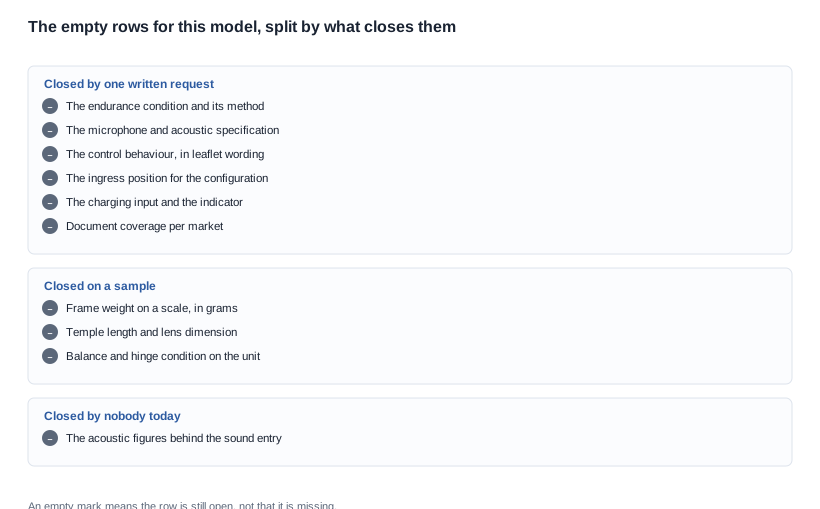
The documentary rows go in one request. The endurance condition and its method, the microphone and acoustic specification behind the sound entry, the control behaviour, the ingress position, the charging input and the indicator behaviour, and the model-level document coverage for each destination market. One message, one deadline, one reply. Six of those rows are closed by a single paragraph from the supplier, and none of them needs a sample.
The physical rows need a unit in the hand. Mass, temple length, lens size, how the frame balances with both cells fitted, and the state of the hinges and arms. A scale, a set of calipers and an afternoon.
One row has no owner. Nothing in the documentation states what the surround-sound entry actually sounds like, and no request will change that, because the record simply does not exist for this configuration. That row does not go on the list at all; it goes on the product page as a deliberate limit, and the copy is written so that nothing on the page depends on it.
Why the split matters commercially. A channel that treats every empty row as a blocker stops buying. A channel that splits them knows that six rows cost one email, five rows cost one afternoon, and one row is permanent — and a plan built on that knowledge can decide the range, the listing and the packaging in the right order instead of all at once.
Where CYNRIN stands on the YK12 against the range
This platform is worth understanding before it is worth selling: a genuine design feature, a modest published endurance figure, and a set of rows that are empty for every model in the range. We will not turn the 6-hour rating into a promise of a full day, we will not treat the sound entry as an acoustic figure, and we will not paper over the empty weight, microphone and certification rows with values borrowed from elsewhere in the industry. The YK12 specifications and the YK12 buyer review checklist cover the published baseline and the sample-stage checks respectively.
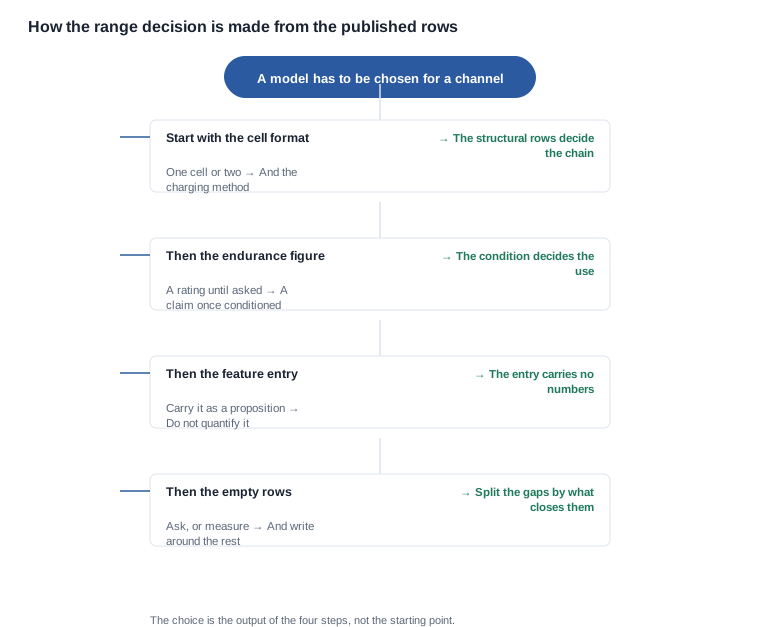
How the range decision is actually made
It is worth being precise about the order of operations, because the order is what makes a range decision defensible rather than a preference with a table attached.
First, decide the cell configuration. One cell or two, and how large. This is the one row that is printed, structural, and decides the accessory chain, the carton and the parcel. Every other row is either a figure without a condition or a question.
Second, decide the charging method. Whether the frame takes a magnetic interface or a cable. This decides what the customer needs in their hand, what the listing has to explain, and whether an accessory has to be stocked at all. It is also the row a gifting proposition is built on, which is why the case question follows immediately after it rather than later.
Third, treat the endurance figure as a rating until a condition exists. On paper the figures do not separate the models, since elsewhere in the range one cell size appears alongside two different published runtimes. In practice the figure decides who the frame is for — a shift that fits inside a rated day, or a customer who is away from a charger for longer than that.
Fourth, turn to the feature designation. A sound entry or a temple profile is the only row in this range that a customer can perceive, and it is the only row that can carry a proposition on a shelf. It is also the row with nothing behind it in the way of measurements, so it carries a proposition and nothing else.
Fifth, and only then, choose the model. The choice is the output of the four steps above, and it is expressed as a selection method rather than a verdict. Given the channel, the usage session, the cable the customer already owns and the markets, one of these models is buildable to the brief and the other is not — and which one that is depends on answers the catalogue does not contain.
Turning the table into a range decision a buyer can sign
A comparison table is not a procurement document. The step that turns one into the other is a short list of commercial and quality questions, and on this model the list is short because the published rows already answer most of what a buyer would ask.
What goes into the request for quotation. The model designation and the configuration, the quantity tiers the supplier will quote, the unit price at each tier, and the packaging specification they will quote against. A quotation that names the model and the configuration is the first thing to check, because a range-level quotation cannot be turned into a purchase order later, and the cost of discovering that after the artwork is approved is the artwork.
What goes into the tooling and customisation discussion. Whether any tooling is required for this model, what the NRE is, who owns the mould, and what the lead time for the first production run is. On a model whose differentiator is a design feature, this is where the design feature becomes a cost, and a buyer who has not asked about tooling has not costed the reason they are choosing the model.
What goes into the quality agreement. The sample order and what it is used to verify, the quality assurance checks the supplier runs before shipment, how a defect is handled, what the warranty period is and what the response time on a claim is. On a model whose endurance figure has no published condition, the sample is what turns a rating into a measured figure, and the quality agreement is what stops that figure from being a one-off.
What goes into the supply chain and the commercial terms. Which distributor or wholesale route the units move through, whether a brand owner is buying direct or through a retailer, the shipping terms, the incoterms, the payment terms and the deposit structure. Each of these has a landed cost attached, and a landed cost built on a price tier nobody has confirmed is not a cost model.
Why the audit and the due diligence come last. The compliance rows for this model are empty, so the documents that matter most are the ones that name the exact designation for each destination market. Collecting them is due diligence rather than paperwork, and it belongs after the commercial shape is known, because the number of markets a channel sells into changes the whole cost of the documentation.
The order in short. Quotation, then tooling and NRE, then the sample order and the quality agreement, then the supply chain and the commercial terms, then the market documents. Each step has an artefact at the end of it, and each artefact is something a purchase order can be built on.
Five things to close before the first order
- The endurance test condition, and whether the 6-hour figure was measured on the production configuration.
- Frame weight, temple dimensions and the frame dimensions.
- Whether a charging case exists for this model at all, and what it would carry if it does.
- The acoustic and microphone specification.
- The certification position for the YK12 in each destination market.
Related reading
- The rows this comparison is built on — the YK12 specification set
- The endurance question, in more depth — how the YK12 battery row reads
- The wider range — picking across the Bluetooth audio range
Send us the application, the expected daily use and the markets, and we will tell you which published figures apply and which have to be measured on a sample.


