

The YK12 publishes seven values: Bluetooth V5.4, a pair of 55 mAh cells, magnetic charging, a charge ceiling of no more than two hours, a rated runtime of roughly six hours, a slim temple and a surround-sound designation. That is the whole of the documented specification. The buyer review checklist below works through what is published, what is named but not quantified, and what is absent — because for this model the named-but-not-quantified items are where a review will trip.
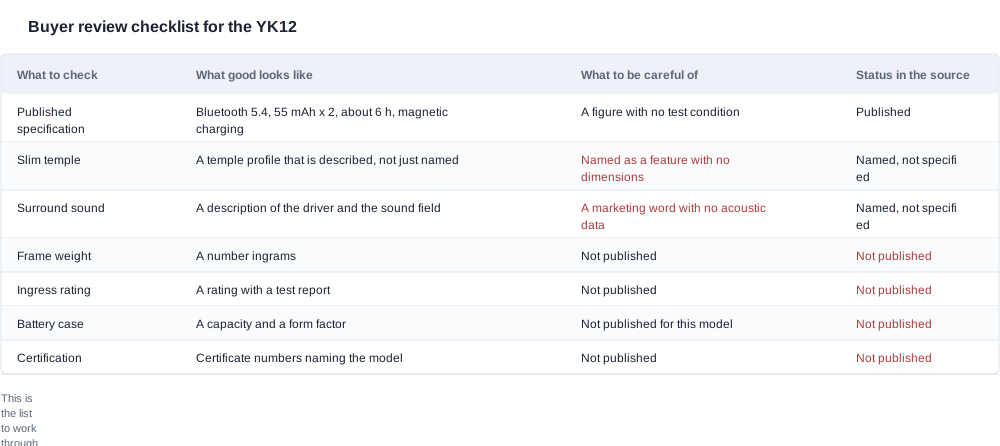
YK12 buyer review checklist: what the published rows support
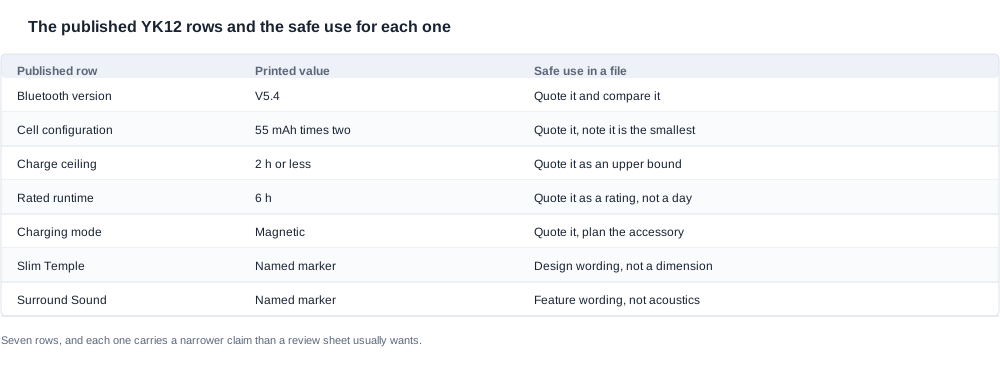
| Item | Published | Safe use |
|---|---|---|
| Bluetooth version | 5.4 | Quote directly, and check it against the range's other models |
| Frame battery | 55 mAh x 2 | Quote directly; note it is the smallest published energy configuration |
| Charge time | 2 h or less | Quote directly as a manufacturer upper bound |
| Endurance | About 6 h | Quote as a rated figure, not a guaranteed day |
| Charging | Magnetic | Quote directly; plan the accessory |
| Slim temple | Named | Use as a design description, not as a dimension |
| Surround sound | Named | Use as a feature description, not as an acoustic claim |
How the published rows were read, and what each one settles
The seven rows are worth reading with the page's own labels in view, because two of them use labels that mean different things elsewhere in the catalogue. This model's page prints the two-hour figure under the charge-time label and the six-hour figure under the endurance label. On some camera pages the same endurance label carries the runtime instead, and the charge ceiling sits under the other label. That is a transcription risk rather than a product fact, and it is exactly the kind of thing a review file should record before the rows are copied into a specification sheet.
With that settled, each row has a natural job. The radio version supports a compatibility statement and says nothing about connection behaviour. The cell configuration supports a capacity statement and says nothing about how long the unit runs. The charge ceiling supports an upper bound and says nothing about typical behaviour. The runtime supports the figure as printed and says nothing about the condition behind it. The charging mode supports a statement about the interface family. The two named markers support design wording.
What none of the seven supports is a performance claim, and that is worth stating plainly in the review file rather than leaving each reader to infer it. A row set this short is enough to build a specification page on, and it is not enough to build a product argument on.
The runtime row and why it cannot be carried between models
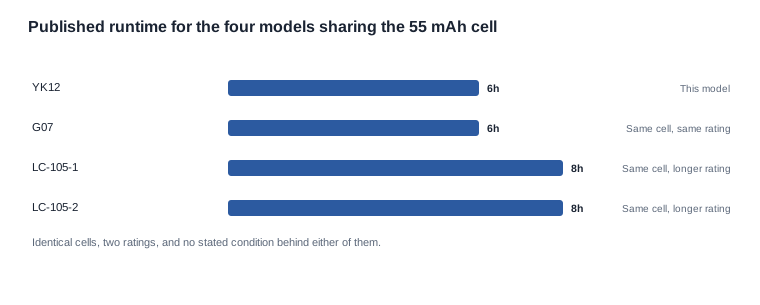
The six-hour rating sits at the bottom of the published range, and the cell configuration behind it is the smallest published energy configuration in the audio range. Both facts are quotable. Neither is a comparison.
Four models in this range are printed with the same paired 55 mAh cells: this one, the G07, and the two LC-105 variants. Of those four, two carry a rating near six hours and the other two are printed near eight. Identical cells, identical charge ceilings, identical charging mode, two different ratings. The gap cannot be a capacity gap and cannot be a charging gap, so it lives in a measurement that is not published.
For a review file the conclusion is narrow and it is important. The rating may be quoted for this model, attributed to this model's page, and used to plan a charging cycle. It may not be carried to another model in the family, it may not be converted into a working day, and it may not be scaled by a duty cycle to produce a listing specification. Any comparison sheet that ranks these four models on runtime is presenting an ordering the catalogue does not contain.
The YK12 charging options piece covers the accessory side, and the published YK12 specification list has the full rows.
The charging row and what a buyer has to plan around
The charging mode is the one published row with a physical consequence that reaches past the unit itself. Magnetic charging means the contact has to be made correctly, and a temple seated a fraction out of position can show a charge indication while progressing slowly. That is a seating question rather than a cell question, and it is the mechanism behind most of the early support contacts this design generates.
It also means the accessory has to be planned rather than assumed. The catalogue prints the charging mode and prints no charging case row for this model, so whether a dock or a case exists, whether one ships with the unit, and what the charger itself takes are three open questions rather than three published facts. A buyer planning the retail carton needs all three answered before the artwork is approved, because the artwork is the slowest artefact to change.
That is why the charging row belongs in a review file even though it is not a specification number. It is the row that decides what goes in the box, and the box is the decision that is expensive to undo.

The two named items that are not quantified
The slim temple. A slim temple is a real design decision with a real effect on how the product looks and how it sits on a head, and it is the one feature that separates this model from the LC-105 pair. It is also, in the source, a name rather than a dimension. You cannot use it to make a claim about how the frame sits, you cannot use it to claim a weight advantage, and you cannot use it in a comparison table against a model with an unspecified temple. Ask for the temple profile and the total weight.
The surround sound. The same problem. A surround or spatial sound claim implies something about the speaker arrangement, and none of it is documented: no driver size, no frequency response, no description of the sound field, and no acoustic testing. The phrase appears in the catalogue for several models in this range, which makes it a category-wide description rather than a differentiator. Do not build a marketing claim on a word that every model in the family carries.
The slim temple: a name, a profile and a number
The gap between a name and a specification is narrower than it sounds, and a review can close it. A name tells a buyer that the temple is slim. A profile tells a buyer how slim: the section dimensions, the material, and the geometry at the hinge. A number tells a buyer what the choice costs: the frame weight, and then the packed weight, which is the figure the freight model actually needs.
All three are obtainable, and none of them is obtainable from a catalogue page. The temple profile comes from a drawing or a sample measurement, and the weight comes from a scale. A buyer who asks for both in one message has a review file that can carry a real claim on this row instead of a borrowed one.
The same applies to what the marker does not settle. A slim temple might reasonably be expected to sit differently on a head than a standard temple, and it might reasonably be expected to weigh less. Neither expectation is supported by anything published for this model, and both are testable on a sample in an afternoon.
The surround sound: a designation used across the range
The sound marker is used on more than one model in this catalogue, and that fact changes how much weight it can carry. A feature that appears on one model is a differentiator. A feature that appears on several is a description of a category, and a category description cannot be the reason a customer chooses between two models that both have it.
What the marker is worth is real, but it is worth what a design phrase is worth. It is concrete, it is photographable, and it can be the opening line of a listing without overclaiming anything. What it cannot be is the basis of a sound quality claim, because no acoustic figure sits behind it anywhere in the catalogue.
For a review file, the honest treatment is a two-line test for every candidate claim. Is there a measurement behind it? If yes, quote it with its conditions. If no, is it a property a customer can see? If yes, describe it as a design property and stop there. If neither, it does not go in the file. Applied to this row, the sound marker passes the second test and fails the first.
The items this model leaves out
Frame weight. Frame dimensions. Ingress protection rating. Charging case capacity. The endurance test condition. The certification numbers for this model. Microphone specification. Bluetooth range.
The microphone, which decides what the product can be sold as
The microphone point deserves a note, because it is the item that determines whether the product can be sold as a calling device rather than an audio-playback device. An open-ear frame with no published microphone specification is a product you can market for playback and for calls as a general category, but you cannot publish a claim about call quality, noise reduction, or wind handling. The microphone testing notes cover how to evaluate it on a sample.
There is a practical sequencing point here. A sample-based microphone test needs a script, an environment and a recording, and it takes longer to set up than a scale or a tape measure. That makes it the line most likely to be skipped when a programme is busy, and it is the line least safe to skip, because the claim it supports is the one customers test in the first week.
The other absent items close more easily. Frame weight and frame dimensions come from a sample. The charging case question comes from a written request. The runtime condition comes from the same request. Ingress and certification come from documents rather than from measurements, and they are discussed in the next section because they are the ones with the longest lead time.
The certificate scope, which is a document question
The certification numbers for this model are not published, and neither is the scope that would let a buyer judge them. What the catalogue does contain is an export page whose content is images rather than text, and the catalogue text itself carries no reference to any conformity mark at all. That means the review cannot confirm a certificate from the catalogue, and it cannot confirm one from a document that names a different model either.
Start from the certification checklist, which sets out what to request and how to read what comes back. The short version for a review file is that a certificate is only useful when four things are on it: the model designation that is actually being bought, the certificate holder, the issue date, and the list of covered variants. A certificate that names a family but not the variant being ordered is a different document for a buyer's purposes, and the difference is easy to miss because the family name looks familiar.
This is the one absent item with the longest lead time, which is why it belongs at the top of the review rather than at the bottom. Everything else on the list can be closed in a week with a sample and a message. A document that has to be issued by an external body cannot be accelerated by a busier buyer.
The items that are absent from the page but not from the product
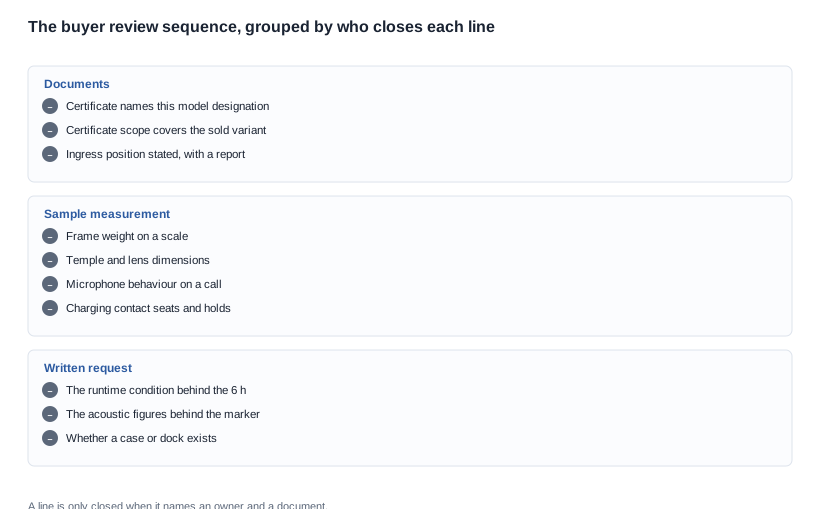
Eight items are absent, and they are absent in three different senses, which is worth separating because they close in three different ways and on three different clocks.
Three of them are physical properties of the unit that a sample settles: the frame weight, the frame dimensions and the radio range. A fourth, the microphone behaviour, is also a sample matter but needs a script, an environment and a recording, so it takes longer and is the one most often skipped when a programme is busy. One of them, the charging case and its capacity, is a product decision rather than a measurement and comes back in writing. The runtime test condition is another written answer, because it describes how somebody else measured a figure.
The last two are documents. The certificate scope for this designation and the ingress position both come from outside the factory, and both have the longest lead time of anything on the list. They should be requested first even though they are checked last, because nothing that depends on them can be finalised until they arrive.
That ordering — documents first, measurements in the middle, written product answers last — is the reason a review that starts with paperwork finishes in a week. A review that starts with the scale and works backwards will end up waiting on a document it never asked for.

The review sequence, in order
- Match the model number to the paperwork. A certificate or test report that names a different model does not cover this one. Start from the certification checklist.
- Weigh the sample and measure it. Nothing in the documentation substitutes for this, and the number belongs on your product page.
- Run the endurance test yourself under the condition your customer will experience, not under a laboratory profile. Record the condition next to the number.
- Test the microphone on a call in a realistic environment, including outdoors.
- Check the frame across the size range you intend to serve, with the slim temple as it ships.
- Verify the box contents against the packing instruction, and confirm the charging accessory is present and works.
What each step of the sequence produces and what it cannot
The sequence is ordered by lead time, not by convenience, and that ordering is what makes it cheap. Step one costs nothing and can invalidate everything else, because a document that does not cover the model being bought makes the remaining measurements irrelevant to that shipment. Step two costs an hour and produces the two numbers the freight model and the product page both need. Step three costs a day and produces a figure that can be quoted because the condition is written next to it. Steps four and five are the customer-facing tests, and both need a sample that has already been weighed and measured.
What the sequence cannot do is produce a certificate, and that is why step one is a request as much as a check. The document sits outside the factory and outside the programme, and the only thing a buyer controls is when the request was sent and how precisely it was addressed.
Two rules keep the sequence from stalling. Write every result down where the next programme can find it, because the same numbers are needed again for the second order and usually are not kept. And record the condition beside every measured number, because a weight without a scale, a runtime without a protocol and a microphone result without an environment are three different ways of ending the same argument later.

Where CYNRIN stands on the YK12 review
The YK12 is a sensible light audio platform with a decent design feature and a modest published endurance figure, and the review should be built around what you can measure rather than what you can quote. We will not present the 6-hour rating as a full working day, we will not present the surround sound label as an acoustic specification, and we will not fill the weight, the microphone or the certification gaps with typical values from elsewhere in the industry. If you need those numbers, they come from a sample and a test house, and we will tell you plainly which questions that leaves open. The Bluetooth audio glasses frame and sizing analysis explains why the frame and weight checks belong at the top of the list rather than the bottom.
What a closed review file looks like
A closed review file for this model is a short document with three parts, and none of them is a brochure page.
The first part is the published set, written out with the page label attached to each value, so that whoever reads it next knows which row it came from and whether it is a ceiling or a rating. The second part is the measured set, with the condition recorded beside every number and the unit the number was taken in. The third part is the open set, with each line naming the party that owns the answer and the date it is due.
The value of that structure is that it survives a change of programme and a change of person. A file that only holds the first part cannot answer a question that arrives in month four, because it does not say which questions were asked and which answers were outstanding. A file that holds all three can answer it in a minute, and the answers accumulate rather than being rebuilt.
That accumulation is the real return on the review. The first order costs a week of measurement; the second order costs an afternoon, because the numbers already exist and the only new work is the changed rows. Buyers who skip the file pay that cost again on every order, and they pay it in a currency that is easy to miss, which is the absence of a defensible number when a customer asks for one.
Related reading
- Where it sits in the range — YK12 smart glasses how it compares
- The commercial side of a light audio product — YK12 smart glasses value for money
- The accessory decision — Bluetooth audio glasses charging options
Send us the model, the destination markets and the application, and we will tell you which of these checklist items we can answer from documentation and which need a sample or a test house.


