

The comparison is a straight trade, and the two sides of it differ in kind rather than in degree. The K02 is the capacity model: 90 mAh × 2, a rated runtime of approximately eight hours, Bluetooth V5.3, and no published feature of any kind. The YK12 is the feature model: 55 mAh × 2, a rated runtime of approximately six hours, Bluetooth V5.4, and a surround sound claim carried on a slim temple.
That is two extra hours of published runtime against a sound claim and a newer radio. Everything else about the decision follows from which of those your channel actually sells. This page is written for the buyer making that choice and then defending it to a brand, a customer or a market-access reviewer.
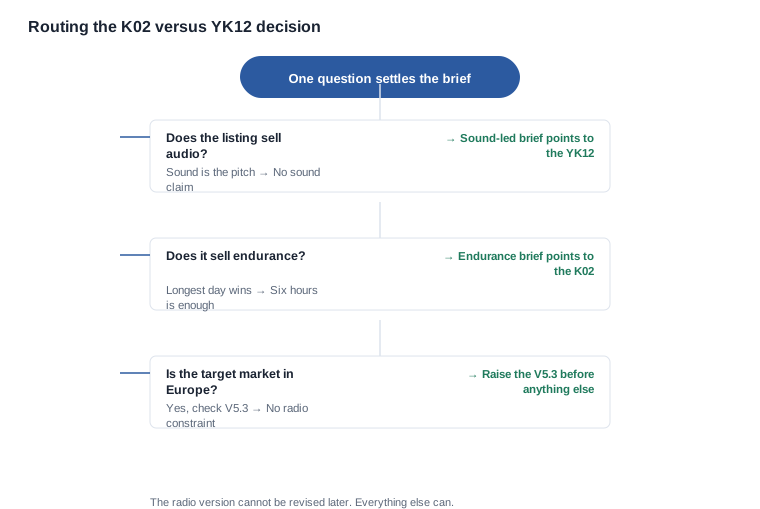
YK12 smart glasses vs K02: three variables, one of them fixed
Who is choosing, and what they are defending. A brand owner is choosing which model carries the proposition, and the two answer different briefs. A channel buyer is choosing a single SKU and needs to know which published row the customer will actually see on the listing page. A procurement manager is defending the choice in a review meeting and needs to know which of the three variables is fixed and which is negotiable — because one of them cannot be changed after tooling.
Runtime. The K02 carries 180 mAh in total against the YK12's 110 mAh, and publishes eight hours against six. On the arithmetic alone the K02 appears to win, and that appearance is the trap this page exists to explain.
The sound claim. The YK12 publishes surround sound and a slim temple. The K02 publishes neither, which is not the same as publishing nothing at all — it is a documented position a supplier can be held to.
The radio version. V5.3 against V5.4, and this is the variable that decides whether the argument above matters.
Runtime is measurable, so it is negotiable in practice. The radio version is not. A framework change, a firmware change or a connection-flow change is a product revision with its own cost and its own certification cycle, while a radio version is a silicon decision made at platform level. If your brief has any European market positioning in it, the V5.3 is worth raising with the supplier even where the K02 is otherwise the stronger answer — and it is the row to raise first, because it is the one that cannot be closed later.
| Variable | K02 | YK12 | What it decides | The threshold or the question |
|---|---|---|---|---|
| Rated runtime | 180 mAh total, about 8 h | 110 mAh total, about 6 h | Whether the published figure is the number the customer will see | The LC-105-1 and the LC-105-2 publish about eight hours on the same 55 mAh × 2 cells as the YK12, which publishes six. Identical cells, a two-hour difference. Average draw or test method is doing the deciding, and no condition is published for any model in this range. Ask whether the figures came from the same method. See battery specification guidance |
| Capacity headroom | 180 mAh | 110 mAh | The workload the product can absorb | Not a published figure but a design fact: a customer on calls all day with the phone ringing is a heavier load than one who is mostly idle |
| Sound claim | None published | Surround sound on a slim temple | Whether the listing can sell audio at all | No leakage figure, driver size, frequency response, microphone count or pickup distance is published. Ask what the customer hears differently, in words rather than in decibels. See open-ear audio |
| Slim temple | Not published | Published as a configuration | A merchandising property and a contact-area claim | No temple length, cross-section or weight is attached to the row |
| Radio | V5.3 | V5.4 | Market access, and a platform lock | The customer's platform and market access requirements, checked against the version quoted |
| Making no claim | No feature published | Sound and temple published | Whether the brand wants a listing with no sound description to support | A decision rather than a question. A price-led channel has a legitimate reason to choose the silent model |
| Charging case, control method, weight, ingress, certificates | Not published | Not published | Whether the product can be sold at all in a given brief | The rows, in one request. A product with no documented control has no documented user experience |

Runtime and capacity headroom, and the row the catalogue contradicts
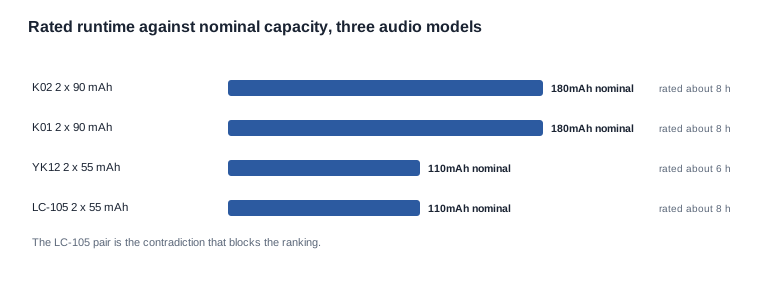
The capacity difference is the strongest argument for the K02 and it deserves to be stated at full strength before it is qualified. Seventy milliamp hours of additional nominal capacity, distributed across two cells, is not a marginal difference — it changes what workload the product can absorb before a customer notices. A buyer whose end user takes calls through the afternoon, keeps the device connected to two phones, or leaves it on through a shift is describing a load the 110 mAh configuration is less well placed to absorb, whatever the rated hours say.
The qualification is that the rated hours cannot be ranked from the catalogue. The same 55 mAh × 2 configuration publishes eight hours on the LC-105 pair and six hours on the YK12. Two models, identical published cells, a two-hour gap. That single contradiction means at least one of three things is true: the measurement conditions differ between models, the power management differs despite identical published rows, or at least one figure came from an engineering sample rather than the production build. All three are common, and none can be distinguished from a catalogue page.
So the honest reading is that the capacity advantage is real and the hours advantage is unproven. A brand that quotes eight hours against six in its own materials is making a comparison the data in the same range contradicts, and that is a position a reviewer or a competitor can point at. Bluetooth audio glasses which model to pick covers the choice across the wider range, and YK12 against K01 on capacity sets out the same cell-versus-claimed-hours pattern from the other direction.
There is a second reason the capacity lead matters more than the hours lead, and it is not visible in either specification. A cell configuration with headroom absorbs a firmware change; one without it does not. If the platform later gains a capability, the 180 mAh model has room to carry it and the 110 mAh model may not. That is a range-planning argument rather than a single-SKU argument, and it is worth more to a brand building three or more models than the two-hour rating is to a channel buying one.
Designing the sample order test. Since the catalogue cannot settle the runtime question, the sample order has to. Agree the protocol in writing before the units ship, because a measurement run without a stated protocol produces a number you cannot use. The protocol needs four things: a volume setting expressed as a percentage rather than as a description, a codec, a distance from the source phone, and a statement of whether the figure is a mean across units or the best unit in the batch. Then run both models on the same protocol on the same day, in the same room, on the same network, and record the result with the date. Two hours of work closes a question that a specification sheet cannot, and the resulting figure is yours rather than the supplier's.
The sound claim, the radio version, and what each one lets you write
The sound claim is a merchandising asset with an evidence gap behind it. The YK12 publishes surround sound and the K02 publishes nothing, so on the face of it the YK12 carries the more complete listing. The difficulty is that surround sound appears across several models in this range as a category description rather than a differentiator, and no acoustic figure accompanies it on either side — no driver size, no frequency response, no leakage rate, no microphone pickup distance. The question to put to a supplier is what the customer hears differently, in words, and whether that difference survives at low, medium and high volume. A listing can say "surround sound" and point to a published feature. A listing cannot say "20% more sound", cannot say "no leakage", and cannot attach a decibel figure that no report supports.
The radio version is the row with the least negotiating room. V5.3 on the K02 and V5.4 on the YK12 is not a performance difference you can measure on a bench — it is a compliance and platform question that surfaces at market-access stage, when the leverage has already moved. If your target markets include Europe, raise it in the first round. If they do not, note it and move on, because V5.4 is not something to pay a premium for on its own.
What the slim temple is worth. A narrower temple changes how the frame reads on a face, which matters in an apparel-adjacent or lifestyle channel, and it reduces contact area against the side of the head. No temple length, no cross-section and no weight is attached to the row, so it supports a design statement and not a measurement. What a sample has to establish where the catalogue is silent covers the ergonomics behind that decision.
What to ask a supplier, and how to check the answer
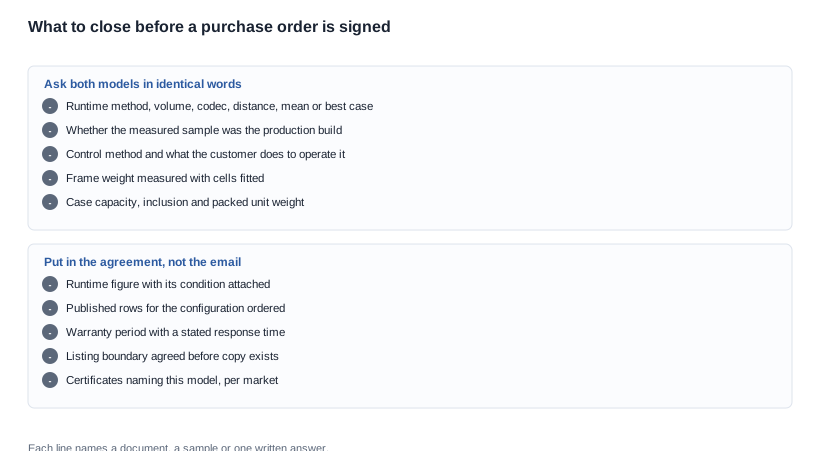
Ask the runtime method question of both, in identical words, in the same message. Whether the figures came from the same method, what was active during the measurement, and whether the measured sample was the production configuration. A condition asked of one model and not the other produces a comparison that cannot be defended in a contract.
Ask the sound question in words, not in numbers. What the customer hears differently with surround sound engaged, and whether that holds across three volume settings. If the answer comes back as a marketing phrase, the answer is that no acoustic claim is defensible and the listing should describe the feature without quantifying it.
Check the radio against the customer's platform and market access requirement before the other two, because it is the only one that cannot be revised later.
Hold a sample of each and use them for a full session. No weight is published for either model, and whether a frame stays acceptable over a long session is the variable most correlated with returns in this category. Weigh both frames with the cells fitted and record the figures yourself, because a measured number you own is defensible in a way a quoted number is not.

Set the listing boundary before the copy exists. Published rows you may use: the radio version, the cells, the rated runtime, the charging method, the surround sound description and the slim temple. Rows you may not use without evidence: the runtime condition, any acoustic figure, the control method, the frame weight, the ingress position, the certificate coverage and the availability of a charging case.
Six ways this choice goes wrong in practice
Treating eight hours as a decisive win. The wrong model is chosen for a workload the figure never described, and the K02 arrives in a channel that needed the sound claim. Root cause: a two-hour gap on a comparison the catalogue contradicts was read as a ranking. Prevention: set the row aside until both measurement methods are explained in writing.
Quantifying the sound claim. A competitor's acoustic figure contradicts yours, or a customer expects a measurement that does not exist. Root cause: a feature name was turned into a number. Prevention: describe the behaviour in words you have observed on your own sample.
Discovering the V5.3 at market-access stage. A market conversation that cannot be closed on the documentation, after tooling and packaging are already committed. Root cause: the radio version was not checked against the brief in the first round. Prevention: check it in round one, alongside the lead time and the incoterms.
Reading the K02's silence as a lack of specification. The model is passed over for a competitor with more published rows. Root cause: absence of a feature was read as absence of a product. Prevention: read the platform rows, and recognise that making no claim is a legitimate position for a price-led channel that does not want to defend an acoustic description.
Assuming a charging case for either. The retail story depends on a reserve battery that does not ship. Root cause: a camera-platform accessory was carried across from another range. Prevention: no model in the audio range publishes a case, so plan as though the answer is no until the capacity and inclusion are confirmed in writing.
Assuming the control method. An instruction leaflet describes gestures that do not work on the shipped firmware. Root cause: a plausible control was written from assumption rather than from the manual. Prevention: ask, and write "supplied separately" in the listing if the answer is that no control is documented.
The commercial line, and what belongs in the purchase order
The two models carry different claim burdens, and the burden is the larger economic fact. A sound claim has to be defended in a listing, in a support script and eventually in a complaint. A product that publishes no feature has nothing to defend, and at price-led volumes that is worth more than a specification advantage a customer cannot verify. The K02 is not the cheaper model by default; it is the lower-maintenance one, and the saving appears in returns, in support hours and in the cost of a listing correction.
Worth the negotiation time. Unit price and volume tiers, the accessory set with its minimum order quantities, packaging specification, delivery splitting, payment terms with a deposit structure, the warranty period with a stated response time, return terms, and the terms of a pilot order. Return terms are the line that moves most in a channel selling a sound claim, because a channel that carries the claim carries the returns.
Cost and schedule, where the negotiation has no room. The cost of a certification and the time it takes are determined by the programme and by whoever runs the test. Tooling is often amortised across the first order while certification cost is per product family — ask which one you are being quoted, because the two are frequently bundled into a single line that hides which is which. Incoterms and freight class follow from packed weight, which follows from a frame weight you have not yet been given, so a freight quotation built on an assumed weight is a quotation built on a guess.
The clauses to include. The published rows for the configuration ordered; the runtime with its condition and method; the sound description and the volume condition where a sound claim is listed; the radio version; the control behaviour; the frame weight as measured; the warranty period with a stated response time; and the certificate references naming the model for each destination market.
What to leave out. Any runtime claim without its condition, any acoustic figure that is not published, any control method that is not documented, and any charging case that is not published.
The due diligence step most first-time buyers skip. Before a bulk order is released, ask whether the factory will accept a quality control inspection against an agreed checklist that you write, and whether the deposit or the balance is held until that inspection passes. This is not adversarial; it is the mechanism that converts an unproven runtime figure into something with a remedy attached. The same request should name the inspection items that follow from this comparison — the cell configuration against the order, the radio version against the order, the firmware version, and a sample of units measured against the runtime protocol agreed earlier. A supplier who declines an inspection tied to those items has answered the question that matters, whatever they say about factory visits.
The range question, if more than one model is in scope. If the brand is qualifying a K-series model and a 55 mAh family model together, the commercial conversation changes shape: the tooling, the certification scope and the accessory set become shared lines rather than per-model ones, and the supplier's incentive moves toward keeping you inside one family. That is worth naming openly in the negotiation rather than discovering it in the quotation. Ask for the tooling position on each family, the minimum order quantity on the shared accessory parts, and the lead time on a mixed order against the lead time on a single-model order.
This is a choice between a capacity model and a feature model, and the runtime row is the weakest of the three arguments available. We will not present a two-hour gap that the catalogue contradicts as a decisive win. We will not add numbers to a sound claim, and we will not describe a control method that is not documented. We will tell you plainly which of the three variables is fixed and which are negotiable.
If you send the channel, the volume, the target market and whether the listing sells audio or endurance, we will narrow this to one model and name the rows you would still need evidence for. The range both models belong to is on the Bluetooth audio glasses page.
What to do next.
- Answer the one question: does the listing sell audio, or does it sell endurance?
- Ask the runtime method of both models, in identical words, in the same message.
- Check the radio version against the customer's platform and market access requirement.
- Hold a sample of each, weigh them, and use them for a full session.
- Set the listing boundary before the copy exists, and put the pass lines in the agreement.
Related reading
- Where this model sits across the range — YK12 best for
- The data behind this model — YK12 specifications
- The battery comparison method — battery specification guidance
Tell us the channel, the volume and the target market, and we will come back with what is available and what is not.


