
The yk12 smart glasses vs k01 spec comparison is not a ranking exercise, because the two platforms are not the same kind of object. One sells on a temple profile, the other on a documented feature set. The YK12 publishes an ultra-slim configuration with a slim temple, two 55 mAh cells and about 6 hours of endurance. The K01 publishes two 90 mAh cells, about 8 hours and an AI translation capability that the source itself flags as a company self-description, while no touch control row is published for it. A buyer comparing these two is not choosing between two options of one thing, and the comparison only works if the difference in kind is respected rather than flattened into a single score.
The reason this matters commercially is that the two models carry different claim burdens, and a claim burden is a recurring cost. A design feature has to be defended in the listing and in the support script. A capability claim has to be defended in the listing, in the support script and eventually in a complaint from a customer who expected something the technical file never promised.
YK12 smart glasses vs K01: what each platform is actually selling
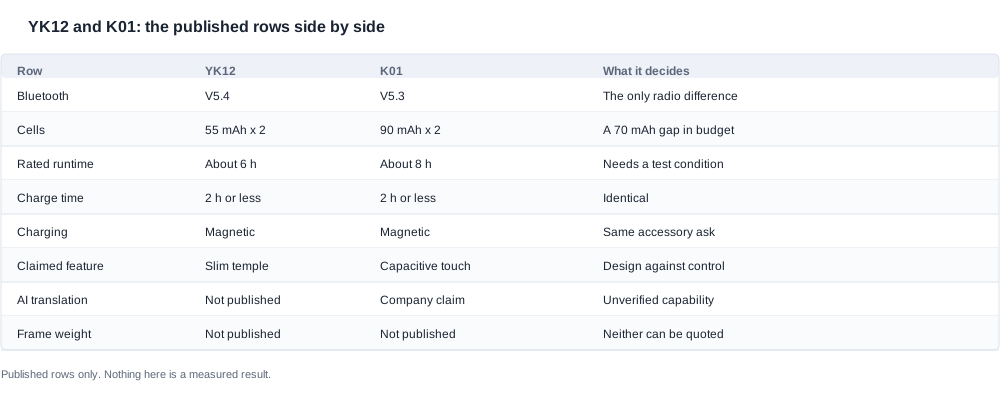
The YK12 sells a profile. Its published differentiator is a slim temple, carried on the smallest published cell configuration in the range at 55 mAh × 2, with a rated runtime of about six hours and Bluetooth V5.4. The frame weight is not published, and no temple dimensions are attached to the name. So what a brand is buying is a design identity, at a cell capacity that sits at the bottom of the range, with a runtime figure that the same cell configuration elsewhere in the range contradicts.
The K01 sells a feature set. It publishes 90 mAh × 2, a rated runtime of about eight hours and an AI translation capability described by the manufacturer rather than by an independent laboratory, while its control method is published nowhere in the range. Bluetooth is V5.3. Nothing about its form factor is published at all, so a brand buying the K01 is buying behaviour and endurance and accepting that it cannot describe the frame in quantitative terms.
Read them as two different supply proposals rather than as two answers to the same brief. A brand whose positioning rests on visual differentiation has a use for the YK12 that the K01 cannot serve, because the K01 publishes no design story. A brand selling on capability and endurance has the mirror-image answer. The most common failure in this comparison is a procurement manager scoring both against a single row and letting the product with the more published rows win by default — which rewards documentation volume rather than commercial fit.

The published rows, and the four that carry no information
| Specification | YK12 | K01 | Practical read |
|---|---|---|---|
| Bluetooth | 5.4 | 5.3 | The only radio difference, and a platform lock either way |
| Frame battery | 55 mAh x 2 | 90 mAh x 2 | A 70 mAh difference in the energy budget |
| Stated endurance | About 6 h | About 8 h | The differentiator, and the row that needs a condition |
| Charge time | 2 h or less | 2 h or less | Identical, so it cannot separate the two |
| Charging | Magnetic | Magnetic | Identical accessory approach, identical omission |
| Published differentiator | Slim temple | Capacitive touch, and an AI translation claim | A design feature against a feature claim |
| Frame weight | Not published | Not published | Neither can be quoted |
| Frame dimensions | Not published | Not published | Neither can be quoted |
Charge time and charging method are identical, so they do not participate in the decision. Frame weight and dimensions are absent for both, so they cannot be scored either — they are rows to close before the purchase order, not rows to weigh. That leaves four rows doing the work: the cells, the runtime, the radio and the differentiator.
For a buyer building a criteria table, the practical move is to mark the non-informative rows as excluded rather than as equal. A row that is identical contributes no discrimination, and scoring it as a tie gives the table a false appearance of depth. The same applies to a row where both values say "not published" — two blanks are not a match, they are an open question, and the difference matters because one of them might be obtainable on request.
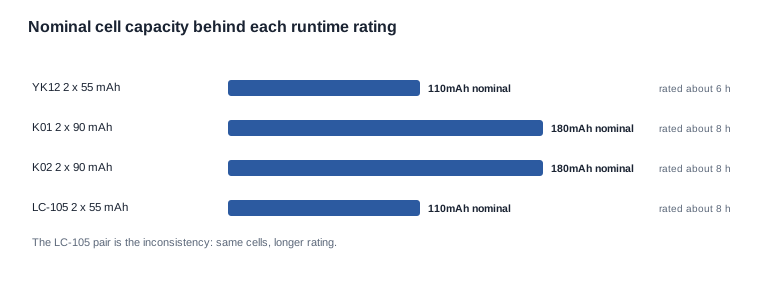
The capacity difference is the clearest signal in the comparison, and it is also the one most often misread. Take the published figures at face value and see what the arithmetic permits.
The capacity gap is real; the two-hour gap is only partly explained
Two hours of rated runtime on a 70 mAh difference, in the direction the cell capacity predicts. That is more plausible than the eight-hour-on-110 mAh result published for the LC-105 pair, and it suggests the K01's larger cell is doing genuine work rather than flattering a specification sheet.
Two things could be consuming it, and neither is characterised in the published material. The capacitive touch surface needs a scan and a drive current, and on a frame resting against a face that circuit is active whenever the device is worn — so it is an always-on load rather than an intermittent one. And the translation capability, whether it executes on the radio or on the network, is an active workload the YK12 does not have at all. A translation capability that runs in the cloud consumes radio time; one that runs on the device consumes cell capacity. The difference between those two architectures is precisely what a buyer needs, and it is not published.
So the direction of the gap is credible and its magnitude is unattributable. No test condition is stated for either figure — not volume, not codec, not distance from the source, not sample size, not whether a mean or a best case was taken. The how to compare battery life method sets out the procedure, and the K01 battery analysis takes the same point on the K01 specifically.
The practical consequence is a listing constraint. If the K01's eight hours was measured with translation idle, then a customer who runs translation all day will not see eight hours, and your listing will be corrected by a public review. Ask whether the measurement included the capability you are going to sell. If the answer is that translation was not active, quote the figure with that condition attached rather than as a headline, and put the condition in the technical file so your support team has it.

The two differentiators, and what each one costs to defend
The slim temple on the YK12. A visible profile difference in a category where most open-ear frames present almost identically, and a lighter frame as a probable consequence — though the temple has no published dimensions and the frame has no published weight, so neither can enter a claim. This is a merchandising feature rather than a specification, and merchandising features are legitimate. What they cannot do is support a number. A listing may state that the model has a slim temple; a listing may not state a temple width, or that the frame is lighter, or that it sits more securely, because none of those figures exist in the documentation we hold.
Capacitive touch on the K01. A control method the K02 and the LC-105 pair do not document, and one with a real failure mode. A capacitive surface resting against a face, or a frame left face-down on a chair, can register an unintended input. That produces an action the person did not request — a call, a track change, a mode switch — at the moment the product is least likely to be handled. This is a support-cost row as much as a feature row. Ask how false activation is handled, whether there is a lock or a long-press requirement, and whether the touch behaviour can be disabled in firmware. A control method with no documented mitigation is a control method your help desk will be asked about, and a control method that cannot be disabled is a red flag in a channel that sells to shared offices and to users who wear glasses.
The translation claim on the K01. This is the strongest capability in the audio range and the one with the most unanswered questions attached: whether it runs on the device or in the cloud, whether it works offline, which languages are covered, whether a subscription applies, and where any processed data is handled. It can be described as a company claim. It cannot be described as a verified capability with a language count attached, and it cannot be described as accurate without a test report. The AI feature notes set out the four questions that decide whether the feature is real, a demonstration unit, or a roadmap item — and the fourth question, data location, is the one an importer in a restricted market needs answered before listing it at all.
How to evaluate the supplier behind a claim rather than the claim itself. A capability claim is a statement about engineering intent, and the only reliable test is whether the supplier can produce the artefact behind it. For the translation capability, that artefact is a technical file entry naming the architecture, a demonstration on your own network rather than on the supplier's, and a written declaration of where voice data is processed. For capacitive touch, it is a firmware setting that disables the surface. For the runtime figures, it is a measurement record. A supplier that answers all three with documents is answering a due diligence question. A supplier that answers all three with adjectives has told you the claim has no artefact behind it, and that is a product decision rather than a paperwork delay.
The asymmetry is worth stating plainly. A missing document is cheap to obtain before a bulk order and expensive to obtain after one, because at that point the leverage has moved to the factory. Ask for the sample order, the runtime record and the translation declaration as one request in the first quotation round rather than as three separate follow-ups, and note which items come back as a document and which come back as an assurance.

Where the decision gets made, and how to run it defensibly
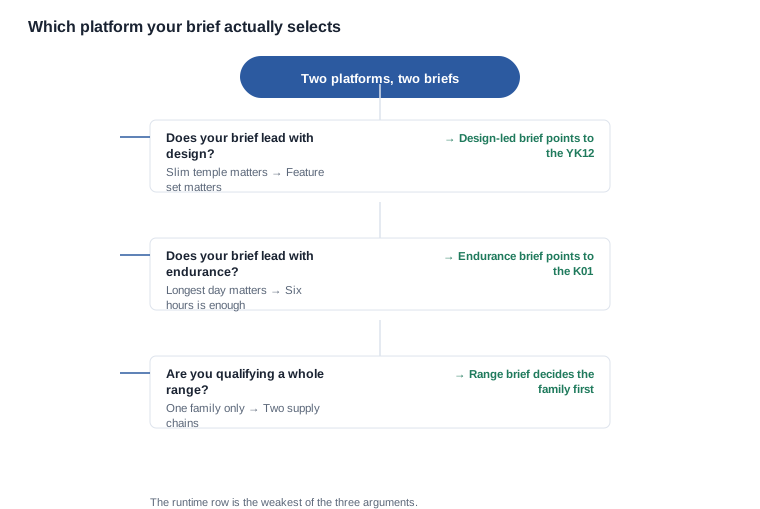
The decision is not a scoring exercise, so run it as a routing question. If your brief leads with design — a lifestyle channel, a style-led brand, a listing where the photograph carries the argument — then the YK12's named temple is the only row in the comparison that serves it, and you should qualify that model on that basis while treating the runtime row as unproven. If your brief leads with endurance, the K01 carries the larger cell and the longer rating and serves that brief better, conditional on the translation capability having been included in the measurement.
If you are qualifying a whole range rather than a single SKU, the question is different again and comes earlier. The YK12 sits on the 55 mAh twin-cell family with the LC-105 pair and the G07. The K01 sits on the 90 mAh twin-cell family with the K02. Both are customisable platforms and both carry the seven documented axes at family level — logo, colour, packaging, temple shape, system and UI, Bluetooth name and firmware. The model readiness overview maps where that structure holds, and the customisation path for this platform covers how to use it.
A brand that qualifies the K-series holds a platform with a 90 mAh configuration. A brand that qualifies the 55 mAh family holds a platform that is lighter to ship. Those are two different supply chains with two different tooling positions, two different accessory sets and two different certification scopes, and the range decision follows from which one your business is built on rather than from which model wins a single specification row.
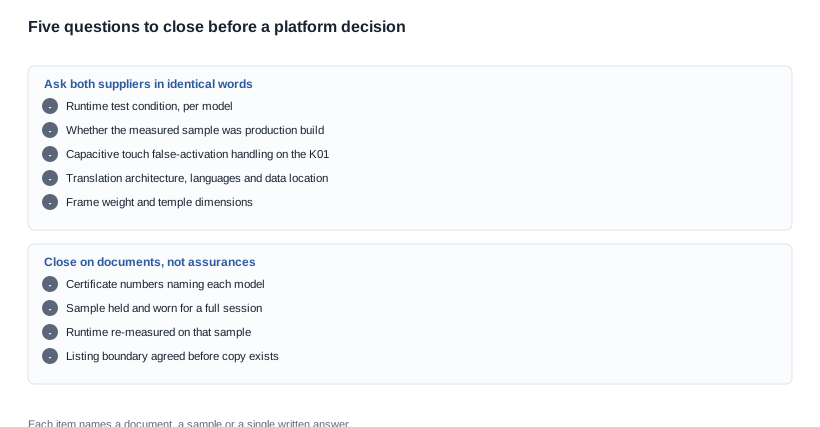
The most reliable version of this method treats identical rows as excluded rather than as points scored for both:
- Write both models on the same page, one column each. A comparison held in the head drifts toward whichever model is being advocated.
- Mark the identical rows and refuse to score them. Four of the comparable rows here carry no information.
- Attach a condition to the runtime row or set it aside. A two-hour gap with no method behind it is a claim, not a comparison.
- Ask the runtime question in identical words, in the same message to both suppliers. A condition asked of one model only produces a comparison that cannot be defended in a contract.
- Decide from the claim that survives — design, control behaviour, or which family the range is built on — rather than from the row with the larger number.
- Record what will not go on the listing before the copy exists. The boundary is much cheaper to set in advance than to correct after publication.

The commercial consequence of getting this wrong is asymmetric. Choosing the K01 on the strength of eight hours, then shipping a product whose translation capability was not active during that measurement, produces returns and a listing correction that is expensive to unwind. Choosing the YK12 on the strength of a temple name, then being unable to answer a question about frame weight, produces a support ticket and a slower sale. The second failure is cheaper, which is a reasonable reason to treat the capacity-led choice as the one that carries the heavier evidence obligation before you commit.
The trade-off worth negotiating is not the unit price. On these two platforms, unit price and volume tiers are quotable and negotiable in the ordinary way, and the accessory set carries its own minimum order quantity. The lines that actually decide the commercial outcome are the sample order cost, the tooling position amortised across the first production run, and the certification scope per model rather than per family. Ask which of those two you are being quoted, because tooling and certification are frequently bundled into one line that hides which is which.
Payment terms and the deposit structure belong in the same conversation as the specification. A pilot order with an inspection milestone before the balance is the mechanism that turns an unproven runtime figure into something you can hold a supplier to. Where the factory accepts it, tying the final payment node to a passed quality control inspection is the cheapest form of due diligence available to a first-time buyer in this category.
Lead time belongs on the same page as the feature decision. A design-led platform that arrives late is a missed season, and the lead time quoted for the first production run is often longer than the one quoted for a repeat order because tooling and firmware work sit at the front of it. Ask for the lead time of the sample order and of the first bulk order separately, and ask which part of that schedule is owned by the factory and which by the forwarder. A feature-led choice with a long lead time carries a different risk from a design-led choice with a short one, and the risk does not show up in either specification.
Warranty terms are a specification row too, and neither model publishes one. A two-year warranty with a stated response time and a defined replacement process is worth more to a channel than a marginal difference in cell capacity, because it determines what happens to a unit that fails in month seven. Ask for the warranty period, the response time, the replacement basis and whether the deposit or the balance is credited on a warranty claim. If the answer is a general policy statement rather than a figure attached to these two models, put the figure in the purchase order before you commit.
What we will and will not claim
This comparison is a choice between a design-led product and a feature-led product, and presenting them as two options of the same thing would misrepresent both. We will not present the 8-hour figure as buying more than 6 hours without the test conditions. We will not present the slim temple as a quantified advantage, because no dimension or weight is published for it. We will not quote a weight for either model, and we will not estimate one. And we will not attach a language count, an accuracy figure or an offline capability to the translation claim, because none has been provided to us in any document.
The published YK12 specification list and the published K01 specification list are the honest baselines, and bluetooth audio glasses which model to pick covers the choice across the wider range rather than between two models.
Five questions to close before you commit
- The endurance test condition for each, asked in identical words — volume, codec, distance, sample size, mean or best case.
- Whether the K01's eight hours was measured with the translation capability active.
- The capacitive touch behaviour on the K01, including false activation and whether it can be disabled.
- Frame weight and temple dimensions for each, measured on a sample order and recorded with the cells fitted.
- The certification position for each model in each destination market, with documents that name the model.
Put those five answers into the purchase order rather than into an email thread. A figure without its condition, a capability without its architecture, and a weight without a measurement are the three things that reopen this decision three months after shipment, and each of them is cheap to close now and expensive to close late.
Related reading
- The published rows for the YK12 — YK12 smart glasses specifications and features
- The published rows for the K01 — K01 smart glasses buyer review checklist
- The sibling comparison on capacity — YK12 vs K02 which one to choose
Send us the application, the customer and the volume, and we will tell you whether a design-led or a feature-led platform fits your brief.


