
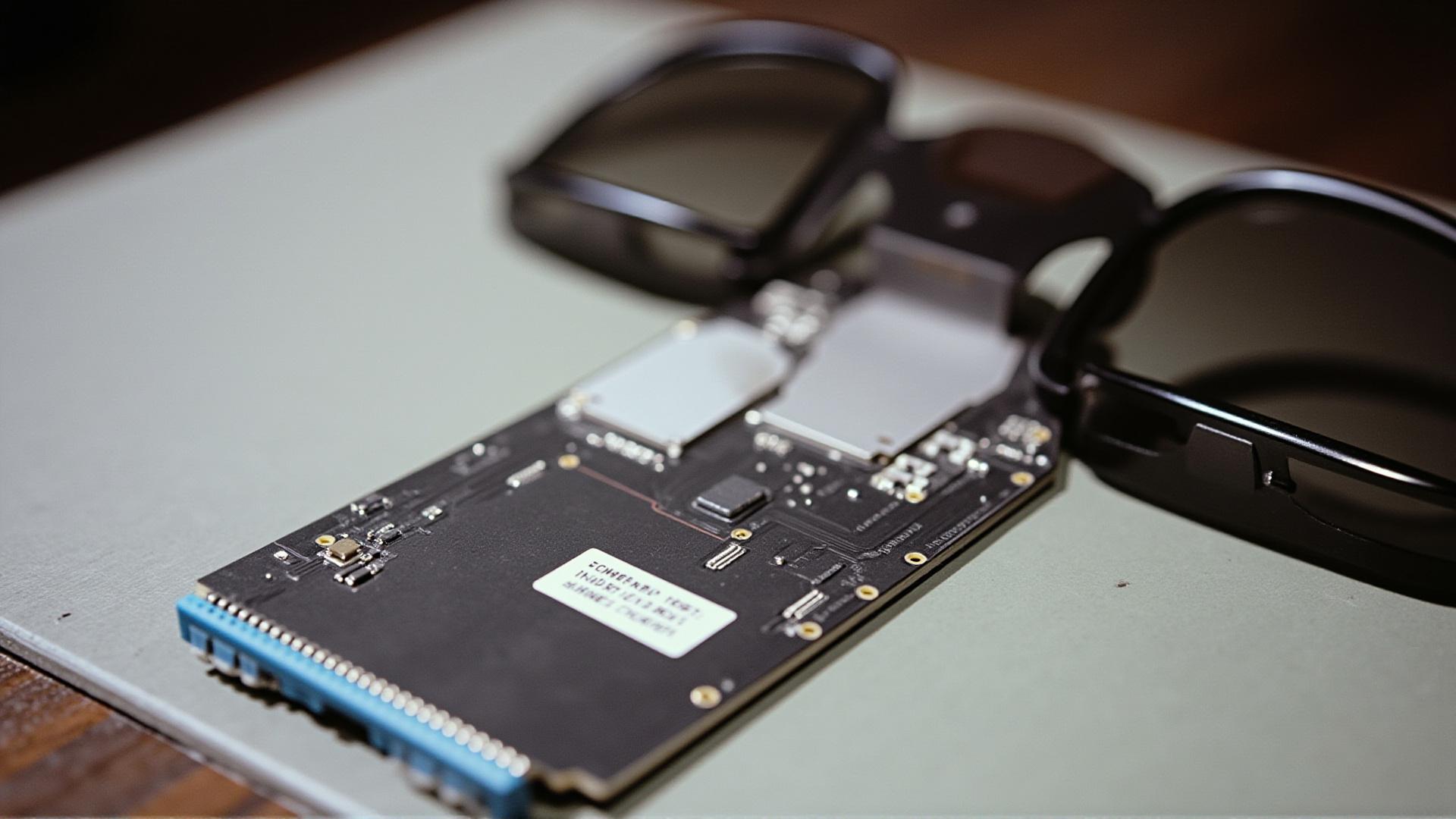
The A06 publishes a 40 mAh battery, charging in two hours or less, roughly 20 hours of rated use, magnetic charging, a lens-based electronic element, and posture and distance detection. That is three usable hardware rows plus two named features. Everything else is absent — including certification scope, frame weight, lens material and Bluetooth version.
So an a06 smart glasses what to check before ordering question is dominated by one issue that sits above the specification sheet. Our documentation records this model and another in the same children's range as carrying identical published rows and the same catalogue product name, with the difference between them recorded as an open item. That is not a detail to note and move past. It is the first question to ask, because it decides whether you are buying one product or two SKUs of the same product.
A06 smart glasses: three published rows and the claim boundary around them
Start with what is settled, because it is a small list and it is reliable. The battery row, the charge-time row and the runtime row are published and consistent. Charging is magnetic. Charge time is two hours or less. Rated use is roughly twenty hours.
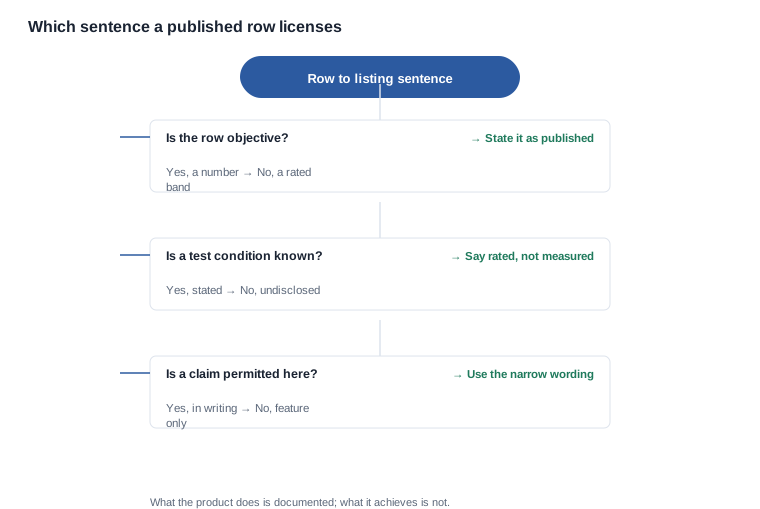
Then the two features, which behave differently and need different treatment. A lens-based electronic element is a component description. Posture and distance detection with a reminder function is a behaviour description. Both are published as features; neither is published as a claim, and the difference between them is the whole of the claim boundary.
The claim boundary in one sentence: what the product does is documented, and what it achieves for the user is not. Our documentation names a component and a sensing behaviour. It does not publish an outcome, an efficacy figure, a test report or a study, and we are not going to write one. For a children's product, where the audience for any claim is a parent and the regulatory expectations are higher than for an adult device, that boundary is not a marketing limitation to be worked around — it is the edge of what can honestly be said.
Practical consequence. Your listing can state what the product is and what it senses. It cannot state what the sensing produces for the child unless the supplier's own documentation permits that sentence, and the permission has to come with the market it applies to. Ask for it in writing, per destination market, and record it beside the feature name.
Two rows that are routinely mis-stated, and the corrected form of each.
- "Twenty-hour battery" — the published row is a rated figure. Write it as a rated value and state that it is rated. A listing that converts a rating into a capability is making a claim the documentation does not support, and it is the single most common form of this error.
- "Bluetooth connectivity" — no Bluetooth version is published for this model. Do not write a version, and do not write "Bluetooth 5" as a family inference from a sibling model. Ask for the version, or leave it out.
And one row that is published but has a scope question attached. Magnetic charging is published. Whether a cable is supplied in the box is not published, and for a children's product the answer changes what goes in the packaging and what the customer is told to expect.
The three rows, stated as claims. Cell capacity, charge time and charging method are objective and can be reproduced from a specification line. Runtime is a rated figure and cannot be reproduced without the test condition, which our documentation does not publish. So a listing may write "approximately twenty hours rated use" as a rated value, and should not write "twenty hours of use" as though it were a measured capability.
Why the rated-versus-measured distinction matters commercially rather than academically. A rated figure is a number the supplier stands behind under a stated condition. A measured figure is a number somebody recorded from a particular unit under particular circumstances. When a listing collapses the distinction, the buyer inherits a claim they cannot defend — and in a children's product the buyer is a parent, not a procurement manager, which means a complaint arrives as a refund request rather than as a claim.
The consequence for your own file. Write the figure and the condition in the same line. If the condition is not published, write that it is not published. A technical file that says "rated, condition not published" is defensible in a way that a file saying only "20 hours" is not, and the difference costs one sentence to write.

The identity question, and why it comes first
The first question to ask a supplier about this model is not about the battery.
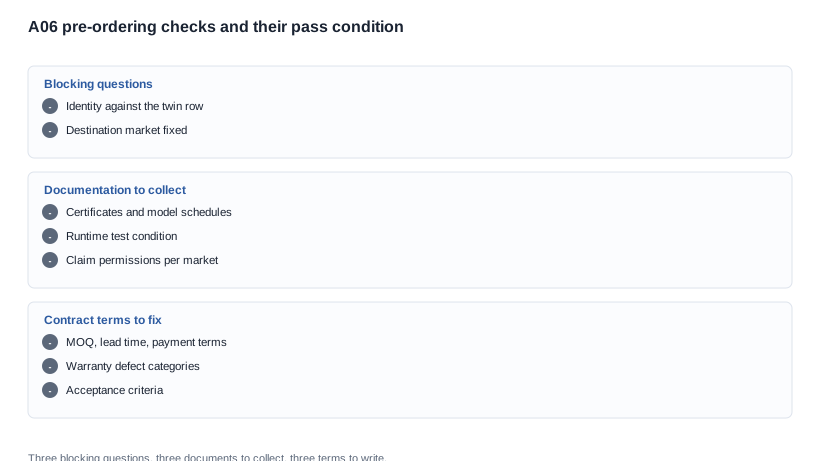
Our documentation records the A06 and one other model in the children's range as publishing the same specification rows and carrying the same catalogue product name, with the difference between them recorded as an open item. Until that is resolved, a buyer cannot tell from documentation which of the two has been quoted, cannot build a listing that distinguishes them, and cannot write a tender response that names a specific product.
Three answers, three different consequences.
- The two are one product. Then the range decision is a branding and volume decision. Negotiate MOQ and price across both, plan one packaging system, and be honest internally about what the second SKU is for — a market, a customer segment or a price point.
- The two differ in certification scope. Then the compliance question becomes the ordering question, because the model you can legally list depends on which documents cover it, and the two may not be interchangeable in the same market.
- The two differ in bill of materials. Then the identical rows are a coincidence of documentation, and you need the rows that actually differ, which our published comparison does not contain.
The question to ask, precisely. What distinguishes these two products today, in writing? Show me where it is written. If the answer is a conversation rather than a document, treat the difference as unverified — not because the supplier is being evasive, but because a difference with no document behind it can be withdrawn at the second order, and a range built on it will fail quietly.
There is a fourth possibility worth naming, because it is the one that surprises people. The two models may have been documented at different times, with one row simply never revisited after the other was added. If that is what happened, the answer will be quick to obtain and entirely non-commercial — and the fix is on your side, in your own file, rather than in the factory. Either way, the resolution belongs in your technical file before the first purchase order, because the next person who reads your documentation will inherit the ambiguity.
A diagnostic question that separates the four answers in one exchange. Is the difference visible on the packaging? If two products ship in identical boxes with identical labelling, they are the same product regardless of what the catalogue says, and that single observation resolves the question faster than any exchange of specification sheets.
And a commercial consequence either way. If you intend to stock both, your packaging, listing copy and channel training have to distinguish them. Two identical product pages lead a customer to the cheaper one, and you lose the more valuable SKU every time. Agreeing the distinguishing mechanism with the supplier before packaging artwork is approved costs nothing; agreeing it afterwards costs a reprint.
Running the claim boundary through a destination market
Because the audience for a children's product claim is a parent, and because markets differ, the boundary has to be tested market by market rather than answered once.
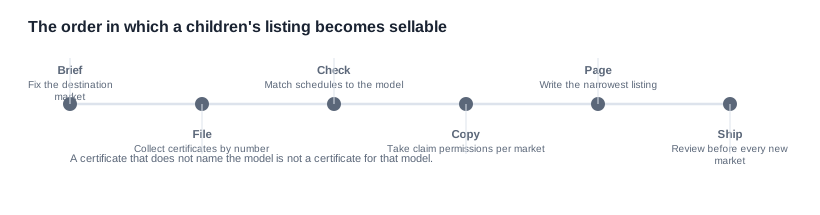
The sequence, in the order it actually binds you.
- Fix the destination market before anything else. Certificate coverage, labelling language, claim wording and packaging all follow from it, and a buyer who chooses the market later has to redo the packaging and the listing.
- Collect the certificates by number, with issuing body and validity period. Our documentation publishes no certificate number, issuing body or validity period for this model, and we will not imply that they exist.
- Check each certificate's model schedule against the model you have been quoted. This is the step that catches the identity problem, because two models with identical rows may sit inside different schedules.
- Collect the claim permissions, per market: what the supplier's own documentation permits to be said about the lens element and about the sensing behaviour.
- Only then write the listing, using the narrowest wording the documents support.
Why the model schedule check deserves its own line. A certificate can be genuine, current and cover the right standard and still be useless to you if its schedule does not name the product being imported. Ask for the schedule itself rather than a statement of coverage. In a range where two models publish the same rows, that single check is what tells you which document belongs to which product.
And one question that is cheap to ask and expensive to skip. Are any claims about the two features restricted in any market you intend to ship to? A feature description that is fine in one market and restricted in another means your listing has to be split by market — a packaging and content decision made at the wrong stage if you find it out at the port.
Our certification checklist sets out the file structure, the family position is in A06 certification status, and the child product compliance page explains why the children's question is a separate one rather than a stricter version of the same one.
A note on how the destination market changes the physical product, not just the paperwork. Labelling language, instructions, warning text and sometimes the packaging configuration all vary by market, and a children's product is more exposed to this than an adult one because the packaging carries the instructions. A buyer who fixes the market late will discover that the box has to be reprinted, and a reprinted box is a retooling conversation with the supplier at exactly the point where the schedule is least flexible. This is why the market question sits first in the sequence above rather than fourth.

Terms to fix in the contract, not in the quotation
The commercial terms are where a first order in this category is most often left vague, and where the vagueness costs the most at the second one.
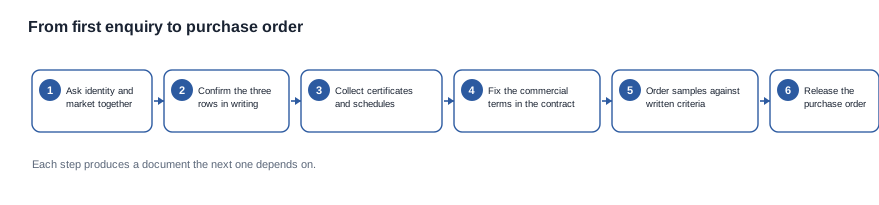
Six terms, and what "written" means for each.
- MOQ. Not published for this model. Ask whether it is a stock quantity or a production quantity, and ask per configuration if colours or sizes exist. The MOQ page covers the distinction.
- Lead time. Not published. Ask what it is measured from — deposit, artwork approval, sample confirmation or order entry — because two suppliers quoting the same number from different starting points are quoting different products. See lead time.
- Unit price and packaging. Not published. Ask for the total cost at your actual volume including packaging, since the box is often a larger share of a children's product's cost than of an adult one. See pricing.
- Payment terms and deposit. Not published. Ask what changes on the second order, because a supplier who offers identical terms on a repeat order has not priced your risk. See payment terms.
- Warranty and defect categories. Not published. Ask which failures count as warranty returns and what the remedy is, because a supplier who will not name a remedy has declined the claim in advance.
- Acceptance criteria. Ask what the goods are measured against when they arrive, and put it in the contract rather than in an email thread. See contract terms.
Two more that belong in the same conversation. Frame weight, temple length, lens dimensions and lens material are not published for this model, and a children's frame that is correct for one age band is wrong for the next. Ask whether sizes exist as separate SKUs or as one adjustable unit, and ask what the warranty position is on a unit the child has outgrown — it is a real question and it gets asked after the shipment rather than before it.
And one about the lens element specifically. Ask whether the lens-based electronic element is consumable, replaceable or permanent, and whether it has a stated service life. A removable element with a service life is a recurring revenue line and an after-sales obligation; a permanent one is neither, and the two positions require different packaging, different spare part planning and different warranty language. Our documentation names the element and does not describe its service position, so this is a question rather than a row.
A third, in the same family of physical unknowns. Ask for the ingress position for this model and where the supporting report is. The sport family's marking is published on other models in our catalogue; on a children's product, what a marking covers and under what conditions is a question to ask before the word is used at all. See IP ratings.
And one about the battery that costs nothing to ask. What is the shipping and transport position for the cell, in the markets you intend to ship to? It is not on the specification row, it is not optional, and it belongs in the compliance conversation rather than the product conversation. See battery transport.
And one about supply. What is the lead time to replace this platform if it is discontinued, not merely to reorder it? A children's product that has been listed in a retail channel and then cannot be reordered is a range-ending event, and the answer costs one email to obtain.
A short verification sequence before the deposit
If you have one working day rather than one working week, this is the order we would use.
- Ask the identity question and the market question in the same message. They are the two that block everything else, and asking them together prevents a two-week exchange of clarification.
- Ask for the three published rows confirmed in writing, including the test condition behind the runtime figure. A confirmed row with a stated condition is worth more than a third row nobody can evidence.
- Ask for the certificates and the model schedules, and check them against the quoted model yourself.
- Ask for the claim permissions per destination market, in the narrowest form: what may be written, not what may be implied.
- Ask for the physical parameters and the commercial terms in one document, so that the answers are comparable and the gaps are visible as gaps.
- Order samples against written acceptance criteria, and hold the purchase order until the sample has been measured.
What a good answer looks like. A supplier who replies with a specification sheet, a certificate list with numbers, a statement of the runtime test condition and a clear answer on the identity question is doing due diligence with you. A supplier who replies with a brochure has answered none of it, however attractive the product page looks.
And how to read the answers when they arrive, because the shape of a reply tells you as much as its content.
- A reply that separates "published" from "not published" is a reply from someone who understands which claims they can defend. That is the supplier you want, even if some answers are unwelcome.
- A reply that fills every gap with a confident number is more dangerous than a reply that admits a gap. Ask what test each number came from, and expect some of them not to survive a second round.
- A reply that answers the identity question with a feature difference belongs to a different context than the one you asked about. Ask which row of their documentation supports it.
The recording habit that makes all of this work. Keep one file per model. Every published row, every supplier answer, every certificate number and every gap goes in it, with a date and a source. When the second order arrives — or when a customer question arrives, whichever comes first — the file is the difference between a five-minute answer and a two-week search.
A final note on how to evaluate a shortlist that contains this model. If you are comparing two suppliers who both offer a model in this category, the criteria that separate them are not the specification rows, because the rows will be close or identical. The criteria are the completeness of the compliance file, the willingness to state a test condition, the clarity of the acceptance criteria and the answer to the identity question. How to evaluate those four is worth more than any number on a comparison chart, and it is the only part of the evaluation you fully control.
Our position on this model is narrow and we will not widen it for a sale. The three published rows are usable as written. The two named features are documented as behaviours, not as outcomes, and we will not extend them into claims the documentation does not carry. The difference between this model and the one that publishes identical rows is an open item in our own documentation, and we will not resolve it in a sales conversation. Tell us the destination market, the volume and whether you intend to stock one model or two, and we will tell you which of these checks has to be closed before the order and which can follow the first shipment.
Related reading
- The rows and what each licenses — A06 specifications and features
- The identity question in full — A06 compared across the range
- Where the gaps sit — A06 limitations
- The runtime row — A06 battery life


