

The A06 publishes a lens-type electronic fogging element with posture and distance detection, a 40 mAh cell, a charge time of two hours or less, roughly twenty hours of rated use and magnetic charging, and it has no camera row. Its certification position is where a children's product differs from everything else in this range, and the honest position is that our catalogue carries no per-model certification information at all.
That is a precise statement rather than a vague one, and the rest of this article is built on it. Below is what the catalogue does and does not contain, the document set to request from a supplier, the method for reading what comes back, and the claims boundary that applies to a product aimed at children.
The practical consequence is that a06 smart glasses certification status has exactly one answer today, and it is a question rather than a status. Every conformity document that covers the units you import has to arrive in writing, per model, per market, before the order is placed.
A06 certification status: what the catalogue says and what it does not
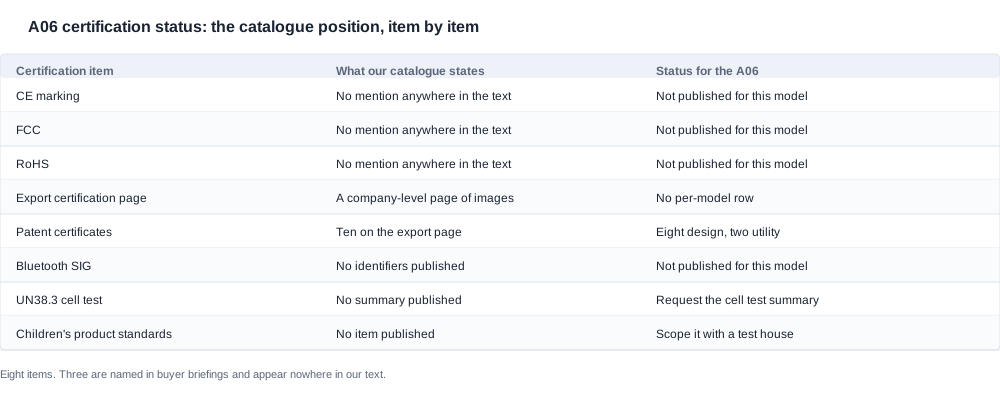
Read the published rows for the A06 and the certification picture is simply not there. The model row gives a cell, a charge ceiling, a rated runtime, a charging method, a lens-type electronic fogging element and two detection functions. It gives no camera row. It gives no radio version row, so there is no published Bluetooth identifier to quote either.
Now read what a buyer's certification question is normally answered against, and the gap becomes concrete. Buyers arrive asking about CE marking, FCC, RoHS, the Bluetooth qualification, the battery transport file and the children's product standards for their destination market. Those are six ordinary questions for a wireless product with a cell in the children's category, and our catalogue text contains no reference to the first three of them at all.
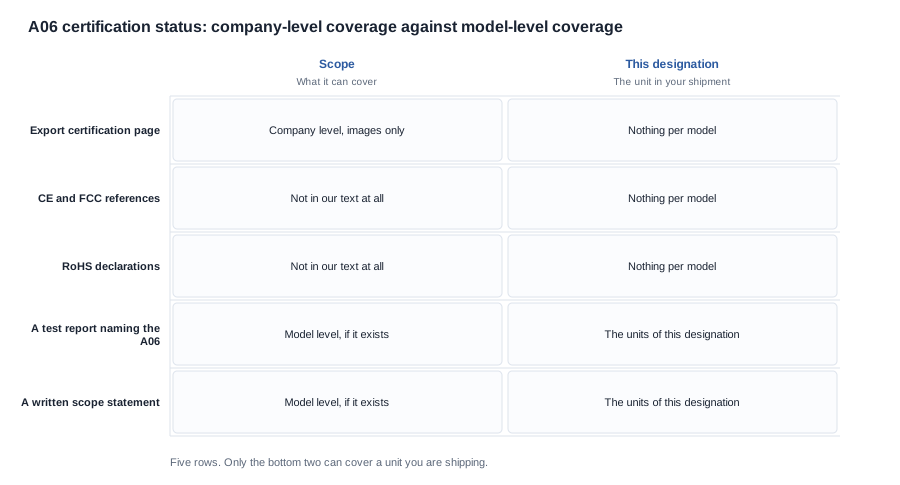
The matrix shows the distinction that causes the most confusion in this category. A company-level document says something about the company. A model-level document says something about the units in your shipment. Only the second kind can be filed against an import, and no document in our catalogue is of that kind for the A06.
So the honest summary for an importer is this: there is no per-model certification row for the A06, our catalogue text contains no CE, FCC or RoHS reference, and the certification scope for this model is something you have to obtain in writing from us before you order. Anything a supplier tells you that is inconsistent with that has to be reconciled in writing, and the A06 buyer review checklist covers how the sample and document work should be sequenced.
The items most often assumed and never established
Three items get treated as settled in this category more often than any others, and it is worth being exact about each.
CE marking. Not published for the A06, and not mentioned anywhere in our catalogue text. If your market requires it, the request goes to us as a model-level item with a scope and a lead time, and the cost of that request belongs in your quotation.
FCC. Same position. A model-level grant reference and test report have to exist for the units you are importing, and a grant issued against a different product or a different radio configuration does not transfer.
RoHS. Same position again. A declaration needs to name the model, with the substance declarations attached.
There is a fourth item that is specific to this tier and cannot be bought as a general file. A product intended for children attracts requirements that adult eyewear does not, the list is market-specific, and nothing about it is published for the A06. It has to be scoped with a test house for the specific market and the specific product type, and the scoping decision has a lead time of its own. The child product compliance guidance sets out how that scoping works.
The export certification page is a company-level page of images
Our catalogue does contain an export certification page, and it is worth describing it accurately rather than paraphrasing it, because the distinction between what it is and what it is not is the whole of this section.
The page is a company-level page. Its content is images rather than extractable text: ten patent certificates, eight appearance-design patents and two utility-model patents. Those are intellectual property registrations, which is a different thing from conformity assessment. A patent certificate says that a design or a mechanism is registered; it does not say that a product has been tested against a market's technical requirements, and it does not name a model.
Three things follow, and each of them changes what a buyer can do with the page.
It cannot be converted into a per-model position. There is no per-model certification row for the A06 anywhere in our catalogue, and there is no wording in the catalogue that claims otherwise. A buyer who has read an export certification page as a company capability and then written "our supplier is certified" into a tender has built a chain of inference that our documentation does not support.
It cannot be cited as conformity evidence. A patent registration is not a test report, a certificate or a grant. If a tender or a marketplace asks for evidence that the A06 meets the requirements of a market, a patent certificate is the wrong document and offering it is worse than offering nothing, because it delays the request.
It does not establish scope. Nothing in that page tells you which models it relates to, which markets it covers, or which configurations it was filed against. Scope has to come from a written statement that names the model you are ordering.
The practical takeaway for an importer is that the export certification page is real and it is not what the certification question is about. Where a supplier, a channel or an internal colleague points at a company-level page as evidence of a product's compliance, the correct response is to ask for the model-level document, not to argue about the company page.
What the patent certificates do legitimately establish
It would be unfair to say the page is useless, and there are two things it does establish that are worth using.
It establishes that the company holds registered rights over design and mechanism work in this category. For a brand that is building a private-label programme rather than distributing our catalogue, that is a relevant due diligence signal about the origin of the design and about whether a competing supplier is likely to be able to copy it. It tells you something about the supplier's position in the chain.
It also establishes that the company-level page is real and is being maintained, which matters when a buyer asks a supplier to produce evidence of anything at all. A supplier with a documented, current company-level page and a clear answer on what is and is not covered at model level is a more reliable counterparty than one with no documentation and no boundaries.
Neither of those uses is a conformity claim, and a buyer who uses the page for either of them should say so in the file rather than let it sit in a folder where somebody later reads it as conformity evidence.
The timing question behind the certification question
One practical point belongs here because it changes how a procurement team sequences the work. Certification is a scheduled activity with a queue at the test laboratory, and the schedule it sits on is the schedule everything else depends on. A buyer who requests the scope in the same week as placing the order has not sequenced the programme; they have added a test-house queue to a date that was already fixed.
The order that works is to start the longest-lead item first, which is the children's product scope, because it depends on the product type and the market rather than on anything the supplier can accelerate. The conformity documents and the radio identifiers come next, because they usually exist for a product already in production. The cell test summary follows, because it exists for any product with a cell. And the age grading and small-parts assessment comes last, because it depends on measurements from the sample stage that cannot start until units arrive.
That sequence is also why the certification question should never be the last thing a buyer asks about. It is the item with the longest lead time, it is the item that cannot be compressed, and it is the item that decides whether the rest of the programme can be scheduled.

The document set to request, item by item
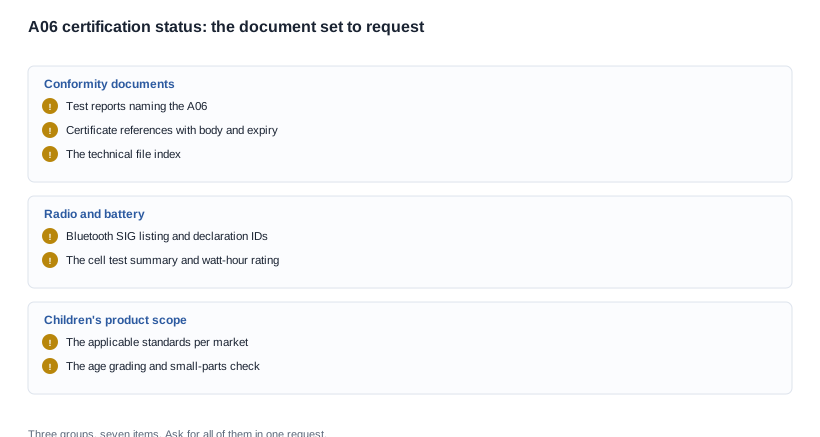
The request is short and specific, and specificity is what makes it answerable. Send it as one list with the model designation in the subject line, and ask for a written confirmation where an item does not exist for this model, because a written "no" is a usable answer and a silence is not.
1. The conformity documents that name the A06. Test reports, certificate or grant references, the issuing body for each, and the expiry date. Ask for the references in the body of the email rather than as attachments, so that your compliance team can check each one independently against the issuing body's register.
2. The technical file index. The index tells you what exists behind the certificate, and it tells you whether the file covers the configuration you are buying or a different one. A technical file for a different variant of the same family is a common and expensive surprise.
3. The Bluetooth qualification identifiers. The A06 publishes no radio version row and therefore no identifiers, so this has to be requested in its raw form: the listing identifier and the declaration identifier. The Bluetooth SIG notes explain what the two identifiers are and why they are quick to verify once you have them.
4. The cell specification and its test summary. The A06 carries a 40 mAh cell, which is small enough that its watt-hour rating determines how it has to be packed and documented for transport. The deliverable is the cell test summary that the UN38.3 documentation refers to, together with the declared watt-hour rating. The battery transport notes set out the chain, and the export considerations for this category cover what travels with the goods.
5. The children's product scope, per market. The applicable standards for each destination market, from a test house, for the specific product type. This is the item with the longest lead time and it is the one that should be started first.
6. The age grading and the small-parts assessment. No recommended age band is published for the A06, and neither are the frame weight and dimensions. The age band drives the warnings, the claims and the marketing copy, and a detachable part sets a floor on it independently of everything else. The age suitability analysis covers the seven items that decide the band.
7. The economic operator details and the traceability arrangements that will appear on the packaging, and the documentation that travels with the shipment.
How to write the request so it gets answered
The list above is the content. The framing is what determines whether it comes back in a week or a month.
Put the model designation in the subject line and repeat it in the first line, because a request that reaches a shared mailbox without a model in it will be read as a general enquiry and answered with a general document. Ask for the items as a numbered list and say that a written confirmation is wanted for anything that does not exist for this model, because that instruction is what turns a partial answer into a usable one. State the destination markets in the same request, because several of the items have a market-specific form and a request without markets produces a document that then has to be re-requested.
Ask for the references in the body of the email rather than as attachments. A PDF is a claim; a reference is a record, and only a record can be checked independently later by your own compliance team or by a broker. This is a small request with a disproportionate effect on how quickly the answer can be verified.
Say what you will do with the answer. One sentence — that the documents will be checked against the issuing body's register and against the model designation — is enough to establish that the request is a due diligence step rather than a box-ticking exercise, and suppliers answer that kind of request better.

How to read the answers, and what to send back
A document set arrives and it has to be read, and the reading method is what separates a filed record from an attachment. Five steps, each with a completion test.
Step one: confirm that every document names the A06. Compare the model string character by character against the string on your order. In a family where two designations publish identical rows, this is the check that catches a substitution, and a mismatch is a stop condition rather than a query.
Step two: check the references against the issuing body's register. Confirm that the reference exists, that it is current, and that the document covers the functions and the radio configuration you are shipping. This step catches more problems than any other single check in the set, and it is the reason the references were requested in the body of the email.
Step three: check the standard against the destination market. A report issued against a different market's standard, or against an earlier version of the standard, does not close the requirement for the market you are shipping into. Where the market's framework has moved, the question is which version applies and whether a re-test is needed.
Step four: check the configuration. The document covers a model; does it cover the configuration you are ordering, with the packaging, the colour and the cell you actually shipped? Configuration mismatch is the failure mode that survives step one and step two and only appears at step three or four.
Step five: file the set with a date and re-check it before every repeat order. Certificates expire, standards move, and a supplier who changes a component does not always reissue the paperwork. A filed record with a date is a control; a folder of documents is not.
When something does not check out, send it back with three questions attached rather than a rejection: which model designation does this document cover, which market and standard does it apply to, and what would be required for it to cover the units we are ordering. That format gets a usable answer far more often than a request for "the right certificate" does, and it keeps the supplier conversation about the document rather than about the relationship.
When the answer is partial
A partial answer is the normal outcome, and how a buyer handles it decides whether the programme moves. Three shapes of partial answer come back, and each has a different remedy.
The document exists but names a different designation. The remedy is a written scope statement from the issuer confirming what the document covers, or a re-issue naming the model you are ordering. This is the item to escalate first, because everything else depends on it.
The document exists but the scope is the wrong market or the wrong version of the standard. The remedy is to establish which version applies to the market you are shipping into and whether the existing document satisfies it. This is a question for a test house rather than for the supplier, and it is the one with a lead time.
The document does not exist for this model at all. The remedy is to price it. Certification cost and certification lead time are not the kind of line that a negotiation moves; they are a fixed cost per model per market and a queue at the laboratory. What a negotiation does move is the schedule around it — the number of markets, the order quantity that amortises the cost, and whether the first order waits for the full scope or ships into a market that does not yet require it.
The last of those three is a legitimate commercial strategy and it is worth putting in writing explicitly rather than leaving to be inferred. Shipping into one market while the scope for a second is being scoped is a normal way to start a programme in this category, and it is only safe if the decision is recorded, because the packaging artwork and the economic operator details both depend on which markets are being entered and when.
The two questions that are not certification items but behave like them
The data question. The A06 carries active sensing hardware, and the published material does not document what the detection produces, whether any of it leaves the device, who operates the application or where anything is stored. That is a data-protection question rather than a product-safety one, but it is handled the same way in practice: a school, a parent and a regulator will all ask it, and the answer has to exist before the product is listed. The privacy considerations piece sets out the questions in full.
The naming question. The A05 and the A06 publish identical specifications, and the catalogue does not state what distinguishes them. A document that names the A05 does not automatically cover the A06, even where the two are electrically identical. If you are importing both, the request has to name both, and the A05 and A06 specification comparison covers the range question in full.
Where the claims boundary sits for a children's product
There is a boundary here that is separate from certification and that a supplier is often more willing to blur. The A06's posture and distance detection is a behaviour prompt. It is not a clinical device, it is not a vision intervention, and we hold no clinical data, no test protocol and no regulatory assessment for this category. A product listing that implies a vision, health or prevention outcome is a regulatory exposure for whoever writes it, which in a brand is usually the procurement team's problem several months later.
The medical boundary guidance sets out where that line sits, and the practical version of it is short: describe the mechanism, not the outcome. A device that senses posture and viewing distance and issues a reminder can be described by those words. It cannot be described by any word that promises what the reminder will achieve.
The same discipline applies to the certification conversation. We will not publish a certificate number we have not seen, we will not state a certification status for the A06 that our documentation does not support, and we will not present CE, FCC and RoHS as verified. What we will do is state precisely what the catalogue does and does not contain, give you the request list above, and check the answers against the model designation and the destination market once they arrive.
That last step is the one buyers most often want help with, and it is the one that costs the supplier time. Send us the destination markets, the age band and the volumes, and we will tell you which of the seven items sit on the critical path for that lane, which of them we can close from documentation today, and which have to go to a test house with a lead time attached.
Related reading
- The category-specific requirements — kids smart glasses safety requirements
- The document that travels with the goods — OEM ready platforms export documentation
- The sample work that has to run in parallel — A06 buyer review checklist
Send us the destination markets, the age band and the volumes, and we will tell you which of the seven items sit on the critical path for that lane.


