
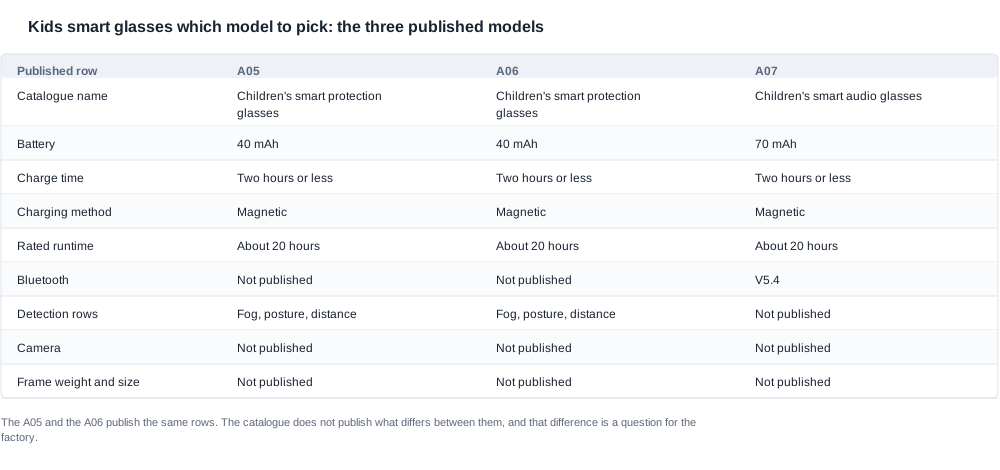
Kids smart glasses which model to pick is a screening question before it is a preference question. Our catalogue carries three children's models: the A05, the A06 and the A07. The A05 and the A06 publish identical rows — a 40 mAh cell, a charge time of two hours or less, magnetic charging, a rated runtime of about twenty hours, and a lens-type electronic fogging unit with posture and distance detection. The A07 publishes a 70 mAh cell, the same charge time, magnetic charging, the same rated runtime, Bluetooth V5.4, and no camera row and no sensing row at all. So the range is two product ideas, not three, and a buyer who starts by comparing three specification sheets is comparing one pair that happens to have two names.
This article is a screening method, not a ranking. We do not publish prices and we are not going to introduce a price tier that does not exist in our material, because the three models do not separate on a value axis — they separate on which rows each one publishes. The method below walks the requirement list against those rows, shows where the screen narrows, and shows the four questions that remain open for every buyer regardless of which branch the screen takes.
Kids smart glasses: the published rows that split this category into two products
The first thing a screening exercise needs is a map of what exists. In this category the map is unusually short, which is a help rather than a hindrance: three models, two product ideas, and one branch point that has to be resolved before anything else can be decided.
| Published row | A05 | A06 | A07 |
|---|---|---|---|
| Catalogue designation | Children's smart protection glasses | Children's smart protection glasses | Children's smart audio glasses |
| Cell capacity | 40 mAh | 40 mAh | 70 mAh |
| Charge time | Two hours or less | Two hours or less | Two hours or less |
| Charging method | Magnetic | Magnetic | Magnetic |
| Rated runtime | About 20 hours | About 20 hours | About 20 hours |
| Bluetooth version | Not published | Not published | V5.4 |
| Fogging unit row | Published | Published | Not published |
| Posture and distance rows | Published | Published | Not published |
| Camera row | Not published | Not published | Not published |
| Frame dimensions and weight | Not published | Not published | Not published |
| Age band | Not published | Not published | Not published |
| Certification row | Not published | Not published | Not published |
Two rows in that table decide the structure of the category.
The fogging and detection rows appear on two models and not on the third. The A05 and the A06 each list a lens-type electronic fogging unit, correct posture and distance, incorrect posture and distance, lens clarity and lens fogging. The A07 lists none of them. That makes the sensing branch of the screen binary in a useful way: if the product concept depends on a detection state that the child can see, there is exactly one published route, and it carries two model designations that need to be told apart.
The camera row appears on none of the three. In a category where the camera-equipped models attract privacy and safety scrutiny, the absence of a camera on all three children's models is a published fact with commercial value. It is not a claim that no imaging hardware exists anywhere in the product, and it is not a privacy guarantee; it is simply what the catalogue states about these three entries.
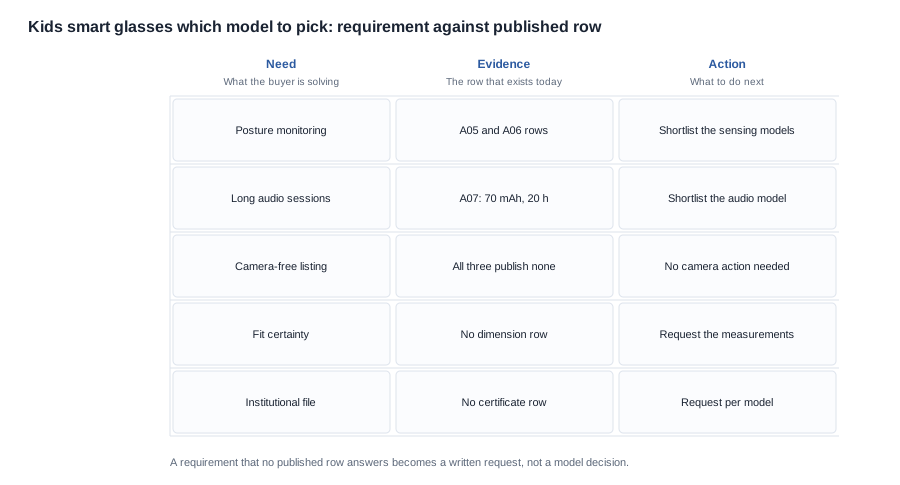
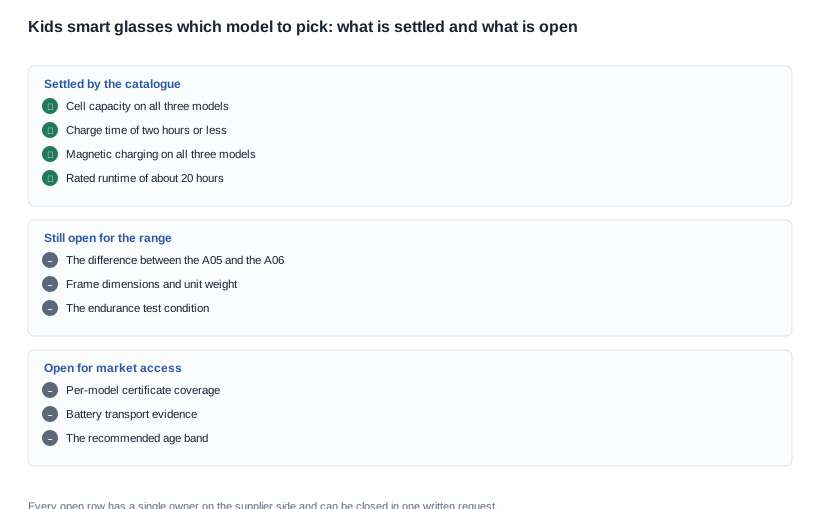
Note also what is absent from all three: the frame dimensions, the unit weight, the recommended age band, the charging case capacity, the endurance test condition and any document naming the model. Those are the six rows that turn a catalogue screen into a supplier request, and they are set out in the closing section of this article.
A screen built on published rows only works if the requirement list is written in the same vocabulary, and that is the practical discipline worth adopting. A brief that says "a comfortable wearable for a nine-year-old who reads for two hours a day" cannot be screened, because neither "comfortable" nor "wearable" maps to a row. A brief that says "a frame whose published width and weight support a stated age band, with a detection state visible to the user and no camera" can be screened against this table in four minutes. The rewrite from the first form to the second is usually most of the work in a sourcing conversation, and it is also the point at which the buyer discovers which rows they actually need and which they had assumed were already settled.

Screening the three models against a requirement list
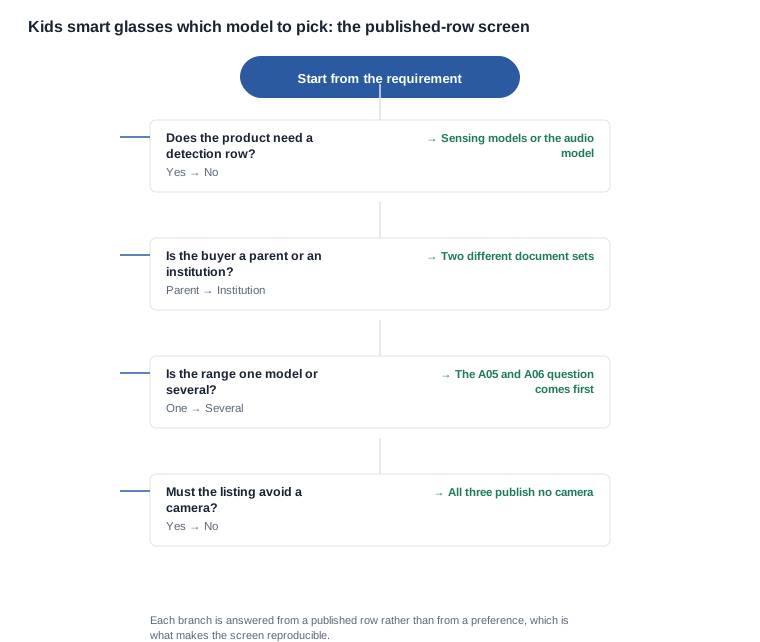
The screen has four branches, and each branch is answered by a published row rather than by an opinion about which product is nicer. That is what makes it reproducible: two people in two companies running the same screen on the same catalogue reach the same place.
Branch one: does the product concept need a detection row? If it does, the A05 and the A06 are the only models in the catalogue that publish one, and the screen narrows to those two. If it does not, the A07 is the only model in this range that publishes Bluetooth, and it publishes no camera row, so the screen narrows to that. Note what the branch does not do: it does not select between the A05 and the A06, and it does not produce a conclusion you can act on alone. It produces a shorter list.
Branch two: is the buyer a parent or an institution? A parent or a retail buyer is solving for whether the device will be used at all. An institution is solving for whether it can be bought, deployed and defended — which is a different set of questions entirely, and the school requirements checklist sets out what an institutional buyer asks for before the technical questions are even reached. The institutional branch has more unresolved rows than the retail branch, and that is a fact about the documentation rather than about the product.
Branch three: is the range one model or several? If it is one model, the branch closes. If it is several, the A05 against the A06 question has to be answered first, because they publish identical rows and a range built on two identical specification sheets is a range built on one product with a duplicated listing. The A06 against A05 specification comparison works through what the possible answers mean for the range.
Branch four: must the listing avoid a camera? On the published rows, all three models pass, which means this branch closes immediately and does not need to be re-run. Recording the branch anyway is worthwhile, because it is the kind of question that gets answered verbally in a meeting and then turns into a listing decision three weeks later.
The sensing branch deserves one extra step that the screen itself does not surface. If the product depends on the posture and distance rows, then the branch has narrowed the list but has not made the product evaluable, because those readings only hold when the frame sits at the correct distance and the correct angle on the face. The fit rows therefore become evaluation criteria rather than comfort preferences, and they have to be requested at the same time as the detection rows, not after the first sample. A buyer who screens on the catalogue and then evaluates the detection on a demo unit that happens to fit an adult is measuring the wrong thing, and will usually reach a conclusion that reverses once the real fit arrives.
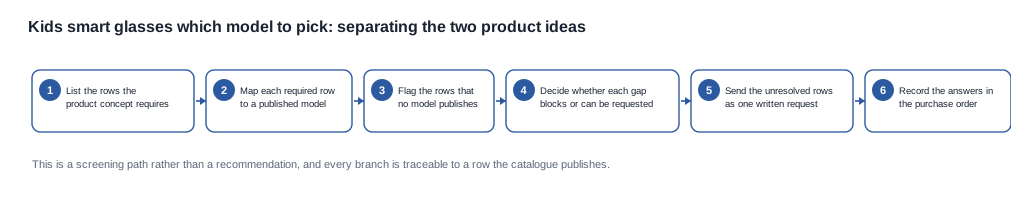
The screen produces a shortlist and a list of open rows. It does not produce a recommendation, and we would rather it did not, because the rows that would justify a recommendation — the weight, the age band, the case capacity, the certificate coverage — are exactly the rows that are not published.
The A05 and the A06 publish identical rows
This is the most consequential gap in the range and it is not a documentation oversight that a buyer can route around. On the published material, the A05 and the A06 are the same product with two designations: same 40 mAh cell, same charge time, same charging method, same rated runtime, same fogging unit, same posture and distance rows, same functional illustrations.
Three commercial consequences follow, and they are worth separating because each one is handled differently.
For a single-model buyer, the question is narrow and cheap to close. One written line — what differs between the A05 and the A06 in writing, including colour, lens, packaging and any regional difference — settles it. Until that line arrives, the buyer does not know whether it is ordering one product twice.
For a multi-model buyer, the range cannot be planned at all. Two identical specification sheets produce two identical listings, two identical comparison pages and a channel that cannot tell the buyer which one to choose. If the only difference is a colour, the range is a colourway range and should be merchandised as one product with options. If the difference is functional, then a functional row is missing from the catalogue and needs to be published before the range is announced.
For a distributor, the answer has to be consistent across territories. A distributor who explains the difference differently in two markets creates a labelling exposure, and a labelling exposure in this category becomes a market access question rather than a sales question.
The published A05 specification list and the published A07 specification list are the honest baselines for the two product ideas, and the A05 against the A07 comparison covers the functional split in detail. What none of them can tell you is what separates the A05 from the A06, and we would rather say that than manufacture a difference that the documentation does not contain.

Institutional buyers and retail buyers ask different first questions
A retail buyer in this category is usually holding three questions, and they are all about adoption: will it be used, will it last the day, and will the battery be a complaint. An institutional buyer is holding a different set: which documents name the model, who operates the application, where any data is stored, what the batch traceability looks like, and what has to travel with the goods when they cross a border.
The second set is larger, and the difference is worth understanding because the product does not change between the two buyers — only the evidence requirement does.
For the sensing models, the data question is the biggest single difference between the two product ideas. The A05 and the A06 publish a detection state that is visible to whoever is using the frame. That raises the questions the privacy considerations piece sets out: what the detection produces, whether any of it leaves the device, who operates the application and where anything is stored. The A07 raises none of them, because it publishes no sensing row. A buyer who has not answered those four questions for the sensing models has not evaluated the product; it has evaluated a specification sheet.
For market access, the documentation position is the same for both buyers and it is thin. No document in our material names the A05, the A06 or the A07. The catalogue carries a company-level export certification page whose content is images rather than text, and the catalogue text contains no reference to CE, FCC or RoHS, so there is no per-model certification row to read, quote or rely on. That is not the same as saying the products are uncertified. It means the evidence is something to request in writing, check against the issuing body's own register, and write into the purchase order. The certification checklist is the request list, and the battery transport evidence is a separate document question that a 40 mAh or 70 mAh lithium cell raises on its own.
For the retail buyer, the adoption questions have no published answers either. The frame dimensions, the unit weight and the recommended age band are all unpublished, and those three rows are exactly the ones that determine whether the device is used. The age suitability analysis covers the seven items that decide an age band, and it is deliberately written as a set of questions rather than as an age table, because publishing an age band against an unpublished weight would be a claim rather than a specification.
The two channels also differ commercially in ways that change how much evidence a buyer needs per unit. A retail buyer amortises one unit across one sale and can absorb a single unresolved row; an institutional buyer amortises the same unresolved row across a deployment, where the cost of a question that surfaces in an audit is paid in the reviewer's time rather than in the unit price. That asymmetry is a good reason for the institutional buyer to insist on the complete request list at the first evaluation, even where several of the rows seem academic to a retail conversation. The OEM ready platforms range covers how the documentation side of that conversation is usually structured on the supply side.

What the shared twenty-hour figure lets you compare and what it hides
The twenty-hour figure appears on all three models, and on two different cell sizes. The A05 and the A06 carry 40 mAh. The A07 carries 70 mAh. All three are rated at about twenty hours.
That is a fair comparison of endurance as published and an unfair comparison of capability, and the distinction matters more than it sounds, because the two architectures reach the same headline by different routes.
The likeliest reading is that the twenty-hour rating is dominated by standby rather than by active use. A device that is largely idle with an occasional prompt draws a very different average current from one that is being used continuously, and the cell difference between 40 mAh and 70 mAh is absorbed by that difference. On that reading the figures are coherent. The alternative reading — that all three run twenty hours of continuous active use — cannot be reconciled with a 40 mAh cell on the sensing models, where the fogging unit and its electronics occupy the internal volume that a larger cell would need.
Either way, the endurance test condition is not published for any of the three, and that is the specific thing to request: what the device was doing during the measurement, whether the radio link was active, and whether the figure came from one unit under several profiles or from several units.
Two further rows are easy to overlook and worth listing because they affect how the figure gets used in a listing. The rated runtime is a rating, so it belongs in a specification table and in a technical datasheet rather than in a marketing claim that a customer will hold you to. And the charge time of two hours or less is a ceiling, which is a different assertion from a claim that it charges in under two hours; the two are not interchangeable, and the published wording is the ceiling.
Both figures also carry a second-order consequence for how a buyer compares quotations. A supplier who quotes a point figure against our range will look like the more precise offer, and a buyer comparing two tables will read that precision as a quality difference. It is not one. A point figure measured once under conditions the supplier has not described is less informative than a range published with the intent of showing that more than one condition was measured, and the only way to tell the two apart is to ask what sits behind each number. Asking that question is cheap; discovering the answer from a returned unit is not.
The four items still open for this category
On this category, our position is that the published rows are enough to separate the two product ideas and not enough to choose between the three models, and we will not manufacture a ranking on top of a set of gaps. The A07 is the simpler product to document and the A05 and the A06 are the more distinctive ones, and which of those matters depends entirely on the buyer — which is the point of a screen rather than a verdict.
We will not present the detection functions as producing any vision, health or prevention outcome, we will not present the twenty hours as an active-use figure, we will not treat the A05 and the A06 as different products until the difference is documented, and we will not state a certification status for this category that our material does not support. The kids smart glasses range page lists all three models with their published rows, and the kids buying guide covers the range-level decision in more depth.
The four questions to close before the model is settled
- What differs between the A05 and the A06, in writing and by specification.
- Where the parent-side function runs for the sensing models, and whether the device works without it.
- Frame weight, frame dimensions and the recommended age band for each model.
- The endurance test condition behind the twenty-hour rating, and the certification position for the model in each destination market.
The one that the who needs the A07 analysis covers in detail is the second, because a detection feature that only functions through a companion application is a different commercial product from one that works standalone, and the difference shows up in the support cost, in the listing copy and in the privacy question rather than in the specification sheet.
Related reading
- The functional split in this category — A05 smart glasses versus A07
- The range-level decision — kids smart glasses buying guide
- The data question on the sensing models — kids smart glasses privacy considerations
Send us the buyer, the age band, the destination markets and the claims your listing needs to make, and we will tell you which published rows apply, which branch the screen takes, and which questions remain open.


