

The A07 and the A05 publish the same endurance figure — about 20 hours — on cells that differ by 30 mAh, and they arrive there by different routes. The A05 is a sensing product with a 40 mAh single cell; the A07 is an audio product with a 70 mAh single cell. Both charge magnetically in two hours or less. Neither publishes a charging-case capacity, a frame weight or the test condition behind its runtime figure. This comparison is therefore a comparison of two duty cycles rather than of two battery specifications, and the practical question for a buyer is not which number is larger but which one you can write on a listing and defend in a distributor's review.
A07 versus A05: what the two published rows settle, and what they do not
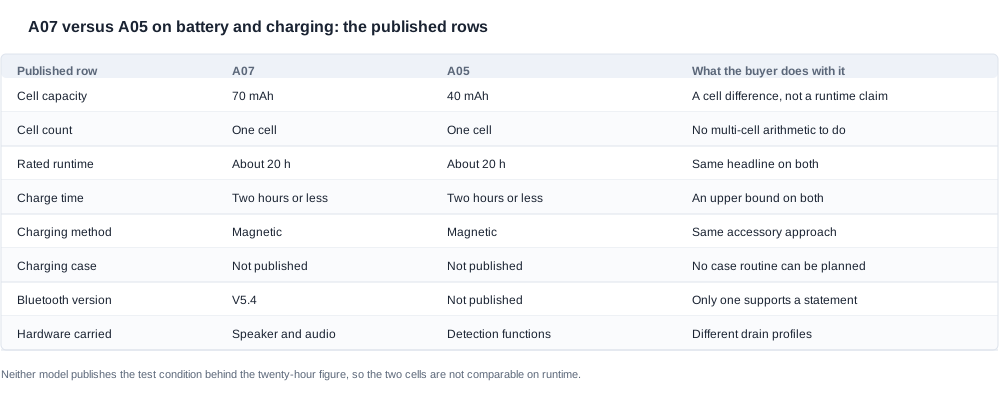
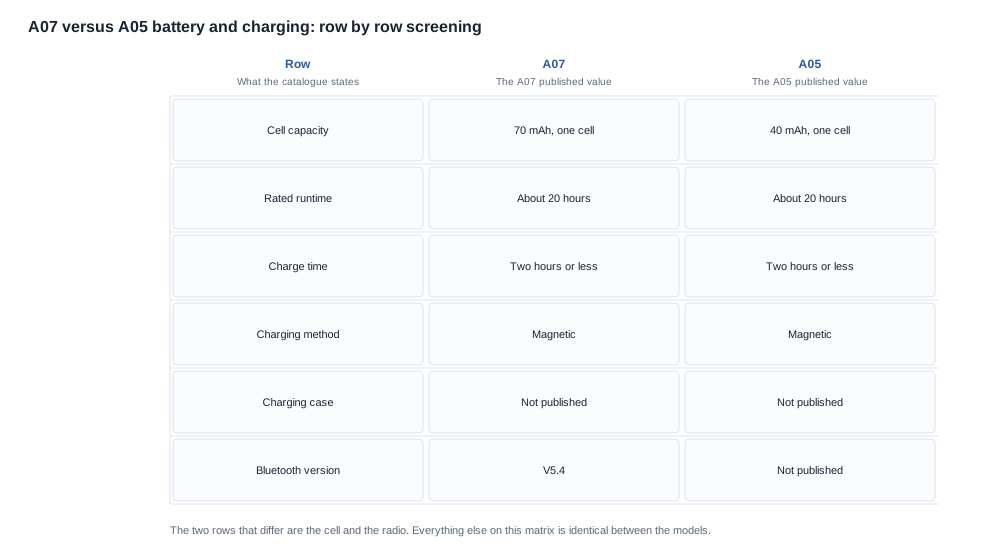
The A07 and the A05 sit in the same family and publish the same structure: one cell, a rated runtime of about 20 hours, a charge time of two hours or less, and magnetic charging. On three of those four rows they are identical. The one row that separates them is the cell, 70 mAh against 40 mAh, and it is the row most often read as a runtime advantage.
Read the cell row as a hardware row. It says how much energy the frame carries. It does not say how long the frame runs, because the catalogue publishes no load, no duty cycle and no test condition behind either figure. Two models that publish the same runtime on different cells are telling you that the work each model does is different, and nothing more. A listing that promises a longer runtime for the larger cell would be a claim the published rows do not support, and it would be a claim a technical buyer can dismantle in one question.
Read the runtime row as a rating. About 20 hours is the highest rated runtime published in this catalogue, and it appears on three models with cells of 40 mAh and 70 mAh. A figure that survives a 30 mAh spread cannot be a capacity ratio, so it describes a platform duty cycle rather than a laboratory measurement of either unit. Nothing in the documentation says whether the radio was connected, whether the audio path was playing, what interval a periodic function ran at, how many units were averaged, or whether the value is a mean or a best case. It is a number the factory is prepared to stand behind, and not much more than that.
Read the charge row as a ceiling. Two hours or less is an upper bound, not a measured duration and not a typical duration. It is also a bound with no stated start and no stated end: the documentation does not say whether the measurement starts from an empty cell or a partly discharged one, and it does not say what "complete" means in the sense of a termination criterion. That makes the figure usable for planning a recharge window and unusable for computing how many units a shift supervisor can rotate through a charging tray.
Read the missing rows as missing, not as zero. Neither model publishes a charging-case capacity, so neither programme can plan a case-based rotation. Neither publishes a frame weight, so the accessory and packaging decisions have to wait for a sample. Neither publishes a Bluetooth version for the A05, so the comparison stops at the power rows for that model and has to be completed in writing.
The accessory decision is a range decision, not a model decision
Charging accessories are usually bought per model. In this category they should be bought per charging method, because the method, not the model, is what determines the physical accessory and the packing instruction.
Where two models share a charging method, the accessory consolidates. The A07 and the A05 both charge magnetically. That means one pad specification, one cable specification, one spare-parts line and one packing instruction can serve both, and the accessory cost per unit falls as the family grows. It also means a defect in the accessory is a defect across the whole family, which changes how the quality plan should treat it: the accessory needs its own incoming inspection rather than being assumed sound because the frame passed.
Where a charging method differs, the accessory multiplies. A model charging over Type-C needs a cable and a port; a model charging magnetically needs a pad. A range that mixes the two carries two accessory lines, two packing sequences and two replenishment paths, and the carton design has to accommodate whichever combination each SKU uses. Nothing in the catalogue tells you how that will be priced, but the structure of the decision is yours to make before the artwork is drawn.
The accessory is also a parcel variable. A magnetic pad plus its cable occupies carton volume and adds packed weight; a case adds considerably more of both, and adds a second lithium cell with its own transport documentation. If the programme intends a case-based routine, the case decision belongs in the same conversation as the charging-method decision rather than after it, because the case changes the parcel profile that the freight quote is built on.
One caution about the same-method assumption. The published charging method describes the model row. It does not describe what is supplied in the carton. A buyer who assumes the magnetic pad ships in the box has assumed a packing decision that the catalogue does not publish. Ask for the packing list per model, and treat it as a separate question from the charging method, because the two are decided by different people in most factories.

Why 70 mAh and 40 mAh reach the same twenty hours
The two figures describe two different products, and the more useful reading is not about which is better but about what each model spends its energy on.
A sensing product spends its life asleep. The A05 carries a lens-type electronic fogging element and posture and viewing-distance detection. The pattern implied by those functions is a device that is on the head and largely idle, waking periodically to sample a distance or posture condition and signalling a change, then returning to a low-power state. That duty cycle draws a very different current profile from one that is decoding and amplifying audio. The 40 mAh cell on the A05 is small, and the twenty-hour rating is reached on it because the device spends most of its rated life in a low-draw state.
An audio product has a larger cell because it has a larger job. The A07 carries a speaker, an amplifier, a microphone and a Bluetooth V5.4 radio. Even where no audio is playing, the radio maintains a connection and the audio path sits ready to drive output. The 70 mAh cell is what covers that load across the same rated period. The extra capacity is doing the work of a heavier duty cycle, not delivering a longer day.
Neither result is better than the other, and the comparison is not a trade-off. This is the point buyers most often get wrong. A buyer who assumes the 30 mAh step is headroom for a longer day has misread the published rows in two ways: the published runtime is identical, so there is nothing to lengthen, and the cell is consumed by a heavier load, so the headroom is consumed as well. The A07 has more energy per unit of frame volume. It does not have more time.
What the larger cell genuinely buys is tolerance of a heavier workload than the rating assumes. If a programme's real usage pattern is more demanding than the condition behind the published rating — longer continuous audio, a constantly connected radio, more frequent operation — then extra cell capacity is genuine engineering margin against an early stop. The margin is invisible on a listing and visible in the return rate. That is a legitimate reason to prefer one cell over another, and it has to be argued from the duty cycle you can describe, not from the mAh number on the sheet.
One consequence is worth flagging for the channel. Two models in a family that publish the same headline runtime but different cells are two SKUs that a customer cannot distinguish from the specification. If they sit on the same shelf or the same listing page, the differentiating argument has to be a feature, a battery technology, an accessory or a price position. None of those is published for these two models, so the argument has to be built. The published specification list for the A05 and the published specification list for the A07 are the honest baselines for that build.
The charging side and the routine it creates
Both models charge magnetically, with a charge time of two hours or less, and neither publishes a charging-case capacity. On paper that looks like a shared accessory strategy. In practice it is a shared strategy with an open variable, and the variable is what the programme has to solve.
Magnetic charging creates an accessory obligation. A magnetically charging product does not charge from a standard cable into a standard port. Someone has to supply the pad, the cable and the connector arrangement, and the volume of that accessory has to be planned alongside the product, because it consumes carton volume, adds packed weight and adds a second item to the packing line. Two models with the same charging method share one accessory decision, which is a genuine advantage when you are building a range. One model charging over Type-C and another charging magnetically means two accessory lines, two packing instructions and two replenishment paths.
The absence of a published case capacity is a routine problem, not a specification problem. A case in this category is not only a charger; it is a second lithium cell, a second item to ship, a second set of transport documentation and a different parcel profile. If a programme intends to sell the product in a case, then the routine is that a case sits in a school bag and charges while nobody is thinking about it. If the programme does not sell a case, then the routine is that a device goes back to a base at the end of the day and is charged overnight. Those two routines have very different operational and freight consequences, and the catalogue does not tell you which one applies, because no charging-case row is published for either model.
The charge ceiling does not tell you how many units a charging tray can turn around. This is the practical limit of a published upper bound. To plan a rotation you need the time from empty to the point at which you would put the unit back into service, and you need to know what state that point corresponds to. Neither is published. The honest approach is to treat the ceiling as the worst case for a full charge and to ask the supplier for one more number: the typical duration from a stated start state to a stated end state, measured on production units.

Plan the routine before you plan the stock. A programme that discovers its recharge pattern after the first production run has already committed to packaging, carton dimensions, accessory quantities and the spare-parts policy that goes with it. Writing the duty cycle down, and then asking two suppliers whether the published rating holds under it, costs a week and saves a production cycle.

Asking both suppliers the same endurance question
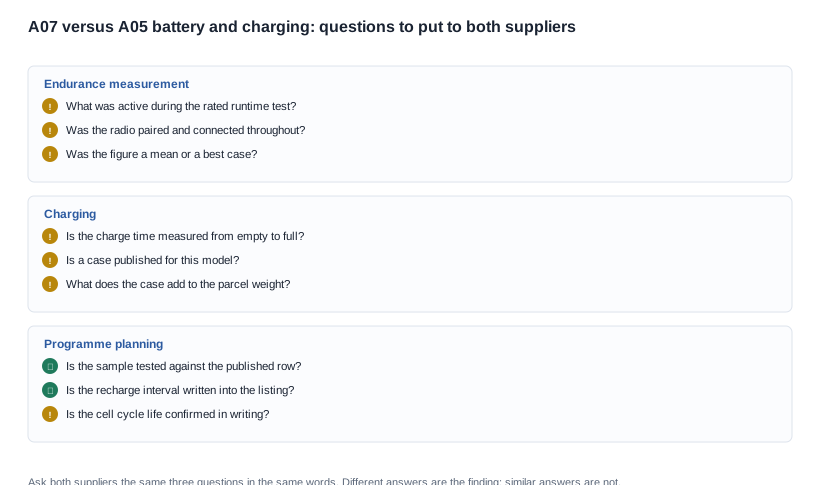
The single most useful thing a buyer can do with these two models is put an identical question to every supplier, because the catalogue's twenty-hour figure is a rating whose condition is unknown. If two suppliers describe the same test, the figure is portable. If they describe different tests, the figure is a marketing number on one and a measurement on the other, and the listing has to reflect that difference.
The questions to put, in the same wording to every supplier
- What was active during the runtime test on this model, and what was idle?
- Was the radio paired and connected throughout the test period, and was audio playing?
- At what interval did any periodic function operate during the test?
- How many units were measured, were the cells new or cycled, and was the published figure a mean or a best case?
- What was the starting state of the cell when the charge time was measured, and what termination criterion was used?
- Is a charging case available for this model, and what is its published capacity?
- What is the frame weight with the cell fitted, and what are the frame dimensions for the production revision?
- Which model numbers appear on the certification file for our destination market?
How to read the answers. Questions one to four are the endurance condition. A supplier that answers them precisely has a measurement behind its number, and that number is safe to quote as a manufacturer rating. A supplier that answers them vaguely has a number and not a measurement, and the listing should describe it as a published rating and carry no endurance promise. Questions five and six determine whether the recharge routine you have planned is the routine the product can actually deliver. Questions seven and eight determine whether the programme can proceed at all.
Where the answers go in the file. Keep the answers with the model number they relate to, because in a family where two models publish identical rows, a general answer is worth very little. Put the confirmed figures into the purchase specification before the sample is approved, not after. A specification that carries a rating with its condition attached is a specification a quality inspector can use; a specification that carries only the rating is a number nobody can check.
One caution about the twenty-hour figure on a retail listing. A rated runtime is a laboratory statement about a duty cycle, and a customer reads it as a working-day statement about their own use. The safe wording names the model and labels the figure as a manufacturer rating; the unsafe wording turns it into a promise. The comparison method for runtime figures sets out the wording discipline, and the A06 endurance analysis covers the sensing architecture in the same family from the other side.
What a distributor's review file needs from this comparison
Distributor due diligence does not ask whether the model is good. It asks whether the claims on the listing can be traced to a document. That distinction decides what has to be in the file.
A rating without its condition is not traceable. If the listing says "about 20 hours", a reviewer asks what that figure was measured under, and the answer has to be a document rather than an assurance. A one-page supplier statement describing the test condition, dated and referencing the model number, is enough for most review processes. A verbal answer is not, because it cannot be attached to the file and it cannot be reproduced by the next reviewer.
Keep the evidence keyed to the model number, not to the family. These two models publish identical rows on four of five published lines. A single family-level statement about the runtime therefore tells a reviewer nothing about either specific model, and the risk is not just a rejected file: it is a claim on one model that has been evidenced by a document about a different model.
Record what was asked as well as what was answered. A reviewer checking a twenty-hour figure will also want to know whether the other published rows were checked. Keeping the request list and the answers together in the file makes that visible without a second round of questions, and it shows a buyer who verified rather than a buyer who accepted.
The negative findings belong in the file too. Where a supplier cannot answer a question — a case capacity, an age band, a certification reference — write that down as unanswered, with the date it was asked. A documented gap is a plan; an undocumented gap is a surprise, and a distributor's reviewer will find it in the sample inspection rather than in your file.
A short worked comparison
Take a hypothetical channel programme that will sell a camera-free children's audio product in volume, with a stated requirement that the device survives a school day plus an evening session without a recharge. The buyer has two candidate models in the same family, one with a 70 mAh cell and one with 40 mAh, both publishing about 20 hours.
The requirement cannot be tested against the published runtime, because the catalogue publishes no test condition and both models publish the same figure. So the requirement is converted into a duty cycle: roughly seven hours of school day with two short active windows, and two hours of evening use with continuous audio. That duty cycle is then put to both suppliers in identical wording.
The answers separate the models, but not in the direction the mAh numbers would suggest. A supplier who describes a test with continuous audio over the whole period reports that the smaller-cell model reaches roughly 20 hours only with intermittent activity, and that under the stated evening session the larger-cell model holds more of its margin. The conclusion a buyer can defend is about margin under a specified load, not about runtime on a listing, and it is only available because the duty cycle was written down before the question was asked.
The generalisable point is small and worth keeping. The published rows will not settle a duty-cycle question, and no amount of careful reading of them will. Writing the load down and asking two suppliers the same question will.
Where the published comparison stops and the commercial one begins
The A07 and the A05 are two different products that happen to publish the same endurance number, and a buyer who reads the comparison table as a tie has read past the only published row that separates them. We will not present the twenty hours as an active-use figure, because no test condition is published. We will not present either cell as producing a longer runtime, because both models publish the same runtime and the larger cell is consumed by a heavier load. We will not quote a weight, a case capacity or a certificate number that the documentation does not contain, and we will not estimate a charge duration more precisely than the published upper bound allows.
What we will do is tell you which rows the catalogue actually settles, which rows are engineering margin rather than a claim, and which questions have to be answered in writing before the two models can be compared on anything beyond hardware. If the comparison your programme needs is a cost comparison, it will be settled by a quotation against a fixed configuration rather than by a specification sheet. If it is a runtime comparison, it will be settled by a sample tested under a duty cycle you describe.
Related reading
- The functional split between the two models — A05 versus A07
- The published rows for the A07 — A07 specifications and features
- The range decision above this pair — kids smart glasses which model to pick
- The charging accessory options for this model — A07 charging options
Send us the buyer, the age band and the duty cycle you expect, and we will tell you which of the two rows you can build on and which has to be tested.


