

These two models are published with the same charge time, the same charging method and the same rated runtime. They differ on two rows: cell capacity, at 70 mAh against 40 mAh, and the radio, which one model publishes as version V5.4 and the other does not publish at all.
That is not enough to choose on, and this article is about the two questions that are. The first is which requirement the programme actually has. The second is whether either model can be listed in the destination market. A buyer who arrives at this comparison with a preference already formed is usually choosing on the cell number, and the cell number does not survive contact with the published rows.
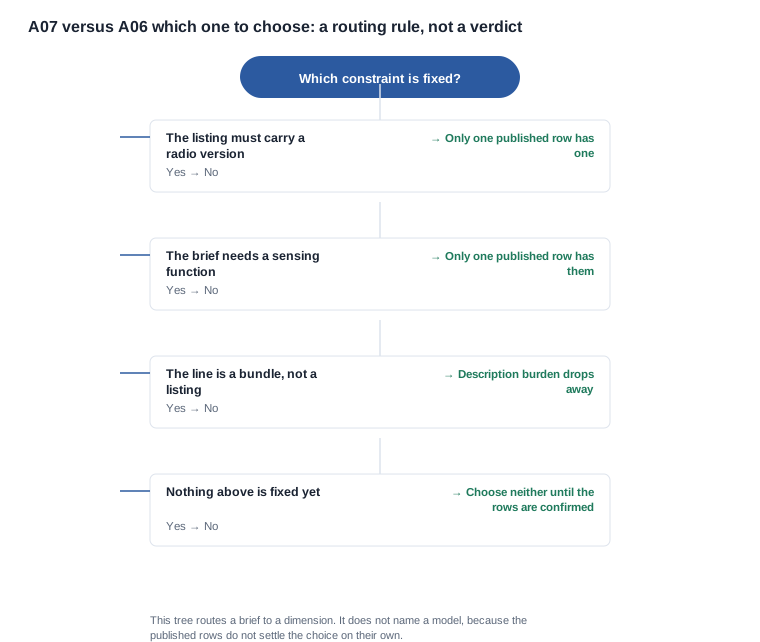
A07 versus A06 which one to choose: a routing rule, not a verdict
The published rows in full. The A07: a 70 mAh cell, a rated runtime of about 20 hours, a charge time of two hours or less, magnetic charging, Bluetooth version V5.4, no camera row and no feature note. The A06: a 40 mAh cell, the same rated runtime, the same charge ceiling, the same charging method, no published radio version, and a lens-type electronic fogging element with posture and viewing-distance indication on its model row.
Why the capacity difference cannot decide anything on paper. Both models publish the same rated runtime, so a buyer cannot tell a customer that one runs longer than the other, because both pages say the same number. Nor can a buyer claim that the larger cell is better engineering: a device that is largely idle, waking periodically to sample a sensor, draws a very different profile from one that keeps a radio connection and drives an amplifier, and the published figures converge precisely because the loads differ. What the 30 mAh gives the programme is tolerance of a heavier workload than the rating assumes. That is real margin, and it is invisible on a listing.
Why the radio row is not a performance row either. A published radio version does not make a better product. It makes a documentable one. With a version published, the compatibility statement, the connection procedure and the support script can be written from a published row today. Without one, all three wait on a supplier, and the programme's launch date inherits somebody else's reply time.
So the decision has two inputs and neither of them is a specification. The first input is the requirement the programme was created for. The second is whether the destination market can accept the product at all. Every route below is built on those two inputs, and every route ends in a question to a supplier rather than in a model name, because that is where the answerable version of this comparison stops.
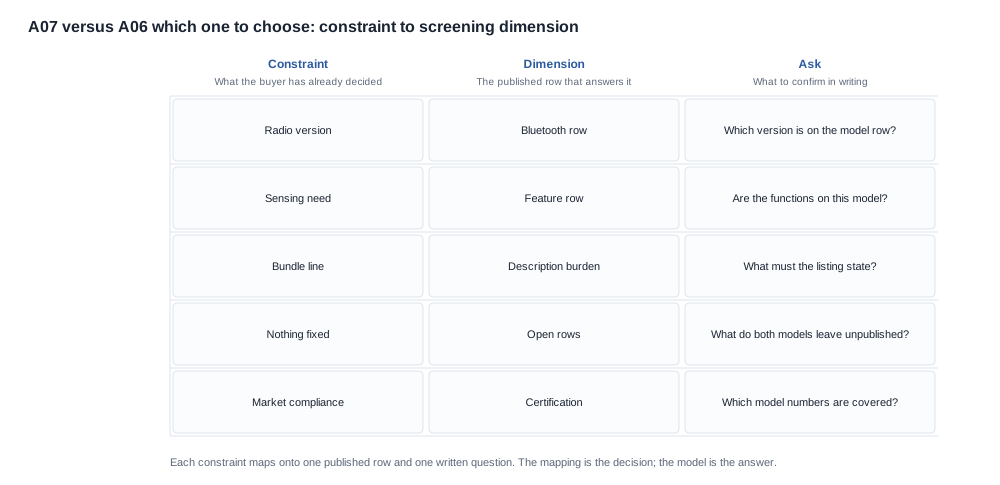

The three routes through this comparison
Route one: the listing has to carry a radio version
This is the route for a programme that will be sold as a product in its own right — a marketplace listing, a channel range page, a shelf, a support script, an instruction leaflet, a compatibility promise.
The constraint. The brief obliges you to produce a compatibility statement and a connection procedure. Both depend on the radio version. Both are published for one model and unpublished for the other.
The dimension to read. The Bluetooth row. One model publishes version V5.4 on its model row; the other publishes no radio version at all. A specification sheet that does not name the version cannot answer the questions a retailer, a channel partner or a parent will ask about connection behaviour, about the companion application, or about what happens when the paired device moves out of range.
The question to ask. Ask for the version fitted to production units, a list of the devices the connection has been verified against, and the written connection procedure as the factory would have a customer read it. If the answer comes back as a version, the documentation work can start immediately. If it comes back as a description of the radio family rather than a version, the programme has learned that the listing cannot yet carry a compatibility statement, and that is a scheduling fact rather than a product flaw.
What this route does not settle. It does not settle the physical rows, the case question or the certification position. Those are common to both models and have to be closed whichever route you take.
Route two: the brief is a bundle line rather than a listing
This is the route for a programme where the product is one line inside a larger set: a giveaway alongside a purchase, a loyalty incentive, a multi-buy offer, a bundle with other products.
The constraint. The brief does not oblige you to produce a full documentation set. The customer is not asking detailed questions about the product because the bundle is sold on something else. Description burden is low and unit cost is the driver.
The dimension to read. The cell row, and only as a bill-of-materials input. A smaller cell is a smaller component, and in a bundle line where the product is not the reason for the purchase, the cost structure matters more than the documentation set. The published runtime reads the same on both models, so the customer-facing claim does not change between them.
The question to ask. Ask for the unit price and the minimum order quantity for each model against one named configuration and one destination, and ask whether the two configurations share an accessory arrangement and a carton. A bundle line that shares its accessory and packaging with a model already in the range is cheaper to run than one that does not, and that is a question the catalogue cannot answer for you.
What this route does not settle. It does not settle whether the model can be described at all beyond a sentence. If the product later becomes a standalone listing — and bundle lines frequently do — the route-one constraint applies and the radio question returns. A bundle line is a deferred decision, not a cancelled one.
Route three: the brief needs a sensing function
This is the route for a programme whose proposition is behaviour-related: a parent-facing tool, an optician or optical channel, an institutional programme.
The constraint. The brief obliges you to describe a function that indicates posture and viewing distance. Only one model in the family publishes such a function on its model row.
The dimension to read. The feature row, and then everything that follows from a feature being present: the data position, the claims space and the compliance surface.
The question to ask. Ask what the detection produces, whether any of it leaves the device, whether a companion application is involved and who operates it, and whether the product functions with no application present. Ask for the thresholds, the intervals, the dismissal behaviour and how quickly the lens returns to its clear state. Ask for those answers in writing and against the specific model, because two models in this family publish the same feature note and the answers may not be identical.
What this route does not settle. It does not settle whether the destination market accepts the product. A product carrying a sensing function in a children's category attracts additional requirements, and the catalogue publishes no per-model certification row for any model, so that question is answered by documents rather than by a specification. The privacy considerations piece and the school requirements checklist set out the questions on both sides.
The branch where nothing is fixed yet
There is a fourth branch on the routing tree, and it is the one most programmes skip.
If the requirement is not yet settled, the correct answer is neither model. Not because the models are equivalent, but because the published rows cannot discriminate on the requirement that matters. In this pair, the runtime and the charge ceiling are identical, so if the brief turns out to be endurance-led, neither model can be described on runtime, and the cell becomes engineering margin rather than a claim. If the brief turns out to be feature-led, only one model publishes a feature. If the brief turns out to be listing-led, only one model publishes a radio version. Until the brief is known, the routes cannot be run, and choosing on the cell number is choosing on the one row that does not decide.
What "nothing is fixed" looks like in practice. The brief arrived as a product category rather than as a requirement. The channel has not been chosen. The target market is still being decided, or the same brief is being quoted to two different channels with different obligations. In all three cases, the work that adds value now is the request list — the open rows, asked in one request, so that when the brief is settled the answer is already in the file.
Why this is the cheapest route. Every open row has to be closed eventually, whichever model the programme ends up with. Asking for them now, in a single request, costs one round of correspondence and removes a round of waiting from every subsequent decision. Asking for them after the model is chosen means asking twice, because two models have different open rows.
When two routes point at different models
The routes are rarely exclusive, and the combination that matters is the one that cannot be satisfied from the published rows at all.
The impossible-looking combination. Suppose the brief requires a standalone listing with a compatibility statement, and it also requires a sensing function. One model publishes the radio version and one publishes the feature note, and they are not the same model. Read from the catalogue alone, the brief cannot be satisfied. That is not a reason to abandon the programme; it is a reason to ask a specific question: can the model that carries the sensing function publish a radio version, and can the model that publishes a radio version carry the sensing function? One of those two answers changes the comparison, and the other means the programme has to choose which obligation to relax.
The bundle line that also needs a sensing function. Here the description burden is low, but the feature note still has to be on the model row, because a bundle line that cannot state what the product does is a bundle line that cannot be sold in most channels. The decision is then driven by the unit cost against one configuration, with the feature note as a screening condition rather than as the thing being optimised.
The standalone listing that is sold inside a bundle. Documentation obligations come back the moment the product appears on a channel page with a customer-facing description, even if it was originally a bundle line. Treating it as a bundle for the launch and a standalone listing afterwards is a common pattern, and it means the radio question cannot be deferred indefinitely.
How to handle a conflict in practice. Write both obligations into the request, in the same message, and ask the supplier to answer each one against each model rather than against the programme as a whole. The reason is that the answers are model-specific, and a programme-level answer hides the fact that only one of the two models satisfies one of the two obligations. Whichever way it resolves, the record then shows which obligation was relaxed and who agreed to it, which is the part a buyer needs at audit.
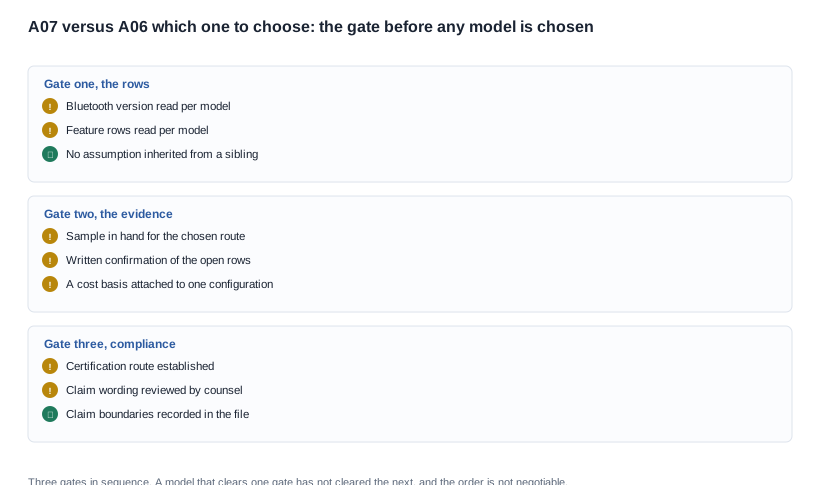

The gate that has to be cleared before either route produces a usable answer
Routing tells you which model the brief points at. It does not tell you the model is orderable. Three gates sit between the routing result and a purchase order, and each one can send the programme back.
Gate one, the rows that are open on both models. Frame weight, frame dimensions, the recommended age band and the charging-case capacity are unpublished for either model. A routing result that ignores these can point at a model the channel cannot physically stock or the programme cannot describe. The A06 specification list and the A07 specification list are the baselines, and both show the same gaps.
Gate two, the evidence. A sample in hand for the route you have selected, the open rows confirmed in writing against that model, and a cost basis attached to one configuration. Until the cost basis exists, the routing result is a preference rather than a decision, because nothing has been compared on the same terms.
Gate three, the market. The certification route established for the destination market, the claims wording reviewed by counsel, and the claim boundaries recorded in the file. The catalogue carries a company-level export certification page whose content is images rather than text, and the catalogue text contains no reference to CE, FCC or RoHS, so nothing about conformity can be read from it. In the European framework the radio equipment directive is (EU) 2014/53/EU and the electromagnetic compatibility directive is (EU) 2014/32/EU; EN 301 489 and EN 300 328 are harmonised standards supporting assessment under them, not directive numbers in their own right. UN 38.3 is not published for any cell in the catalogue either.
The gates run in that order for a reason. Gate one is the cheapest to close and the one most likely to send the programme back to the routing step, because an unmeasured frame can disqualify a model that the routing pointed at. Gate two is the one that converts a routing result into a decision. Gate three is the one that can stop a launch entirely and is therefore the one to start first if the market is already fixed — a certification route can run in parallel with a sample programme, whereas it cannot run in parallel with a decision to proceed.
And one row that is open on both models for a different reason. The A05 and the A06 publish identical specification rows, and the catalogue carries no statement that separates them. If your programme carries both of those models, that is a separate identity question to settle, and it is not settled by anything in this comparison. The A05 versus A06 specification comparison covers what the possible answers mean.
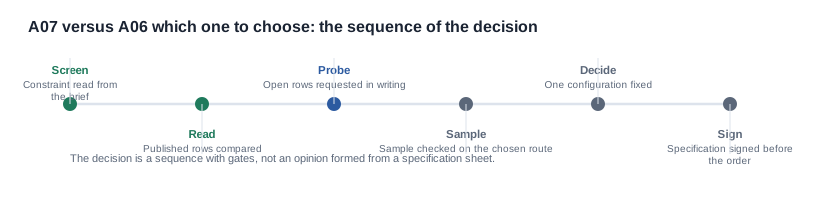
Writing the decision down
The output of this comparison should be a short record rather than a conclusion, and the record has four fields.
The constraint that was fixed, stated as an obligation rather than a preference. Not "we want a long-lasting product" but "the listing has to carry a compatibility statement". Obligations survive a change of mind about which product is nicer; preferences do not.
The dimension that answered it, and the row that was read. Two fields, because they are different: the dimension is the axis you screened on, and the row is the specific published line you read. A record that has only the dimension is not auditable.
The answer, with its source and its date. A supplier's written answer, a catalogue row, or a measured value from a sample. A recorded answer without a source becomes an assumption within a month, and assumptions are what a distributor's due diligence review finds.
What is still open, and who owns it. The open rows, the person or supplier who owes each answer, and the date by which it is needed. This is the field that stops a programme from choosing a model it cannot yet describe.
A worked example of the record. A brand owner needs a compatibility statement for a marketplace listing, so the constraint is the listing obligation and the dimension is the radio row. One model publishes a version and one does not, so the routing result points at the published one. The record then notes that frame weight, dimensions, the age band, the charging-case capacity and the certification position remain open, that the sample has been ordered, and that the cost basis is pending a quotation against one configuration. Six lines, and the programme can be reviewed by someone who was not in the conversation.

How we leave this decision with the buyer
We can tell you what both models are published as, that the capacity difference does not produce a runtime difference on paper, and the feature and radio rows point in different directions from the cell. We will not guess which features each model carries beyond what the model rows state, we will not resolve the twenty-hour figure without its condition, and we will not estimate a certification status. We will not tell you which one to choose, because the published rows do not settle the choice: they settle which model answers which brief, and the brief belongs to you.
What we will do is run the routing with you, in writing, so that the decision record exists and can be reviewed by someone who was not in the conversation. Send us the market, the channel, the age range and the wording you intend to use, and we will tell you which of the two models the published rows point at for that brief, which rows remain open on it, and what has to be answered first.
Related reading
- The category both models belong to — kids smart glasses
- The functional split in the same family — A05 versus A07
- How the feature documentation gap works — A06 limitations
- How certification is actually verified — certification checklist
Send the market, the channel, the age range and the wording, and we will tell you which one you can list.


