

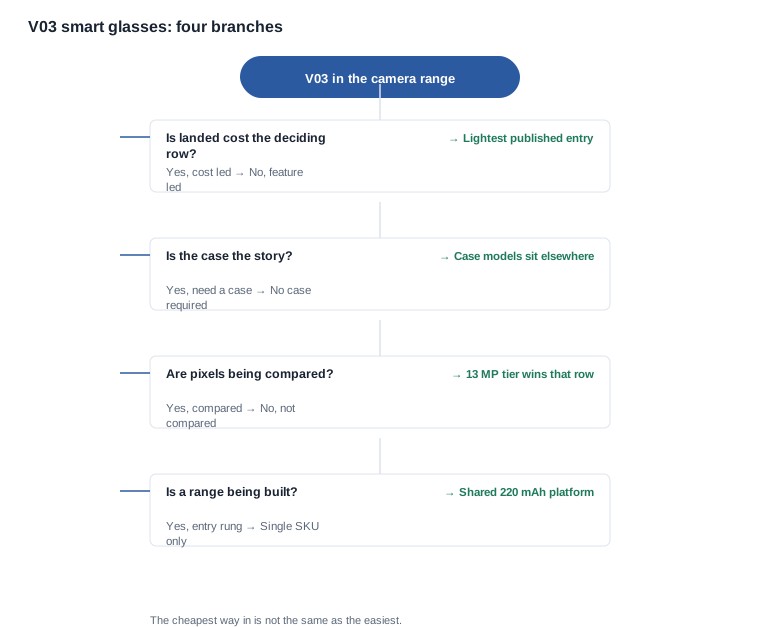
The V03 smart glasses suit a buyer who is entering the camera glasses category economically, or who is building a range on the 220 mAh platform and needs an entry SKU to sit under the V03 Pro. They do not suit a retail proposition led by the charging case, a customer who compares pixel counts, or anyone planning to promote a product page from the catalogue alone.
V03 smart glasses are the cheapest published way into this category, and the cheapest way in is almost always a platform decision rather than a product decision. That distinction matters more than any specification on the model, because the platform is what determines your accessory inventory, your certification footprint and your reorder path for the rest of the range. What follows is the branch structure, the rows that carry a proposition, the rows that constrain one, and the sequence that closes the model before a purchase order is signed.
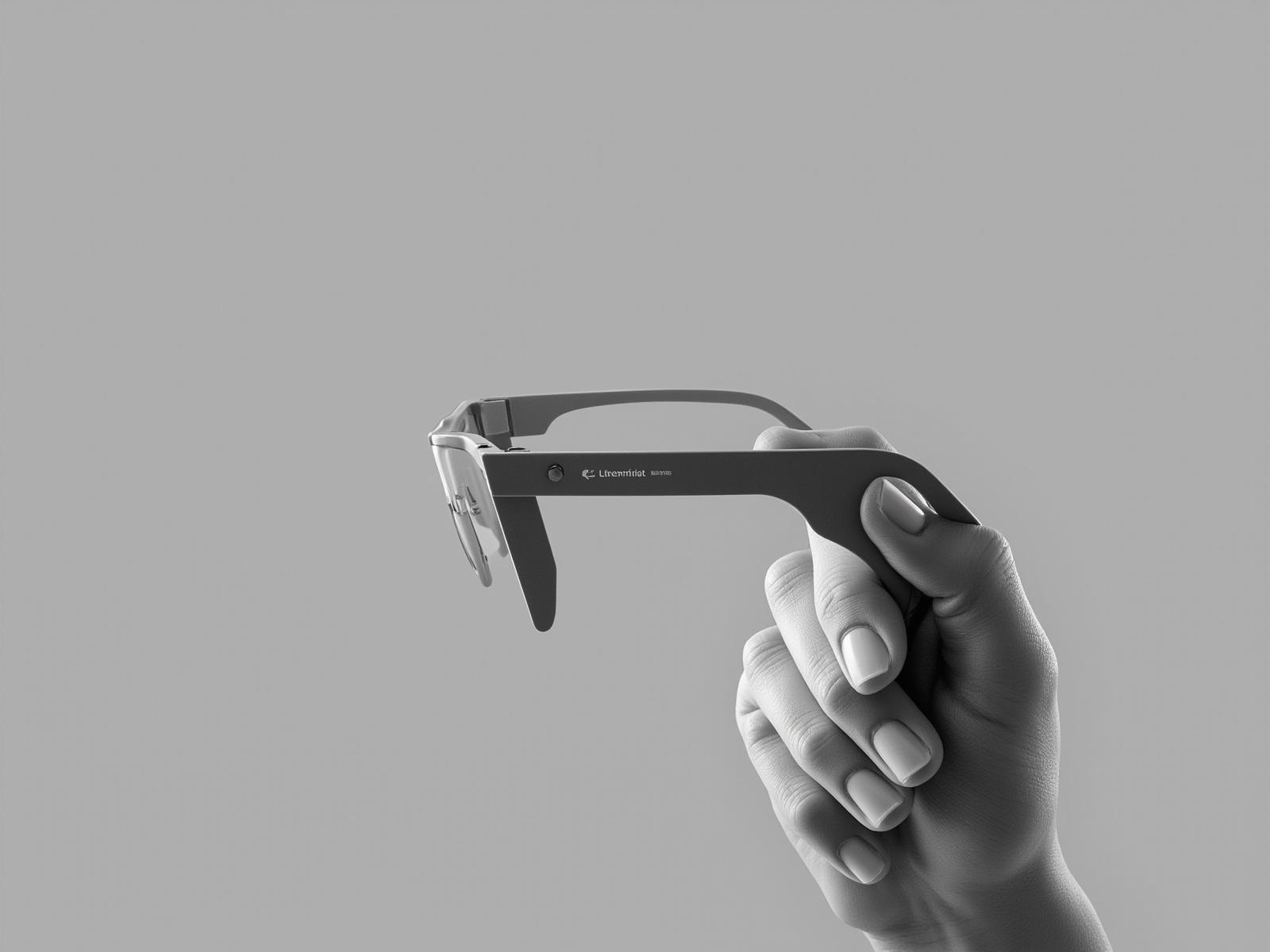
V03 smart glasses and the two published rows that set the bottom of the ladder
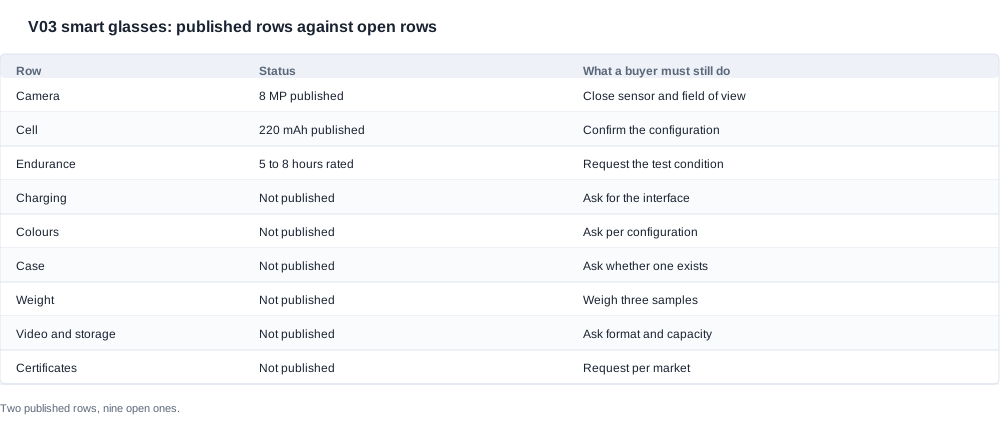
An 8 megapixel camera, and nothing else about it. The resolution figure is published. The sensor model, the field of view, the video format, the frame rate and the storage arrangement are not. That is the most important single fact on this page, because it decides what kind of listing can be written. For a customer whose whole comparison is on picture quality, there is nothing to answer with, and a competitor with a lower published resolution can be shown to be better in low light without your documentation ever being tested.
A 220 mAh cell with a rated endurance range of 5 to 8 hours. The smallest published cell configuration in the camera range, shared with the V03 Pro and the MT5. The range is a better disclosure than a point figure, because it says more than one condition was measured, and it is also an admission that the result depends heavily on what the camera is doing. Plan the product on five hours, not eight, and treat any listing that leads on the upper figure as a listing that has overreached.
Nothing about the physical product is published. Frame weight, frame dimensions, temple length, lens dimension, head-size range and colour list are all absent. For a model whose selling point is being economical, the weight is still the number that decides comfort and the freight class, and it is the number a customer will ask about in a shop even if no listing mentions it. The shipping weight analysis covers what a missing weight does to a landed-cost model, and the answer is that it does not remove the cost — it removes your ability to predict it.
The charging method is not published for this model. That is worth flagging explicitly, because charging rows are the single most frequently carried across between neighbouring models in comparison charts. The sibling V03 Pro publishes a Type-C interface; that row belongs to that model until it is confirmed for this one. Ask for the interface against this model's name, in writing, and record the answer in your technical file for this SKU.
The endurance range, and why it is the honest disclosure
Five to eight hours on a 220 mAh cell is not a weakness to explain away. It is the most honest figure in the camera range, and a buyer who treats it as one will make better decisions than a buyer who reads the top of the range as a promise.
What a range actually tells you. It tells you that more than one measurement condition exists and that the conditions were not written down. It does not tell you which conditions, and that omission is what makes the figure unusable for comparison. In this catalogue the same pattern repeats across the camera group, where figures come in three different shapes — a point and two different ranges — with no condition attached to any of them. The battery comparison across the camera range shows the spread.
Why the shape matters more than the number. A point figure invites a ranking. A range invites a question. When every model in a category publishes a range, the buyer who asks each supplier what the range means gets comparable answers, and the buyer who compares the top numbers gets a comparison that means nothing. That is why this model is a better platform choice than its published runtime alone suggests: the platform buyer is buying the cell size and the accessory family, and the cell size is a specification, while the runtime figure is a measurement convention.
The three conditions worth asking for. Whether the Bluetooth link was paired and active throughout. Whether the camera was recording, and if so at what resolution and frame rate. And whether the measured sample was the production configuration on a new cell or a cycled one. Ask those three questions in the same words to every supplier on the shortlist, and compare the answers rather than the numbers. The method for comparing battery figures sets out the full procedure.
And the number you can produce yourself. A buyer who runs the duty cycle on a sample, in the condition the customer will actually experience, ends up with a figure that carries a condition — which is the only kind of runtime figure that belongs on a product page written by a brand rather than copied from a catalogue. That measurement is worth more than the published range precisely because it is yours.
Platform positioning: why the cheapest entry is often still the wrong one
The 220 mAh platform carries three models. The MT5 and the V03, and the V03 Pro, which carries a sport positioning. One cell size, one accessory family, one firmware branch. That is the argument that makes this model a good base for a range rather than a good product to stop at.
What the platform saves. One accessory family instead of two. One certification footprint spread across more units. One instruction-sheet set. One spare-parts line. One reorder path. For a channel that will carry the range for years, those five lines usually outweigh any specification difference between two models on the same platform.
What the platform cannot fix. If the customer's day genuinely needs more than five hours, no amount of range disclosure saves the product — the cell is the cell, and the fix is a different platform. That is the moment to know about, and it is a moment that arrives in customer returns rather than in a quotation. Buyers who are confident about the duty cycle should take the platform saving; buyers who are not should take the model with the cell that matches the day, and accept the second accessory family as the price of not guessing.
The naming problem, which is commercial rather than technical. The source writes this model as the V03 and the differentiated sibling as the V03 Pro, and the two differ by a photochromic lens, a flexible temple, a Type-C interface and three colourways. A range containing both needs the naming settled before the listing exists, because the single most common customer confusion in this category is a shopper who received the entry model when the listing described the Pro. Settle the naming, the packaging hierarchy and the shelf placement as one decision.

Which buyer profile closes, and which one should not, for the V03
A brand entering the camera category with a fixed budget. This is the plainest case for the model and the one it was built for. The V03 is the cheapest published way into camera glasses, and if the plan is to build a range upward, it is the natural floor.
A content-focused channel that is not selling on resolution. First-person capture for a livestream, a walkthrough or a training clip, where the picture is re-encoded downstream and the price point is what matters. The test of whether this brief applies is whether your customer watches the output at full size. If they do, the 8 MP figure with no sensor behind it will surface as a complaint; if they do not, the specification is a rounding error and this model is correct.
A distributor building a price ladder across platforms. The 220 mAh platform, the 260 mAh platform and the 290 mAh platform give three economic tiers, and this model anchors the bottom one. A distributor's job here is to make the bottom rung legible — which is a listing task, not a specification task, and it is why the boundary between published and unpublished rows decides more than the choice of model.
The buyer who should not buy it: a pixel-count comparison shopper's channel. The L1 Pro and the L2 Utral are the 13 MP models, and a shopper comparing this model beside them will be comparing a published resolution against a published resolution with nothing behind either. The model pick guide across the camera range covers how to build a ladder that does not invite that comparison.
The buyer who should not buy it: a retail proposition built on the charging case. The 1400 mAh cases are on the L1 Pro and the CY03, and the CY05, with the L2 Utral offering a 900 or 1400 mAh option, and the MT6 at 1200 mAh with a documented folding form. A range built on the case needs one of those models, and the charging case options analysis sets out the trade-off model by model.
The buyer who should not buy it: anyone planning to promote the product page from the catalogue alone. Two published rows and nine open ones is a page that cannot answer a customer's second question. That is survivable for a marketplace listing and fatal for a brand's own product page, which is where most of the traffic and most of the brand risk sits.


Verification steps and the criteria before the purchase order for the V03
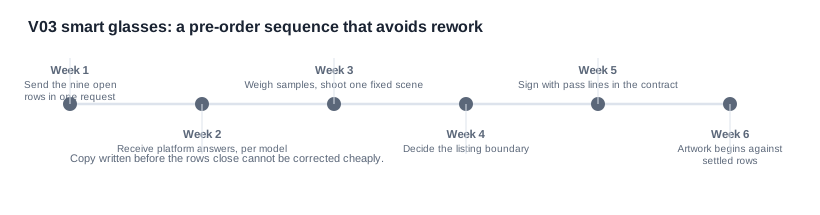
Ask the platform first, the model second. The camera specification is best requested once for the 220 mAh platform so that the V03 and the V03 Pro, and the MT6 cannot end up with contradictory figures in three different listings. The model-specific rows — the charging interface, the colour list, the case availability — are then asked against this model's name.
Weigh three samples and record all three. The same production spread question applies here as on any model, and on a model where nothing physical is published, the sample is the only source. A spread figure written into your quality control document is worth more than an average quoted to a customer.
Shoot one fixed scene and hold it against the tier above. Same light, same framing, same subject, and record whether the difference is visible in the delivered output. On an 8 MP model with no sensor published, this test decides whether the specification is a constraint or an irrelevance for your particular use case — and it is the only way to answer that before the listing exists.
Request the runtime condition at both ends of the range. Five hours and eight hours were produced by different conditions, and knowing both is what lets you plan the product honestly. A range whose endpoints are not described is a range you cannot put on a page.
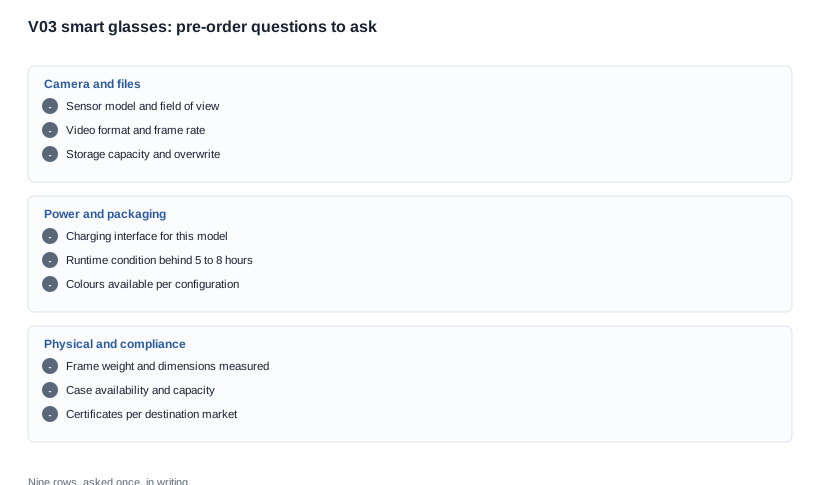
Fix the listing boundary before the copy is written. Published rows you may print: the resolution as a resolution, the cell capacity, the rated range as a range. Open rows you may not: the sensor, the field of view, the video specification, the storage arrangement, the charging interface, the weight, the dimensions, the colour list, the case, the runtime condition and the certificate coverage. This paragraph is the most useful one on the page for a brand that has never run the exercise before, because it converts a catalogue into a list of things to ask.
Settle the case question before the packaging design, not after. No case is published for this model, and the pattern across the camera family is that the case arrives on specific models rather than across a platform. Whether a case can be made for this model is a question with a real answer and a real lead time attached, and a packaging designer who learns about it during artwork approval will lose a week. Ask it in the same written request as everything else, and record the answer as either a capacity and a lead time or as a documented absence.
Run one fixed-scene test before you accept the resolution tier. Not to prove the product is good, but to find out what the tier costs you in a specific application. Record the light level, the subject distance, the framing and the delivery resolution your channel actually uses. The output of that test is a decision, not a review: it tells you whether the 8 MP figure is the floor of your use case or nowhere near it, and in a due diligence file that decision is worth more than any opinion about the model.
Terms, red flags and the position we take on the V03
What this model's position is worth commercially. A floor for a camera range, at the lowest published cell configuration, on a platform that carries two other models. What it cannot do is anchor a retail proposition on its own, because two published rows do not carry a product page. The correct commercial expectation is a range plan in which this model is the entry rung and another model does the visible work.
Open to negotiation, and worth the time. Unit price and volume tiers across a bulk order; the minimum order quantity per colour once colours are established; packaging specification; delivery splitting so a first tranche can be validated; payment terms with nodes against inspection rather than against shipment; the warranty period with a stated response time; return terms for defective units; and the terms of a pilot order. The lead time is the term to negotiate hardest on this model, because an entry SKU usually sits on a brand's critical path for launching the rest of the range, and a delay there delays the whole plan.
Neither of these two lines rewards a negotiation on its own. Certification cost and lead time are set by the procedure and the testing body. The useful question is about the quotation rather than the price: ask whether tooling and certification are quoted separately, because tooling is frequently amortised across a first order while certification cost attaches to a product family, and a bundled line hides the difference until the second order.
Red flags worth naming at the quotation stage. A supplier who quotes the charging interface by reference to the sibling model. A supplier who collapses the 5-to-8-hour range to a single figure. A supplier who offers a case for this model without a capacity. A supplier who treats a certificate as covering the whole platform rather than a model schedule. Each of those is a question to ask rather than an objection to raise, and each is far cheaper to ask before the purchase order than after the first shipment.
A second class of red flag, which is commercial rather than technical. A quotation that bundles tooling and certification cost into a single line without separating them, because the two amortise differently and the difference decides whether a first order at your volume carries a tooling charge at all. A quotation whose minimum order quantity is stated per total units rather than per colour or per configuration, which turns a three-colour range into a nine-figure problem. And a quotation that gives a lead time without naming what it covers — sample approval, artwork approval, inspection or shipping — because a lead time that includes artwork you have not yet supplied is not the lead time your launch plan is built on.
Where we stand. Our position is that the V03 is the economical entry into the camera category and a poor choice for a retail proposition that has to be sold on the product photograph. We will publish the 8 MP as a resolution and not as a picture quality claim, we will publish the 5-to-8-hour range as a rating, we will not quote a weight, and we will not attach an AI capability to this model that our source attaches only to the family. Where a customer asks a question the documentation cannot answer, we would rather name the gap than fill it.
Clauses for the agreement. The published rows for the configuration ordered; the camera specification once closed for the platform; the charging interface confirmed against this model name; the runtime condition; the measured weight and dimensions; the certification position per market; the warranty period with a stated response; and the minimum order quantity, lead time and price for the configurations ordered. Clauses to leave out entirely: any image quality claim, any weather claim, any runtime point figure drawn from a range, any weight not measured on your own samples, and any feature carried across from a neighbouring model in the same family.
The published V03 specification list is the honest baseline, and the V03 common questions page puts the same nine open rows in a form you can hand to a supplier. The OEM platform readiness overview maps which models share which platform, which is the question that decides whether this model belongs in your range at all.
Related reading
- What is published for this model — V03 smart glasses specifications and features
- The differentiated model on the same platform — V03 Pro smart glasses best for
- Choosing across the camera range — AI camera glasses which model to pick
Send us the channel, the target price band and the volume, and we will tell you whether the V03 is the right entry point for your range.


