

Exporting a product from this category is not the same undertaking as exporting an ordinary open-ear audio product, and the reason sits above the paperwork. The catalogue publishes an amplification gain of 35 dB for the bone-conduction entry, alongside a 200 mAh cell, a charge time of two hours or less, a rated runtime of roughly seven hours and Type-C charging. A gain figure of that size makes the intended claim a decision that determines the regulatory route, and the intended claim is a decision rather than a measurement. Everything else in the export file follows from that one decision, which is why the export conversation has to start there and not at the carton.
There is a second structural fact that shapes the whole file, and it is easy to overlook because it presents as an omission rather than a design choice: the catalogue publishes no model designation for this entry. The product appears in the catalogue as bone conduction glasses, without a model string attached. That single missing field is the root cause of most of the work in this article, because nearly every document an export programme needs has to name the product it applies to.
This article sets out the export file for this category in the order the documents actually have to be obtained, what each one depends on, and which questions belong to the brand, which belong to the supplier, and which belong to a legal adviser qualified in the destination market.
Bone conduction glasses export considerations: the chain
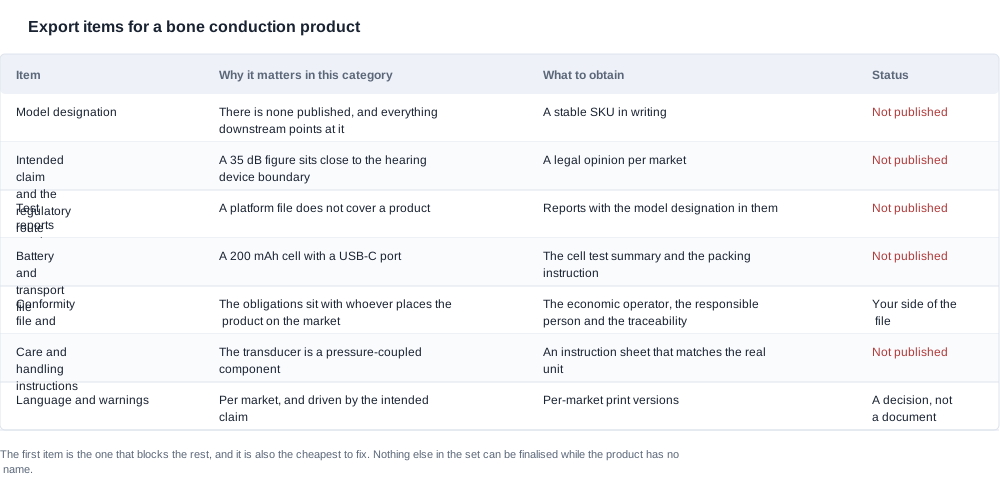
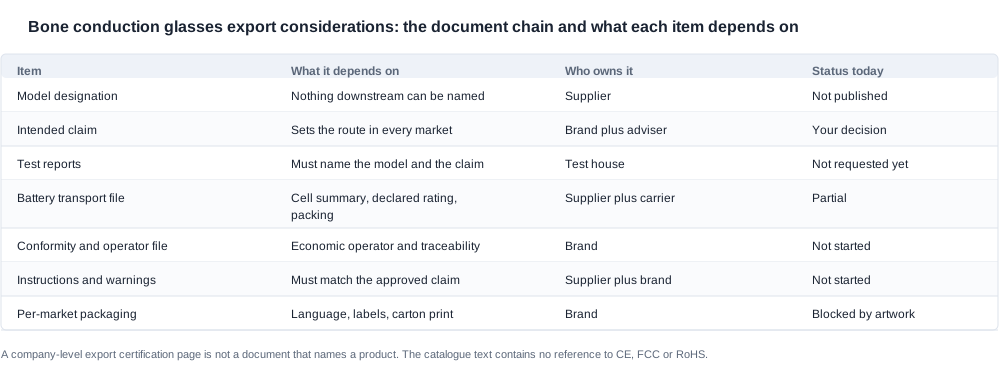
The export file is a chain, and the chain breaks at its weakest link. It runs from the product designation, through the intended claim, to the technical documentation, the labelling, the battery transport file and the commercial paperwork, and the order in which those are obtained is not negotiable.
The seven export items
1. The model designation. The cheapest item on the list to fix and the one that blocks the most. Without a stable string, no document can name the product, a warranty claim cannot be tied to a specific configuration, a second quotation cannot be compared against a first, and a conformity file cannot be assembled. This is a supply-chain problem before it is a compliance problem.
2. The intended claim, and the route that follows from it. Whether the product is sold as a consumer device with an amplification specification, or as a device that assists with hearing, determines the regulatory route in each destination market. The same hardware, the same gain figure and the same cost can sit on opposite sides of a medical device boundary depending on the wording on the box. Get a written opinion from an adviser qualified in that market, before the artwork is finalised rather than after the first container has left.
3. Test reports that name the model. As with every product in this range, a report written for a platform does not cover a product. In this category the reports are likely to include acoustic ones, because a gain figure without a reference level, an input signal, a frequency band and a measurement location is not a specification. The gain levels analysis sets out what a usable gain figure has to contain, and the certification and medical device boundary piece works through the distinction the claim turns on.
4. The battery and transport file. A 200 mAh cell charged over Type-C, and no charging case row published for this entry, which makes this one of the shortest battery chains in the catalogue. The file needs the cell test summary, the declared rating that follows from it, and the packing instruction. The battery transport compliance notes set out the chain in general terms.
5. The conformity file and the operator details. The economic operator, the responsible party, the technical documentation and the traceability arrangements sit with whoever places the product on the market, so they belong in the file from the first shipment rather than being added when a market regulator asks.
6. The handling instructions. In this category the instruction sheet is not a courtesy. The transducer is a pressure-coupled component whose condition directly affects what the person using the frame hears, so the instructions have to describe the real unit and the real unit is the only reference available. The handling instructions piece covers the rows the instruction sheet needs.
7. Language, warnings and per-market packaging. Driven by the intended claim from item 2, and by the destination market's own rules, which is why item 7 cannot be closed before item 2 is.
Where the catalogue stands on certification
A buyer who has read the catalogue's front pages may have formed the impression that certification is a matter of course. It is worth being precise, because the opposite is true. The catalogue's export certification page is a company-level page whose content is images rather than text, and the catalogue text contains no reference to CE, FCC or RoHS anywhere. There is no per-model certification row for any product in the range, and there is no record of a certification number pending confirmation for this entry either.
What the certification page carries is ten patent certificates — eight appearance-design patents and two utility-model patents — which is a statement about the design of the product, not about its conformity in any market. A patent certificate is not a conformity assessment, and a company-level page is not a document that names a product. A buyer who treats it as either will find out at a customs query or a tender scoring session, which is an expensive place to find out.
The model designation that blocks everything else
It deserves a section of its own, because the practical consequence of a missing designation is not abstract.
What a designation does in a customs and conformity workflow
A model designation is the string that appears on the invoice, in the customs declaration, on the test reports, in the declaration of conformity, on the packaging, in the technical file and in the warranty terms. Every one of those documents has to agree with every other one, and an agreement between eight documents is impossible when one of them has no identifier at all.
The practical failures follow in a predictable sequence. The purchase order has to be raised against something, and without a designation the order names a category rather than a product. The customs declaration then has a line item that does not match any commercial code description the importer is used to handling, which is a query rather than a rejection. The conformity file cannot be closed because the document and the product do not share a name. And the warranty terms have nothing to attach a claim to, which means the commercial exposure sits with the brand by default.
The question that has to be asked
One question closes it: is a model designation allocated to this entry, and can it be issued in writing, with a date against it? This is not a request for a product name for the sake of tidiness. It is a request for the key that eight other documents need.
If the answer is that a designation will be issued once the product is defined, then the product is not yet defined, and the correct buyer response is to treat the export programme as a definition project with a compliance tail rather than as a shipment with paperwork attached. That is a scheduling decision, and it should be made at the start of the programme rather than discovered at artwork stage.
The common questions piece covers the full set of documentation gaps in this category, and the buying guide sets out where this entry sits in the range.
A designation does not solve the rest
It is worth saying plainly what a designation does not do, because it is easy to treat it as the whole answer. A designation makes documents possible; it does not make the content of those documents correct. The gain figure still has no conditions, the runtime still has no test condition, and the frame weight is still unpublished. A named product with empty rows is a documented absence rather than an undocumented one, which is an improvement and not a resolution.
Three files that depend on the intended claim
The claim decision does not change the hardware, the carton or the cost. It changes which documents exist, and that is why it has to be made first.
The technical file
Whatever route applies, a technical file is expected, and the content of the bone-conducted product's file is dominated by the acoustic documentation: the gain figure with its conditions, the frequency response, the delivered output across the adjustment range, the microphone specification, the battery performance, the materials in contact with the skin and the instructions for use. For this entry, most of that content does not exist yet, and the file is therefore a schedule rather than a document.
The practical question for a procurement team is what the schedule contains: which items are in the supplier's hands, which are in a test house's hands, and which need a decision. The export documentation checklist covers the general structure for platforms in this catalogue.
The labelling and the warnings
Labelling follows the claim, and so do the warnings, and both are market-specific. The general requirement in every market is that the labelling matches what the product is and what the documentation supports; the specific requirements are the market's own. The practical pitfall in this category is a warning written for one claim and a listing written for another, because the warning and the listing are usually written by different people at different times.
The way to prevent that is to fix the claim in a single sentence, in writing, and have the listing, the packaging and the instructions all reference that sentence. If a marketing team cannot keep the listing consistent with one approved sentence, the claim is not yet settled.
The radio route
The catalogue publishes no Bluetooth version for this entry, and it publishes no radio rows at all, because the entry's published page carries the amplification gain and the standard electrical rows. If the product places on the market with a radio function, the applicable route has to be confirmed with the supplier and the module documentation, and the framework to confirm it against is the Radio Equipment Directive (EU) 2014/53/EU for the European market. An unpublished radio row is a gap to close, not a reason to assume the module is covered — the module's own documentation does not automatically become the product's conformity evidence.

The battery and transport file
This is the part of the export file that is most often treated as administrative and least often causes a delay, so it is worth doing properly on the first attempt.
What the catalogue gives you
The published row is a 200 mAh cell, a charge time of two hours or less, a rated runtime of roughly seven hours and Type-C charging, with no charging case row published for this entry. The catalogue publishes a charge time for every product it lists, so the absence here is not a missing charge figure. What is absent from the row is the start state of charge and the termination criterion, which is exactly why the figure cannot be used to plan an interruption in a shift or to derive a case turnaround time.
What the transport file needs
The cell test summary, which is a supplier document rather than a buyer document, and the declared rating that follows from it. The packing instruction for the cell in the assembled product, which has to match the way the product is actually packed. The restrictions on the shipment that follow from the cell and the route. And the carrier and broker instructions, which have to exist before the first booking rather than being negotiated against a booking that has already been made.
For a brand shipping into multiple markets, the efficient structure is a master file per product and a market annex per destination, because the battery and transport content is common while the labelling, the warnings and the operator details are not. The export considerations for the kids category covers the same structure for a different product type.


Sequencing the paperwork around the artwork
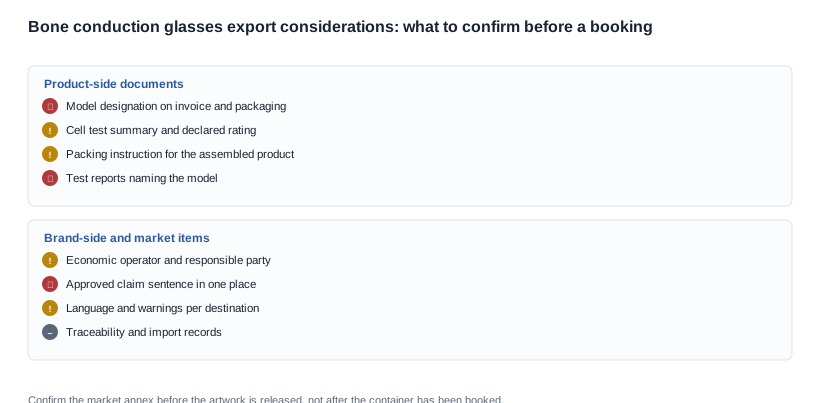
Artwork is the point at which paperwork becomes expensive, because artwork is a plate cost and a lead time. Every item in the export file either has to be closed before artwork is released or has to be deliberately deferred.
The four that must be closed first
The model designation, because it appears on the artwork itself. The intended claim, because the whole listing and the warning set are written from it. The destination market list, because the languages and the warnings are per market. The cell and transport content, because the packaging and the carton print depend on it.
The three that can run in parallel
The acoustic test reports, which need the designation and the claim but not the artwork. The conformity file assembly, which needs the reports and the designation. The operator and traceability arrangements, which need the brand's own legal and logistics decisions and can start immediately.
The commercial annex, which is not a compliance document
Alongside the compliance chain sits a second set of items that a buyer in a hurry routinely treats as routine and that later turn into the most expensive line on the file.
The importer of record and the incoterms. These are commercial decisions, and they determine who is the operator in the destination market for customs purposes. The decision has to be made before the first booking, and it has to be consistent with the operator details in the conformity file, because the two documents are read together by a broker. A mismatch between the importer named on the shipping paperwork and the operator named in the technical file is a query that stops a clearance, and it is entirely self-inflicted.
The packaging, the carton and the pallet. The cell and the product both travel in this box, and the packing instruction has to describe what is actually inside it. The physical design decision that affects the file most is the inclusion of the product documentation in the box, because in a category where the transducer's condition determines performance, the instruction sheet is part of the product rather than an insert. The commercial cost of that sheet is trivial; the cost of a unit that arrives without it is a return.
The insurance and the freight terms. Worth settling with the same care as the compliance items, because a claim that is refused on a packaging discrepancy after a long transit is a loss that nobody recovers. The carrier's own requirements for a product with a cell are not negotiable after the booking, which is why the transport file has to be closed first.
The customs classification. The description written on the invoice is a commercial description, but it has to be consistent with how the product is described everywhere else, including the claim sentence and the packaging. Three different descriptions of the same article in three documents is a question waiting to happen.
A file worked through
This is a worked case rather than a customer case. Which order the decisions take.
A brand is planning a first shipment into two markets. The buyer asks for the seven items in the chain. The answer is that a model designation will be issued once the configuration is finalised, which tells the buyer the configuration is still moving.
Week one is a configuration freeze, with the designation issued in writing at the end of it. Week two is the claim sentence, fixed in one approved paragraph and sent to the adviser in each market, with the acoustic document request issued against the designation in parallel because it does not depend on the answer. Week three is the artwork, released only after the claim sentence and the market list are both confirmed, with the labelling and the warnings written from the sentence rather than from a summary of it.
Week five is the transport file: cell summary, declared rating, packing instruction, then the booking with the incoterms and the importer of record consistent with the operator details already in the file.
Week seven is the advice, and it is the item that moves. The adviser's view on the claim in one market is the same as the brand's; in the other it is narrower, and the listing copy changes accordingly. That change costs a copy edit rather than a reprint, because the artwork was released against an approved sentence and the sentence was the thing under review. Had the artwork gone first, the same advice would have cost a plate.
The outcome is a first shipment with a complete file and one market on a narrower wording. The decision that produced it was not a negotiation with a factory; it was the order of the paperwork.
What we hold and what to ask
This category can be shipped and documented, and the two things standing between the current documentation and a complete export file are a model designation and a decision about the intended claim. We will not publish a certificate number we have not seen, we will not state a certification status for this product that our documentation does not support, and we will not describe the product as a hearing aid or attach any hearing-improvement claim to it. We hold no clinical data, no test protocol and no regulatory assessment for this entry, and the determination of how it must be described in a given market belongs to a legal adviser qualified in that market.
We will also not describe a durability class, a frame weight, an ingress rating or a frequency response for this entry, because the catalogue does not carry them.
What we can do is tell you which of the seven items in the export chain we can evidence in writing today, which ones require a model designation, and which ones require a legal determination before anyone can answer them. The published bone conduction specification is the honest baseline for the product side, and the common questions piece covers what the documentation does not contain.
Related reading
- The regulatory question in full — bone conduction glasses certification and medical device boundary
- The document set for a platform — OEM ready platforms export documentation
- The battery chain — battery transport compliance buyer checklist
Send us the destination markets and the intended claim, and we will tell you which of the seven items are on the critical path and which need a legal opinion rather than a test house.


