

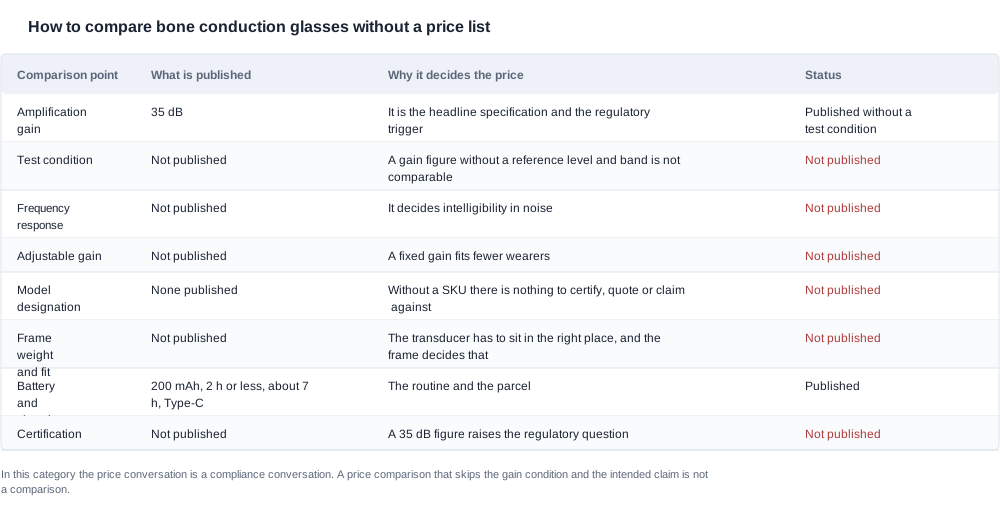
No unit price is published for the bone conduction entry in this catalogue, and in this category that is the least of the problems. What is published is an amplification gain of 35 dB, a 200 mAh cell, a charge time of two hours or less, a rated runtime of roughly seven hours and Type-C charging — and nothing else that would let a buyer compare it with another product on anything other than a description.
The gain figure without a test condition, the absence of a model designation and the unresolved claim together decide whether a price comparison is possible at all. A price comparison built before those three are settled produces a number that looks like a conclusion and is not one.
This article is about the comparison method rather than the outcome: what can legitimately be normalised before any quotation is requested, what cannot be compared at all from published material, the order in which the comparison has to be run, and why the claim has to be settled before the unit price is discussed.
Bone conduction glasses price comparison: what to normalise
A price comparison is a set of like-for-like normalisations. If two products are not the same thing on the dimensions being compared, the price difference measures the difference between the products rather than the difference between the suppliers. In this category, three of the normalisations cannot be completed from published material, and a comparison that skips them is a comparison of descriptions.
The three normalisations that have to happen first
Normalise the function. Comparing this entry with an open-ear audio frame on price is comparing a product that amplifies the environment with a product that plays the person's own audio. The price difference between them reflects a difference in what they do, what they cost to certify and who they are for — so it tells the buyer something about the products and nothing about the suppliers. The open ear comparison works through the function difference in detail.
Normalise the documentation. A product with a complete technical file and a product with no model designation are not two entries in the same comparison, because a large part of the cost of the first is compliance work that the second has not yet had done. The comparison has to be against the cost of bringing both to the same documentation state, not against the price of a finished product and the price of a definition.
Normalise the claim. The same hardware, the same gain figure and the same unit cost can sit on opposite sides of a medical device boundary depending on the wording on the box. The claim decides the regulatory route, and the route decides a large part of the total cost. This is why the certification and medical device boundary piece is the first thing to read in this category, and why a price conversation that starts with the unit is a conversation about the wrong variable.
The two things the published rows support
Two things are comparable today, and they are the two that matter most operationally.
The power and charging path. A 200 mAh cell, a charge time of two hours or less, a rated runtime of roughly seven hours, Type-C charging, and no charging case row published for this entry. That is a single-cell configuration on a standard cable, which means no accessory in the box, no proprietary dock in the bill of materials, a light parcel and a product a customer can use on the first day. It is the cleanest shipping proposition in this catalogue, and it is a structural fact rather than a price.
The category's physics. Bone conduction sits between open-ear audio and a hearing device, because it delivers sound to the inner ear through the skull rather than through the air. A buyer comparing this category is comparing a sound path, not a speaker, and the sound path determines which environments the product can be sold into at all.

The comparisons the published rows will carry
Beyond the two structural facts, a buyer can build a comparison worksheet from the published material, and the worksheet is what makes a later quotation readable.
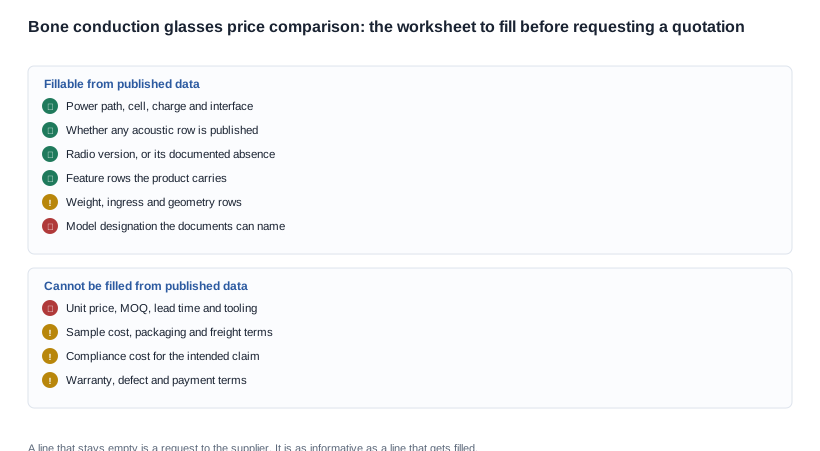
The six lines that can be filled from published data
- The power path: cell configuration, charge ceiling, runtime rating, charging interface, and whether a case row exists.
- The acoustic row: whether a performance figure is published at all, and if so on what terms. For this entry the answer is a 35 dB gain with no conditions; for the audio range the answer is that no acoustic figure is published on any page.
- The radio row: the radio version where one is published, and the absence of one where it is not. This entry publishes no radio version, and that absence is a question rather than a feature.
- The feature rows: which additional characteristics the product carries. The D11 carries a surround-sound row and a long-endurance row, the YK12 a surround-sound row and a slim-temple row, the G07 an ultra-thin and detachable-temple row, and the D12 no feature row at all.
- The structural rows: weight, ingress rating and geometry. Across the whole catalogue a weight is published once, for the MT6 glasses body at 158 g excluding its folding charging case, and an ingress rating twice, on the V06 and the S7. For this entry, none of the three is published.
- The naming row: whether the product carries a model designation that a document can name. For this entry it does not, and that single fact sits underneath almost every other row in the comparison.
Why the worksheet has to be filled before the quotation
A comparison worksheet filled from published data is the only part of the comparison that is not negotiable. Once it exists, a quotation can be read against it: a price is attached to a specific set of rows, and the buyer can see which rows the supplier is quoting for.
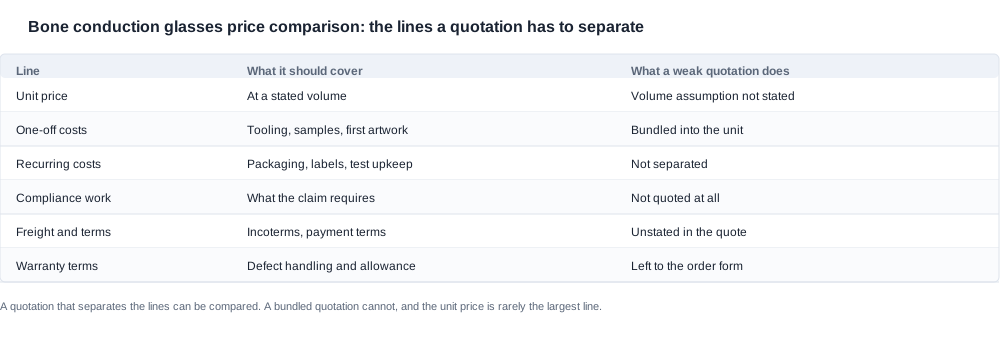
A comparison started from the quotation does not work, because the quotation is structured to sell rather than to compare. It bundles the unit price with tooling, samples, packaging and compliance work, and it does not say which of them are one-off and which recur. The red flags to look for in a quotation are bundled line items with no separation between one-off and recurring costs, and a unit price that is only valid at an unstated volume.
Why there is no price tier to compare against
A buyer who has worked in other electronics categories will expect a range of options, and it is worth saying plainly that this catalogue has no price tiers, no value tiers and no price bands for any product. That is a deliberate position rather than an omission, and it has two reasons.
The published rows do not support a tier structure. A price tier is a claim that a set of products serves the same need at different levels of investment, and that claim has to be traceable to rows that separate the products. In this range the rows that exist are cell capacity, charge time, charging method, runtime, radio version, pixel class and the occasional feature row, and those rows describe what a product is rather than how much it should cost.
A price tier also has to survive a comparison with other suppliers' products, and in this category the other supplier's tiering may be based on rows that do not exist in ours. A buyer who is shown two tiers built on two different documentation bases is being shown two different things, and the way to detect it is to ask what row each tier boundary corresponds to. If the answer is a document rather than a specification, the tier is a marketing construction.
The comparisons they cannot support
Some comparisons are not available from published material at all, and a buyer who attempts them will produce a confident number with no evidence behind it.
Output, and anything that depends on it
No output level is published for either product type, and a gain figure is not a level. Any comparison that reaches a conclusion about how loud one product is than another is unsupported at the first step.
The population each product serves
No frame weight, temple length or adjustment range is published for this entry, so the two products cannot be compared on who they are for. A buyer cannot say that one serves a wider group than the other without the geometry rows, and cannot write a fitting instruction for either.
Durability and service life
No cycle rating, ageing data or ingress rating is published for this entry. The durability analysis covers what a product with an active transducer demands of the frame around it, and it is a list of open rows rather than a set of numbers.
The costs nobody publishes
Unit price, minimum order quantity, lead time, tooling cost, sample cost, certification cost, packaging cost, freight, duty, payment terms and warranty terms are all unpublished for this entry, and we publish no price list for any product in this range. A buyer who asks for "the price" is asking for a quotation, and a quotation has to be requested line by line.
The buying guide covers the category in general terms, and the export considerations cover what travels with the goods, which is the part of the cost structure that is most often underestimated.

Running the comparison before the quotation
The practical sequence matters, because the order determines whether the comparison is comparable.
Step one: fix the claim sentence
Before anything is normalised, the product has to be described. The claim decides the regulatory route, the route decides what documentation is required, and the documentation is a large part of the total cost. A comparison run before this step is a comparison of two different compliance burdens at two different unit prices.
Step two: fill the worksheet from published data
Do this before contacting any supplier, because the worksheet is the part of the comparison that does not depend on a response, and a buyer who arrives at a supplier without it will be quoted for whatever the supplier has decided to offer.
Every line that can be filled from published material is filled, so that the quotation arrives into a framework rather than into a blank page. The lines that stay empty are as informative as the ones that are filled, because an empty line is a request to the supplier.
Step three: ask for the quotation as separate lines
A quotation that separates the lines can be compared; a bundled quotation cannot. The lines to ask for are: the unit price at a stated volume, the one-off costs and what they cover, the sample cost and what a sample includes, the packaging cost and the minimum packaging quantity, the compliance and test costs that apply to this product, the freight terms and the incoterms, the payment terms, and the warranty and defect terms. Each of these is a question to ask rather than a number we can supply.
Step four: compare the total, not the unit
A unit price is one line of a total, and in this category it is rarely the largest one. The costs that decide a private-label programme are the one-off costs and the recurring costs, and the ratio between them determines how the programme scales. A buyer who compares unit prices alone will systematically prefer the product with the highest one-off cost, because that product's unit price is lowest at a volume the buyer will never reach.
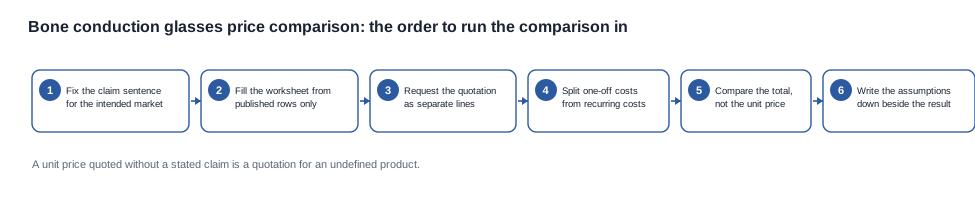
Step five: state the assumptions
Every comparison has assumptions, and the ones that matter are the ones that are not written down: the volume, the destination market, the claim, the packaging, and the compliance route. A comparison that states its assumptions can be repeated by a second buyer; one that does not is a private opinion with a table attached.
Two quotations, one comparison
This is a hypothetical exercise rather than a client project, and it is written to show the method rather than to report a result.
A brand has budgeted for a private-label programme in this category and has two quotations on the table. Neither is a comparison yet; each is a single number with a description attached. The buyer has decided to run the comparison rather than accept either.
The claim sentence comes first, because everything downstream depends on it. The brand fixes a mechanism-only claim — amplification, the published gain, the open ear, the cell and the charging — and takes it to an adviser in the destination market. Until that returns, the buyer does not treat either quotation as comparable, because a quotation that assumes a wider claim contains compliance work that the other may or may not include.
The worksheet is filled from published rows. Power path, acoustic row, radio row, feature rows, structural rows, naming row. For this entry the naming row is empty, which is the finding that shapes everything after it: neither quotation can attach to a product that has no name, so the model designation becomes the first line of both requests.
The quotations come back separated. Each is broken into the unit price at a stated volume, the one-off costs and what they cover, the sample cost, the packaging cost, the compliance work, the freight terms, the payment terms and the warranty terms. The two sets differ in structure before they differ in price: one has a compliance line that is clearly scoped and one has a compliance line that is described in a sentence.
The comparison is then run on the total, and the assumptions are written beside it. The result is not that one supplier is cheaper; it is that the two offers are not the same product at two prices, and that one of them has already scoped the work that the other has priced as an unknown.
The outcome for the buyer is a decision about which offer to develop rather than which offer to accept, and the questions to ask are the ones above in the order above, asked of both suppliers in the same terms.
The claim comes before the unit price
This is the part of the category that most surprises buyers used to other electronics, and it is worth stating as a rule rather than as an observation.
The same product, sold with different wording, has a different cost. The hardware is identical, the gain figure is identical, the cell is identical, and the unit price is identical. What changes is the route: the route determines the evaluation requirements, the technical file, the labelling, the warnings, the review process and the timeline, and those items are a substantial part of what a brand actually spends.
That means a unit price quoted without a stated claim is a quotation for an undefined product. This is not a negotiating position; it is a description of what the number is. The questions to ask are the same ones the common questions piece sets out: the model designation, the gain conditions, the frequency response, the geometry, and the conformity route in each destination market.
A second-order point follows for anyone comparing this product with a competitor's. If a competitor quotes a lower unit for a comparable-sounding product, the difference may be in the claim, the documentation state, the included accessories or the volume assumption rather than in the hardware. The comparison that resolves it is the line-by-line quotation request, not a negotiation on the unit price, and the questions to ask are the same in both cases.
What we will not put in a price conversation
This category is not yet comparable on price, because the numbers needed for a comparison do not exist in the published documentation, and because the regulatory question has to be answered before a price is meaningful. We will not quote a unit price, a minimum order quantity or a lead time, we will not present the 35 dB figure without the conditions that give it meaning, and we will not describe the product as a hearing aid or attach any hearing-improvement claim to it. We publish no price list for any product in this range, and we publish no price tier, no value ranking and no best-value position, because the published rows do not separate the products on any dimension that such a ranking would rest on.
We will not invent a reference level, a frequency band, a measurement location, a frame weight, an ingress rating, a cycle count or a certification status, because our documentation does not contain them.
What we can do is set out the questions in the order they have to be answered, say plainly which of them our documentation cannot answer at all, and tell you which lines a quotation should contain so that you can compare what you receive. The published bone conduction specification is the honest baseline for the product side, the buying for hearing support guide works through the six questions a buyer should take to a test house, and the export considerations cover the paperwork that travels with the goods.
Related reading
- The regulatory question in full — bone conduction glasses certification and medical device boundary
- The six questions for a buyer — bone conduction glasses buying for hearing support
- The physical side of the product — bone conduction glasses durability
Share the market you are quoting for and the claim you intend to make, and we will set out the documented position on this product and the questions that still have to be answered before a quotation is possible.


