

A bone conduction product has a component that an ordinary pair of glasses does not: a transducer that has to stay seated against the skull to deliver the sound, and whose position is set by the frame rather than by the person using it. That single fact changes what the instruction sheet has to cover, and in this category there are no published instructions to start from, so they have to be written.
Bone conduction glasses care instructions: a document the buyer has to commission
Why this is a sourcing deliverable and not a courtesy
An instruction sheet is usually thought of as something that arrives with the product. In this category it cannot, and the reason is worth stating before anything else: the product has no published instruction sheet, no model designation, no acoustic detail and no published service-life figure. There is nothing to copy and nothing to adapt.
That turns the instruction set into a procurement deliverable with a supplier, an owner, a deadline and a cost. It has to be commissioned, scoped, written, tested against a sample, inserted into the packaging, published on the product page and given to the support team — and every one of those steps belongs to somebody. A buyer who has not scoped the instruction set at the RFQ stage will discover at artwork stage that there is no text to put on the box, and the text that gets invented at that point is a warranty claim the brand has just made.
The commercial logic is straightforward. The instruction set is the cheapest control a buyer has over a support desk, because it determines how many of the "the product stopped working" contacts are actually about handling rather than about the product.
The seven areas, and why this product needs all of them
The original instruction set for an ordinary audio frame covers a frame, some lenses and a charging cable. This product needs seven areas instead, because it adds a pressure-coupled transducer, a 200 mAh cell and a Type-C port into the same box.
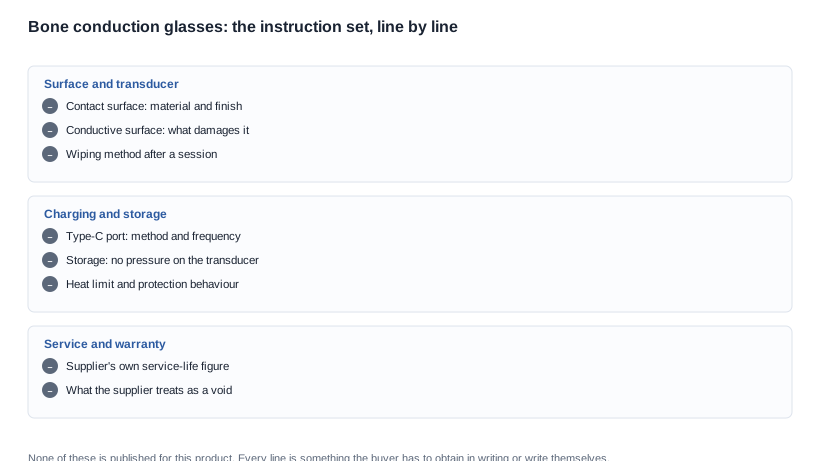
One, the transducer contact surface. The surface that has to sit against the skull, where sweat, skin oil and salt collect.
Two, the frame and lens surfaces. The visible part, which is easy to mark and is judged closely because it is what a customer sees when they put the product on.
Three, the charging contacts and the port. The product charges over Type-C, and a port that has collected debris presents as a unit that will not charge — a fault report that is not a fault.
Four, storage. A transducer pressed against a flat surface for hours takes a set, and a set transducer changes the sound the user receives.
Five, sweat and salt. Salt is the corrosive case, and the common one.
Six, heat and the cell. A 200 mAh cell is small, and small cells do not like being left in a hot vehicle.
Seven, the expected service life. No figure is published, and none should be invented.
Who has to own it
A brand owner owns the wording, because the wording is a claim and it appears in the packaging and on the listing. A channel buyer owns the enforcement, because the enforcement is the support script and the returns policy. A procurement manager owns the commissioning, because the instruction set is a line in the RFQ and a line in the purchase order like any other deliverable. And a supplier owns the engineering behind it, because the material facts, the damage mechanisms and the service-life expectation come from the product's construction and cannot be inferred from a sample alone.
The last of those is the one that is usually missed. A buyer can write a plausible instruction sheet; only the supplier can write a true one.

The transducer contact surface, and the one instruction that matters most
What the surface is, and why it is different here
The transducer contact surface is the part of the product that delivers the signal. It has to stay conductive, it has to stay free of the film that insulates it, and it has to stay geometrically where the frame puts it. On an ordinary pair of glasses, the closest equivalent is a pair of nose pads, and nobody writes a detailed instruction for those.
Here it is the primary acoustic element, and the instruction about it is the most consequential line in the whole set. The behaviour that makes the product work — a transducer seated against the skull with a consistent pressure — is exactly the behaviour that a customer can break with a household surface spray, a solvent wipe or an abrasive cloth, without any visible sign that anything has happened.
The instruction, and why solvent is the wrong answer
The correct instruction is narrow and it is specific: wipe the contact surface with a dry cloth after a session, and do not use solvent, because the conductive surface that delivers the signal is precisely the part a solvent attacks.
What makes it hard is that solvent is the default advice for a frame. A customer who has been told to wipe their glasses with a household surface spray for years will do exactly that, and the product will continue to work well enough for a while and then will not. That delay is what turns a handling error into a warranty claim.
What to ask the supplier is short: the material of the contact surface, the finish on it, what is known to damage it, what removes salt from it, and whether a protective coating is fitted that would change the answer. All five, in writing. None of them is published for this product, and all five determine the wording of the most important line in the instruction set.
What a buyer can establish on a sample, and what they cannot
A sample in the hand establishes some of it. Whether the surface is a smooth pad, a textured pad or a coated metal, and whether it holds a visible film, are both observable. What is not observable is the chemistry: which solvents attack the finish, whether the conductive path is on the surface or beneath a coating, and how the material behaves after salt has been left on it and dried.
That division is the whole method for this article. Observe what a sample can show, and request in writing what it cannot.
The other six areas, and why each is different in this category
One: the frame and lens surfaces
Fresh water and a soft cloth, no abrasives, and no household surface product on the frame. For a product in a category with a 35 dB amplification figure, the frame is also the thing a customer judges most closely, because it is what they see when they put the product on. The visible surface of this product carries a brand's identity, which is a commercial reason to keep it presentable and a support reason to keep the instructions narrow.
Two: the charging contacts and the port
The product charges over Type-C. A port that has collected debris presents as a unit that will not charge, and a customer who does not know what a charging unit resembles will report a working one as faulty. The instruction has to state the behaviour of the indicator, and the indicator behaviour is not published.
There is a second reason the port matters commercially: a channel that sells this product in a market where cables are supplied separately, or where customers use their own, will generate port complaints that look like battery faults. The instruction is the first line of defence, and the product page needs the same line in it.
Three: storage, and the specific reason it matters here
A transducer pressed against a flat surface for hours takes a set, and a set transducer changes the sound the user receives, which is a quality complaint that looks like a product failure. Store it in a case or a pouch, and do not put anything on top of it.
Note that this instruction depends on whether a case or pouch ships with the product, and the catalogue publishes no charging-case row for this product, so whether a pouch is part of the box is itself an open question that the buyer has to answer before the instruction can be written.
Four: sweat and salt
Salt is the corrosive case, and it is the common one, because the product is in contact with the head through the whole of a working day. Rinse with fresh water after a session and dry before storing. This matters more here than on an open-ear audio frame, because the transducer is a pressure-coupled device and the salt film is on the coupling surface.
Five: heat and the cell
A 200 mAh cell is small, and small cells do not like being left in a hot vehicle. A product left in a parked car can also trip a protection circuit that will not reset until it cools, which presents as a flat battery. This is a case where the instruction protects the supplier as much as the customer: a unit that has been left in a car and will not turn on is a unit that gets returned as faulty, and the return is avoidable.
Six: the expected service life
No figure is published, and none should be invented. What a buyer can do instead is ask what the supplier's own figures are, in writing, and what the service commitment is. The bone conduction common questions piece covers what is missing from the documentation, and the durability analysis covers what the product's construction demands.

Why the instruction set cannot be copied from a supplier leaflet
Three reasons, and they compound
The category has no published model designation, no published instructions and no published acoustic detail. A brand cannot lift an instruction sheet from a supplier document, because there is no supplier document to lift, and it cannot write one that specifies a surface product or a replacement part that may not exist.
It also cannot write a service life, because there is no figure, and a service life is the line that a warranty is measured against. And it cannot write a storage instruction that depends on a case it has not yet established ships in the box.
The three gaps compound rather than sit side by side. A missing designation means the instruction set has no product to attach to; a missing service life means the warranty clause has no reference point; and a missing accessory confirmation means half the instruction set is provisional.
The three checks that make the instruction true

The instruction set has to be built on three things: the physical construction as it actually is, a sample unit in the hand, and the test results.
The construction, taken from the supplier's own material statements. The sample, examined for what the contact surface is made of, what the indicator looks like when the unit is charging, and what the port is like. The tests, which are the part most people skip: check what happens to the charging port after a week of ordinary handling, check whether the indicator is legible in daylight, and check the contact surface after salt has been left on it and dried.
Those three checks produce an instruction set that is true, rather than one that is plausible. A plausible instruction set is worse than none, because it gives a customer confidence that the product is being handled correctly when it is not.
How to verify an instruction set before it ships
An instruction set is a document, and documents are verified the way documents are verified: against a reference, by a named person, with an acceptance condition.
The reference is the supplier's own written position. If the buyer has written an instruction and the supplier has written one, the two are compared and the difference is resolved in writing. A supplier who will not confirm a material statement in writing has not confirmed it, and the buyer should treat that line as provisional.
The acceptance condition is a test rather than a review. Three of the seven areas can be tested on a sample within a week: the port and the indicator, the contact surface, and the storage set. The remaining four are written answers. A buyer who has tested three and received four written statements has a complete instruction set; a buyer who has read one draft and liked the tone has nothing.
The questions to ask are short, and the same for every line. What is the material; what damages it; what removes salt; what the indicator does while charging; what the storage requirement is; what the heat limit is; what the service-life expectation is. Seven questions, one document, one deadline, all of them asked before you order rather than after the first support ticket quotes the wrong answer back at you.
The red flags in a draft instruction set are recognisable. A draft that says "keep the surface clear" without naming a method. A draft that names a specific surface product the supplier has not confirmed. A draft that quotes a service life that no document supports. A draft that assumes a case in the box when no case row is published. Each of those is a line a customer can break and a support team cannot defend.
The criteria for acceptance are worth writing as a short checklist, and the checklist belongs in the purchase order: instruction set received; all seven areas covered; every statement traceable to a supplier confirmation or a sample test; translations delivered; the packaging version carrying the short form; and the support script matching the same wording.
The bone conduction buying guide covers the commercial side of the same category, and the bone conduction price comparison covers the questions that have to be answered before a quotation is possible.
The instruction set as a commercial asset, and what it costs to get wrong
What the instruction set protects
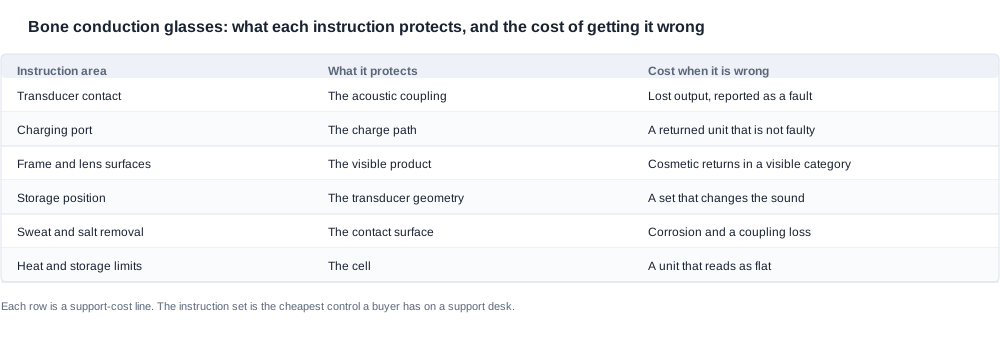
Read the table earlier as a support-cost table rather than a maintenance table, and it becomes a commercial one.
A mis-stated instruction about the contact surface produces returns that are diagnosed as acoustic failures, and acoustic failures are the most expensive kind of return in this category because the replacement is rarely the answer. A mis-stated instruction about the port produces returns that are diagnosed as battery failures, and each one consumes a support contact, a replacement unit and a freight movement. A mis-stated storage instruction produces returns that are diagnosed as product faults and that recur, because the customer's own habit has not changed. A mis-stated service life produces warranty claims the brand cannot settle, because there is no reference point.
None of those costs is visible in a unit price, and all of them are visible in a support budget.
Where the instruction set has to be produced
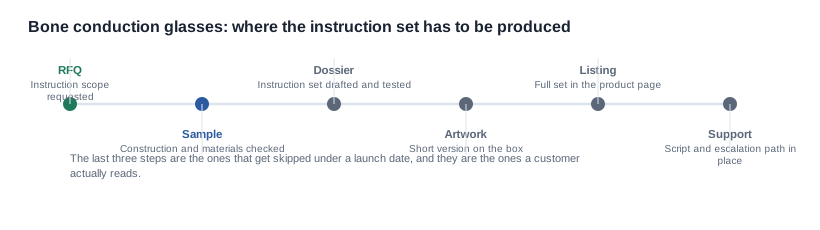
The timeline above is the production sequence, and the last three steps are the ones that get skipped under a launch date. They are also the only ones a customer actually reads: the short version on the box, the full set on the product page, and the script the support team uses when a customer calls.
The step that gets skipped most often is the middle one — the drafting and testing of the set itself — because the rest of the programme is visible and the instruction set is not. The result is a box with a paragraph of generic advice, a listing with no instruction section at all, and a support team improvising.
The commercial terms around it
The negotiable items are the supply of the supplier's own written instructions and material statements; a structured technical handover session with the supplier's engineering team; the inclusion of the instruction set in the packaging rather than only online; the translation of the set into the languages the channel needs; the supplier's written service-life expectation as the reference for the warranty clause; and the supplier's agreement to answer a technical query on a returned unit rather than only issuing a credit.
The items that do not move are the material facts themselves, the conditions under which the product works, and the fact that no instruction set can substitute for a design that tolerates ordinary handling. A buyer who asks a supplier to write an instruction set around a fragile surface is asking for a warranty to absorb the fragility.
What we will and will not write into it
The instruction set in this category is a product requirement rather than a courtesy, because the transducer is a pressure-coupled component whose condition directly affects what the user hears. We will not publish an instruction that the documentation does not contain, we will not quote a service life figure that nobody has published, and we will not describe the product as a hearing aid or attach any hearing-improvement claim to it.
We will do the part that can be done honestly: specify the scope of the instruction set, identify the observations a sample can support, and list the written answers that have to come from the supplier's engineering team. The published bone conduction specification is the honest baseline, and the export considerations cover the paperwork that has to travel with the goods.
Seven items to establish before the instruction sheet is written
- The transducer contact surface: what it is made of, and what damages it.
- The frame and lens surface: what can be used on it.
- The port and the indicator: the behaviour, and the method.
- The storage requirement, and whether a case or pouch is in the box.
- The rinse and dry procedure after a sweaty session.
- The heat and storage limits, and any protection-circuit behaviour.
- The supplier's own service-life expectation, in writing.
What to send before the next supplier conversation
Send the seven items as a single list, and split them into the two they belong to: the six that need a written answer from the supplier's engineering team, and the one that needs the sample in the hand. Then add the market it is going to and the claim you are making, and we will separate the seven items we can close from a sample from those that need the supplier's own input.
Related reading
- The documentation gaps in this category — bone conduction glasses common questions
- What the construction demands — bone conduction glasses durability
- The category overview — bone conduction glasses buying guide
Pass the market you are shipping into and the claim you plan to make, and we will mark which of the seven items a sample can close and which ones still need the supplier's own engineering input.


