

A bone conduction frame delivers sound as mechanical vibration through the skull rather than as pressure waves through the air, which is why the ear stays open. Understanding how bone conduction glasses how bone conduction works matters commercially for one reason above all: the mechanism determines what may be claimed about the product, and in the United States that boundary is drawn in statute.
It also determines what a buyer has to control. A bone-conducted product has a signal path with a contact point in it, and that contact point is a variable the frame geometry sets and the person using the frame perturbs. Two units from the same production run can deliver different output to two different people, and no product parameter on the catalogue page explains why. Everything else in this article follows from that.
This article walks the signal path stage by stage, sets out the four consequences that follow directly from it, compares the three acoustic routes that a buyer can specify between, and then states what the mechanism demands from the frame and what the documentation for it would have to contain.
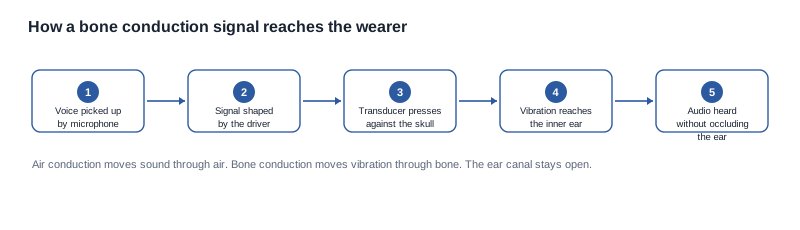
Bone conduction: how the signal reaches the listener
Five stages, each of which has a published row or an unpublished one, and each of which changes what the product does in a room.
The stages
A microphone picks up the voice at the front of the frame. The catalogue publishes no microphone specification for this entry: no count, no pickup distance, no processing behaviour, no noise figure. In the open-ear audio range, the same row is equally thin, which is one of the reasons the range's pages read as electrical specifications rather than acoustic ones.
A driver and amplifier shape the signal into vibration rather than into sound pressure. Here the catalogue does publish something, and it is the only acoustic figure anywhere in the range: an amplification gain of 35 dB. It is a ratio between an input and an output, with no reference level, no input signal, no frequency band and no measurement location attached, which means it describes the stage without describing what the stage delivers.
A transducer rests against the temporal bone, usually at the hinge end of the temple, and presses there. The catalogue publishes nothing about the transducer itself: no driver unit size, no frequency response, no contact geometry, no material. The only feature row on this product's page is the gain, so the transducer is undocumented in its entirety.
The vibration travels through the skull and arrives at the inner ear, where it is perceived as audio. The ear canal is never occluded and never has to be, because no air-transmitted sound is involved in the output path.
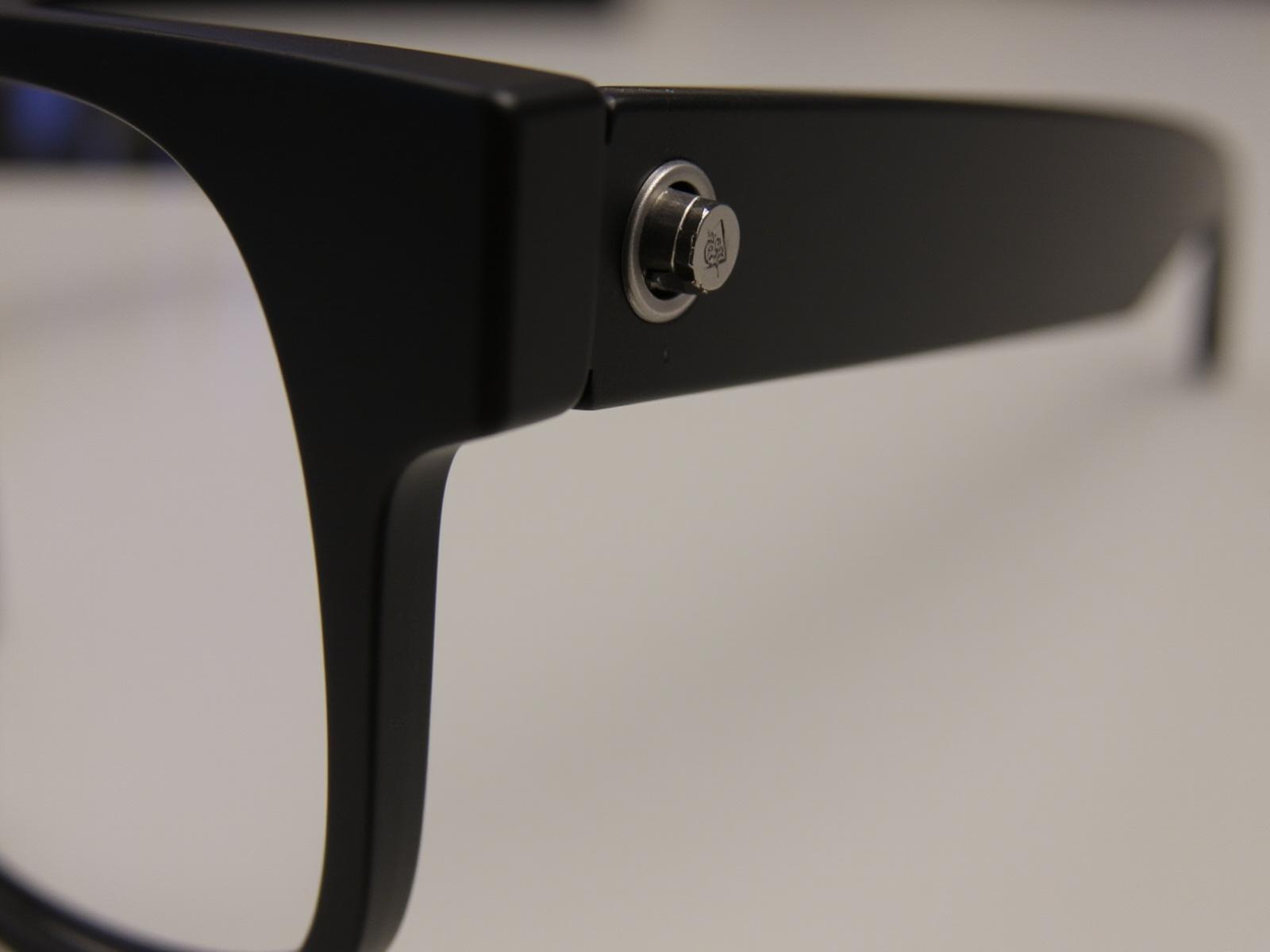
The frame holds the whole assembly, and it is the frame that sets the contact geometry, the contact pressure and the alignment of the transducer with the bone. No frame weight, no temple length and no adjustment range is published for this entry.
Why the path matters more than the parts
The mechanism is not a set of components; it is a chain with a coupling in it, and the coupling is the part of the chain that a buyer cannot change. A buyer can choose a cell, a chip and a housing. A buyer cannot choose where the temporal bone is, how thick the skin over it is, or how much the frame presses against it on a given head. That is why a bone-conducted product's performance is a property of a system that includes the person, and why a test performed on a fixture is not the same measurement as the one a customer receives.
The practical consequence for a procurement team is that the acceptance criteria for this product have to be written in terms of a range across people rather than a single number. A supplier who quotes a delivered output figure without stating the coupling condition has quoted a fixture measurement, and the difference between the two is the difference between a specification and a claim.
Four consequences of an open ear
The open ear is the defining characteristic of the category, and it produces four consequences that a buyer should price into the brief.
Ambient noise enters, and it is amplified with everything else
Because the ear is open, traffic, wind and conversation all arrive at the same time as the intended signal. This is the defining trade of the category: open-ear awareness traded against signal-to-noise ratio. A 35 dB gain amplifies the environment, and it amplifies the noise floor with the same ratio it applies to speech, because the amplifier does not know which is which.
For a buyer whose use case is a noisy environment, this is the first thing a customer will report. The mitigation is a signal processing strategy, and the catalogue publishes no processing row for this entry, so the question of what the product does with noise is a question for the supplier rather than something a buyer can read.
There is no occlusion effect, and no sealed canal
Nothing is inserted and nothing is blocked, so there is no occlusion effect and no need for a sealed earbud. This is an advantage in environments where a blocked ear is unacceptable, and it is the reason the product suits use cases where the person has to hear their surroundings at the same time.
It also means the output will not measure well on the same loudness scales as an earbud. A comparison against an earbud on a published volume figure is a comparison of two different measurement systems, and the conclusion it produces is an artefact of the measurement rather than a property of either product.
The transducer position is a signal path parameter
Vibration transfers most effectively where bone is close to the surface and the contact is firm. Temple pressure on this product is not a preference setting; it is a signal path parameter. A frame that slides loosens the path, and a frame that presses harder increases the coupling along with the pressure the person feels.
This is the mechanism's most important commercial consequence, and it is also the one most often missed. A report that the product has become quiet is usually a geometry report, not a defect report, and the remedy is adjustment rather than a firmware change. A brand whose support script does not know this will replace units that do not need replacing.
Geometry problems surface as audio problems
The coupling is the mechanism, and the coupling is set by geometry. This is why the coupling analysis treats the contact as a signal path rather than as a preference, and why a sample review has to record the output at more than one coupling condition.
It is also why the absence of published geometry data is a genuine problem for this entry rather than a formality. No frame weight, no temple length and no adjustment range appear on the product's page, so there is no way to reason about the population the product will serve, and no way to write an adjustment instruction that a distributor could follow.
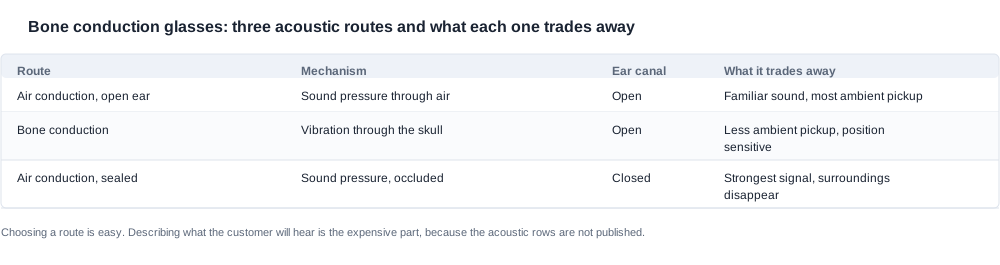
Three acoustic routes compared
Three routes to open-ear or covered audio appear in this category, and they are three different products rather than three versions of one.
| Route | Mechanism | Ear canal | What it trades away |
|---|---|---|---|
| Air conduction, open ear | Sound pressure through air | Open | Familiar sound, but the most ambient pickup |
| Bone conduction | Vibration through the skull | Open | Less ambient pickup, but position-sensitive |
| Air conduction, sealed | Sound pressure, occluded | Closed | Strongest signal, but the surroundings disappear |
Choosing between them
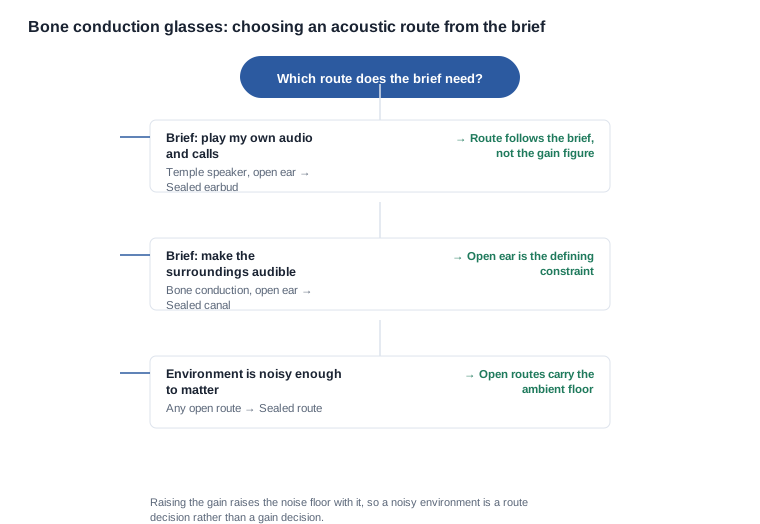
If the brief is to deliver the person's own audio and calls while keeping the surroundings audible, the open-ear air conduction route is the answer. These are the products the rest of this catalogue's audio range is built on: the K01 and the K02 with their V5.3 radios and 90 mAh × 2 cells, the D11 and the D12 with their V5.4 radios and 100 mAh cells, and the LC-105 pair, the G07 and the YK12 with 55 mAh × 2 cells. The open-ear audio guidance sets out the trade-offs in general terms.
If the brief is to make the environment more audible, the bone conduction route is the only one of the three that addresses it, and the product in this catalogue that does it is the entry with the 35 dB figure. That is a different brief, a different customer and a different compliance profile, and the open ear comparison works through why the two should not share a comparison table.
If the environment is noisy enough that the ambient floor matters more than awareness, the sealed route is the correct engineering answer, and it is the one that cannot be met by a bone-conducted product at any gain setting. Raising the gain raises the floor with it. This is the trade that a buyer has to make explicitly rather than by default, because the natural instinct in a noisy environment is to ask for more gain, and on this mechanism more gain is not the answer.
What the comparison costs in documentation
A buyer comparing two routes also has to budget for the documentation each route implies, and the asymmetry is worth noting. The open-ear audio products in this catalogue publish a consistent set of electrical rows — radio version, cell, charge time, charging method and runtime — and no acoustic rows at all, so their acoustic file has to be built from scratch by whoever sells them. The bone-conducted entry publishes one acoustic row and a thinner electrical set, and no model designation, so its file has to be built from scratch in both directions. Neither route is documented for acoustic performance, which is a property of this catalogue rather than of this category, and a buyer comparing on published rows alone is comparing two products that are equally undocumented and not equally named.
Choosing a route is easy. Choosing a route and then being able to describe what the customer will hear is the expensive part, because the description has to rest on measurements that this catalogue does not publish: no frequency response, no leakage level, no driver unit size, no microphone pickup distance, and no delivered output at a defined coupling condition.

What the mechanism demands from the frame
Because the coupling is mechanical, the frame stops being a housing and becomes part of the signal path. Four demands follow.
The contact surface has to stay consistent
The transducer presses against the bone through a surface that abrades and deforms. A degradation in that surface reduces output with no visible fault, which is the failure mode the durability analysis covers in detail. A frame that seats firmly on day one and loose on day ninety has a signal path that has changed, and the change is invisible to every test that does not measure output.
The geometry has to be repeatable across units
A production tolerance on the position of the transducer in the temple becomes a tolerance on the coupling for every person who uses the frame. A wide tolerance in production is an acoustic spread in the field, and the spread is a commercial fact: it becomes the range across which a customer's experience varies, and it becomes the width of the acceptance window a brand has to publish.
The frame carries an amplifier, not just a cell
A 35 dB gain stage running continuously is a power load and a heat source, and the cell and the amplifier share the same temple. The catalogue publishes a 200 mAh cell, a charge time of two hours or less and a rated runtime of roughly seven hours, with no test condition, and no thermal data. A buyer who has to plan a full working session on one charge is planning against an unconditioned number, and the question of what the rating assumes is the same question that the common-questions piece asks.
The product needs a physical identity
There is no model designation for this entry. A frame whose geometry carries the signal path is a model, in the practical sense, and a product that cannot be named cannot have its geometry controlled, because there is nothing to hold the tolerance against.
How to choose the acceptance criteria for a coupled product
A buyer writing acceptance criteria for this product has to make one decision before the others: whether the acceptance value is a single number or a range. A single number implies that the coupling is held constant, and the only way to hold it constant across people is to constrain the population, which is a product decision rather than a test decision. A range implies that the variation is expected and managed, which is the honest position for a product whose performance depends on contact.
How to choose between them is a function of the brief. If the channel is a controlled one, with a known user group and a trained setup, a single number with a documented coupling procedure is reasonable. If the channel is open retail, the range is the only defensible form, and the listing has to describe the range rather than its best end.
Three criteria then apply whatever is chosen. The coupling condition has to be part of the criterion, because a delivered output without it is not comparable with anything. The population has to be stated, because a range across three people is not a range across a channel. The failure consequence has to be written before the measurement, because a criterion without a consequence produces a report rather than a decision.
Two red flags are worth naming. The first is a delivered output quoted on a fixture, which is a different measurement and will be read as a customer-facing figure. The second is an acceptance value that names a single person, which produces a specification that cannot be held by a second unit. Both are common, and both are caught by asking what the coupling condition was and how many people the number covers.
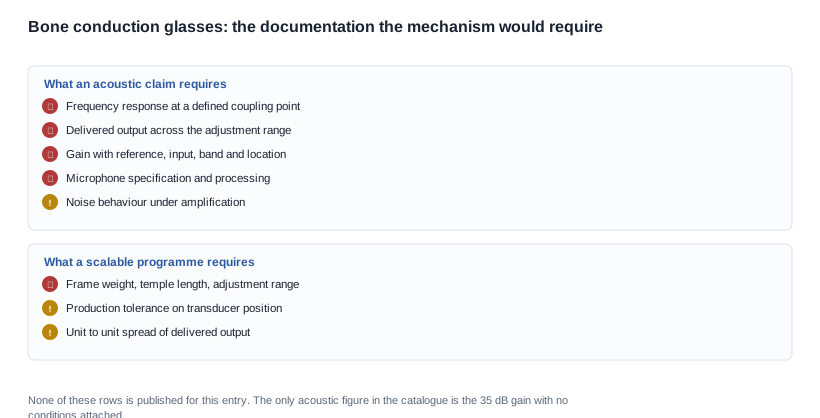
The documentation this mechanism would need
A buyer specifying this category should know what a complete acoustic file contains, because the catalogue version is one number.
The eight rows
- The frequency response, measured at the transducer and, separately, at a defined coupling point.
- The delivered output across the adjustment range, with the coupling condition recorded.
- The gain with its reference level, input signal, band and location.
- The microphone specification, including pickup distance and any processing behaviour.
- The noise behaviour under amplification, which is the row that matters for a noisy environment.
- The frame weight, the temple length and the adjustment range, without which the coupling cannot be reproduced across a population.
- The production tolerance on the transducer position, which sets the acoustic spread in the field.
- The unit-to-unit spread of the delivered output, which tells a brand whether one SKU serves a channel.
Why each row is worth requesting
Rows one to five are what make an acoustic claim possible. Without them the product can be described mechanically and not acoustically, which is a legitimate position but a limited one for a listing.
Rows six and seven are what make the product scalable. A brand that cannot describe the geometry it covers or the unit-to-unit spread cannot write an adjustment instruction, cannot set a quality-control sample plan, and cannot predict what a customer will report.
Row eight is the one that decides whether a private-label programme is viable. A wide spread means a brand is shipping a different product to every customer, and the complaint pattern follows immediately. A tight spread means the same product arrives every time, and a listing can promise the experience it describes.
The order to request them in is worth noting, because it is not the order of technical importance. Rows one, two and three are acoustic measurements and they need a rig, so they are the slowest and the most expensive. Rows six, seven and eight are production and quality records, which most suppliers already hold in some form and which are therefore the quickest to produce. A buyer who requests the production records first gets a usable picture of the product's spread within days, and can then decide whether the acoustic programme is worth funding. The pitfalls in this category come from requesting the acoustic package first and waiting months for a number that does not answer the commercial question anyway.
None of these eight rows is published for this entry, and the only acoustic figure the catalogue carries is the 35 dB gain with no conditions attached.
Where we draw the line on mechanism claims
The mechanism is worth describing precisely, because describing it accurately tells a buyer immediately what the product cannot do. It delivers vibration through bone with the ear open. It is not an over-the-counter hearing aid in the United States, because the over-the-counter hearing aid definition at 21 CFR 800.30 describes an air-conduction device and this is not one. It does not treat a condition.
We will describe the mechanism accurately and we will decline to describe a benefit we cannot evidence. We will not publish a clinical result, a diagnostic capability or a hearing outcome; we will not describe the product as a hearing aid in any framing; and we will not invent a reference level, a frequency band, a measurement location, a noise figure, a frame weight or a certification status, because the documentation does not contain them. The health claims and limits piece sets out that boundary in full, and the certification and medical device boundary piece works through the regulatory reasoning.
What we can tell you is which of the eight rows above are the ones that decide whether the mechanism works for the brief you have, and which of them a supplier can produce on request.
Related reading
- The legal boundary — certification and the medical device boundary
- The mechanism as a signal path — coupling and geometry
- Choosing between mechanisms — open ear comparison
Tell us the destination market and we will tell you which claims the product can carry in it.


