

These two frames agree on the battery row and disagree on everything around it. Both carry a 290 mAh cell, both state a rated use of about seven hours, and both state a charge time of two hours or less. The differences are the charging interface and the case — and the case is where a retail proposition is actually won or lost. This page is written for the buyer choosing between them, and it sets out what the published rows decide, what they deliberately do not, and the questions to ask before the order.
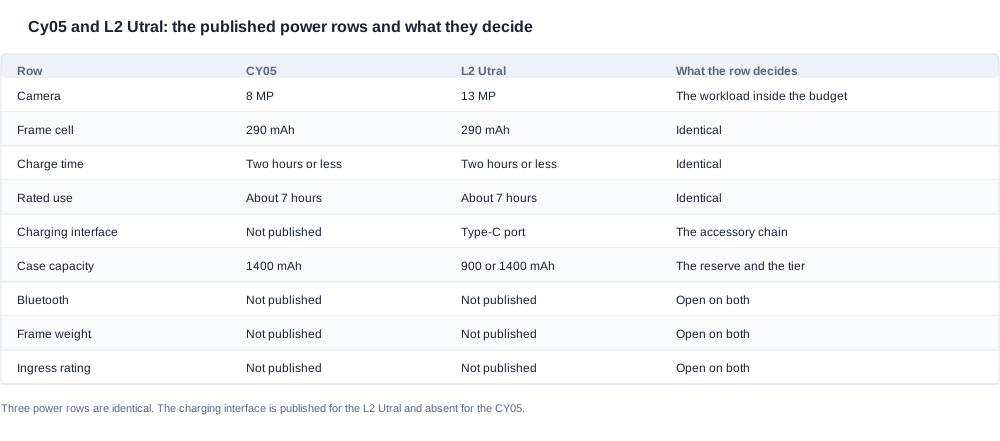
One point has to be made before anything else, because it changes how the whole comparison is read. Our catalogue publishes a charging interface for the L2 Utral and publishes no charging method row at all for the CY05. The CY05 entry carries a pixel row, a cell capacity, a charge time, a rated runtime and a charging case capacity, and no interface line. That is not the same as a magnetic interface written differently; it is an absent row, and an absent row is a question to a supplier rather than a value to design around.
Cy05 and L2 Utral: identical power rows and one published interface
Here is the published comparison in full.
| Row | CY05 | L2 Utral | What the row decides |
|---|---|---|---|
| Camera | 8 MP | 13 MP | The workload inside the budget, and therefore the real runtime |
| Frame cell | 290 mAh | 290 mAh | The platform row; identical on both |
| Charge time | Two hours or less | Two hours or less | The overnight turnaround |
| Rated use | About 7 hours | About 7 hours | The endurance claim, subject to a condition nobody has published |
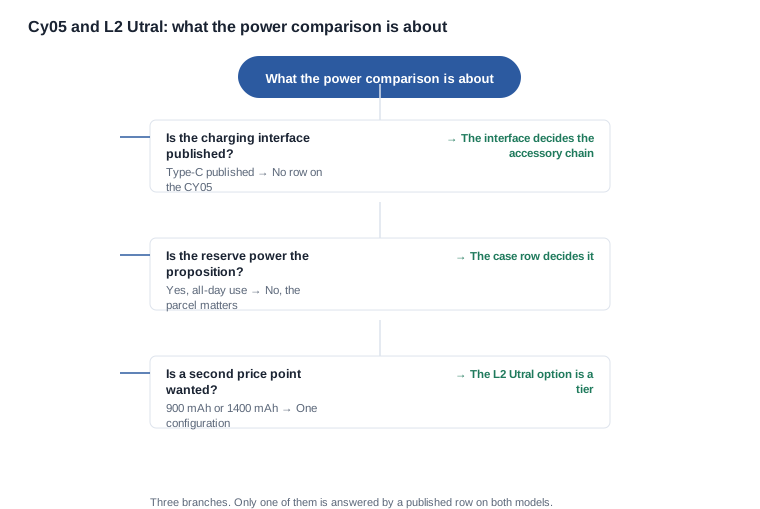
| Charging interface | Not published | Type-C port | The accessory chain, the in-box cable and the retail proposition |
| Case capacity | 1400 mAh | 900 mAh or 1400 mAh | The reserve-power argument, and a second price point from one platform |
| Bluetooth | Not published | Not published | A compatibility row that has to be requested |
| Frame weight | Not published | Not published | Whether the product can be sold with a number |
| Ingress rating | Not published | Not published | Whether it can be positioned for outdoor use |
Three identical rows, one genuinely different pair, and a second case option on one of them. That is the comparison.
Why the charging row is the difference that reaches the customer
A Type-C frame with a case is a retail proposition. It lets a customer try the product at a desk, wear it for the rest of the day, and top it up in a bag. A single cable that can be replaced anywhere in the world is a small thing on a specification sheet and a large thing in a channel.
A frame whose interface is unpublished is a design task, not a specification. If the CY05 charges magnetically, the box needs a dock or a pad and the customer has to learn a charging orientation; if it charges over Type-C, the box needs a cable. Both are workable, but they are different boxes, different accessory lists, different instruction cards and different freight weights, and a buyer who designs the accessory chain on an assumption is designing something that may have to be reworked late.
The second case option is worth reading too. Being able to offer a 900 mAh and a 1400 mAh variant lets a brand build two price points from one platform, and that is a cheaper tier strategy than developing a second product. It also has a cost: two configurations, two accessory paths and two sets of copy to keep accurate.
What identical battery rows hide from a buyer
Identical published battery figures do not mean identical behaviour. The two frames carry different camera modules — 8 megapixels against 13 — and a camera is the largest power consumer in this class of device. Neither figure states whether the camera was active during the measurement, whether the radio was connected, or what the starting state was.
The honest reading is this: on the published data, these two frames have the same energy budget and potentially very different workloads inside it. If your content is 8-megapixel stills on one and 13-megapixel video on the other, the runtime gap in real use will be wider than the specification sheet suggests, and it will not show up in any comparison table. The same question is covered in CY05 battery life and L2 Utral battery life, and raised from the other direction in V03 Pro versus L2 Utral charging.
The charge ceiling is a ceiling and not a promise. Two hours or less permits exactly two hours and does not permit the stricter claim that a charge is completed inside two hours. The starting state is not published for either model, so full-to-empty and empty-to-usable are different numbers and only one of them is in the document.
And the endurance figure is a rating rather than a measurement of your use case. No test condition is published for either model. Write it as a rated figure with its qualifier attached, and put the condition you have established into the purchase order as an acceptance criterion rather than as an assumption.
A caution about the model pair
Another model in the same catalogue publishes specifications identical to the CY05 — the same 8 megapixels, the same 290 mAh cell, the same 1400 mAh case, and the same absent charging method row. Nothing in the published data says what separates them.
Before you build a listing that argues for this model over its sibling, ask in writing what the difference is. It may be a firmware variant, a frame style or a supply arrangement, but a private-label listing that differentiates two products on an unnamed feature is a listing that cannot answer a customer question.
The CY05 charging method is not published, and what follows from that
This deserves its own section because it is the point where a buyer can most easily build a product on an assumption.
Across our catalogue, seventeen models publish magnetic charging and seven publish a Type-C interface. Four camera models publish no charging method row at all: the CY03 and the CY05, and the L1 Pro and the MT6. The CY05 is one of those four, and the L2 Utral — the model it is being compared against here — is one of the seven that publish a Type-C port.
Three consequences follow from that, and each one is commercial.
First, the box contents are an open question for the CY05. A Type-C frame needs a cable in the box and no proprietary accessory; a magnetically charging frame needs a dock or a pad, and a customer who loses the pad has a product that will not charge. That is a service cost as much as an accessory cost, and the charging options analysis for the L2 Utral covers that route for the model that does publish an interface.
Second, the customer instruction card and the support script cannot be finalised. Both of them describe an interface, and both of them have to be produced and revised if the assumption was wrong.
Third, the certification scope may be affected, because a radio and charging arrangement of this kind is normally described in the technical file that supports a conformity declaration. The catalogue carries a company-level export certification page whose content is images rather than text, its text contains no reference to CE, FCC or RoHS anywhere, and there is no per-model certification row for either model — so this has to be confirmed in writing for each designation.
The remedy is one line in a reply. Ask which interface the CY05 uses, whether the frame can be charged without the case, and whether the answer applies to the configuration being quoted. That is not an unreasonable request; it is the row that seventeen other models in the catalogue carry and four do not.

Case capacity, case logistics and the L2 Utral dual option
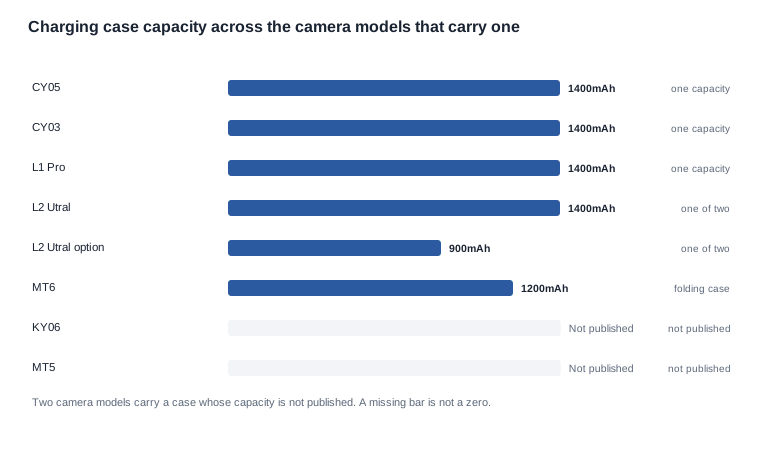
The CY05 publishes a 1400 mAh case. The L2 Utral publishes two capacities at 900 mAh and 1400 mAh. Both figures are for the charging case rather than the frame, and both are the largest published case capacities in the camera family. A case of that size is roughly five times the 290 mAh frame cell — a derived comparison, not a published figure — and it is what makes an all-day product story possible.
The case is also the heaviest line in the delivered cost. A second lithium cell in every shipped unit changes the packed weight, the carton dimensions, the volumetric calculation, the freight class and the battery transport documentation. That is the trade the shipping weight analysis covers, and it is why the comparison between these two models is better made on the delivered parcel than on the frame.
And the case is where the customer meets the product. A customer who sees a case in the product photograph and receives one in the box is the point of the whole exercise. A customer who sees a 1400 mAh case advertised and receives a smaller one has a returns problem. On the published rows, the CY05 commits to one capacity and the L2 Utral commits to two, so a brand choosing the L2 Utral has to decide which configuration it actually ships — and that decision is a range decision, not an accessory decision.
Two case capacities and the configuration they create
When a model offers two published case capacities, the configuration question moves upstream into the range plan rather than staying with the accessory. The L2 Utral publishes both a 900 mAh case and a 1400 mAh case, and the CY05 publishes a single 1400 mAh capacity. On the published rows, the CY05 therefore has one case configuration to stock, artwork and describe, while the L2 Utral has two, and each of them becomes a separate packing instruction, a separate carton line and a separate entry in a spare-parts list. A buyer who plans one configuration for a model that publishes two has already decided to defer that decision to the first stock cycle, which is the point at which a packaging change is most expensive to make.
There is a second, quieter consequence. A charging case is the component a customer is most likely to lose, most likely to buy a spare of, and most likely to return a mismatched one for. A range that stocks two capacities needs a spare-parts rule that says which one applies, and a returns rule that says what happens when a customer orders the 1400 mAh version and receives the 900 mAh version. Neither rule can be written from a catalogue row, because the catalogue does not state whether the case capacity follows the frame configuration, the destination market, or a pack format the buyer selects. That is a question for the quotation, and it is a cheaper question to ask before the artwork is designed than after a customer complains.
Verifying the CY05 and L2 Utral comparison before ordering

Ask for the runtime test condition on both models, in identical words. Seven hours is a number without a workload, and the workload is the question on which the two models differ.
Ask whether the camera was active during the measurement. This single question determines whether the identical rows are comparable, and it is the question that decides the real-world gap between the two.
Ask for the charging interface on the CY05, and for the case contents on both. The case capacity alone does not describe the customer experience; what matters is what is in the box, whether the case charges the frame, and how long the case itself takes to charge.
Ask for the Bluetooth row for each configuration. It is not published for either model, and a compatibility question is settled at the request stage or not at all.
Ask for the frame weight. It is not published for either, and it is the row that decides whether a product can be described with a number or only with a price.
Confirm the certification position for the configuration you intend to order, in each destination market. The certification coverage page sets out what that means, and the use-case fit between the camera platforms is covered in CY05 versus MT6 use-case fit.
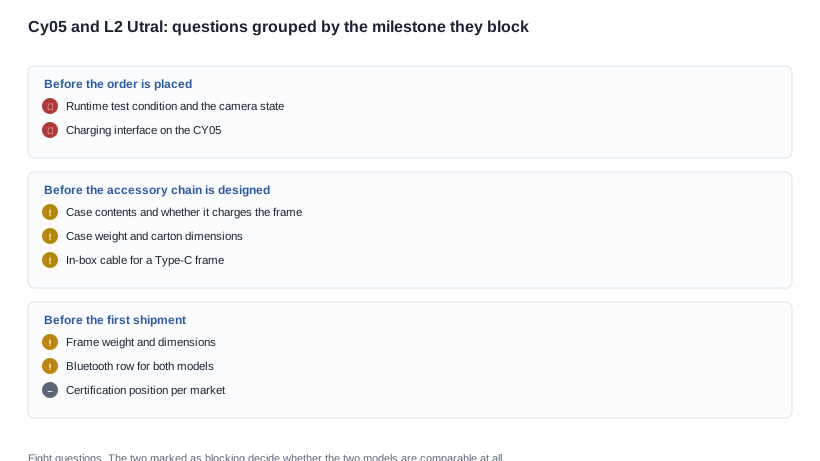
The criteria for evaluating the answers. Each reply must be tied to a model designation, must state the configuration it was measured on, and must say what it excludes. A reply that answers at the family level has not answered, and the reason that matters here is specific: the L1 Pro and the CY03, and the CY05 all publish identical power rows, so a family-level reply for any of them is a plausible reply for all of them. The red flags to watch for are a figure with no date, a case described by what it does rather than by what it holds, and a certification answer naming one designation where the range needs two.
Making the two runtime figures comparable before they reach a specification sheet
Two identical figures are not the same claim until the conditions behind them match, and a buyer who puts both on a specification sheet without that work publishes a comparison nobody can reproduce. Four conditions have to be aligned before the two endurance figures can sit in the same column, and each one is a question to the supplier rather than an assumption to be made.
- The camera state during the measurement. A camera that is idle and a camera that is recording draw differently, and the difference is large enough to change which of the two models appears to last longer. Ask what the camera was doing for each published figure, and ask for a figure measured in the state the customer will actually use.
- The radio state. Whether the radio was connected, and whether it was carrying traffic, belongs in the answer. A figure measured with the radio idle is not the figure a customer experiences in the field.
- The duty cycle. A runtime figure measured at a low frame rate or a low sample rate is not the same product. Ask for the capture settings the measurement used, and write them into the specification sheet next to the figure.
- The ambient condition. Battery behaviour in a cold room is not the battery behaviour of a warm one, and a laboratory figure carries an ambient condition that a customer in a cold market will not reproduce. Ask for the condition rather than assuming the measurement was made in a temperate room.
The same four questions apply to recharge time, and the recharge time carries an extra gap: the published ceiling of two hours or less covers the frame, and the catalogue publishes no charge time for the charging case on either model. A buyer planning a shift-based rotation needs the case's own recharge time, because the case is what determines how quickly a parcel goes back into service. Ask for that figure together with the case capacity, the case interface and the packed weight, in the same message, so the answer arrives as one package rather than as four separate replies.
The CY05 and L2 Utral power comparison in the purchase agreement
The case is the commercial decision, not the battery. A 1400 mAh case changes the customer's day, the accessory set, the packaging specification, the freight class and the battery transport documentation. The trade-off between a Type-C frame with a case and a frame whose interface is not yet documented is a delivered-cost decision, and the unit price gap between the two frames is usually the smallest part of it.
The terms worth negotiating, and worth asking for. Unit price and the quantity breaks across the two models, the accessory set and its order minimums, the packaging specification, delivery splitting, payment nodes against inspection, the warranty period with a stated response time, the return terms, and the terms of a pilot order with a defined exit.
The terms that follow the process rather than the negotiation. Certification cost and lead time, which follow the testing body and the destination market. Tooling, which is often amortised across the first order while certification cost is per product family — ask which one you are being quoted, because the two are frequently bundled into a single line that hides which is which.
The purchase agreement for this pair has to carry the items the catalogue cannot. The published rows for the configuration ordered; the rated use with its test condition and the camera state; the charging interface and the accessory set; the case capacity and, where two are offered, the second capacity; the Bluetooth row; the frame weight once established; the certification position per market; and the warranty period with a stated response.
What to leave out. Any claim that the two frames are equivalent on the power rows, because the camera rows differ and no test condition is stated for either. Any inference from megapixels to image quality, because the sensor model, the field of view and the video format are not published for either model. And any statement that the CY05 charges magnetically, because our catalogue does not publish a charging method for it.
The CY05 and the L2 Utral are the two ends of the same commercial idea: one sells the day at a desk, the other sells resolution and a travel-friendly cable. We will not describe a magnetic interface as more convenient than Type-C in general, or the reverse, because the answer depends entirely on your channel — and in the CY05's case the interface is not published at all, so we will not describe it either way. We will not present the two identical power rows as proof that the two products are equivalent, when the camera modules differ and no test condition is stated for either. We will not quote a frame weight, an ingress rating or a Bluetooth version that we have not been given.
Send us the target market and the quantity, and we will come back with what is documented and what still needs confirming. The AI camera glasses page is the range reference.
Related reading
- Use-case fit between these platforms — CY05 versus MT6 use-case fit
- Certification position for this comparison — certification coverage
- Camera platform range overview — AI camera glasses
Send the target market and quantity and we will come back with what is documented and what still needs confirming.


