

A sample review is only worth running if it is designed to produce evidence a buyer can act on, and most sample reviews fail at that first step: they repeat the catalogue. The protocol below is built the other way round. It starts from the published rows, turns each one into a test or a document request, defines what counts as a pass before the unit is opened, and ends with a record that can be attached to a purchase order. The point is not to find reasons to reject a unit. The point is to know, before a shipment is accepted, which claims can be made on published evidence, which claims can be made on measurement, and which claims cannot be made at all.
D11 sample review: what a unit can settle
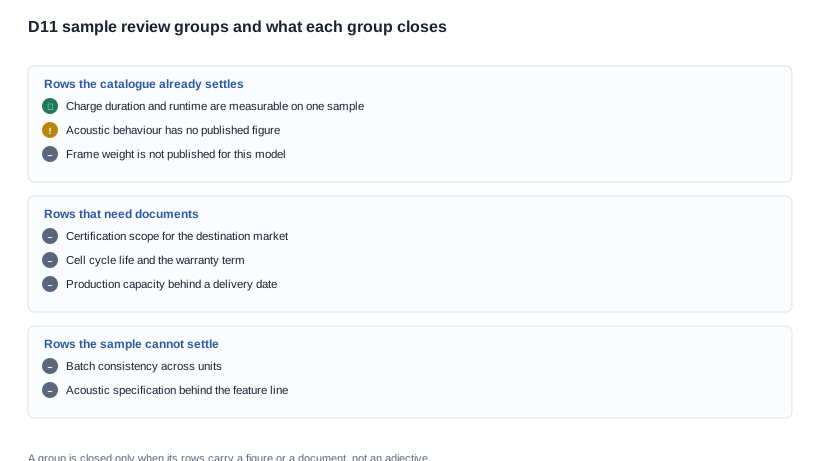
What the catalogue settles before the box is opened
The published sheet for this model is short and it should be the first item on the review checklist, because every later check is measured against it. The catalogue publishes a single 100 mAh cell, a charge time of two hours or less, an approximately seven-hour rated runtime, Type-C charging, Bluetooth V5.4, and two feature lines: surround sound and long battery life. It publishes no frame weight, no acoustic figure, no charging input, no ingress rating, no per-model certification row and no charging case row.
A review that starts here behaves very differently from one that starts with the unit. The published rows are the specification, and anything the sample does not match is a conversation with the supplier about a specification rather than a preference about a product. The published specification list sets the same rows out one by one.
What only a unit in the hand can settle
The sample is the only source for the following, and each one needs a written condition attached:
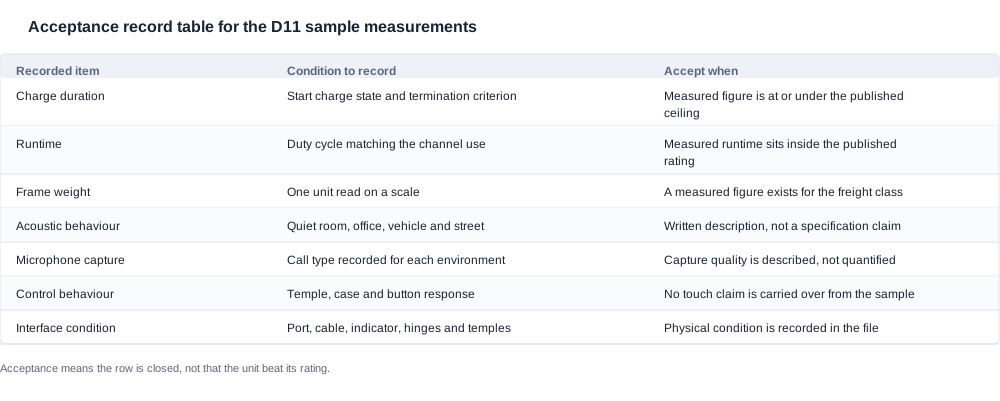
- Charge duration. Measured from a stated start charge, with the termination criterion recorded.
- Runtime. Measured against a duty cycle the channel will actually use, not against a laboratory loop.
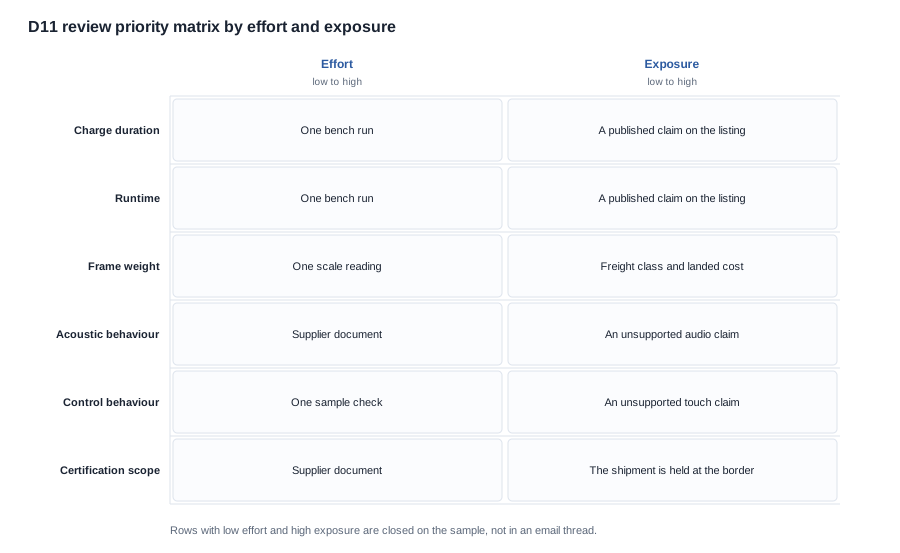
- Frame weight. Not published for this model, so a scale reading is the only figure that exists. The weight comparison across the audio range explains why that number decides the freight class.
- Acoustic behaviour. No driver size, no frequency response and no leakage figure are published, so what the sample can produce is a written description per environment, not a specification.
- Microphone capture. Not published either; a live call is the test, and the call type has to be recorded.
- Control behaviour. What the unit actually responds to. The catalogue publishes no touch row for any model — the only control rows anywhere in the catalogue are the AR model's indicator light and button control, and that is a button. A sample that reacts to a tap on the temple does not license a touch claim on a product page.
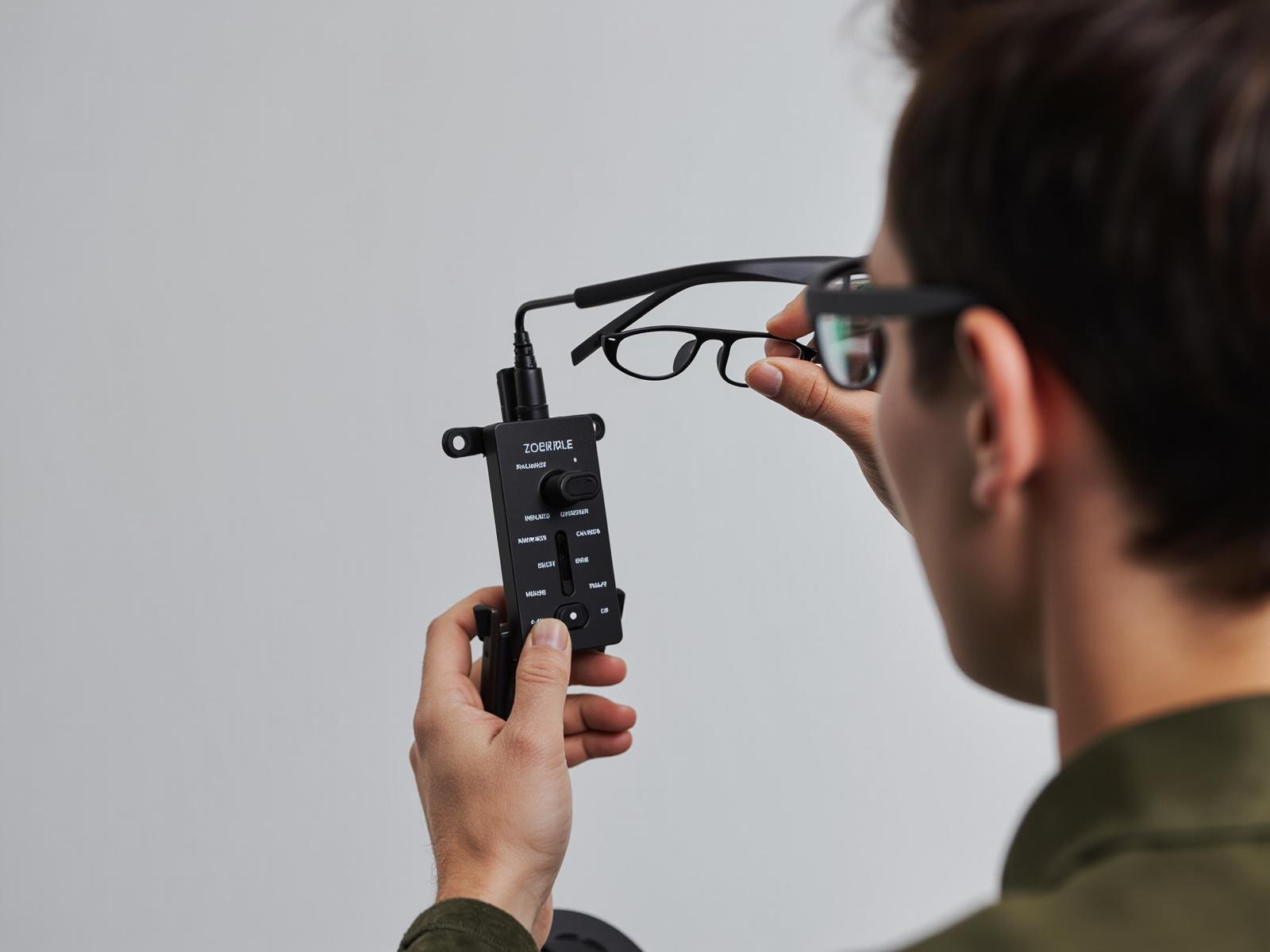
- Interface details. Port location, whether a cable is included, indicator behaviour and the physical condition of the hinges and temples.
What no sample can settle
Some items are outside the reach of a unit in the hand, and a reviewer who tries to close them with a sample is wasting time. The certification scope for the destination market, the cell cycle life, the production capacity behind a delivery date, the warranty term and the acoustic specification itself all need documents. So does any statement about how consistent the product is across batches, because one sample is one unit. These belong in the document request, not in the bench checklist, and the certification position for this model lists what has to arrive in writing.

D11 power checks: bench protocol and field check

The bench protocol
The bench run is short and it is written down before it starts. Record the unit identifier and the date. Charge from the stated start state and time to the stated termination. Then run the duty cycle — playback at a fixed level, a defined number of calls, and the link in a defined state — and time to the end point. Repeat on the same unit so that variance is visible, and measure a second unit once so that unit-to-unit difference is measured rather than assumed.
The battery life analysis sets out the same protocol in full, and the battery comparison method explains why the condition, rather than the figure, is the thing to hold on to.
The field check
The bench protocol produces a number. The field check produces the answer to the question the buyer actually has: does the unit hold up across a shift, a shift pattern, or a trading day? A unit that passes four hours on the bench and fails a six-hour route is a normal result, not a defect, and the only way to see it is to run the duty cycle that the channel will actually impose. It is also the cheapest red flag in the whole review, because a supplier who cannot describe the typical duty cycle has not thought about the product the buyer is going to sell.
Red flags in the power results
Four results deserve escalation rather than a note:
- A charge that stops early, or a unit that reports full while the case or cable behaves inconsistently.
- A runtime that collapses on the second run of the day with the same unit, which points at the cell rather than the protocol.
- A unit that becomes too warm to hold during continuous playback.
- A supplier answer that changes the figure between two emails without changing the condition.
None of these can be resolved by repeating the measurement until a better number appears. Each one is a question back to the supplier with the log attached.
The rule a buyer applies to a measured sample
The acceptance rule is written before the results, and it should be about the evidence rather than about the product. A suggested rule: the unit is accepted against the power rows when the measured charge duration falls within the published ceiling and the measured runtime falls within the range the published rating implies, and the result is published as a measured figure with its condition attached. The rule deliberately does not require the sample to beat the rating — that is a test the supplier can pass by choosing the measurement condition, which is exactly how a disputed claim is created later.
D11 acoustic checks without an acoustic specification
What the surround-sound line does and does not license
The surround-sound feature line is a name on a page. It is enough to describe the product in a catalogue sentence and to give a listing a feature to point at. It is not enough to compare the product with another brand, because no acoustic figure is published for any model in the range, and it is not enough to support a superlative, because there is no baseline in the range for the word to be measured against. A review that writes "surround sound verified" has verified a label, not an acoustic specification.
The environment series
Because there is no specification, the review has to be qualitative and it has to be repeatable. Run the same content in three environments — a quiet room, a normal office, and a street — and write down what the listener actually gets in each: intelligibility at a low level, whether the sound field appears to open up or simply get louder, and how much of the audio reaches the immediate surroundings. The comfort and fit analysis explains why the open-ear geometry determines the answer before any measurement is taken.
Three environments also produce a comparison a reviewer can use to select. If a channel sells into quiet indoor settings only, one environment decides the product; if it sells into street or warehouse settings, the third environment decides it, and the result may be that no model in this range can carry that proposition on published evidence.
The microphone check
The microphone side follows the same logic. No microphone count, no pickup distance and no noise-handling figure is published for this model or for any other in the range, so the review produces a description of behaviour on a live call: intelligibility to the far end, whether the wearer is audible in a busy environment, and whether background sound is captured with the voice or instead of it. The microphone testing notes cover the procedure in more detail. Record the call type — quiet room, office, vehicle, street — because a single uncontrolled call is not a result.
What to request instead
Where the sample cannot produce a figure, the answer is a request. Ask the supplier for the acoustic specification behind the feature line, for the microphone specification, and for the charging input. If the answers come back as documents, they can be quoted as the supplier's specification; if they come back as adjectives, the line stays a name and the product page should treat it as one.

D11 documentation checks before the shipment is accepted
Documents that must name the model
The rule for every document is simple and non-negotiable: it has to name the model designation. A declaration that covers "the Bluetooth audio glasses range" is not evidence about this model, because the range contains models with different cells, different charging methods and different feature rows. Ask for the documents that name the model, with the issuing body, the issue date and the expiry or review date recorded alongside each one.
The battery and shipping chain
The cell specification, the cell test summary, the watt-hour rating, the packing instruction derived from that rating and the packing list itself form one chain, and a break anywhere in it stops the shipment. This model publishes no charging case row, so the frame cell is the item that travels and the accessory, if any, has to be established from the packing list rather than from the product page. That is a specific question to ask, and the answer belongs in the file.
The export file
The export documentation is the part of the review that is easiest to leave until the last minute and the part that costs the most when it is late. Ask for the full set in one request, list it in advance, and check the set against the list rather than reading the set. A missing document discovered after the first shipment is a delay with a cost attached; a missing document discovered during the sample review is a line on a list.
D11 review record and the order acceptance rule
The record structure
One row per check, one page per unit, is enough. Each row carries the check, the value or the observation, the condition, the evidence reference, the reviewer and the date. The record is not a report; it is a set of attachments to the purchase order, and it is written so that a colleague can repeat the same check on the next batch without asking a question.
How to weigh a failed check
Not every failed check is a failed product, and the review needs a rule that separates the two. A check that fails against a published row is a specification failure and goes to the supplier. A check that fails against the buyer's own expectation — a runtime shorter than the channel hoped for, an acoustic result weaker than the sales team imagined — is an expectation failure, and the answer is to adjust the proposition or to select another model. Mixing the two is how a sample review turns into an argument.
A hypothetical review, worked through
Consider a hypothetical channel team reviewing a sample of this model before a launch.
The team reconciles the published sheet first and finds five rows to test and six rows that only a document can close. It runs the bench protocol on two units, defines a duty cycle that matches a warehouse shift, and finds the measured runtime consistent between them but shorter than the published rating under that duty cycle — a result they file as a measured figure with its condition attached rather than as a rejection. It runs the acoustic series in three environments and finds the third environment decides the product, which is information the sales team can act on. It asks for the six documents and the charging input, and receives four of them the same week.
The purchase order that follows states the published rows, the measured figures with their conditions, the two documents still outstanding as named open items with an owner, and the claims the channel may and may not make. Nothing in that order is a guess, and nothing in it is a quotation of a number that nobody can produce.
D11 review ownership and commonly skipped checks
Who owns each check, and when
Ownership is what turns a checklist into a process. In a typical review there are four parties and they each own a different part of the record. The supplier's product or application engineer owns the written answers: the measurement condition behind the published runtime, the charging input, the acoustic detail behind the feature line, and the cell specification. The buyer's own engineer owns the bench measurements and the field run, because a supplier-measured number is not independent evidence of a supplier's claim. The channel's quality function owns the comparison of the sample against the specification annex and the packaging check. The buyer signs the record and owns the decision on whether the shipment is accepted.
Timing is part of ownership. A review that starts after the purchase order has been placed is an inspection, not a due diligence step, and the buyer has already committed. A review that starts before the order can still change the configuration, the claim set or the quantity. The practical sequence is to ask for the documents in the same week the sample arrives, run the bench protocol in the following days while the acceptance rule is still fresh, and complete the field run before the first shipment rather than after it. The Bluetooth audio glasses entry level options piece sets the surrounding range context for channels building a first line.
That sequence also tells the buyer which checks cannot be compressed. A certification document that arrives after the first pallet has shipped is not a delay in the file; it is a shipment held at a border. A weight measurement takes ten minutes. A runtime measurement takes most of a day, and a field run takes as long as a shift.
The three checks most often skipped
Three checks are routinely left out of a sample review, and each of them is cheap.
The first is the second unit. A single unit that behaves well proves that one unit behaved well on one day. Measuring a second unit once, for one cycle, is enough to reveal whether the sample is an outlier, and it costs one additional charge cycle. Channels that skip it usually discover the variance at the customer end.
The second is the cable. If the charging method row is Type-C, then the cable included in the box, the cable a customer buys at a service counter and the cable a warehouse stocks are three different objects with three different failure rates. Checking what ships in the box against what the channel intends to stock takes a minute, and the charging options analysis for this range covers the accessory economics behind the choice.
The third is the control behaviour. A reviewer who tries every input on the unit will find a reaction to something, and the temptation is to write it down as a feature. The catalogue publishes no touch row for any model, and the only control rows anywhere in it are the AR model's indicator light and button control. So the correct record entry is an observation of what the unit responds to, kept in the sample file and kept out of the product page, because a behaviour observed on one unit is not a specification, and a specification the catalogue does not carry cannot be published as one.
Each of the three is a small job with a disproportionate effect on the accuracy of what is claimed afterwards.
What a failed acoustic check does to the proposition
A failed acoustic check is rarely a rejection trigger; it is usually a scope change. If the third environment — a street or a warehouse — decides the product, then the channel's proposition has to be evaluated against that environment rather than against the quiet room where the sample was first opened. Three outcomes follow. The channel keeps the model and narrows the environments it sells into. The channel keeps the model and the environment and accepts that the product is not the right answer for that segment, which is a decision with a cost attached to it. Or the channel selects another model whose published rows fit the environment better.
Which outcome applies is a commercial question rather than a technical one, and it is exactly the kind of decision that a sample review is supposed to inform. A review that reports only pass and fail leaves the buyer to make that decision later, without the evidence. A review that reports what the product does in each environment lets the buyer make it now, and the D11 how it compares piece puts this model's published rows next to the rest of the audio range so that the alternative selection has a documented basis.
The limits of this checklist
Our position on the sample review is simple: the catalogue publishes a specification sheet for every model and nothing beyond it. For this model that sheet is a single 100 mAh cell, Type-C charging, an approximately seven-hour rated runtime, a charge time of two hours or less, Bluetooth V5.4, and two feature lines — surround sound and long battery life. No price, minimum order quantity, delivery schedule, warranty term, production capacity figure, frame weight, acoustic figure, charging input, ingress rating or per-model certification row is published for any model, and we will not substitute a typical value for one. We will not turn a sample observation into a published specification, and we will not fill an empty row with a value taken from another model. The checklist tells a buyer what to test, what to request and what to record; it does not turn a measurement into a claim that the documentation does not support.


