
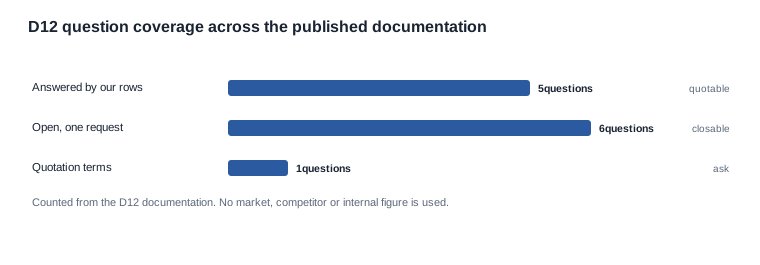
Five published rows describe the D12, so the questions that reach us about it are almost entirely about rows that do not exist. This page takes those questions in the order they arrive and answers each one with either a published figure or a clear "not published". Where the answer is the second one, we would rather say so than hand over a plausible figure that fails in your channel.
What is published: the wireless version is Bluetooth V5.4, the cell is 100 mAh, the charge time is two hours or less, the rated use is about seven hours, and charging is by Type-C.
What is not published: frame weight, temple and lens dimensions, ingress protection, the endurance test condition, the charging case position, the colour list, any acoustic descriptor, certificate numbers and model coverage, and the commercial terms.
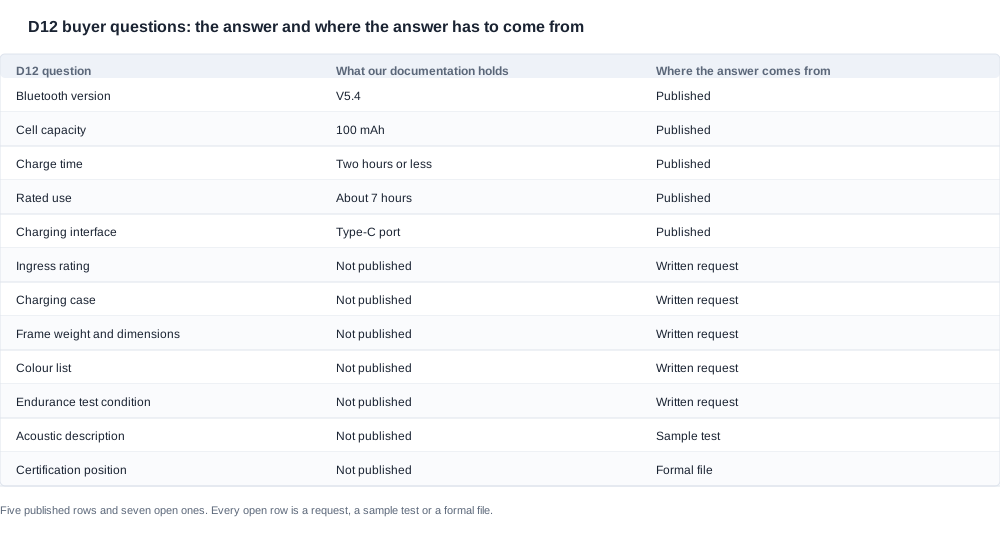
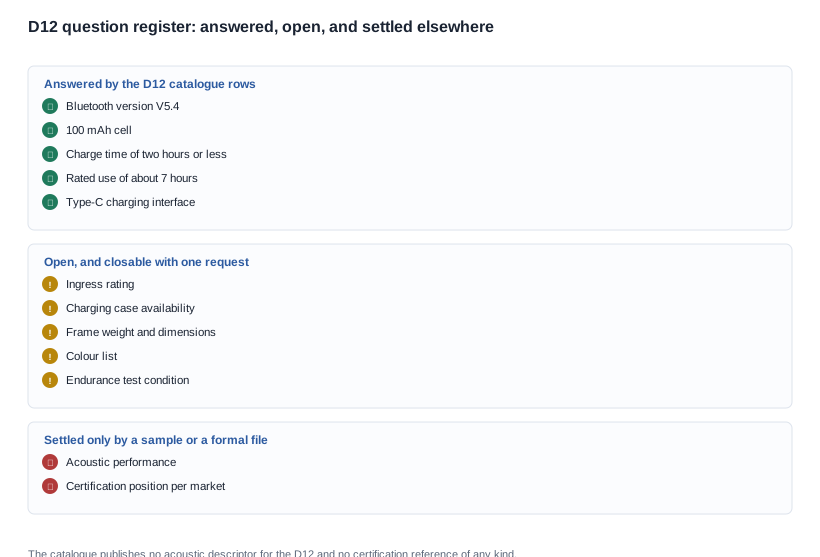
D12 common questions: what the five published rows settle
Before the individual questions, it is worth naming which questions the published rows close on their own, because that determines how the rest of a buyer's evaluation gets spent.
A published row settles three kinds of question. A row can settle what the product is (a 100 mAh cell, a Type-C interface, a Bluetooth V5.4 radio), what a specification line should say (charge time of two hours or less, rated use of about seven hours), and what can be copied into a listing without further work. Those three things are available for the D12 today, and they are enough to build a product page around the interface and the endurance rating.
A published row never settles a question about performance. Nothing in the D12's documentation says how the product sounds, how it behaves in rain, how it sits on the head, or how it holds up over a working day. A row that states a number is a statement about the specification, and a buyer who treats it as a statement about the result is the source of most of the disappointment in this category.
And a row cannot settle a question about the commercial terms. Minimum order quantity, lead time, unit price and the certification scope are not in our catalogue for any model, and a buyer who expects them to be will wait for a document that does not exist. The published D12 specification list is the row-level reference, and the D12 charging options page takes the power rows in more detail.
The questions that never get asked, and why they matter
Every list of buyer questions is shaped by what has already gone wrong for someone else, and three items on this model are routinely missing from the list because nobody asks until after the first shipment.
The cell configuration. The D12 publishes a single 100 mAh cell. That is published, and it is also the reason several other answers take a particular form — why the accessory is a cable, why the rated runtime sits below the two-cell models, and why the charge time ceiling matters more on this frame than on a larger one. A buyer who reads the 100 mAh as a number without the architecture attached will not know why the accessory list is short or why a shift-based customer will need a socket in the middle of the day.
The colour list. Nobody asks it until the packaging artwork is due, and then it is urgent, because a new colourway means new samples, new tooling and a new lead time that was never in the plan. The catalogue publishes no colour list for the D12, so the merchandising plan waits on a conversation with the factory rather than a selection from a list.
The battery transport file. It is the one item on the list that stops a shipment rather than a launch, and it is frequently raised late because it sits with logistics rather than with compliance. A 100 mAh lithium cell travels under transport rules that need their own paperwork, and that paperwork is separate from market access. The battery transport guidance covers what the file has to contain, and the right time to ask for it is in the same message as everything else.
And one item that is asked constantly and should not be. "What is the battery capacity compared with the other models?" The answer is a number, and the number is misleading on its own. The catalogue publishes cell values and counts — 100 mAh as one cell, and two-cell configurations written as a value and a multiplier — and the arithmetic total of a two-cell configuration is a derived figure rather than a published one. A comparison table that mixes the published form with a derived total makes the derived number look official. Write the published form, and if you need the total for a cost model, mark it as derived.

Is the D12 waterproof, and can it be positioned outdoors
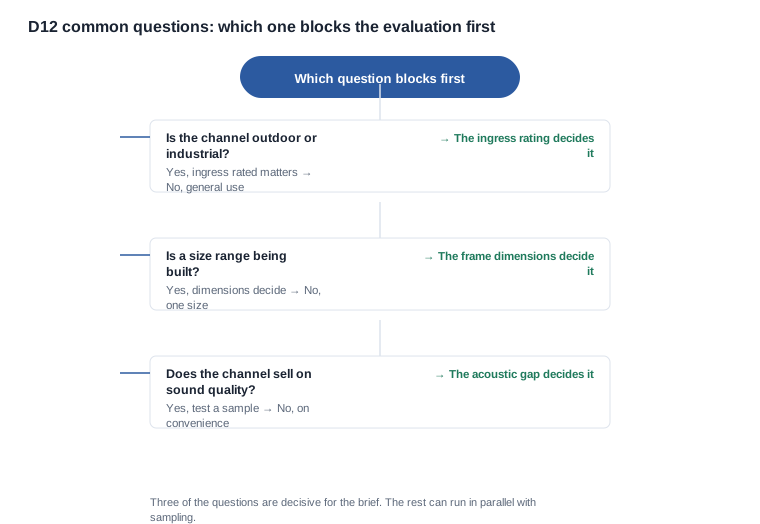
No ingress rating is published for this model. The absence is meaningful, and it needs to be read carefully: it does not mean the product has no resistance, it means neither we nor you can write a water resistance claim on a page.
That distinction has a commercial consequence rather than an engineering one. A channel selling into outdoor, sport or industrial applications has to answer a customer's "is it waterproof" question in writing, because that question arrives from a buyer rather than from a user. Without a published rating and without a test report, the answer is a conversation with the factory — which is a slower and less certain answer than a document.
It is worth knowing where our catalogue does publish a marking. The IP54 marking appears on the V06 and the S7, and on no other model. No audio model in this catalogue carries an ingress marking at all. That is not a comment on the audio models' build quality; it is a statement about what our documentation holds, and a buyer who wants an ingress-marked product should look at the models where the marking exists. The sport smart glasses range is where that question is at least addressed, and even there the position is a catalogue marking rather than a test report.
And a marking is not a test report either. Where a marking exists, it tells you the class of protection; it does not tell you the conditions, the duration, the post-test state of the product or the configuration the marking was assessed on. The IP rating and durability guidance sets out how that distinction works in practice, and it is the same distinction a buyer needs when a factory offers to state a rating informally.
How long the D12 runs, and what the seven hours is measuring
The published figure is about seven hours of rated use from a 100 mAh cell. The test condition is not published, so it is a rating rather than a measurement of a working day, and it should be written that way.
Three variables would each move it, and none of them is disclosed: the playback volume, the codec in use, and the distance between the frame and the source. A phone on a desk and a phone in a pocket are different radio conditions, and the second is what happens on most of the day. That is why the method for comparing battery life matters before any of these figures go into a comparison chart next to a camera model's runtime or a two-cell model's.
One published fact is worth noting about the architecture. The D12 publishes a single 100 mAh cell, where several neighbouring audio models publish two cells. That is a deliberate balance of the bill of materials against the energy budget, and it is the reason the accessory arrangement on this model is a cable rather than a cradle. What it is not is a weight claim: our catalogue publishes no frame weight for any audio model, so nothing can be said about how the single cell feels on the head.
The practical instruction for a buyer. Plan against seven hours as a rated figure, state the rating as a rating in the copy, and then measure it on a sample under your own workload before you promise anything to a channel. The measurement is cheap and it converts an open question into an acceptance criterion.
Is there a charging case, and what actually ships in the box
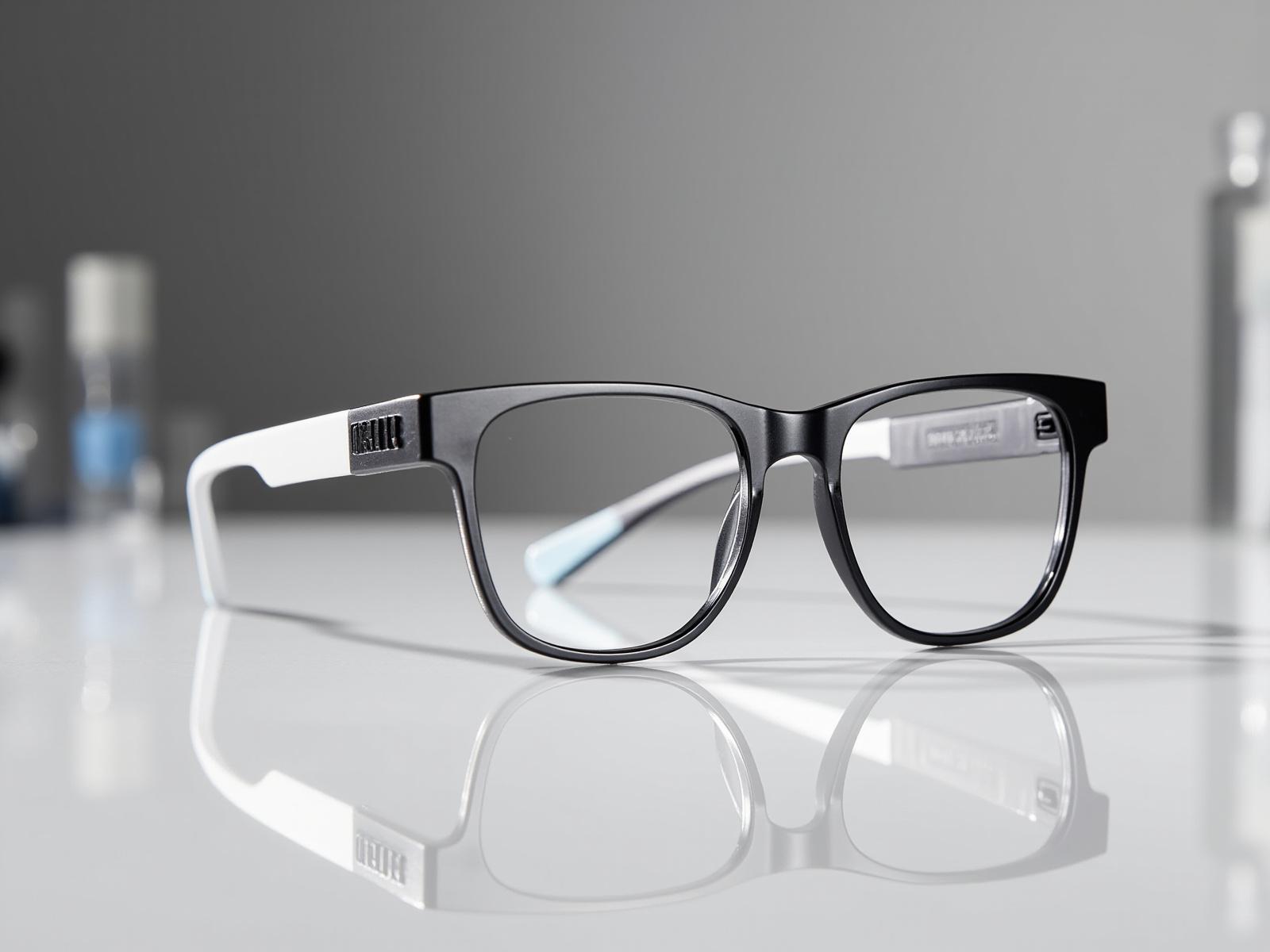
No charging-case capacity is published for the D12, and the Type-C interface is consistent with a cable-charged product: no dock, no cradle, no proprietary accessory in the box.
That is a genuine commercial advantage in one direction and a genuine limitation in the other, and a buyer should see both.
The advantage. There is no proprietary dock to lose, no dock to package, no dock-loss return reason, and no second lithium cell in the parcel. The customer replaces a cable on any street, which removes an entire support category. For a channel where the product is bought for use away from a desk, that robustness is worth more than the unboxing theatre of a cradle.
The limitation. If the retail proposition depends on a dock or on an unboxing moment — the product photograph showing a case, the customer lifting a lid, the ritual of setting the frame down to charge — then the D12 will not give you one, and no configuration change fixes that. It is a proposition decision rather than a specification gap, and it should be taken before the artwork rather than after it.
What is still open. Whether a case exists for this model at all is not published, so it is a question rather than an established absence. Ask it in the same message as the in-box cable question, and get the cable's length and specification while you are there, because that answer determines the accessory list, the spare-parts policy and the customer instruction card.

How heavy is the D12, and can a size range be built from it
Frame weight and frame dimensions are not published for this model, and that is the most consequential of the open rows for an open-ear frame.
The reason is that the number decides three things at once. It decides whether the product can be described with a figure rather than an adjective, which is the difference between a listing that a buyer can compare and a listing they have to believe. It decides the freight class of every shipped unit. And it decides the return exposure, because a frame that does not suit the customer comes back, and on a product with no size range the returns arrive as sizing complaints rather than as product faults.
If you are building a size range, the dimensions are blocking. A brand distributing through an optical channel needs the overall frame width, the lens width and height, the bridge, and the temple length, in millimetres. Our catalogue publishes no frame weight for any audio model, and the only frame weight published anywhere in the catalogue belongs to the MT6 — the glasses body including its battery and camera, excluding its folding charging case — which is a different product in a different tier and cannot stand in for an audio frame.
The measurement is straightforward on a sample unit. Weigh the frame with the cell fitted, measure the five dimensions, and repeat on three units so that the spread across a production batch is visible rather than assumed. That is a morning's work, and it is the difference between a size range you can merchandise and a size range you can only describe.
And the question is worth asking as a specification line. Request the weight and the dimensions tied to the model designation, with the battery configuration stated, so that the answer can go into the specification sheet and into the purchase order as an acceptance criterion rather than into a conversation.
What to put in the specification once the gaps are closed
The point of chasing these questions is not the answers themselves; it is the specification sheet that results. A D12 specification a quality team can accept has five kinds of line, and they are written differently from each other.
The published lines. Bluetooth V5.4 for the wireless link, 100 mAh for the cell, two hours or less for the charge time, about seven hours for the rated use, and Type-C for the charging interface. Each of these goes on the sheet with its qualifier attached, and no more.
The measured lines. The frame weight in grams with the cell fitted, the frame dimensions in millimetres, the observed charge time from a stated starting state, the observed partial-charge result, and the measured runtime at your own workload. Each carries the configuration it was measured on and the number of units measured.
The ruled-out lines. The claim that the product is water resistant, the claim about sound quality, the claim that it lasts a working day. Writing these into a specification sheet as excluded claims is what stops a copywriter, a channel partner or a customer-support script from reintroducing them.
The open lines. Anything that has not been answered stays on the sheet as an open item with an owner and a date. An open line on a specification sheet is a scheduled task; a deleted line is a gap that reappears as a dispute.
And the commercial lines. The order minimum, the quantity breaks, the lead time, the certification scope and the warranty response, each with a source and a date. These come from a quotation rather than from a catalogue, and a specification sheet that mixes them with the published rows without marking the difference is a document nobody can audit.
This structure is what lets the sheet survive a change of supplier or a change of configuration. Every line says where it came from, and a buyer who has to re-verify the sheet after a change knows exactly which lines to re-check.
Is the D12 certified, and can we tell you how it sounds
On certification, the accurate position is that our catalogue holds no certification reference for any model. Not one of CE, FCC or RoHS is mentioned anywhere in the text. What exists is a single export certification page at company level, and what sits on it is imagery rather than prose; ten certificates are shown, eight appearance-design patents plus two utility-model patents, which are intellectual-property records rather than conformity assessments. No per-model certification row exists for the D12, and no record of a pending confirmation either.
So the answer to "is it certified" is that it has to be requested, and the request is a normal one: the document numbers, the issuing bodies, the validity dates and the model coverage list, per destination market. What matters commercially is that the model designation on the document matches the designation on the purchase order, because a certificate that names a sibling model does not automatically cover the D12 — and the D12 shares its published rows with a sibling, which makes the assumption easy to make and expensive to discover late. The D12 certification status page takes this apart in full.
On sound, the answer is more limited than buyers expect. The D12 publishes no acoustic descriptor at all — no driver size, no frequency response, no leakage figure, no microphone pickup distance, and no surround-sound row, where the neighbouring model in the same 100 mAh group does publish one. That last point is the single published specification difference between those two models, and it is the reason a sound-quality argument cannot be transferred from one to the other.
The honest framing is that the architecture is knowable and the performance is not. If the channel sells on convenience rather than on sound quality, that gap does not matter. If it sells on sound quality, the gap has to be closed with a sample unit and a capture kept as the reference file — not with a category description. The open-ear audio technology page and the noise control and microphone pickup page set out what to ask for and what to measure.
Six criteria for reading a supplier's answer
The questions on this page are easy to send and easy to answer badly, so the criteria for judging a reply are worth writing down before the replies come in.
- How to evaluate a weight answer: a figure in grams for the frame with the cell fitted, the case excluded, and a note of how many units were measured.
- How to evaluate a dimensions answer: frame width, lens width and height, bridge and temple length, with the temple's adjustment range if the temple adjusts.
- How to evaluate a runtime answer: the workload, the volume, the codec and whether the radio was connected, with the figure given as a mean rather than a best case.
- How to evaluate a charge answer: the starting state, the charger used and the elapsed time, rather than a restatement of the published ceiling.
- How to evaluate an acoustic answer: a capture under stated conditions, retained as a reference file, rather than a description of the architecture.
- How to evaluate a certification answer: the market, the document, the issue date and the model designations covered.
The red flags are the same across all six: an answer given for the family rather than for the model designation, a figure with no date, a best case offered where a mean was needed, and a certification answer naming a sibling model. When you assess a reply against a written criterion you can show your reasoning to a colleague, and when you assess it against an impression you cannot.

Where our own answers stop
We can answer the questions about the interface, the cell, the charge ceiling, the rated runtime and the radio version from published rows, and we will answer the rest by telling you they are not published and by naming the request that closes each one.
We will not quote a weight, a frame dimension, an ingress rating or an acoustic figure for this model, and we will not repeat the seven-hour figure as though its conditions were verified. We will also not describe the D12 as having or not having a feature on the basis of a sibling model's entry, and we will not claim the model holds a certification our documentation does not mention.
Send us the channel, the target retail price band, the quantity and the one requirement that is genuinely non-negotiable, and we will tell you whether the D12 meets it — or whether a different model in the range does.
Related reading
- Where the model lands — Bluetooth audio glasses
- The published rows, read one at a time — D12 specifications and features
- The nearest alternative on the platform — D12 versus D11 which one to choose
Send the channel, the price band, the quantity and the hard requirement, and we will answer it directly.


