
A d12 smart glasses vs k01 spec comparison is short, because each model prints five specification rows and four of those five sit close together. The useful version of the comparison is therefore a ledger rather than a verdict: it shows which published row settles which question, and which rows are blank on both models. Neither the D12 nor the K01 has a published frame weight, an acoustic figure, an ingress rating or a per-model certification row, so no ranking of the pair is defensible from our own documentation alone.
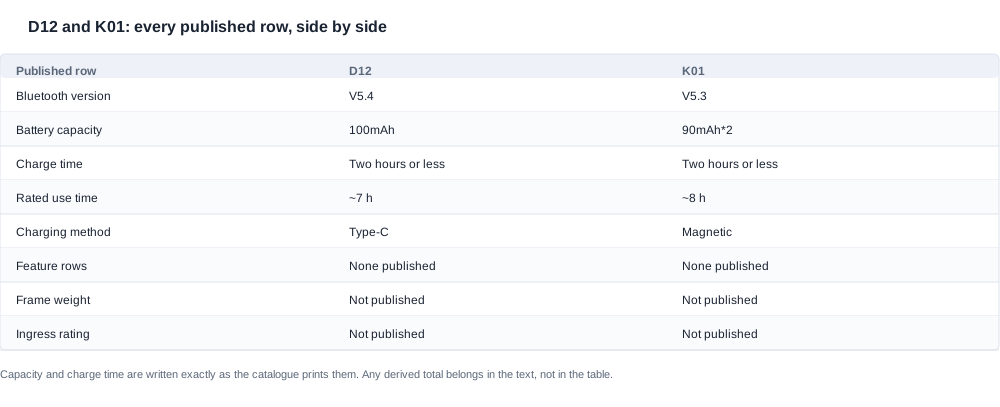
The short version first. The D12 publishes a 100 mAh cell, a charge time of two hours or less, about seven hours of use, Type-C charging and no acoustic descriptor. The K01 publishes two 90 mAh cells, a charge time of two hours or less, about eight hours of use, magnetic charging and no acoustic descriptor. That is the whole of the published difference between the two, and everything below is an explanation of how to use those rows in a buying conversation, what they leave unsaid, and which questions to put to the supplier in writing before anyone signs a specification sheet.
D12 and K01 on every published row
Both models sit in the same structural group. The catalogue's own contents page divides the range into camera models, audio models, sport models, a child group, a photochromic entry, a bone-conduction entry and an AR entry, and the D12 and the K01 are both audio models. The audio group contains eight models: the LC-105-1 and the K02, the D12 and the K01, the LC-105-2 and the YK12, and the G07 and the D11. The sport group contains three: the YKC02, the D17 and the ZH12. If your channel is deciding between audio models as a group rather than these two specifically, the Bluetooth audio glasses range is the page that carries the full set.
What matters for a comparison is the shape of each page. The D12 page prints five rows and nothing else: Bluetooth version, battery capacity, charge time, use time, charging method. The K01 page prints the same five rows in the same order. There is no feature row on either page. That is unusual inside the audio group, and it is the reason this comparison cannot be made on features, because there is nothing printed to compare.
The five rows that exist
Bluetooth version. The D12 publishes V5.4 and the K01 publishes V5.3. One generation apart, and in a channel that runs comparison sheets this is the row a competing listing will pick at. It is also the row we would least like a buyer to make a decision on, because the catalogue publishes no codec support, no multi-point behaviour, no connection range and no pairing test for either model. A generation number on a datasheet is a fact about the radio component, not a measure of what the customer experiences through your channel.
Battery capacity. The D12 prints 100 mAh. The K01 prints 90 mAh × 2, which is two cells of 90 mAh. The catalogue publishes cells and cell counts; it does not publish a total. We can add the K01's two cells together to reach 180 mAh, but that is a derived figure and it has to be labelled as one wherever it is used, in a quotation, in a specification sheet and on a product page. A number that appears without its derivation will be read as a published figure within a month.
Charge time. Both models publish a charge time of two hours or less. That is a ceiling, not a measurement, and the difference between a ceiling and an exact figure matters when you write a claim. Two hours or less permits exactly two hours; it does not permit a promise of under two hours. If a channel wants a headline number, the only honest headline from this row is the ceiling itself.
Use time. The D12 publishes about seven hours, the K01 about eight hours. No start state, no volume level, no radio state and no test profile is published for either figure, so the two numbers describe a test that nobody has described to you. Both are catalogue claims, and both need a stated condition before they can be written into a contract.
Charging method. The D12 charges over Type-C. The K01 charges magnetically. This is the row with the largest commercial consequence, because it decides what a customer must own, what you ship in the box, and what your support line will be asked about.
The rows that do not exist
The comparison is limited by absence as much as by content, and a buyer who reads the table above without reading this list will over-read it.
- Frame weight is not published for either model. Not the frame, not the temples, not the weight with the cell fitted.
- Acoustic behaviour is not published for either model: no driver size, no frequency response, no leakage figure, no microphone pickup distance.
- Ingress protection is not published for either model, so no water-resistance claim can be made.
- Colour and finish options are not published for either model, so a channel cannot plan a colour range from our documentation.
- Control method is not published for either model. The catalogue contains no touch row for any model in the range, so a capacitive control claim cannot be attached to either one.
- Per-model certification does not exist in the catalogue at all. There is no per-model row for any of the 28 models, so a certificate scope for the D12 or the K01 has to be requested in writing.
The Bluetooth version row and what it does not license
The Bluetooth version is the row most often used as a tiebreaker, and the row least able to carry that weight. A version number in a catalogue tells a buyer which Bluetooth specification the radio was built against. It does not tell a buyer which pairing experience the customer gets, because pairing behaviour also depends on the host device, the operating system version, the number of stored profiles, the antenna design in the temple and the firmware shipped on the day the carton was packed.
Three questions follow from that, and they are the same three questions for both models.
- Which profile is stored, and how many? A model that stores one profile behaves very differently from one that stores several, and neither page says.
- What happens on a second device? A channel that ships to offices, rather than to one person, meets this question in the first week.
- Is the radio held open during the rated use time? This is the condition question again, and it is worth resolving in the same document as the runtime condition, because the two answers belong to the same test.
None of this changes the D12 and K01 comparison, because the gap between V5.4 and V5.3 is real as a printed difference and small as a commercial one. What it does change is the risk that a channel publishes a generation number as though it were a quality statement. The Bluetooth connectivity page covers what a radio version does and does not establish, and the Bluetooth SIG qualification material covers the separate question of whether the radio itself is qualified for your market.
Reading a cell count against a single cell figure
The D12's 100 mAh and the K01's 90 mAh × 2 look like a capacity decision, and on paper the K01 is the larger number. On the rows as printed, the K01 also publishes the longer use time, which is at least the direction a buyer would expect.
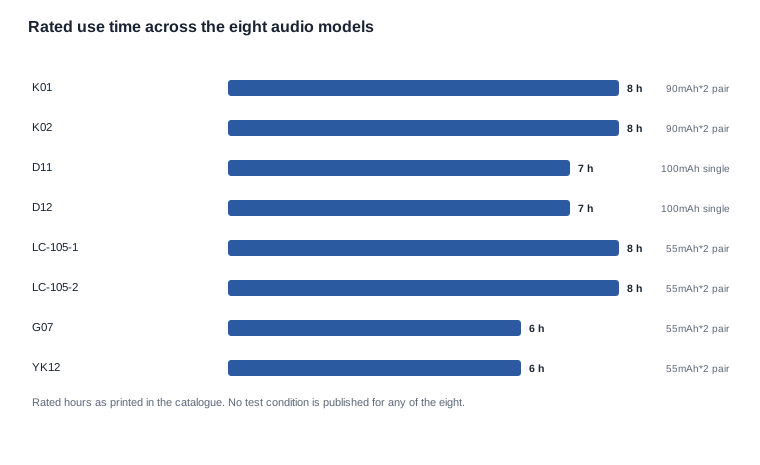
The chart above is the audio group at a glance, and it is worth reading as a whole rather than as a ranking. The G07 and the YK12 publish the same 55 mAh × 2 configuration as the LC-105 pair, but at about six hours rather than eight. The K01 and the K02 publish 90 mAh × 2 at about eight hours. The D11 and the D12 publish a single 100 mAh cell at about seven hours. The D17, one row away in the sport group, publishes a single 115 mAh cell at about seven hours with a charge time of about one hour.
What the printed capacity does and does not mean
Two models with the same printed cell configuration publish different rated use times, and two models with different printed cell configurations publish a use time that does not follow the capacity order. That is the observation that should stop a buyer from ranking on capacity at all. Cell capacity is a purchasing input: it tells a buyer roughly how much energy the device carries, and it tells an engineer something about the design. It does not, in this catalogue, predict the use-time row, and any quotation that converts one into the other is making a claim our documentation cannot carry.
The cell count itself does have a commercial meaning, and it is a different one. One cell in the frame means one power path, one charging connector, and a mass distribution that a buyer cannot see because no weight is published. Two cells, one per temple, spread the mass across the frame and split the charging interface into two points that have to mate with a dock. A buyer planning a magnetic-dock product has to think about alignment, about the dock itself becoming a second thing that can be lost, and about what happens to the in-box contents.
Why the runtime difference cannot be ranked without a condition
An hour separates the two published use times, and it is the number a channel will put on a product page. Before it goes there, three things have to be settled.
- The start state. A use-time claim without a stated start state is not a claim, it is a mood. Full, or part-charged, is the difference between a number you can reproduce and one you cannot.
- The volume level and the content. A published figure means nothing without the audio profile it was measured against, and no channel should invent one.
- The radio state. Whether the connection is held open for the duration changes the draw materially, and the catalogue does not say which condition applies.
If a supplier will not state the condition, the buyer has a legitimate reason to write the claim as the catalogue prints it — about seven hours, about eight hours — and to keep the word "about" attached to it in the copy, rather than promoting it to a round number on a product page.

The interface row and the accessory decision it creates
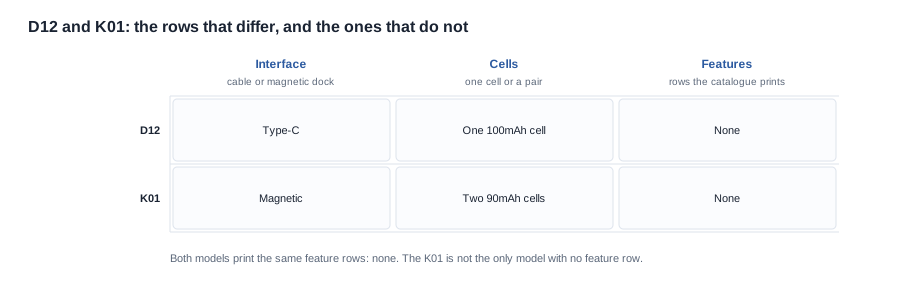
The matrix above is the comparison reduced to the rows that actually differ. Two columns are identical on both models: the Bluetooth version differs by one generation, and the feature rows are empty on both pages. The interface and the cell configuration are where the two models part company, and both of those are supply-chain decisions before they are product decisions.
What magnetic charging commits the channel to
A magnetic charging interface is a smaller box, a tidier unboxing and no cable in the retail unit. It is also a proprietary relationship between the device and an accessory. Three consequences follow for a procurement team.
The dock becomes a line item. Either the dock ships in every box, which is a cost and a packing decision, or it is sold separately, which is a support cost and a customer-acquisition cost. Ask which one applies, at which quantity, and whether the dock is the same part number across the model. A magnetic interface sold without a dock in the box converts a hardware decision into a service desk.
Alignment is a return driver. A magnetic contact has to be seated correctly, every time, by a customer who did not read the manual. That produces early-life contacts that are not defects in any meaningful sense but land on your support line and in your return statistics. A channel with a high share of first-time buyers should weigh this against the tidier box.
Type-C is the opposite bet. A Type-C model asks the customer to own a cable, which is a small ask in 2024 and an ask that most buyers have already made. It also means the in-box cable is a specified item with a length, a rating and a cost, and it means the customer can charge from a power bank or a laptop. The D12 charging options page sets out that decision in more detail, and the broader battery life guidance covers how the two interface types behave across a working day.
None of this makes the interface row a tiebreaker in a ranking. It makes it a constraint that the channel either has or does not have, and once that constraint is known, one column of the comparison is settled.

Where both models are interchangeable, and where they are not
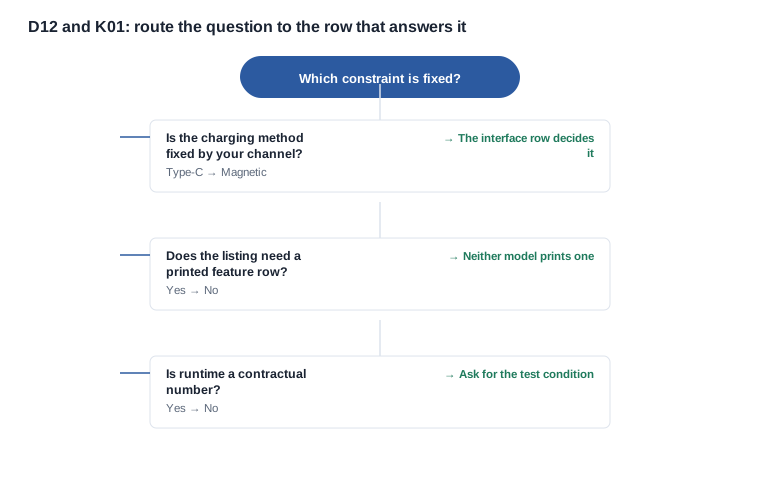
The decision chart above is the working method we would use with a buyer who arrives asking which model is better. It routes a constraint to the row that answers it, and it deliberately stops there, because a constraint is a channel fact and the rows are catalogue facts, and a channel fact plus a catalogue fact is a shortlist, not a purchase.
The three questions that separate the pair
If the channel has already standardised on a charging interface, the question is already answered by the channel and the remaining rows are marginal. A Type-C standardisation leaves the D12 in scope and the K01 out; a magnetic dock standardisation does the reverse. Neither conclusion is a quality judgement.
If the listing needs a printed feature to differentiate, neither model can supply it. The K01's page has no feature row and the D12's page has no feature row. A buyer who needs a named feature in the copy has to look at a different model in the range, and the honest statement to the channel is that this pair cannot carry a feature-led proposition at all.
If the runtime figure is going into a contract, then the condition has to come with it, and if the condition cannot be obtained, the number stays a catalogue description and not a deliverable. This is where the certification and documentation work in the D17 certification status piece generalises: a number without a condition is a claim, and a claim without a document is a dispute waiting to happen.
The rest of the comparison is symmetry. Both models are audio models, both print a Bluetooth version, both publish a charge time, and both leave the mechanical, acoustic and certification rows blank. Where two models are symmetric, a buyer is really choosing between two supplier conversations, and the sensible move is to make both suppliers answer the same list of questions in writing.
What our documentation settles, and what it leaves to you
On this pair, our position is narrow and deliberate. We can lay out every published row for both models, show that the electrical differences are small, show that the runtime direction is the sensible one, and show that the two models print the same number of feature rows, which is none. We will not rank them, and we will not quote a figure we do not hold, because the figures that would decide this comparison are the ones that are missing from both pages.
The rows that decide a real buying decision are not in our catalogue, and they have to be requested. Before a specification sheet is signed for either model, we would want these answers in writing from the supplier, not verbally from a sales contact.
- The frame weight in grams, and whether it is measured or declared, with the cell fitted.
- The use-time test condition: start state, volume level, radio state and the profile the figure came from.
- The charge-time test condition: start state, the end criterion, and the input current the figure was taken at.
- The acoustic figures a channel would need to write a defensible product page: driver size, leakage at a stated level, and microphone pickup distance.
- The certification scope: which documents name the D12, which name the K01, and what each of them covers. The certification checklist sets out the order of requests.
- The accessory and pack contents, including whether a charging dock ships in the box and at what quantity it is included.
Those six answers will do more to a channel's decision than any further reading of the five published rows, because they are the rows a customer will eventually ask about and a support team will eventually have to answer.
How we would work the request. Send the same six questions to both suppliers, in the same format, and ask for the answers in writing with the model name and the date on them. Ask for a sample of each model at the same time, and work the sample acceptance procedure on both. Where an answer comes back as "typical" or "approximately", ask again for the figure that appears on the specification sheet, because a typical figure is not a deliverable. The buyer review checklist exists for exactly that pass.
Where this pair sits against the rest of the range. If the interface constraint points away from both models, the decision moves to a different comparison rather than ending here. The D11 against the D12 piece covers the single most common alternative route, because the D11 shares the D12's cell figure, its Type-C interface and its charge-time ceiling and adds a published surround-sound row. The D11 and K01 comparison covers the K01 side of that same substitution. And if the question is really about what a model cannot do, the D12 limitations page is the shorter read.
We will take a specification request, a quantity, a target market and a channel, and we will tell you which of these two models the published rows put in scope, and which of the six questions above is still open.
Related reading
- The range both models belong to — Bluetooth audio glasses
- The two models as product pages — the D12 and the K01
- The most common substitution route — D12 against D11
- Where the paperwork starts — certification checks
Send us the channel, the quantity, the target market and whether a feature claim is required, and we will tell you which of the two models the published rows keep in scope.


