

The d17 smart glasses certification status cannot be read off our catalogue, because our catalogue does not make certification claims for any model, including the D17. The compliance material it does contain amounts to one export certification sheet at company level, and the sheet is written in images rather than in words; the per-model pages carry specification rows and nothing else. That is not a weakness in the documentation so much as a description of it, and it puts the whole compliance question in the buyer's hands: what has to be requested, from whom, and in what order.
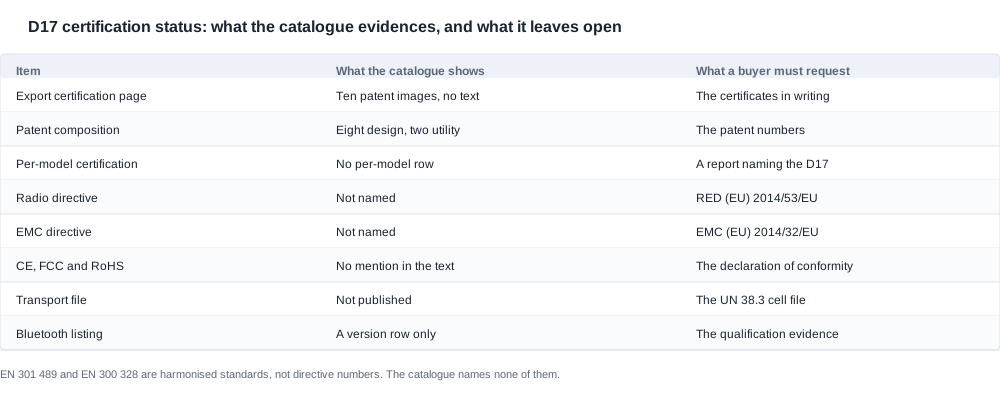
The position in a sentence. The catalogue text contains no mention of CE, FCC, RoHS, REACH, RED, the Radio Equipment Directive, the EMC Directive, UN 38.3 or a Bluetooth qualification number, and it contains no per-model certification row for any of the 28 models. The only certification-related content is one page titled export certification, made of patent images. So there is nothing to quote, and correspondingly nothing to inherit: a buyer who assumed the catalogue was making a compliance claim would be assuming something the catalogue does not say.
D17 certification status: reading the catalogue as evidence
A catalogue is evidence of what it states, and of nothing else. Learning to read it that way is the difference between a documentation file and a wish list.

The chain above is the order we would build the file in, and each step depends on the one before it. The reason it starts with the market rather than with the product is that the market determines the document set, and the document set determines what has to be requested from the supplier. A buyer who requests a generic compliance pack from a supplier and then tries to map it onto a market has the order backwards, and will end up with a file that is complete for a market the product is not shipping into.
The distinction the catalogue forces on you
There are three different things a buyer can be looking for, and they are routinely confused with one another.
A conformity claim is an assertion that a product meets a regulatory requirement. It comes with a legal responsibility attached to the party making it, and in the European Union that responsibility sits with whoever places the product on the market under a name of their own. A catalogue written by the manufacturer is not a conformity claim unless it says so, and ours does not.
A technical file is the evidence behind a conformity claim: test reports, design records, the instructions, the risk assessment and the declarations. It is what a market authority asks for, and it is what the person who placed the product on the market has to be able to produce.
A document request is what a buyer issues to obtain the first two. Our catalogue supports the third and supports it well, because it is precise about what it does not contain.
A patent is none of the three. The export certification page in the catalogue is made of ten patent certificate images, and a patent certificate is a statement about intellectual property. It is not evidence of radio conformity, of chemical restriction compliance, of transport safety or of anything a market authority would ask about. A buyer who treats a page of patents as a compliance page is reading a category error, and it is one of the most common errors in this category because the page is titled export certification and carries certificates.
The D17 specifically, and the rows that do not help
The D17 is a sport model with a 115 mAh cell, a charge time of about one hour, a use time of about seven hours, charging over Type-C, Bluetooth V5.4, a remote control photo row and a surround sound row. Those rows are useful and they are complete for what they are. None of them is a compliance row.
The Bluetooth version row in particular deserves a sentence of its own. A published V5.4 tells you the radio was built against that version of the Bluetooth specification. It is not a qualification listing, it is not a declaration of conformity, and it is not evidence that the radio is authorised for a given market. A buyer who needs that evidence asks for it under the radio regime that applies to the destination market, and the Bluetooth SIG material sets out the separate trail.

Directives, harmonised standards, and the numbers that get mixed up
Supplier documents in this category are assembled by people who are not always sure which number belongs to which instrument, and the result is a document trail where a directive number and a standard number have been used interchangeably. Getting this right is not pedantry: the numbers identify the legal instrument, and a file that mixes them cannot be checked by anyone downstream.
The Radio Equipment Directive, (EU) 2014/53/EU, is the instrument that covers radio equipment, which includes a Bluetooth device. It is the framework under which a declaration of conformity is drawn up for radio equipment placed on the market in the European Union.
The EMC Directive, (EU) 2014/32/EU, is a different instrument with a different scope. It is frequently referred to alongside the radio directive because a radio device has to satisfy electromagnetic compatibility requirements as well as radio requirements, and the two routes are often discussed in the same meeting. It is not an alternative numbering for the radio directive, and a document that cites one for the other is wrong in a way that a compliance reviewer will catch.
EN 301 489 is a harmonised standard for electromagnetic compatibility of radio equipment, and EN 300 328 is a harmonised standard covering 2.4 GHz wideband data transmission equipment. Both are standards, not directives. A standard describes how to demonstrate conformity; a directive is the legal instrument the demonstration sits inside. When a supplier's test report lists the standards used, those numbers belong in the technical file; when the declaration of conformity names the legal basis, that is where the directive number belongs.
The three-part summary, then: the declaration names the directive, the test reports name the standards, and the model list on each document has to include the D17. A buyer who has all three can assemble a file. A buyer with only the first two has a file that might cover a different model. A buyer with only the first has a claim with no evidence.
The market-side instruments, and why one file is rarely enough
A buyer who sells into more than one market usually starts from a single compliance pack, on the reasonable assumption that a product that is compliant in one large market is compliant in the next. That assumption does not hold, and the reason is structural rather than accidental.
The legal responsibility sits with the party placing the product on the market. A manufacturer, a distributor and a retailer each carry a different set of obligations in a given market, and the evidence that has to exist is different in each case. The same physical product can require three different files from the same supplier, because three different parties are carrying the responsibility. A buyer who intends to distribute under their own brand is in a different position from one who imports under the manufacturer's name, and the document set follows that structure.
The instruments are not the same across markets. The European Union has its own radio, EMC and chemical framework, the United Kingdom has a parallel but separate set, and the United States has a different regime again, with a certification route that is not structured like a European declaration at all. A single pack assembled for one market will not satisfy another, and the parts that do transfer, typically the chemical declarations, are the parts that are least likely to be asked about first.
The timing is different. Some documents are event-driven: a change to the radio, a change to the cell or a change to the enclosure can invalidate a report and require a new one. A file assembled once and never revisited is a file that decays. That is why the maintenance obligation belongs in the agreement rather than in a filing cabinet, and it is one of the clauses worth checking carefully in the contract terms page.
The practical consequence for a D17 order. Ask the supplier for the documents market by market, in the same request, rather than asking for a general pack and discovering the gaps later. Name the market, name the model, and ask for the model schedule on each document. The EU route, the US route, the UK route and the FCC material are the four a European or American channel most often needs, and they are four different conversations.
On this, our position is that we will not state a certification status for the D17 in either direction. We will not write that the D17 is certified, and we will not write that it is not. The catalogue does not carry the information, and the honest way to express that is that the status is something the buyer has to establish and file.

The export certification page and the patents behind it
The catalogue's export certification page is a page of images. There is no text on it beyond the page title, and the images are patent certificates. The composition of that page is ten certificates: eight appearance-design patents along with two utility-model patents.
That composition is worth stating precisely, because a page of ten certificates is easily summarised as ten design patents, and it is not. Eight of them are appearance designs, which cover the look of the product, and two are utility models, which cover a technical construction. Neither category is a conformity document.
What the page does establish is that the company holds intellectual property covering its products. What it does not establish is anything about radio, chemicals, transport, labelling or the particular market a buyer is shipping into. The patent numbers themselves are the thing to request, because a patent number can be checked against a public register, whereas a scanned image on a page cannot.
Three practical consequences. First, any statement of the form "our factory holds export certification" is not supported by this page, whatever else is true, and we will not write it. Second, if a buyer wants the patents as part of their due diligence, the request is for the numbers, and the check is against a public register. Third, the existence of a page titled export certification, in a document that otherwise contains no compliance claim at all, is a reason to ask the question rather than a reason to skip it. The certification checklist and the procurement risk page cover the two ways a buyer typically uses that distinction.

The document request that closes the gap
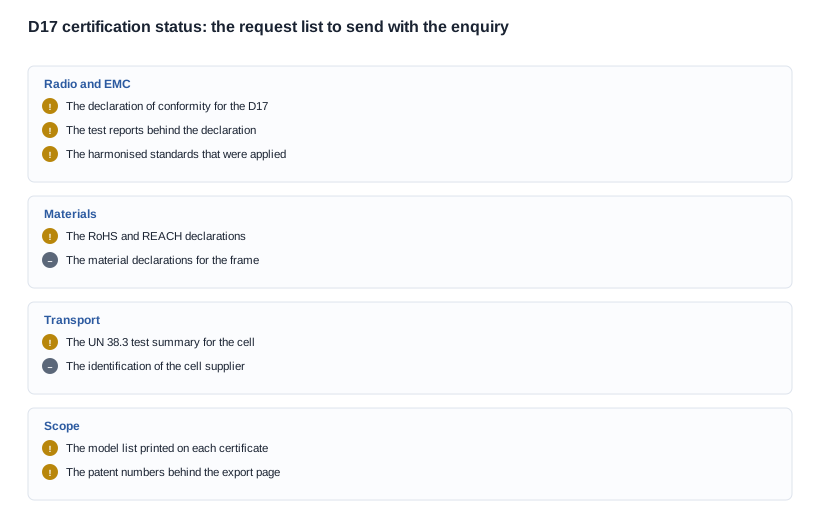
The gap is closed by a request, and the request is more effective when it is specific, dated and answered in writing. The list above is the full set; the four points below are the ones that most often come back wrong.
The model schedule. Every certificate and every report has a scope, and the scope is expressed as a list of models or a list of product variants. The D17 has to appear on it. A report covering a sibling model does not cover this one, and in this catalogue the siblings are close enough to be confused: the ZH12 shares the Type-C interface, the single-cell architecture and the remote-photo row, and the D11 shares the 100 mAh cell and the Type-C interface. Ask for the schedule, and check the string on the document against the string on the purchase order.
The declaration of conformity itself, signed and dated, with the model it covers. A supplier that will not supply it for the D17 specifically has a reason, and the buyer needs to know what the reason is before the order rather than after the shipment.
The chemical declarations. RoHS and REACH are separate instruments with separate scopes, and a file that contains one of them is not a file that contains the other. The RoHS and REACH material covers what each one requires and what a declaration has to state.
The transport file. The D17's cell is a lithium cell, and a lithium cell moving between factories, ports or warehouses is a regulated item whose documentation is normally held by the cell supplier rather than by the device assembler. The catalogue publishes nothing about it, and the battery transport compliance pages set out what that file normally contains, what a shipping document has to reference, and who typically holds each part.
The market side. The destination determines the set. The EU route and the US route have different instruments behind them, and a channel shipping into both needs two files rather than one wider one. The UK route and the UKCA material are separate again. The market compliance hub is the index for those routes.
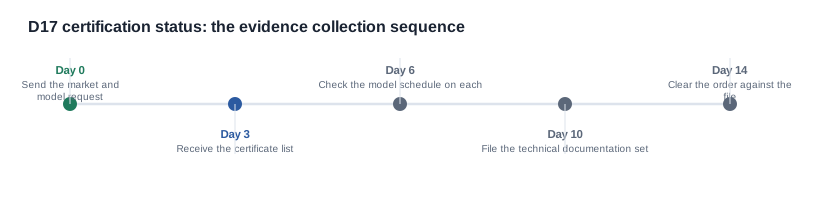
The sequence above runs from the request to the purchase order clearance, and the last step is the one most often dropped. A file that is complete but not checked against the order is not yet a file: the model schedule has to be compared with the purchase order, the dates have to be inside their validity, and the document references have to be recorded in the technical file. The contract terms page is where the obligation to maintain that file is usually written, and the sample procedure is where the first tranche of documents should be requested rather than at the moment of the first booking.
Building the file so it survives the second order
A technical file that has to be rebuilt from scratch for every reorder is a cost that nobody budgets for, and the rebuild happens because the file was assembled as a collection of attachments rather than as a structured record. Six fields turn it into something reusable, and they are the same six fields whatever the model.
- The document reference, exactly as printed, with the issuing body and the date.
- The model scope, exactly as printed, with a note of where it sits in the product family.
- The market it was drawn up for, so that a file for one market is never handed over for another.
- The event that would invalidate it, which is usually a change to the radio, the cell, the enclosure or the firmware.
- The holder of the original, which for a cell-level document is often the cell supplier and not the assembler.
- The date the document was last verified against a production unit, which is a different date from the date it was issued.
Written once, those six fields turn a folder of scans into a file. A purchase order can be cleared against it in minutes, an incoming compliance question can be answered without a fresh request, and a new product manager can pick it up without reading the whole history. The factory audit page is where a channel that wants to check the production side rather than the paperwork side would start, and it is worth noting that an auditor and a compliance reviewer ask for the same six fields in different words.
One more habit is worth naming, and it is the one most often skipped. Record the gap as a gap. When a document has been requested and not received, the file should say so, with the date of the request, rather than leaving the slot empty. An empty slot reads as an oversight; a dated gap reads as a known risk with an owner, and that is a document a lawyer and a market authority can both work with.
What we will not state about the D17
The compliance conversation is where a manufacturer's catalogue is most likely to be over-read, and it is worth being explicit about the limits of ours.
We will not say the D17 is CE certified. The catalogue contains no mention of CE, and we do not hold a document that we would be willing to summarise in a sentence. When a buyer asks, the answer is the request list, not a reassurance.
We will not quote a certificate number, an issuing body, a report reference or a validity date. Not for the D17, and not for any other model. A number quoted from memory or from a marketing summary is a number nobody can check, and a compliance file is only as good as its references.
We will not describe the export certification page as evidence of product compliance. It is a page of patent certificates, and we will describe it as exactly that.
We will not say the D17 is not certified either. Absence of a catalogue claim is not evidence of absence. The correct statement is that the catalogue carries no per-model certification row and that the status has to be established by the buyer from the supplier's documents.
We will not infer transport status from the cell figure. The 115 mAh cell is a published specification. A UN 38.3 test summary is a document, and it is not in our catalogue.
We will not use the Bluetooth version row as a compliance claim. V5.4 is a version. Qualification for a market is a separate question with a separate trail.
What we will do is be precise about the position, give you the request list, and work with the documents you obtain. If the file comes back with a gap, we would rather know about it at the request stage than at a market inspection. The D17 buyer review checklist shows which items on that list can be closed with a sample and which cannot, and the D17 common questions piece covers the same ground in the format a buyer uses with a supplier.
Tell us the destination market, the model, the quantity and whether the channel is a distributor, a retailer or a direct-to-customer operation, and we will tell you which document set the D17 needs on the way in, and which parts of that set have to come from the cell supplier rather than from us.
Related reading
- Where this model sits — the D17 product page
- The full request list — certification checks
- Market routes — compliance by market
- Which items a sample can close — D17 buyer review checklist
Send us the destination market, the model, the quantity and the channel type, and we will tell you which document set the D17 needs on the way in.


