
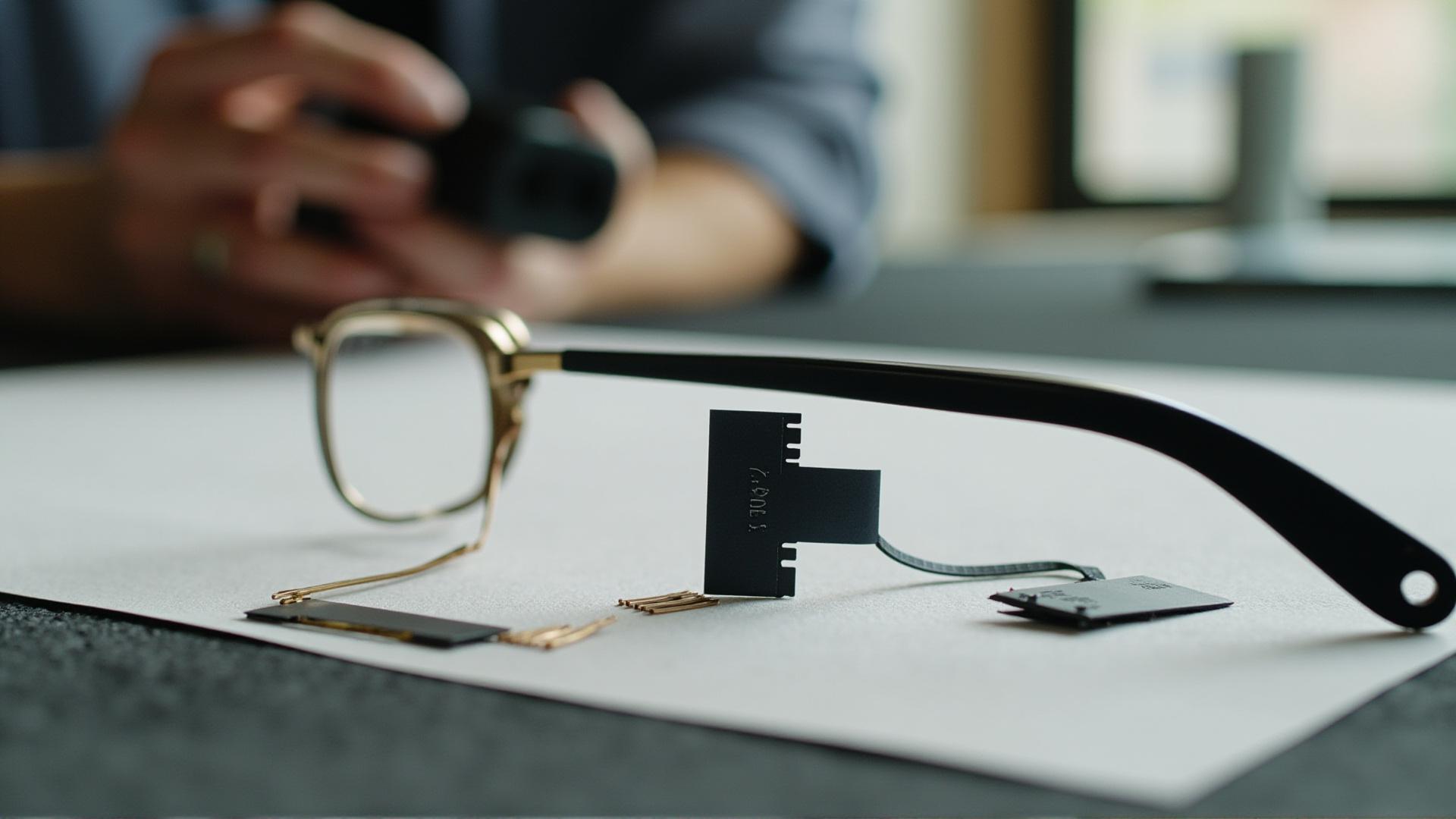
The G07 and the K02 sit on the same charging method with opposite propositions. The G07 is a design-and-serviceability product with a published ultra-slim detachable temple. The K02 is a plain platform with the most generous published cell configuration in the audio range and no published feature line at all. Neither wins a specification comparison, and a buyer who arrives expecting one will be disappointed.
The choice between them is not a ranking question. It is a question about which claim your channel is going to make, because between these two models the claims do not overlap at all — one of them has a feature row and the other has an eight-figure cell configuration, and there is no row on which they can be compared head to head.
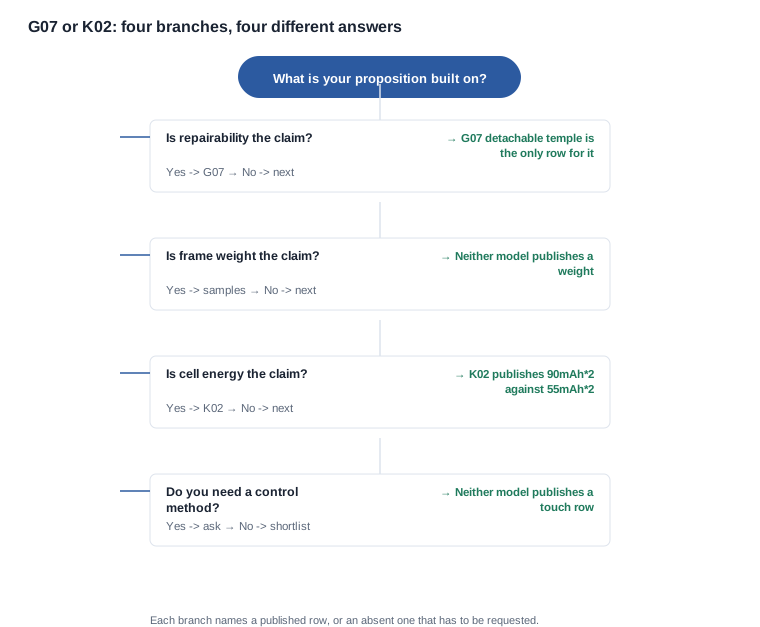
The four branches that actually decide this choice
Branch one: is repairability the claim?
If your proposition is that a damaged frame can be repaired at your own bench rather than returned to the supplier, the G07 is the only model in the pair that carries a published row for it. A detachable temple means the part most likely to take the impact is a replaceable item instead of a scrapped unit, and that changes the returns arithmetic for a distributor whose reverse logistics travel a long way.
The follow-up matters more than the answer. A detachable temple without a replacement route is a shape, not a service. Ask what the joint's cycle count is, what the connector is, and whether an arm can be ordered on its own at your quantity. If the answer is that arms come only with a serviced unit, the advantage you are buying is thinner than it sounds.
Branch two: is frame weight the claim?
Then neither model answers, and this is the branch most buyers get wrong. The source describes the platform as ultra-light, and it publishes no weight for it. The one weight published anywhere in our catalogue belongs to a different model — the MT6, at 158 g for that camera model's eyewear body including its battery and its camera and excluding its foldable charging case — and it cannot be carried across to an audio frame.
So the branch ends in a measurement, not a choice: weigh a sample of each and quote your own figure. A larger cell does not make a frame lighter, and a slim temple does not make it lighter either, unless somebody has weighed it.
Branch three: is cell energy the claim?
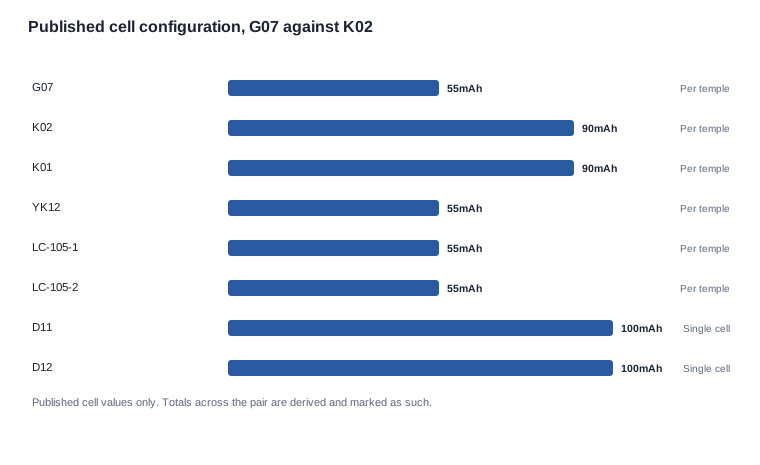
Then the K02, and this is the branch where the published rows point cleanly. The K02 publishes 90mAh2 against the G07's 55mAh2, which is 70 mAh more across the pair of cells, and it publishes about eight hours of stated endurance against the G07's about six.
Read the second half of that with care. The eight-hour figure is not usable as a differentiator until a test condition is documented, because the LC-105 pair publishes the same 55mAh*2 configuration at about eight hours too — the same cell size producing a two-hour spread across this range. The K02's cell configuration is a real, published difference. Its endurance number is not yet a comparable one.
Branch four: does the channel need a control method?
Neither model publishes a touch-control row, so this branch has no answer in the catalogue and never will. It resolves into a request: ask how each model is controlled, on what surface, and whether the method is operable in the environment the product will be used in. Whichever model you land on, list only what that answer supports.
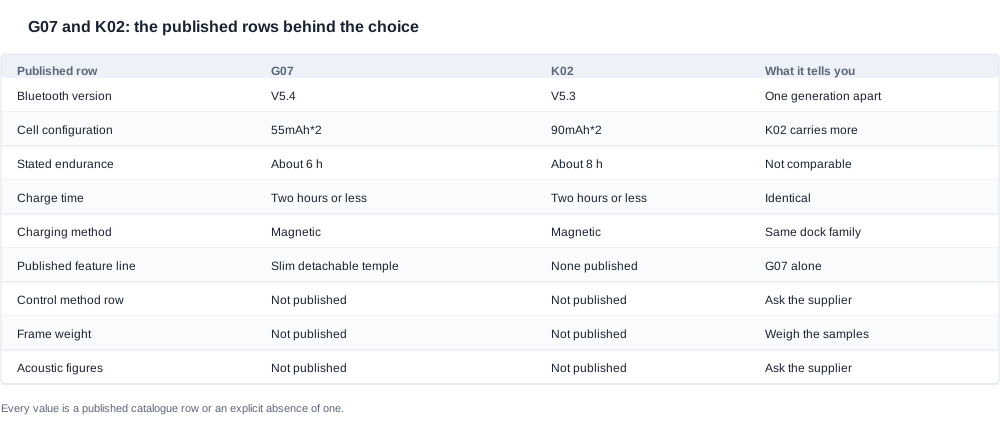

The published rows, read without over-reading them
| Published row | G07 | K02 | What it settles |
|---|---|---|---|
| Bluetooth version | V5.4 | V5.3 | One generation apart; rarely decisive alone |
| Cell configuration | 55mAh*2 | 90mAh*2 | 70 mAh more across the pair for the K02 — a derived difference |
| Stated endurance | About 6 h | About 8 h | Not comparable until a condition is published for both |
| Charge time | Two hours or less | Two hours or less | Identical, so it cannot separate the models |
| Charging method | Magnetic | Magnetic | Identical accessory approach and the same dock family |
| Published feature line | Slim and detachable temple | None published | The only row that separates them qualitatively |
| Control method row | Not published | Not published | Has to come from the supplier |
| Frame weight | Not published | Not published | Weigh the samples |
| Acoustic figures and microphone pickup | Not published | Not published | Has to come from the supplier |
| Charging case and packed unit weight | Not published | Not published | Has to come from the supplier |
The table is short on purpose. The G07 and the K02 are not two configurations of one product; they are two products that happen to share a charging method. A comparison that tries to rank them on a single scale ends up ranking the presence and absence of information.
What the K02 is, precisely
The K02 publishes a cell configuration, an endurance figure, a charge-time ceiling, a charging method and a radio version — and nothing else. No feature line, no acoustic descriptor, no structural claim. It is the most generous energy configuration among the audio models and the quietest in terms of what it offers a page to write about.
That combination suits a channel whose proposition is private label and price architecture: the frame arrives without a rival's wording on it, carries more energy than the other paired-cell model in this comparison, and leaves the page to the buyer's own brand assets. Its weakness is that every published row it does have is also published by the K01, so it cannot be differentiated from its own sibling by specification — the K01 and K02 comparison covers what does separate those two.
What the G07 is, precisely
The G07 publishes the same five standard rows, a radio version one generation higher, and one feature line: an ultra-slim detachable temple. It is the only model in this pair that a shelf can be differentiated by, and the only one that carries a published serviceability argument.
Its weakness is that the supporting numbers do not exist. No weight, no temple cycle count, no connector detail, no acoustic figures, and the shortest published endurance figure among the paired-cell models — about six hours. The design argument is real and it is also unquantified.
Why the endurance figures must be retired from this comparison
Two hours of difference between about six and about eight, on the G07 and the K02, invites the reading that the bigger cell produces the longer day. The rest of the range contradicts that reading directly: the LC-105 pair uses the same 55mAh*2 configuration as the G07 and publishes about eight hours, while the G07 publishes about six on the identical cell size.
A two-hour spread on an identical published cell configuration is diagnostic of a measurement convention rather than a product property. No test condition is published for any of these models, so the figures were not taken under one protocol. Retire the row until a condition exists, and if endurance is genuinely central to the buyer's proposition, make the condition a precondition of the order rather than a footnote to it.
Closing a G07 or K02 decision without guessing

Start with the proposition, not the table
Write one sentence describing what the channel will actually lead on, and refuse to write two. A range built on both models without a stated reason for each produces two packaging SKUs, two accessory chains and one shared complaint that the two products look the same.
Then match that sentence against the published rows. If it names repairability, the G07's row is the one that answers it and the spares question follows. If it names energy in the frame, the K02's cell configuration answers it and the endurance condition follows. If it names lightness, sound or a control method, neither model answers it from the catalogue and the honest answer is that the buyer needs a supplier answer first.
Retire the rows that cannot decide anything
Two published rows look decisive and are not. The charging method is identical, so it cannot separate the two models on any dimension except the spares implication of the G07's detachable temple. The charge-time ceiling is identical, so it cannot separate them either. And the Bluetooth generation is one step apart, which becomes decisive only when a customer's platform is known and turns into a compatibility question rather than a product question.
Retiring these three rows leaves the comparison in a usable state: one published capacity difference, one published feature-line difference, and a list of rows neither model publishes.
The evidence to hold before the order
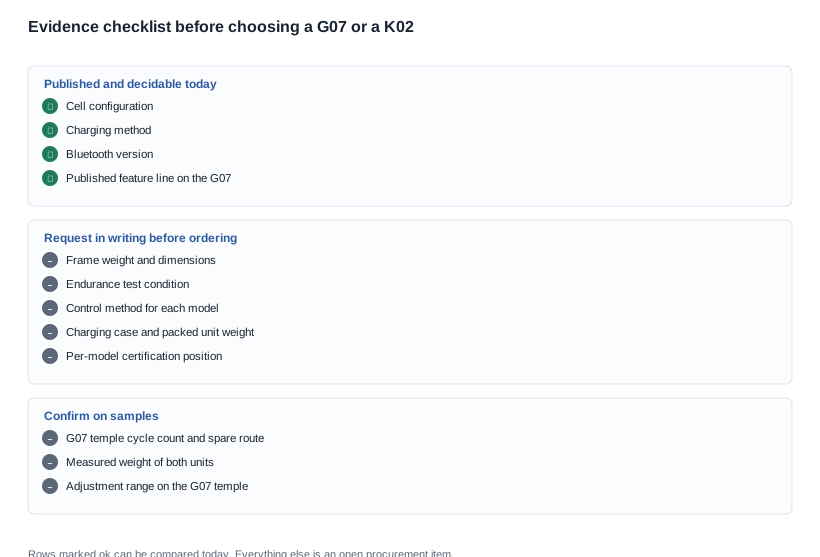
Four of the items on that checklist are requests rather than measurements, and all four are cheap to ask for in a single message: the frame weight and dimensions for each model, the endurance test condition, the control method, and the charging case and packed unit weight. The fifth is a certificate question for the destination markets in scope, which has the longest lead time and should be issued first.
The remaining items need physical units: the G07's temple joint has to be cycled to a stated count and its adjustment range measured, and both frames have to be weighed.
How the two models behave in a range
One more consideration matters if both are to be stocked. The G07 and the K02 are not two tiers of one ladder in the way a buyer might assume — they serve different claims, so a channel carrying both is carrying two propositions rather than two price points. That has consequences for how the range is merchandised, how the accessories are stocked, and how much inventory a slow-moving unit ties up.
If the channel only needs one, the decision is between a repairable frame with a design story and a high-energy plain platform. Both are legitimate choices. The mistake is choosing one for the reason the comparison table appears to offer — the endurance figure — because that is the one row the catalogue will not support.
Four ways this choice goes wrong, and what each one costs
The endurance figure decided the order. The symptom is familiar: the model with the longer quoted figure went into the range, and the field result does not match the sheet. The root cause is treating a figure with no condition as a comparable measurement, and the prevention is to require the condition in writing before the figure is allowed to influence anything. If the buyer's proposition genuinely turns on endurance, make the test condition a precondition of the purchase order rather than a request that can be declined.
The ultra-slim description was sold as a light frame. The symptom is a listing that implies lightness, a return rate that does not justify the positioning, and a channel that has to correct its own copy. The root cause is reading a design word as a measurement. The prevention is the cheapest action in this whole comparison: put both samples on a scale, write down what they weigh, and quote your own figure rather than borrowing an adjective.
The detachable temple was bought as a service and delivered as a shape. The symptom is that a broken arm goes back to the supplier instead of being replaced from stock, and the returns economics revert to exactly what the buyer was trying to avoid. The root cause is that user-replaceable and factory-only were never distinguished. The prevention is to establish which one it is, along with the cycle count and the replacement price, before the first order rather than after the first damaged unit.
Both models were stocked without a stated reason for each. The symptom is a range where the customer cannot tell the two products apart on a shelf, two accessory chains competing for the same shelf space, and a slow-moving unit tying up inventory. The root cause is that the range was planned as a set of price points rather than as a set of propositions. The prevention is the one-sentence proposition test: write one sentence for the G07 and a different one for the K02, and if the two sentences turn out to be the same sentence, one of the models has no place in the range.
An acceptance test that settles more than a specification table
Because so much of this comparison rests on rows neither model publishes, a short physical acceptance protocol is worth more than any further reading. Five checks, one afternoon, two samples of each model.
Weigh each frame. Record the figure and quote it. This is the number that decides whether a lightweight positioning is supportable, and it is the row most likely to contradict a marketing assumption.
Measure the temple on the G07 — the adjustment range, and whether it detaches and refits without a tool. A detachable temple that needs a tool is still a service argument, but a different one, and the channel's after-sales page has to describe it accurately.
Cycle the joint to a stated count and record where it fails. If it survives, the service claim holds. If it does not, the claim has to be dropped before the copy is written rather than after a customer reports it.
Make and take a call on each model in an environment resembling the one the product will be used in, and note the microphone pickup. Neither model publishes an acoustic row, so a channel planning to lead with sound has to have this evidence before the page goes up.
Time a charge from a stated starting point and note what the frame does at the end of the charge-time ceiling. The catalogue publishes a two-hours-or-less ceiling for both models, which tells you the upper bound but not where the charge actually stops — and a buyer who has to schedule charging around a device needs to know the difference.
None of these five checks is expensive, and together they close most of the gap between what the catalogue says and what the channel will actually be able to promise.

What the choice costs to run commercially
Neither model can be priced from anything we publish, so the commercial work is in the terms rather than in the unit price. We do not publish unit prices, minimum order quantities or lead times, and we would rather tell you that than quote a figure that becomes a commitment.
What separates the two models commercially is the shape of what has to be arranged around them. The K02 is a plain platform with one cell configuration and no accessory chain to configure, so the terms that matter are the standard ones: unit price at volume tiers, the split of a first order across delivery dates, payment nodes tied to inspection, the warranty period with a stated response, packaging specification, and the terms of a pilot order.
The G07 adds a second arrangement on top of those: the temple spares. Arms have to be orderable, stocked and priced, the supplier's commitment to hold them has to have a term, and the replacement price has to be a number the channel can put on an after-sales page rather than a number it discovers during a returns cycle. That arrangement is not optional if the detachable temple is the proposition, and it is the term that decides whether the price difference between the two models is justified.
Certification cost and its timeline are fixed by the process rather than by the order size, and they follow the testing body. Tooling behaves differently — it is often amortised across a first order while certification cost sits per product family — so ask which of the two you are being quoted, because the two are frequently bundled into one line that hides which is which.
Four clauses worth putting in the agreement
- The published rows of the exact configuration ordered, referenced to the catalogue page rather than restated in prose.
- The endurance figure with its test condition once established, or the explicit statement that no condition is agreed and the figure will not differentiate.
- The charging method, the in-box accessory set, and the packed unit weight to be confirmed at inspection.
- For the G07 specifically: the temple arrangement — detachability, cycle count, connector, replacement route and replacement price.
The G07 and K02 claims that cannot be carried into copy or contract
Any weight figure that was not measured on a sample, any endurance claim without a condition, any control method that has not been confirmed in writing, any acoustic description, and any certification number. Neither model in this pair publishes those rows, and the absence is a fact to be stated rather than filled.
Where CYNRIN stands on choosing between the G07 and the K02
These two models are not competing products, and a range built on both should make the difference explicit — a serviceable, distinctive frame against a generous plain platform — rather than present a specification comparison neither of them wins. We will not present the slim temple as a quantified advantage, we will not present either endurance figure as a working day, and we will not quote a weight, a case capacity or a certificate number that the documentation does not contain.
The published G07 specification list and the published K02 specification list are the honest baselines for the two models. The audio range weight comparison explains why the one published weight in the catalogue cannot stand in for either, and the how to compare battery life method covers the endurance condition in detail.
Five questions to close before you choose
- Frame weight and dimensions for both, measured on samples.
- The endurance test condition for each, asked in identical words.
- The G07 detachable mechanism: cycle count, connector design and replacement route.
- The charging case capacity for each, and a measured packed unit weight.
- The certification position for each model in each destination market.
Related reading
- The published rows for the G07 — G07 smart glasses specifications and features
- The published rows for the K02 — K02 smart glasses specifications and features
- Choosing across the range — Bluetooth audio glasses which model to pick
- The commercial structure around a range — OEM ready pricing tiers
Send us the customer, the proposition and the volume, and we will tell you which of the two platforms fits the brief.


