

Two questions sit inside this one, and they are answered by different numbers, which is why they get answered badly in the category. The first asks what the wearer hears. The second asks what the person on the next seat hears. A pair of glasses can be entirely satisfactory on the first count and completely unacceptable on the second, and a product listing that addresses only the first has answered half of what the buyer asked.
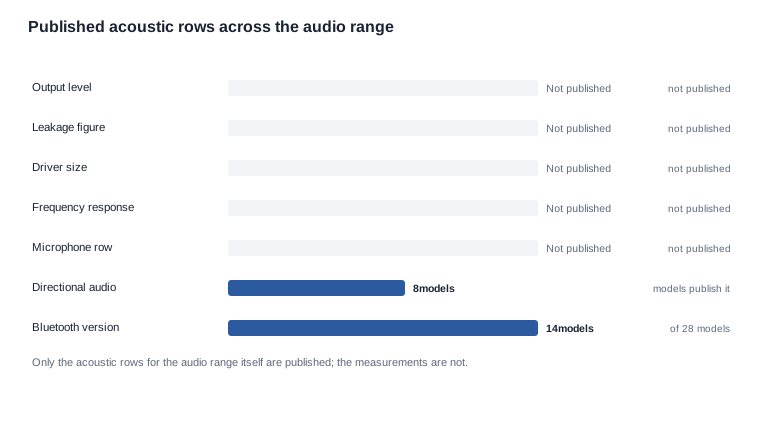
We publish neither figure. There is no output level, no leakage measurement, no driver size and no frequency response published for any model in our audio family, and we will not present a sample measurement as a product specification. What we can do is tell you what the two numbers depend on, how a defensible measurement is built, and what to ask for and what to write in your own documentation when the answer arrives.
That matters commercially because leakage decides which channels a product can enter at all. Open-plan offices, cafés, libraries, shared transport and any retail floor where two people stand close together are the places where the question becomes a return. It is also the reason this article is written the way it is: not as a specification, but as a method a procurement manager can run on a sample and record in a file.
How loud is the sound leakage: the six variables behind a leakage figure
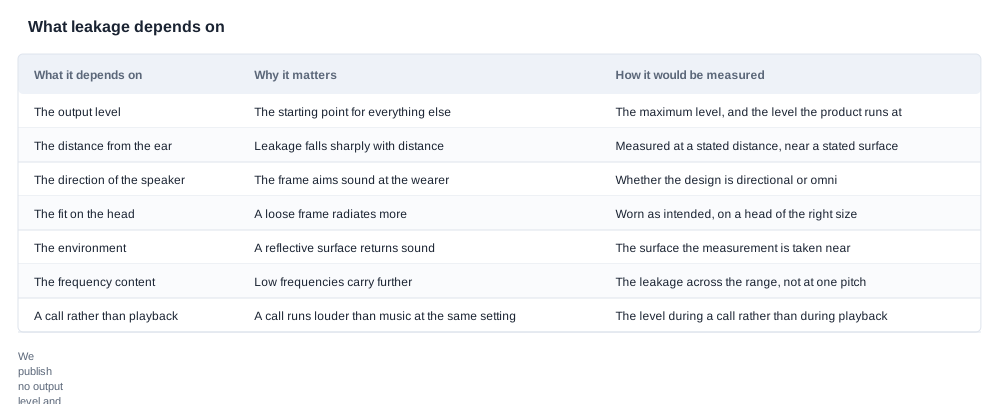
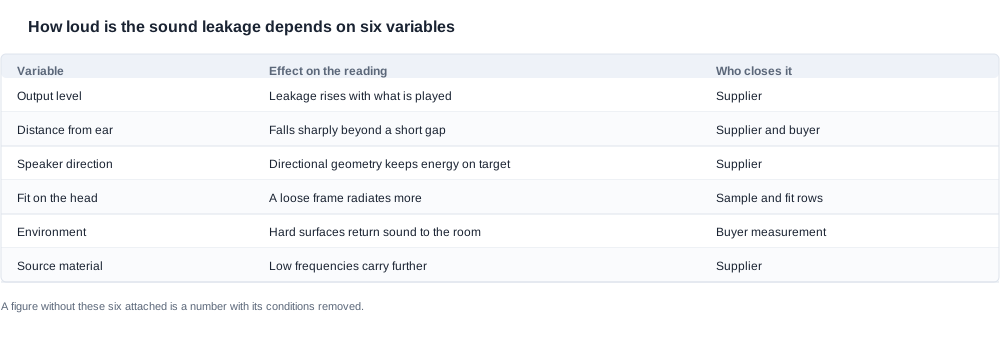
A leakage figure is never a single measurement of a single thing. It is the result of at least six variables that move independently, and a number quoted without them is not a specification — it is a number with the interesting parts removed.
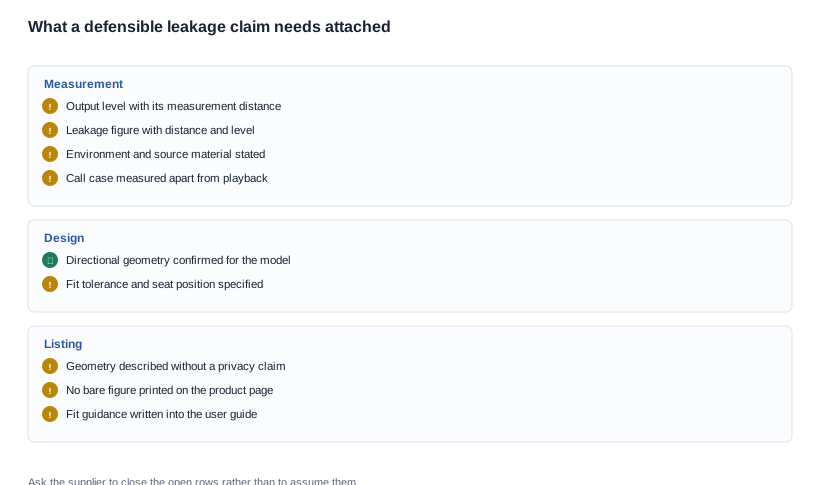
1. The output level itself. Leakage rises with what is being played. This is the variable most often left off a claim, because a leakage figure is usually taken at one particular setting on the volume control. The same product at a lower level can be effectively silent to the person next to you; at the top of the range it can be plainly audible across a table. Any figure therefore describes a condition, not a product.
2. The distance from the ear. Leakage falls sharply with distance, and the distance that matters is the gap between the speaker and the ear canal of the listener beside the wearer. It is not the distance between the speaker and the wearer's own ear, and the confusion between those two numbers is the most common error in acoustic specification sheets in this category.
3. The direction of the speaker. An open-ear design aims sound at the wearer's ear. The more directional the geometry, the more of the energy goes where it is intended and the less reaches the room. Our audio family publishes directional audio as a key technique for its eight models — the G07 and the LC-105-1, the LC-105-2 and the D11, the YK12 and the K01, and the K02 and the D12 — and that is the design feature that reduces leakage relative to a conventional open speaker. It reduces it; it does not eliminate it.
4. The fit on the head. A frame sitting loosely radiates more, because the speaker is no longer aimed at the point it was aimed at. This is why the fit rows in an audio product are not only an optical and comfort matter, and why a leakage comparison performed on two different head shapes is not a comparison. The comfort and fit page covers the fit variables that change this result.
5. The environment. A hard floor and a glass wall return sound into the room. The same product in a quiet office and the same product in an open park produce materially different readings, and the environment is the variable that most often separates a laboratory figure from a customer complaint.
6. The frequency content of the source material. Low frequencies carry and leak further than high ones. A leakage figure taken at a single pitch is not a leakage figure, and it will flatter the product on exactly the content — bass-heavy music and spoken voice — that produces complaints.
There is a seventh case that is not a variable but a separate condition, and it is the one customers complain about first: the call rather than the playback. A voice call is typically louder than music at the same volume setting, because the signal is different and the level is chosen for intelligibility rather than for enjoyment. Leakage during a call is a different measurement from leakage during playback and has to be measured separately.
Why how loud is the sound leakage is not one number
The reason suppliers publish different figures for the same category of product is not that some of them are dishonest. It is that the figure they publish describes their test, and the tests differ. Two products with identical published output levels can behave completely differently in a café because one was measured at half a metre in an anechoic room and the other was measured at a metre in an office.
This has a direct consequence for a buyer comparing two candidates. A comparison is only valid when both products were measured the same way. If the supplier of candidate A quotes a figure with conditions attached and the supplier of candidate B quotes a bare number, you do not have two candidates — you have one measurement and one assertion, and the second is not worth anything on its own.
The practical way to handle this is to stop looking for a universal number and start looking for a measurement you can reproduce. What a procurement manager needs is not a decibels figure that can be quoted in a tender, it is a repeatable method that produces the same ranking for two candidates in the same room. The ranking is the decision. The absolute number is a bonus.
There is a second reason the number resists simplification: the thing being evaluated changes under the buyer. Fit, head shape, the position of the frame on the nose, the hair, the glasses case, the weight of a jacket collar — all of these shift the result, and all of them vary between customers. A figure that is stable in a laboratory and unstable in a shop is a figure that will produce inconsistent customer experiences, which is a product characteristic and not merely a measurement artefact.
For that reason, the honest commercial position for an open-ear product is not a claim of privacy. It is a claim about geometry and about the conditions under which the claim holds. Both of those can be defended in a listing, in a user guide and in a support script. Neither requires a figure we do not publish.
Measuring how loud is the sound leakage before you place an order
Because the catalogue publishes no leakage figure for any model in the audio range, a sample is the route. What follows is a method that can be run in an ordinary room, on two candidates, with results you can put in a file.
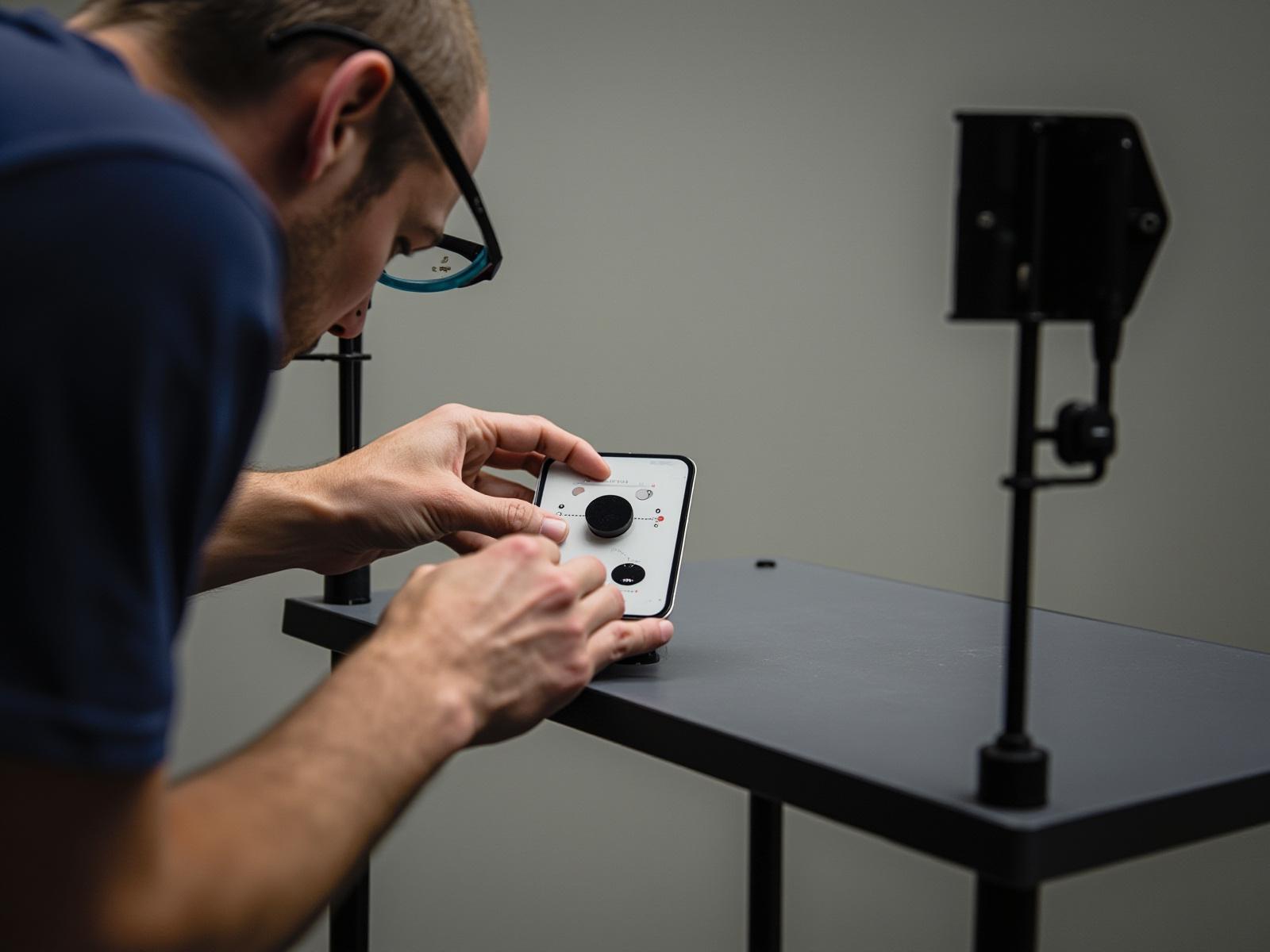
Set up the same environment for both units. Same room, same position, same background noise. A reflective room raises every reading and raises them unevenly, so what matters is that the room is identical across the comparison rather than that the room is ideal.
Fix the source material and the level. Use a real track with bass content and a spoken passage, and run both units at the same volume setting rather than at each one's maximum. Comparing maximum to maximum is how a buyer ends up with a winner that is louder rather than better.
Measure at a stated distance. Pick a distance that means something in the channel you are targeting — arm's length for a shared desk, a table width for a café — and record it with the result.
Seat the frames the same way on the same head. Both units, same head, same temple position, same adjustment. If a unit needs different seating to aim correctly, that is itself a finding worth recording.
Measure the playback case and the call case separately. The call case is where the neighbour notices.
Record the environment and the setup alongside the number. A reading with no conditions attached is a data point nobody can use later.

The value of running this yourself is not the absolute figure. It is the comparison, on one setup, between two candidates, at the level you intend to ship them. That is a defensible test with a repeatable method, and it produces an answer to the question that actually decides the purchase.
Two practical notes that save time. First, run the test at the volume you will recommend to customers, not at maximum — if the product needs to be run near its limit to sound good, that is a finding about the product and about the instructions you will need to write. Second, run the same test twice on the same unit a day apart, because a unit whose fit varies between wearers is going to produce complaints in the field regardless of what the average figure says.

Six ways how loud is the sound leakage gets overstated in a listing
This is the part of the topic where the commercial damage actually happens. A privacy claim that the geometry cannot support produces returns, and returns in a channel where the complaint is about a neighbour rather than about the product are the expensive kind, because the customer does not think of them as a hardware fault.
"Private" appears in the copy. A design description has been inflated into a guarantee. The customer discovers the truth in a shared space and returns the product, and the listing is what caused it.
A figure was published without its conditions. The customer measures at a different distance, gets a different number and finds the listing contradicted by their own arithmetic.
The call case was never measured. Leakage during a call is worse than during playback, and the neighbour is the one who complains first.
A single pitch was used as the figure. The product leaks considerably more bass than the figure implies, and the complaint arrives as "the bass leaks" rather than as a technical objection.
Fit was ignored in the comparison. The better-seated unit leaks less, and two candidates ranked on a loose head will rank differently on a properly adjusted one.
A reflective room was published as the number. The reading is not reproducible in the customer's environment, so every subsequent customer measurement contradicts the listing.
The pattern behind all six is the same. The problem is rarely a wrong number; it is a number with its conditions detached, and the conditions are what make it defensible.
What a listing can honestly say is a description of the geometry: that the product uses an open-ear design which leaves the ear canal unobstructed, that it is directional, and that at higher volumes audio is audible to a person sitting close by. What a listing must not say is that other people cannot hear it, or that the product is private. Both are false in the general case, and the customer who has been told otherwise in a shop discovers it on a train.
The thing that actually reduces complaints is rarely the wording. It is the fit guidance. A customer who knows the product leaks at full volume, and who has been told what level to use, is not the customer who returns it.
What to ask a supplier about how loud is the sound leakage
Four questions, sent with the request for quotation, produce a usable answer. An answer without conditions is a non-answer, and the difference is visible on the first line.
- What is the maximum output level, and at what distance is it measured?
- What is the leakage figure, at what distance, at what level, in what environment and with what source material?
- Is the speaker directional, and is the direction set by the frame geometry, by a fixed mount, or by an adjustment per head?
- Is there a published maximum recommended level, and does the firmware enforce one?
There are two further questions that belong in the negotiation rather than in the technical request, because they are commercial rather than acoustic.
What happens to the warranty position when leakage is a design characteristic rather than a defect? A buyer needs to know how the supplier treats a return whose reason is "I could hear it". If the supplier has a position on that, it protects the buyer. If the supplier has never been asked, the first customer who asks will define the answer, and it will not be on the buyer's side.
Which level will your customer support script recommend? If the recommendation is model-specific and differs between the eight models in the audio range, that belongs in the training material before launch rather than in a support article written afterwards.
None of these questions asks the supplier to publish a figure we do not hold. They ask for the conditions behind whatever figure exists. A supplier who has run the measurement can answer all four. A supplier who has not will answer the first with a bare number, which tells you what you need to know about the depth of the acoustic work behind the model.
Putting how loud is the sound leakage into a supplier evaluation
The four questions belong in a wider due diligence process, and a buyer running a shortlist of audio candidates will usually be running the same process for several models at once. This is where leakage fits into that process rather than sitting beside it.
Acoustic evidence is part of the sample acceptance criteria, not a separate exercise. A sample that arrives without a conditioned measurement can still be evaluated acoustically by the method above, and doing that on a sample is often the fastest route to a decision. What must not happen is a purchase order placed on the basis of a category-level description, because the category-level description is identical for every candidate and therefore carries no information for the one decision you are actually making.
Weigh the acoustic depth against the rest of the commercial position. A supplier with a conditioned measurement has done acoustic work that costs engineering time, and that work tends to show up elsewhere too — in the tolerance of the frame, in the consistency of the speaker placement across units, in the willingness to document. In a shortlist comparison, that correlation is useful. A supplier who has no conditioned figure and no tolerance story is usually a supplier who is buying a reference design and selling it on, and that can be a perfectly good commercial choice for a channel that will never be asked about leakage.
Ask for the acoustic position in the quotation, not in an email. A figure quoted in correspondence tends to lose its conditions within two forwarding cycles. Put it in the request for quotation as a named line, with the conditions attached, and it becomes a term of the offer rather than a recollection.
And treat the unmeasured case as a negotiation item, not a gap to accept. Where a supplier cannot supply a conditioned figure, the sensible response is to ask what they will commit to instead: a recommended maximum volume level, a fit instruction they will stand behind, a warranty position on leakage-as-design, or a support script that does not claim privacy. Those four things are all achievable without an acoustic laboratory, and together they replace most of the commercial risk that a measurement would have covered.
The sample order is where this decision is actually made. A buyer who requests two candidates, runs the measurement method above on both and records the conditions alongside each result is not only making a better selection decision — they are building the acceptance reference they will apply to the production order. That reference is what stops the acoustic question from being reopened after launch, when it is expensive to reopen. The sample evaluation protocol covers the rest of what a sample is for, and the sample policy and SOP template covers how the sample request should be structured so the acoustic questions get answered with it.
Once the answer arrives, it has to be placed somewhere. There are three places, and each has a different tolerance for imprecision.
The product listing. This is where the tolerance is lowest, because a customer will test the claim within a week of delivery. The listing should carry the geometry, the conditions and the limit. It should not carry a privacy claim, and it should not carry a bare figure.
The user guide and the fit instructions. This is where the tolerance is lowest for a different reason: the fit guidance is what converts a design characteristic into an acceptable customer experience. A buyer who writes "use a moderate level; in a very quiet room you will hear the audio" has removed most of the future complaint volume.
The supply agreement. This is where the tolerance is highest in the sense that it does not need to be a number at all — it needs to be a commitment. What goes in it is the configuration ordered, the output level and its measurement distance if one is supplied, the leakage figure with its distance, level, environment and source material, the fit tolerance and the specified seat position, the call-case result, and the warranty period with a stated response time.
Two commercial points sit underneath that list.
The return terms matter more here than in most categories. In a product whose complaint is "my neighbour could hear it", the return rate is a function of how the listing described the product and how the fit guidance framed it, and a buyer who has both under control has a materially lower return exposure than one who has neither. Where the return terms are negotiable, they are worth negotiating hard in this category specifically, and the specific line to negotiate is the treatment of a return whose stated reason is that the audio was audible to others — a reason that is a design characteristic, not a fault.
The negotiation agenda is long, and most of it is not acoustic. Unit price and volume tiers, the accessory set and its minimum order quantities, packaging specification, delivery splitting, payment nodes tied to inspection, the warranty period with a stated response, the return terms, and the terms of a pilot order are all negotiable and all worth the time. Certification cost and lead time follow the testing body rather than the relationship, and tooling is usually amortised across a first order while certification cost is a per-family charge, so ask which one you are being quoted rather than accepting a single bundled line. The trade-off to hold in view is speed against rigour: a supplier who can produce a conditioned measurement has had to do acoustic work that costs time, and the quotation should reflect that rather than treating the measurement as a free extra.
The summary of the whole topic is short enough to put in a purchasing note. We do not publish output levels or leakage figures for any model in the audio range. What we publish is the range itself, the models within it, the directional technique behind them, and the published rows for each model on the Bluetooth audio glasses page. The format and what it gives up is covered in open ear audio, and the fit variables that change the result are in comfort and fit. Where a programme needs a conditioned figure, the sample is the route, and the method above is how you make it defensible.
Related reading
- The range and its published rows — Bluetooth audio glasses
- The geometry and what it gives up — open ear audio
- The fit rows that change the result — comfort and fit
Tell us the channel, the volume you intend to run and the models you are comparing, and we will tell you what is published and what has to be measured on a sample.


