
A brand that puts its own name on lc-105-2 smart glasses is buying two different things at once: a device with six published specification rows, and a set of brand-owned assets the catalogue says nothing about. Mixing those two layers is where programmes go wrong — a designer treats catalogue silence as permission, a procurement lead treats the artwork file as the product. This guide keeps the layers apart: what the published record fixes, what the brand has to decide, and what has to be asked in writing before a quantity is committed.
lc-105-2 brand programmes separate the device from the identity
The device is the easy half, because the published record is short and consistent. The catalogue lists this model with 55mAh*2 cells, a runtime of about eight hours, a charge time of two hours or less, magnetic charging and Bluetooth V5.4. Its catalogue page carries no feature rows beyond those, so no acoustic descriptor, no temple description and no structural note is published for it.
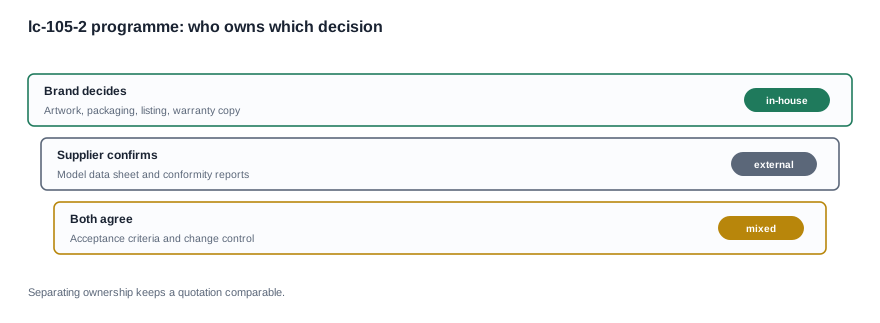
The identity is the hard half, and it is entirely yours. Your name, your packaging, your unboxing, your listing copy, your warranty promise and your after-sales path are all things the supplier has no opinion about and no published record for. When a brand briefs a supplier on "customisation" without separating those two halves, the reply arrives as a list of options with no criteria attached, and the option list is where the programme's cost hides.
The six published rows, and what they are actually worth
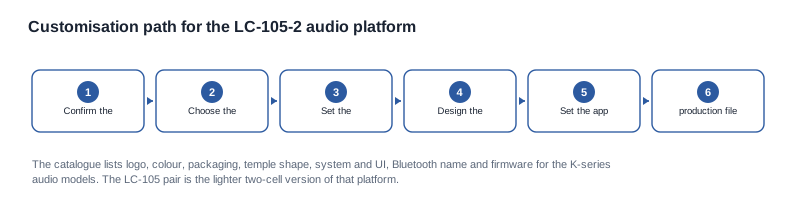
Read the six rows as a filter, not as a description. Cell format, runtime, charge time, charging method and radio version are the only things you can rely on before you hold a unit, and each one earns its place by eliminating something. The cell format is two 55 mAh cells, and because the format is shared across four audio models in this catalogue, it cannot on its own tell you anything about runtime; two of those four publish about six hours instead of eight, and the two that publish about eight hours are distinguished on the page by a feature row that this model does not have.
The runtime row therefore means "roughly eight hours, in the supplier's stated conditions", which is not the same claim as "eight hours in your shop". The catalogue publishes no volume level, no source description, no ambient temperature and no codec, so the number cannot be converted into a shift length. Use it to exclude the six-hour models and to set expectations internally. Do not put it in a listing.
The charge time row is a ceiling: two hours or less. It says what a supplier may claim, not how long a unit sits unusable on a counter while it charges, and it carries no starting state and no completion criterion. If your brand is built around fast turnaround — same-day dispatch, an hour of browsing in store, a gift set that must be charged before it is wrapped — this row needs converting into a measured number during sampling, because the published ceiling alone will not support a service promise.
Magnetic charging is a packaging fact as much as an electrical one. The charge contacts determine the shape of the insert tray, the clearance in a gift box, the position of any charging dock in a display, and the instruction card. Every one of those downstream decisions is easier when it is made against a real contact geometry instead of an assumption.
Two models carry the same published rows
Here is a fact that is easy to miss and expensive to discover late: this model and its sibling publish identical rows — 55mAh*2 cells, about eight hours, a charge time of two hours or less, magnetic charging, Bluetooth V5.4, and no feature row on either catalogue page. The catalogue does not separate them, so no published comparison can tell you which one to buy.
That is not a defect in the document; it is the honest state of the record, and it dictates the method. If two models are indistinguishable in the published rows, the choice has to be made on physical evidence — samples, measurements, an acoustic comparison, an interface review — and the written evidence has to be captured while the choice is still reversible. A buyer who selects on the basis of "the one with the longer runtime row" is selecting on a number that is identical for both, and is therefore selecting on nothing.
The catalogue publishes no charging-case row for this model, either. That absence is an open question, not a "no". Ask whether a case is supplied, what it holds, and whether it is magnetic.

Deciding the private-label scope for lc-105-2
Once the device layer is understood, the brand layer can be designed properly. The point of a private-label programme is to own the parts of the offer that a customer actually judges you on, and to buy the parts that require industrial capability. Writing that split down before the supplier conversation is what keeps a quotation comparable.
Artwork, packaging and the decisions that get expensive late
Artwork is where scope creep is most visible and least reversible. The surface area available for brand elements — temples, arms, the case, the box insert, the cable wrap, the manual — determines what a shopper sees in a thumbnail and what they see in the hand. Two decisions have to be made early because they change tooling rather than artwork: whether the brand mark sits on a surface that can carry it without interrupting a published design line, and whether the packaging opens a path to a charging dock or a display fixture.
Those questions are answerable. What is not answerable from a catalogue is the tolerance: how the mark will sit on a curved surface, how it will survive a wear-and-tear cycle in a pocket, and whether a specific ink or plating process is available on a given part. Those go to the supplier as part of the artwork discussion, with a sample of the actual surface in front of you, because a logo placed on a flat proof tells you nothing about how it will sit on a temple.
Packaging is the second early decision, and it is a cost decision rather than a creative one. A rigid gift box, a folding carton with an insert, and a plain mailer are three different supply chains, with different minimum order quantities, different lead times and different unit costs. Each of them also changes what the brand can promise about the unboxing, which is often the moment a customer photographs and shares. The range of private-label packaging options is set out in customization options for packaging design, and the structural questions that should be settled before artwork begins are listed there.
What goes in the box, and what belongs in the listing
The box contents and the listing are two different promises, and confusing them is expensive. What goes in the box is a physical decision: the device, a charging cable for the magnetic contacts, a printed quick-start card, and any case or accessory the supplier actually supplies. What belongs in the listing is a written one: what the customer receives, how long the battery lasts, what is in the warranty, and what to do if something fails.
The temptation is to make the listing promise match the unboxing, because a mismatch shows up in returns. The better practice is to make the listing promise match what you can evidence, and then design the box to support it. That means knowing, before the artwork is final, whether a charging case exists for this model, whether the quick-start card can be printed in the languages your channels need, and whether the warranty statement in the listing can be honoured by a return process you control.
The private-label options for Bluetooth audio glasses note covers the range of brand-owned choices, and what to include in the box works through the contents list and the trade-offs behind it. Both are worth reading before the first supplier meeting rather than after the first proof.
Listing copy that stays inside the published record
A private-label listing is a commercial document written in marketing language, and the fastest way to create a problem is to copy a number the published record does not support. Three habits prevent most of that.
The first is to treat the runtime row as a laboratory figure rather than as a promise. The catalogue publishes about eight hours for this model without stating the volume, the source, the codec or the temperature, so a listing that turns that figure into a guaranteed playback time asserts a ceiling the source never established. A listing that says "rated at about eight hours by the manufacturer" describes what the manufacturer published and nothing more.
The second habit is to keep the charge-time wording inside the published ceiling. Two hours or less is the whole of the published statement, so wording that promises a shorter guaranteed time than that asserts something the catalogue does not support, and a reviewer comparing the listing with the manufacturer's sheet will see the discrepancy.
The third habit concerns claims the catalogue never makes. This model publishes no feature row, so there is no acoustic descriptor to borrow for a listing, and a brand that writes a marketing line about sound quality is writing a line the supplier has not substantiated. The same applies to water resistance, to any certification mark, and to any assistive or vision-related benefit. None of those appear in the published rows for this model, and each of them is the kind of phrase that turns a routine listing review into a compliance investigation.

Sampling lc-105-2 before a bulk order is placed
Sampling is the only stage where a brand can convert published rows into its own evidence, and for a private-label programme it does a second job as well: it is the first physical proof of the brand surface. The discipline is to arrive with criteria, not with opinions.
Turning a sample order into a specification
Start by writing the acceptance criteria before the units arrive, and split them into two lists because they have different owners. The supplier-side list covers what the supplier must demonstrate: the cell arrangement is two 55 mAh cells, charging is magnetic, the radio is Bluetooth V5.4, and a charge from the stated starting state completes within the published ceiling. The brand-side list covers what you must decide on the physical sample: how the mark sits on the surface, how the insert holds the unit, whether the quick-start card reads clearly, and whether the unboxing sequence works when a customer does it without instructions.
Then run the operational test, because the published runtime row is a nominal figure and the brand's own service promise depends on what happens in practice. Log a full session at a realistic volume with a defined source device, record the intervals, and note the conditions. Do the same across the whole sample set rather than on one unit, because variance between samples is information about the supplier's production consistency, and a brand that only measures the best unit learns nothing.
Finally, record what the sample does not tell you. A sample of a few units cannot establish a defect rate, cannot validate a charge-case ecosystem, and cannot confirm certification scope. Those need documents, and the documents are what turn a favourable sample into a defensible specification. The sample before bulk guidance sets out how to structure that stage, and which models are ready for an OEM programme is worth checking against the platform view of the range.
The record a brand should keep
Records are cheap to keep and impossible to recreate. For each sample unit, keep the model designation, the revision of any document supplied with it, the measured weights, the charge timings, the acoustic notes and the photographs of the brand surface at each revision. Keep the supplier's answers with dates and the name of the person who gave them. Keep the sample itself, or at least two units, in the packaging revision that was tested, because a packaging change is a new variant even when the device is identical.
The brand's own specification file should then be treated as a controlled document: a revision number, a date, an owner, and a list of the open items with the date each was answered. Any brand that can produce that file on demand can answer a channel partner's audit in an afternoon. A brand that keeps screenshots and emails cannot.

Pricing and order terms for an lc-105-2 private-label run
Nothing commercial is published for this model, so the quotation is the first document in which any of it exists. That is not a reason to distrust a quotation; it is a reason to read it as a specification document with prices in it.
Price, minimum order quantity and lead time
Ask for the unit price at two volume bands, not one, because the band structure tells you more than the headline figure. A quotation that only names a price at your intended volume tells you what that quantity costs and nothing about how the economics move. Two bands give you the slope, and the slope is what your forecast and your margin model depend on. The published specification rows for this model are available in the specifications and features note, and the battery life reference sets out how to read the runtime row honestly.
Minimum order quantity needs to be stated separately for the base unit and for each customised element. A brand that needs 500 units of the device and 500 printed cards has two different minimums, and a supplier who quotes only the larger one has not answered the question. Tooling, artwork setup, packaging development and any conformity work should appear as named line items rather than being folded into the unit price, because only named items can be forecast, amortised or renegotiated.
Lead time needs a starting point named. Days from purchase order to shipment, days for the first sample and days for a repeat build of the identical specification are three different commitments, and a supplier who quotes one number has told you about one of them. For a brand with a seasonal window, the repeat-build figure is often the one that matters, because it decides whether a second run can be rescued when the first sells out.
Warranty, quality control and the remedy route
The warranty a brand publishes is a promise it makes to a customer, and it has to be backed by a route it controls. Ask what the supplier's warranty covers, for how long, and what it excludes; then ask what happens to a defective unit in practice — whether it is replaced from the next batch, whether the brand pays return freight, and whether there is a process for a customer who needs a replacement before the next shipment exists.
Quality control belongs in the same conversation. Ask for the incoming inspection standard, the sample size, the acceptance criteria for cosmetic and functional defects, and the defect rate the supplier stands behind. Then ask the harder question: what is the remedy when a batch arrives outside the agreed band, and who decides. A brand that has agreed that in advance can hold the conversation to a standard instead of negotiating from a weak position after the goods are in the warehouse.
The commercial terms that a supplier will not answer without pressure are usually the ones that matter most — which is why the request should be written down and numbered before the meeting rather than improvised inside it.
Evidence a channel partner will ask for
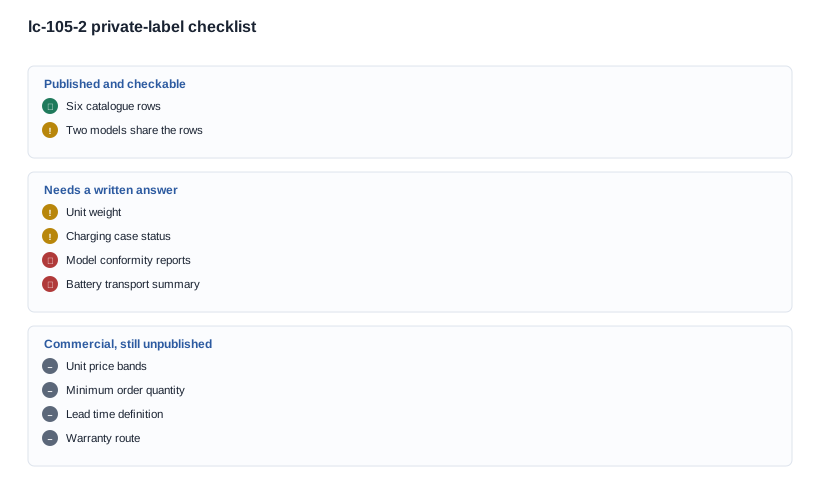
A channel partner is a second audience for the same evidence file, and their request list is usually longer than the supplier's. Marketplace listings, corporate ordering programmes and retail buyers ask for the same families of documents in slightly different forms: a model-level conformity report with a report number, a battery transport test summary, a statement of what the device does not do, an inspection standard, and a warranty statement that names the responsible party.
The useful discipline is to answer each request with a document reference rather than with a sentence. A request for conformity evidence is answered with a report number and a date, not with a paraphrase of what the report says. A request for a battery declaration is answered with the test summary and the shipping classification. A request for certification status is answered by naming the model, naming the scope of the report, and stating that the catalogue carries no per-model certification row, because that is the accurate position and a precise answer is a stronger position than a vague assurance.
Two requests deserve particular attention. The first is a request to place a certification mark on packaging: artwork changes are slow to reverse once a print run begins, and a mark the supplier's documentation does not support transfers the exposure to the brand. The second is a request for a battery-life figure inside a tender response, where the wording is often copied into a contract; the honest answer is the published nominal figure with its conditions attached, plus the brand's own measured figure from its operational test if one exists.
A hypothetical lc-105-2 launch, in six steps
The sequence below is a hypothetical case, not a client project. It uses no customer name, no order value and no delivery commitment, because none of those are published facts.
A hypothetical launch, step by step
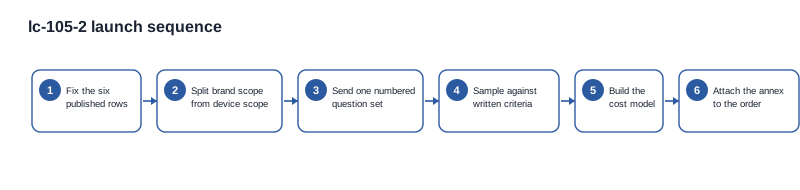
- Fix the device baseline. The brand writes the six published rows into its specification file and marks them as catalogue facts — two 55 mAh cells, about eight hours, a charge time of two hours or less, magnetic charging, Bluetooth V5.4, no feature row. Nothing else is written down as fact about the device.
- Separate the brand scope from the device scope. Artwork surfaces, packaging format, box contents, quick-start languages, warranty wording and the after-sales route are written as a brand-owned list with a decision and an owner against each item.
- Send one numbered question set. Weight, control surface, acoustic configuration, charging-case status, model-specific conformity reports with report numbers, battery transport documentation, unit price bands, minimum order quantities, lead-time definitions and warranty terms — all in one document, all requiring written answers.
- Sample against written criteria. Units arrive, the supplier-side and brand-side acceptance lists are executed, the operational session is logged, and the packaging revision is checked against the artwork revision.
- Build the cost model. The quotation is broken into named lines, the volume bands are converted into a margin model, and the missing items are added as open questions rather than as assumptions.
- Commit as one annex. Specification, evidence file, acceptance criteria and commercial terms are attached to the purchase order together, so a change to any of them is a documented change rather than a fresh negotiation.
The limits of the published record
Two boundaries close the method. The first is that published rows are a floor and not an answer: they exclude options, they orient a conversation, and they cannot tell you what a unit weighs, how it behaves acoustically, or what it costs. Wherever a quantity is needed and the catalogue does not publish one — unit price, minimum order quantity, lead time, warranty, weight, certification numbers, sample cost — the accurate answer is that it is not published, and the useful answer is the question to ask.
The second boundary concerns claims. Nothing published for this model supports a medical, hearing-assistance or vision-protection claim, and a private-label programme must not be built on one. Open-ear audio frames are communication and consumer devices; marketing them as assistive products creates a regulatory exposure that the six published rows do nothing to cover. The same applies to positioning aimed at children.
What CYNRIN publishes and what CYNRIN withholds
At CYNRIN the catalogue is a product record and this model occupies six rows of it. We do not publish unit price, minimum order quantity, lead time, warranty terms, certification numbers, unit weight or sample charges, and we will not quote a number for any of them informally. The catalogue does carry a company-level export certification page, and its content is images rather than text: ten patent certificates, eight of them for appearance designs and two for utility models. The catalogue text contains no mention of CE, FCC or RoHS, and there is no per-model certification row anywhere in it, so the certification scope for this model is a question to put to the supplier rather than a line to copy out of ours. Our approach is to hand a brand a precise list of what is published, a precise list of what is not, and a recommendation to keep the two lists apart in every document the programme produces.


