
LC-105-2 smart glasses battery life is published as five specification rows, and three of those five reach a procurement team with no method attached to them. The catalogue page for this model gives paired 55 mAh cells, a charge time of two hours or less, a rated use of about eight hours, magnetic charging and Bluetooth version 5.4, and it carries no feature line, no charging-case row and no certification reference of any kind. The numbers themselves are quotable as written. What is absent is everything that would make them defensible: the workload behind the eight hours, the accessory that the magnetic interface implies, the weight of the unit, and the documents that name this model in a destination market.
The route below follows the order a sourcing team meets the problem. The first section takes the five published rows apart and states what each one settles. The second places this model against the other audio pages that publish the same rows, because the notable fact about an eight-hour rating is that three other audio pages carry it as well. The third deals with the condition problem and sets out the request list that closes it. The fourth covers where the model stands across the wider catalogue on runtime and charge time, and against the G07 that shares its cells. The last section states our assessment and the items that have to be closed before any of this reaches a page. We publish no unit price, no minimum order quantity, no lead time and no warranty term for this model, and nothing here ranks it against another product.
What the LC-105-2 publishes about power
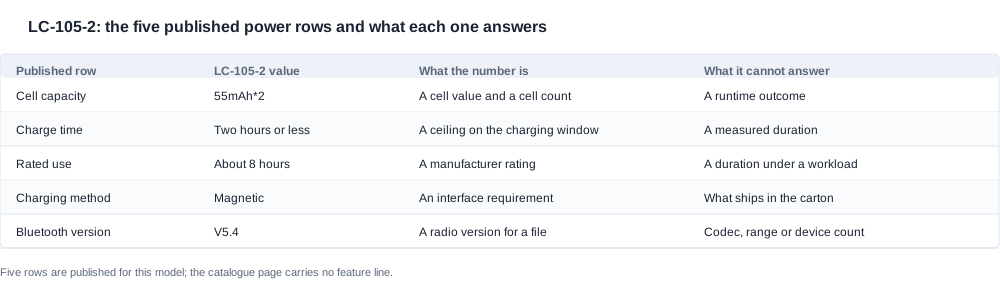
Five lines and nothing more. The LC-105-2's catalogue page gives the radio version as 5.4, the cells as 55mAh*2, the charging window as two hours or less, the stated use as about eight hours, and the interface as magnetic. Those five entries are the whole set of permissions a listing page has to work from, and for an audio product that is a thin sheet.
What the page omits is at least as consequential as what it prints. There is no per-model certification reference, no colour list, no ingress rating, no touch row of any kind, no driver or amplifier figure, no temple or hinge descriptor, no microphone pickup distance, no leakage figure, no surround-sound note, no frame weight and no charging-case row.
The capacity row is written exactly as the catalogue writes it, 55mAh2, which is a cell value and a cell count with no total printed. The per-side value is roughly three-fifths of what the K01 and the K02 publish on their 90mAh2 rows. The same 55 mAh value appears on four audio pages in total: this one, the LC-105-1, the G07 and the YK12. Two of those four publish about eight hours of rated use and two publish about six, on cells the catalogue describes identically. That is the fact the title of this piece points at, and it is a fact about the published data rather than about the engineering behind it.
The charge row is the one that gets transcribed incorrectly most often, so the rule for it is mechanical. Two hours or less is a ceiling, and exactly two hours falls inside what that wording permits, so the figure cannot be rephrased as a charge that completes inside two hours. Twenty-six of the twenty-eight models in this catalogue publish the same ceiling; only the D17 and the ZH12 publish roughly one hour, and both of those are sport models rather than audio products. This page adds no starting state and no completion criterion to the row, which means it does not tell a buyer how long a unit waits before it is usable again from empty, and it cannot be converted into a turnaround time for a dock.
The rated-use row carries the most commercial weight and the least method behind it. About eight hours is a large-sounding figure, and it is the number most likely to be lifted straight into listing copy. No model in this catalogue publishes the workload, the volume, the starting charge, the end criterion, the ambient condition or the number of units measured behind a rated-use figure, and this model has no second page and no datasheet that supplies them instead. A rating without a condition is still a legitimate thing to hold and to cite. It is not something to convert into a customer's expectation.
Magnetic charging and the radio version close the sheet. Magnetic means the unit needs a magnetic interface to charge on; it does not say what that interface is, what ships in the carton, whether a spare can be bought separately, or what any of it weighs. None of the eight audio models publishes a charging-case row at all, which is a gap in the documentation rather than a statement that no case exists for these products. Bluetooth version 5.4 belongs in a technical file as a radio version; it says nothing about codec, range, latency, or how many connected devices the unit will hold.
The three audio models on the same charge ceiling
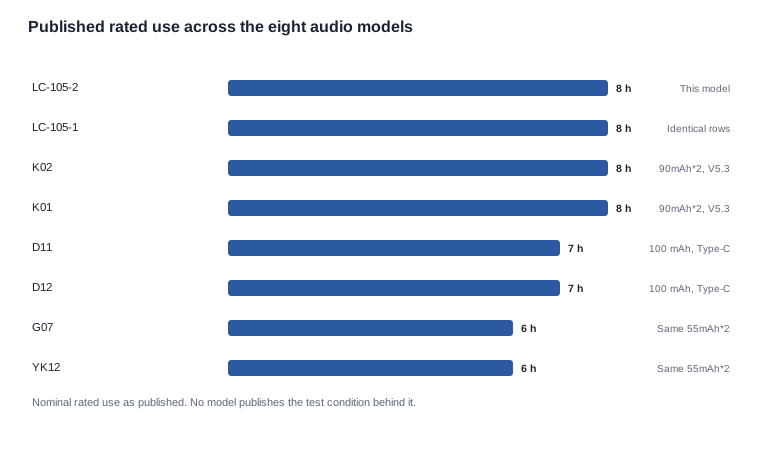
Three other audio models publish the same rated use under the same two-hours-or-less charge ceiling: the K01, the K02 and the LC-105-1. Together with this model that puts four of the eight audio pages in the top published band of about eight hours, and those four sit on two different cell configurations. The ceiling itself separates nothing inside the audio group, since every one of the eight pages publishes it. The band narrows the field from eight models to four. The cell value narrows it further, because among those four only the LC-105-1 carries the same 55mAh*2 notation as this model.
| Audio model | Cell value as published | Rated use | Charge ceiling | Charging method | Bluetooth |
|---|---|---|---|---|---|
| K02 | 90mAh*2 | About 8 h | Two hours or less | Magnetic | V5.3 |
| K01 | 90mAh*2 | About 8 h | Two hours or less | Magnetic | V5.3 |
| D11 | 100 mAh | About 7 h | Two hours or less | Type-C | V5.4 |
| D12 | 100 mAh | About 7 h | Two hours or less | Type-C | V5.4 |
| LC-105-1 | 55mAh*2 | About 8 h | Two hours or less | Magnetic | V5.4 |
| LC-105-2 | 55mAh*2 | About 8 h | Two hours or less | Magnetic | V5.4 |
| G07 | 55mAh*2 | About 6 h | Two hours or less | Magnetic | V5.4 |
| YK12 | 55mAh*2 | About 6 h | Two hours or less | Magnetic | V5.4 |
The two remaining pairs occupy the other two bands. The D11 and the D12 both publish a single 100 mAh cell, about seven hours and a Type-C port, which makes them the only audio models that charge over a cable rather than a magnet. The G07 and the YK12 both publish the same 55mAh*2 notation as this model and both publish about six hours, which makes them the pair that demonstrates what the identical cell notation does to the published band elsewhere. In total the audio group contains four distinct configurations of the same five rows, and which configuration a channel takes is decided by the requirement written into the RFQ, not by the catalogue.
That distinction is worth stating explicitly for a sourcing team, because a specification sheet quoting only the ceiling and the band will select four of the eight audio models without saying which four. The rows that actually discriminate are the cell value and the radio version, and they pull in different directions. The two 90mAh*2 models publish V5.3 while every other audio model publishes V5.4, so a requirement written against the radio version narrows the group to six models and, inside the top band, to the LC pair alone. A requirement written against the charging interface narrows it to the six magnetically charging models instead. A requirement written against the cell value narrows it to the four pages that publish 55 mAh.
The commercial consequence of the two identically specified pairs is separate from the specification argument and arrives first. The K01 and the K02 publish the same five rows, and the LC-105-1 and the LC-105-2 publish the same five rows. Two designations that publish identical rows still produce two artwork sets, two accessory lines, two certification files, two serial ranges and two sets of transport documentation, because every one of those is keyed to the model string rather than to the published specification. Whether a channel carries one string or two is a decision the catalogue cannot make, since it records no difference between the members of either pair. The K01 and LC-105-2 comparison sets out that structure across the two pairs in detail.
Reading an endurance band with no stated condition
The published band for this model is about eight hours, and the catalogue attaches nothing to it. There is no workload description, no playback volume, no source or codec, no statement about whether playback runs continuously or intermittently, no starting state of charge, no criterion for when a run counts as finished, no ambient temperature, and no count of how many units were measured. Each of those omissions is ordinary in a catalogue and each of them is load-bearing, because a figure that cannot be reproduced by anyone else cannot be defended by anyone either.
Two facts inside the published data show that the band is a label rather than a measurement. The first is the one this model is named for: on the very same 55mAh*2 notation, the LC-105-1 and the LC-105-2 publish about eight hours while the G07 and the YK12 publish about six. If the cell value determined the outcome, those four pages would agree, and they do not. The second sits outside the audio group. Six models across the whole catalogue publish about eight hours — the K01, the K02, the LC-105-1, this model, and the YKC02 and the ZH12 from the sport group — and they do it across four different cell configurations. A number that survives that much variation is a band assigned to a class of product rather than a result produced by a cell, and no reader of the catalogue can reverse it back into one.
Read against that, the eight hours still has to be written down, because it is the catalogue's own figure and a buyer is entitled to cite it. The question is which wording carries it. A rated figure of about eight hours of use is the catalogue's claim restated in the buyer's own voice, and it is the correct line for a product page. A ceiling of up to eight hours is a different claim, because it converts a rating into a limit on what a customer experiences and invites comparison against figures that were never measured the same way. A full working day is a third claim, and the published row does not reach it. Where the condition is not yet on file, the honest line is that the model is rated for about eight hours of use and that the measurement condition is stated on request.
Seven questions to ask in writing convert the band into something a specification sheet can hold:
- The workload — continuous playback, intermittent playback, a call loop, or a stated mix of the three, and the volume level used.
- The start state — the charge level at which the run began, and whether a full or a partial charge was assumed.
- The end criterion — what counts as the end of a run, and the point at which the product is treated as discharged.
- The source — the device and the codec, because the radio link and the decode stage are part of the drain.
- The ambient condition — the temperature of the run, and whether the unit held a connection throughout.
- The sample — how many units were measured, which build they carried, and what spread was seen across them.
- The charging condition — the starting state and the completion point behind the two-hours-or-less ceiling.
Those answers belong in a document rather than in a conversation, and they belong to this model string rather than to the family. If the supplier answers for the LC-105-1 and not for the LC-105-2, that reply is itself a finding: it tells a buyer that the two designations were not measured the same way, and the shared figure becomes a coincidence of labelling rather than a shared result. If the answers arrive in identical form for both strings, then the catalogue's identical rows reflect a genuinely identical test, and the figure becomes usable on the page. Either answer is worth having, and neither can be guessed from the catalogue.
Until those answers exist, a sample order is the only route to a number a buyer can schedule against. The protocol for how to verify the band on a sample is straightforward: run the workload the product is actually sold for, from a stated starting charge, to a stated end point, on more than one unit, and record the result against the same seven parameters. The gap between the published band and the measured result is the real endurance of the product the customer receives, and that gap is what belongs in any shift or duty-cycle plan. The G07 endurance analysis covers the same cell notation carrying a different published band.
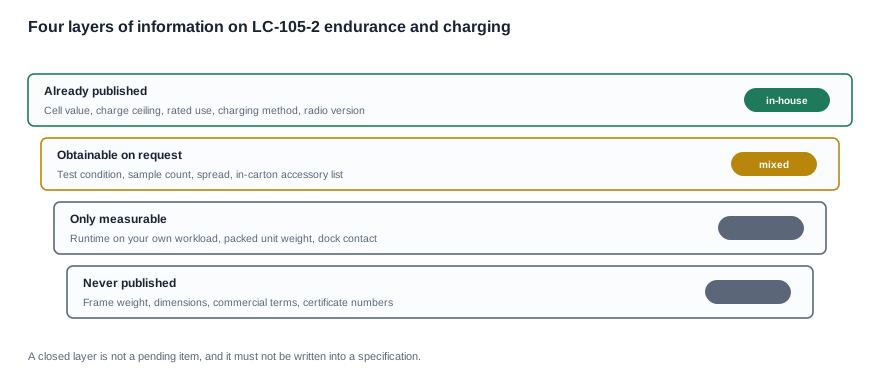
The four layers above are worth keeping separate, because they are answered by four different parties and a buyer who mixes them up ends up writing a claim the evidence does not support. The published layer is ours and can be cited today. The obtainable layer is the supplier's, and it arrives in writing if it arrives at all. The measurable layer is the sample's, and it costs an afternoon with a stopwatch. The fourth layer contains the figures that will never be published for this model and have to be treated as out of scope rather than as pending.
Where the LC-105-2 sits on runtime and charge time
On runtime, this model sits at the top of the audio range's published band and in the middle of the catalogue's. Four of the eight audio models publish about eight hours; six models across the whole catalogue publish it, the other two being the YKC02 and the ZH12 in the sport group, and they do so on four different cell configurations. On charge time the picture is flatter still: twenty-six of the twenty-eight models publish a ceiling of two hours or less, and the only two that publish roughly one hour are the D17 and the ZH12, both of them Type-C sport models. On both axes this model therefore sits in the modal group rather than an outlier, which is a useful thing to know before a buyer writes anything, because the instinct on a high-sounding number is to treat a model as exceptional and the published data does not support that reading.
What distinguishes this model is not the number of hours or the length of the charging window. It is the specific combination of the 55 mAh cell value, the radio version and the absence of a feature line, together with the fourth fact that the catalogue publishes an identical set of rows for the LC-105-1. A specification sheet that treats an eight-hour band as the deciding criterion has selected on the least discriminating row available, and the same is true of the charge ceiling, which every audio page shares.
The G07 comparison gives the sharpest illustration of the point, because the two are separated by less than a buyer expects. The G07 carries the same 55mAh*2 notation, the same two-hours-or-less ceiling, the same magnetic charging method and the same V5.4 radio version, and it publishes about six hours where this model publishes about eight. What the catalogue does not publish is the cause of that two-hour gap. It does publish one other difference: the G07 carries a feature line describing an ultra-thin, detachable temple, and this page carries no feature line at all. So the honest answer to why two identical cells produce different published bands is that the catalogue records the difference without recording its reason, and the reason has to come from the supplier as a test condition or as a design note.
Two adjacent gaps matter for anyone writing a specification sheet for this model. The first is the charging accessory: none of the eight audio models publishes a charging-case row, so there is no published capacity, no published dock weight and no published statement about what is in the carton, and an absent row is a documentation gap rather than a statement that no case exists. The second is protection: the audio group publishes no ingress-protection row at all, and IP54 appears in this catalogue only on the V06 and the S7, so this model cannot be quoted with a protection rating and cannot be placed in a channel that promises one. The charging accessory questions for this model work through what the magnetic interface leaves open.
The same discipline governs the figures the catalogue does publish elsewhere. The catalogue publishes one weight anywhere, 158 g for the MT6's glasses body, which belongs to a camera model and already includes its battery and camera rather than describing a bare frame, so it cannot stand in for this one. Frame weight, dimensions, sensor configuration, storage, unit price, minimum order quantity, lead time, warranty term and certificate numbers are all absent for this model, and none of them may be borrowed from a neighbouring page. A specification sheet carrying a borrowed figure is worse than one carrying a blank, because a blank gets chased and a borrowed number gets signed.
Three questions decide where a buyer should take this model, and the order matters because each one either narrows the shortlist or closes the claim.
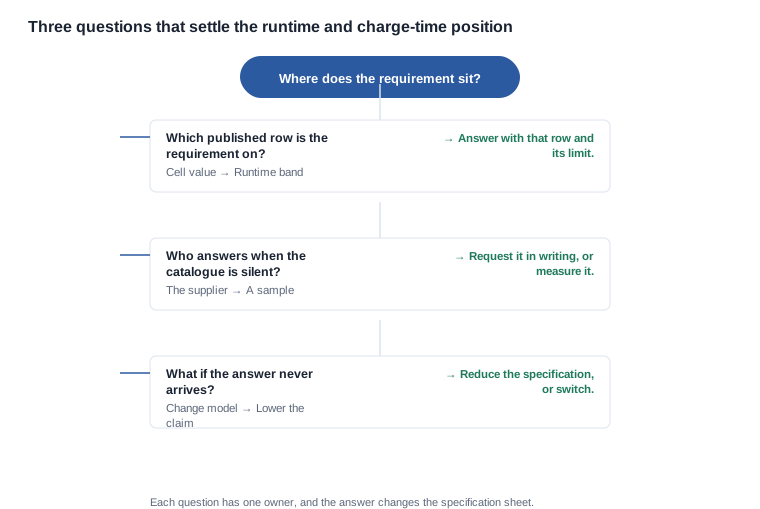
A requirement written against the runtime band selects this model, the LC-105-1, the K01 and the K02, and it does not select between them. A requirement written against the cell value selects the four pages that publish 55 mAh and still leaves this model beside the LC-105-1. A requirement written against the charging interface does not reach this model at all, because the D11 and the D12 are the only audio models on a cable. When the catalogue cannot answer the question, the answer is a written request to the supplier rather than an inference drawn from a neighbouring page, and when even that does not arrive, the specification gets reduced rather than the claim inflated.
The LC-105-2 smart glasses battery life assessment
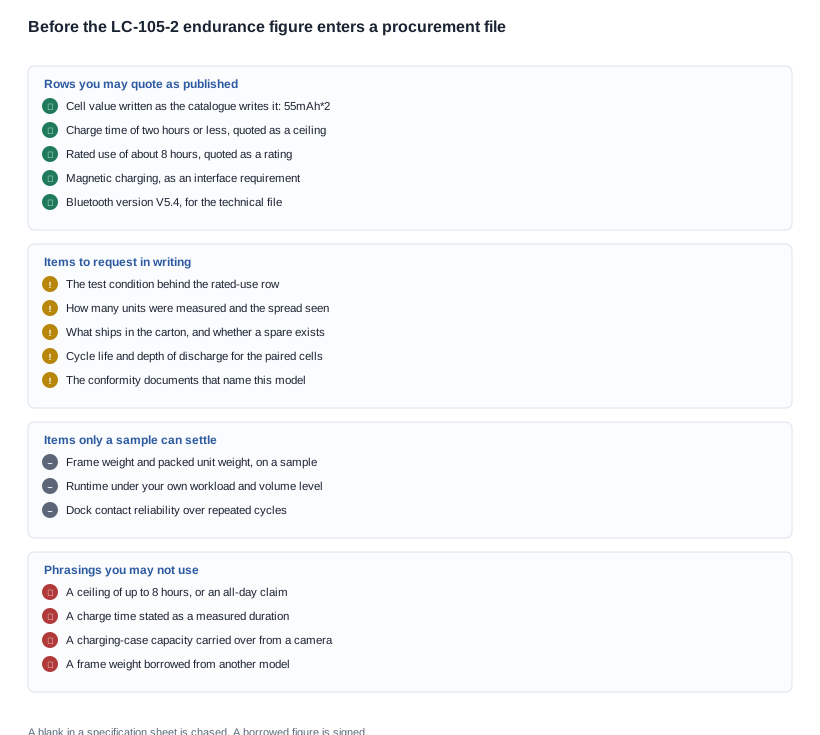
After working through those five rows, our position is that the LC-105-2 has to be shortlisted on its published configuration rather than on its hours. The configuration is coherent: a paired cell, a catalogue-wide charge ceiling, magnetic charging and a current radio version, with no internal contradiction between any two of them. The numbers are quotable as written, and a buyer with a requirement against the cell value or the radio version has a defensible reason to carry this model. What is not quotable is anything that turns about eight hours into a shift, and what is missing is the method behind that figure together with the accessory and weight facts a delivery plan needs.
Five items have to be closed before the runtime figure reaches a product page or a procurement file:
- The test condition behind the rated-use row, requested for this model string by name rather than for the family.
- Whether the measured sample carried the production configuration, and how many units were measured.
- What is in the carton for the LC-105-2, and whether spare magnetic accessories are available separately.
- The measured frame weight and the packed unit weight, taken from a sample rather than from any other page.
- The conformity documents that name this model for the destination market, including the radio identifier and the declaration that cites the Radio Equipment Directive (EU) 2014/53/EU, with electromagnetic compatibility handled under the separate EMC Directive 2014/32/EU.
Our catalogue text contains no reference to CE, FCC or RoHS for any model, and there is no per-model certification row anywhere in it. The company-level export-certification page carries ten patent certificates — eight appearance-design patents and two utility-model patents — which are intellectual-property documents rather than conformity assessments, and they cannot be used as evidence that a radio product meets the framework a buyer has to satisfy. That is a documentation gap rather than a product defect, and it closes the same way every other gap here closes: by asking, in writing, for the documents that name the model.
Three pitfalls are worth naming, because each is easy to commit to and expensive to withdraw. The first is publishing the hours as a promise — an up-to figure or an all-day claim — when the catalogue gives a rating with no condition. The second is importing a charging-case capacity from a camera page, because several camera models in this catalogue do publish one and none of the audio pages does. The third is quoting a weight, because the single published weight in the catalogue belongs to a different product category entirely. Each of the three is a single line of listing copy, and each of them surfaces only when a customer compares two pages side by side.
The shortlist criteria that survive all of this are short enough to write into a file. What does the requirement sit on, which published row answers it, who answers it when the catalogue is silent, and what happens to the specification if the answer never arrives. A decision built on those four questions carries its reasons with it, which is the only kind of decision a procurement review accepts, and the total cost of the accessory chain is negotiated only after the evidence questions have been answered rather than before.
Across the wider range the audio models publish the same five rows in four configurations, and the questions raised here apply to every one of them. Send the workload your customers will actually put the product through, the destination market, and the quantity band, and we will tell you which of the five rows carries that requirement and which of them has to be obtained in writing before it appears on a page.
Related reading
- The twin model's own endurance analysis — LC-105-1 smart glasses battery life
- The same cell notation with a different published band — G07 smart glasses battery life
- The accessory questions the magnetic interface leaves open — LC-105-2 smart glasses charging options
- What this model publishes — LC-105-2 smart glasses specifications and features
- The band across the audio range — Bluetooth audio glasses battery comparison
For the LC-105-2 the eight hours and the two-hour ceiling are both citable as written; the condition that makes either of them enforceable is the one line on this page that still has to be obtained.


