
The charging story for this model is short in the catalogue and long in practice. The published charging line for the K01 is one row: magnetic charging, with a charge time of two hours or less, on a two-cell configuration of 90 mAh per cell, supporting a rated runtime of about eight hours. That is the entire published charging content. Four things a buyer planning a deployment needs are not published: how the two cells are actually charged and whether the dock seats both of them at once, what a part-finished charge restores, whether a charging case is in the box and what that case holds, and what the dock draws from the wall. Each of those four gaps carries a written question, and a buyer who sends all four as one list gets a far more usable answer than one who asks them in four separate rounds.
This page is written for the person who has to answer a customer's operational question: "how many of these do I need, and how do I keep them working?" That question is a logistics question before it is a technical one, and it cannot be answered from a catalogue row alone.
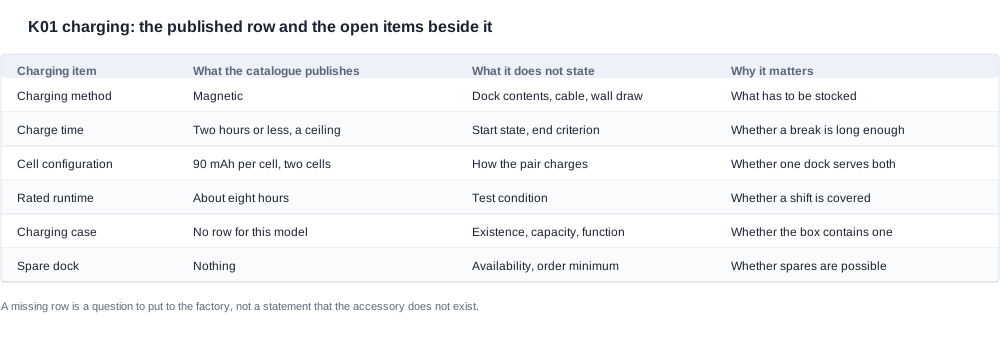
K01 charging options: the two-cell layout and what a magnetic dock does with it
What the catalogue publishes, in the order a buyer would ask for it
- Charging method — magnetic
- Charge time — two hours or less, published as a ceiling
- Cell configuration — 90 mAh per cell, two cells
- Rated runtime — about eight hours
- Bluetooth version — V5.3
The charging method is the row that matters most operationally, and it is worth understanding what it commits a buyer to before assuming it is a convenience. A magnetic dock is a physical interface: a pair of contacts, a defined alignment, and a dock that has to be present, handled and replaced when it is lost. A wired interface is a physical interface too, but one whose only requirement is a compatible connector. The difference in what has to be stocked and counted is larger than the word suggests.
The two cells, and what the number does not settle
The published cell configuration is 90 mAh per cell across two cells. Two things follow from that, and one of them is a trap.
The catalogue publishes the cell value and the cell count, not a combined total. Any figure that adds the two cells into a single capacity is a derived number, and it has to be labelled as one wherever it appears. That matters because a derived total in a product listing reads to a customer as though it were published, and it is not.
Two cells in one product do not tell you how they charge. The documentation does not state whether the two cells are charged together or in sequence, whether the dock charges both at once, or how a partially charged unit behaves. Those are exactly the questions a buyer needs answered, and none of them appear in the published row. They are questions about the dock and the cell arrangement, and they have to go to the supplier in writing.
The pattern that makes the arrangement question sharper
The range contains several two-cell configurations, and their published runtimes do not follow from their capacities. The LC-105 pair publishes 55 mAh per cell across two cells and a rated runtime of about eight hours. The G07 publishes the same 55 mAh per cell across two cells and rates about six hours. The YK12 also publishes two cells of 55 mAh and rates about six hours. The YKC02 publishes 70 mAh per cell across two cells and rates about eight hours.
Two models with identical published cell configurations and different published runtimes is enough to establish that cell count and cell value do not determine endurance in this catalogue. It is a strong reason not to read a runtime figure as a consequence of a cell figure, and a strong reason to ask how a specific configuration behaves rather than to infer it from a neighbouring model.

Why the charge time row is a ceiling and not a duration
The published charge time for this model is two hours or less, and it is a ceiling. That wording is precise and the distinction is not pedantic: a ceiling of two hours permits a charge that takes exactly two hours, whereas a statement of under two hours would not permit it. Written the other way, a published ceiling becomes a promise the supplier never made, and a buyer who has built a schedule on the wrong version of the claim discovers the problem at the dock rather than in the agreement.
The two things the row does not state
No starting state. The row does not say what charge level the unit was at when the clock started, and this is the single most consequential omission for anyone planning around it. A unit charged from a low state and a unit charged from a partly depleted state are not the same number of hours, and the difference is usually large enough to matter over a shift.
No completion criterion. The row does not say what the end of the charge is — what charge level counts as charged, and what the dock or the unit reports when it is done. A charger that indicates completion by a light and a charger that indicates completion by a full stop may also stop charging at different points.
No interruption behaviour. Whether a charge can be interrupted and resumed, and whether a partial charge counts, is not published either. This is a routine question with a real operational answer, and it should be asked rather than assumed.
The broader treatment of why published runtime figures do not transfer between models is in the K01 battery life page, and the battery life guidance covers the reasoning behind it. The K01 specifications and features page sets out all five published rows together, which is the right starting point for any specification question on this model.
What a buyer should be able to say about the charge line
A buyer who has this answered can write a defensible sentence into a customer document. A buyer who has not can only write a cautious one. The sentence looks roughly like this: the unit charges magnetically, a full charge takes two hours or less from the supplier's stated test conditions, and a charge begun part-way through the working day restores enough runtime for the remainder of that day. Everything after the first clause depends on the answers.
The replenishment rhythm across a working day, and where the interruptions land
The operational question is how many units and how much dock time a team needs, and it has three inputs: the rated runtime, the charge ceiling, and the length of the break in which a top-up can happen. All three are known, or partly known, and the arithmetic is straightforward once the gaps are filled.
The rhythm the published numbers describe
A unit rated at about eight hours does not cover a second shift, and a unit charged in a two-hour window cannot be recharged in a fifteen-minute break. That is not a criticism of the product; it is the shape of the published figures, and a deployment plan built on it is a plan that will hold. The two levers a buyer has are the number of units issued per person and the position of the recharge break, and the second lever is usually the one with the most room in it.

Where the interruption risk actually sits
The dock is the single point of failure. If one dock serves several units, the dock is on the critical path for every unit that touches it. A spare dock in the same building removes that risk, and the question of whether spare docks are available at order quantity is a supply question worth asking early.
Alignment is a handling question, not a specification question. Magnetic charging depends on the unit and the dock meeting in a defined position, and that position has to be right every time. A dock that requires careful alignment will generate user error, and user error in a charging routine is where units end up uncharged at the start of a shift. Test the alignment with cold hands, with gloves, in a pocket, and with a unit that has been in a case. A dock that is forgiving in the factory and unforgiving in a warehouse is a staffing problem, not a product problem.
The count is the thing that fails quietly. Docks and cables go missing. If the accessory set and its minimum order quantities are not established before the order, the shortfall appears as an operational problem several weeks after the goods have landed, at which point the only remedy is a second shipment.
The comparison that a buyer should make before choosing a charging arrangement
The range splits on charging method, and the split is not even: seventeen of the twenty-eight models charge magnetically, seven use Type-C, and four have no published charging method at all. The Type-C models in the audio range — the D11 and the D12 — take a 100 mAh cell, rate about seven hours, and charge over Type-C.
Stated narrowly, the practical difference is in what has to be stocked and what has to be found. A Type-C model needs a cable and a wall supply; a magnetic model needs a dock. The cable is consumable and cheap; the dock is a proprietary item with a lead time. For a buyer who is managing spares across sites, that is the entire decision, and it is a decision about the accessory supply chain rather than about the product. The Bluetooth audio glasses charging options page covers the range-wide view, and bulk ordering covers how accessory minimums are usually handled.
How to choose a charging arrangement: the four criteria that decide it
The published rows leave a buyer with four decisions to make, and each one can be settled on evidence rather than on preference. Writing the criteria down before the order is what stops the choice from being made by whichever accessory happened to be in the sample box.
- Break length against the charge window. A charge of two hours or less has to fit inside the recharge window that actually exists, and that window is set by the shift pattern rather than by the device. Settle this first, because if the arithmetic does not work, the arrangement has to change rather than the expectation.
- Dock-to-unit ratio per site. How many units one dock has to serve, and whether the dock can sit within reach of where the recharge break happens. This criterion decides the spare stock quantity and the number of charging locations a site needs.
- Handling tolerance of the magnetic interface. Whether the dock accepts the unit at a slight angle, with gloves on, at the end of a long shift. Test it rather than assume it, because a dock that has to be aligned deliberately produces uncharged units that nobody notices until the following morning.
- Accessory lead time against the service window. How long a spare dock takes to arrive, and whether that is shorter or longer than the time a unit can be out of service. Where the accessory lead time is the longer of the two, the spare quantity has to be larger.
The trade-off between them is real: more docks per unit removes the alignment and availability risk, and it adds cost and stock. The way to resolve it is to fix criteria one and three first, because those are the ones that cannot be corrected by adding stock later, and then to set the dock quantity from the resulting numbers rather than from a budget assumption.
What to ask the supplier, in one message
A single request, sent once, closes most of the charging questions and stops them resurfacing in the middle of an order. These are the questions the catalogue does not answer, and every one of them is answerable in writing.
- The charging test condition behind the two-hour ceiling, including the starting state and the completion criterion.
- Whether the two cells charge together or in sequence, and what the dock reports while charging.
- Whether a charge can be interrupted and resumed, and what a partial charge is reported as.
- Whether a charging case is included, what capacity it holds, and whether it charges the unit or only stores it.
- What the dock ships with, what cable it uses, and what it draws from the wall.
- Whether spare docks are available as a separate line, and the order minimum for each accessory in the set.
Ask all six in the same message. A charging question asked on its own tends to be answered in isolation, and an isolated answer is the one that is hardest to plan a deployment around, because it describes a condition rather than a behaviour.

The unresolved items: the case, the cable and the spare dock
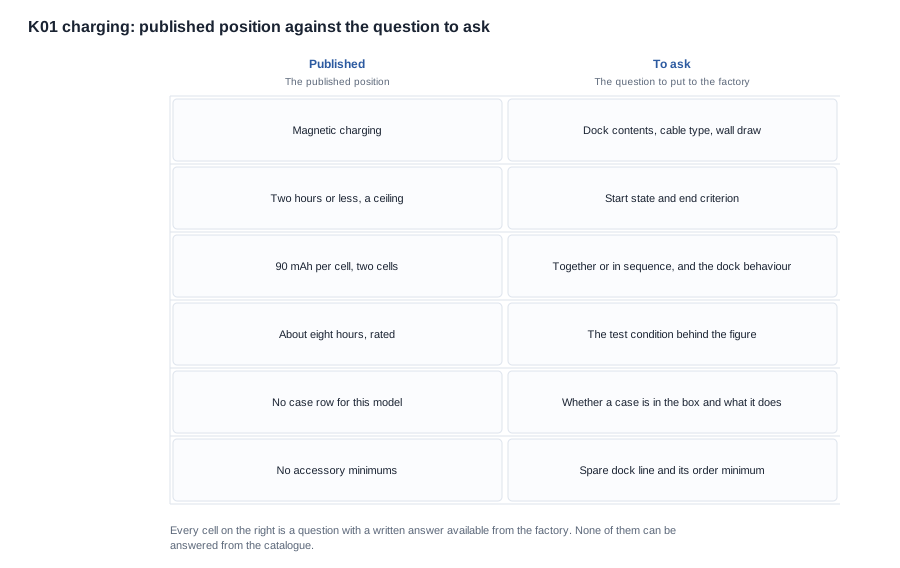
This section is deliberately a list of things that are not published, because a buyer who knows the gaps can plan around them and a buyer who assumes they are closed cannot.
The charging case
The catalogue publishes no charging-case row for this model. That is a different statement from saying the product has no case, and the difference is material: a missing row means the specification has not been recorded, not that the accessory does not exist. The case rows in this catalogue belong to the camera models, where several are published with capacities — 1400 mAh for three of them, a choice of 900 or 1400 mAh for one, and a 1200 mAh folding case for another. The audio models carry no such row, the K01 included.
For a buyer, the question is therefore not whether a case exists but what the accessory set contains. Ask for the packing list contents, and ask specifically whether a case is included, what capacity it holds, whether it charges the unit or only stores it, and whether the unit charges in the case or on the dock. The last question matters more than it appears, because a case that stores a unit without charging it does nothing for the replenishment rhythm described above.
The cable and the dock contents
What the dock ships with is not published. Whether a cable is included, what connector that cable uses, whether the dock takes a proprietary adapter, and what the dock draws from the wall are all open. The consequential one is the last: a dock that draws more than a phone charger needs a different outlet, and in a warehouse where the outlet plan is fixed weeks before the goods arrive, that is a planning input rather than a detail.
The shipping weight page covers what weight figures do and do not settle for this class of product, and the private label options page covers the packaging questions that sit alongside the accessory list.
The spare dock and the accessory minimums
Two questions, both of which belong in the first enquiry rather than the second: whether spare docks are available as a separate line at order quantity, and what the minimum order quantity is for each accessory in the set. The second is the one that decides whether the accessory arrangement works at all, and it is a routine question that takes a routine answer. The what to check before ordering page sets out the wider pre-order question set.
A note on what must not be written
No case capacity, no dock weight, no cable length, no charger output, and no figure for a partial charge may appear in a listing for this model, because none of them is published. If a product page needs a figure in that position, it has to come from the supplier's own documentation, and the documentation is the thing to request.

What the sample settles about charging, and what it cannot
Verification happens on a sample, and the sample is the only place several of these questions can be answered at all.
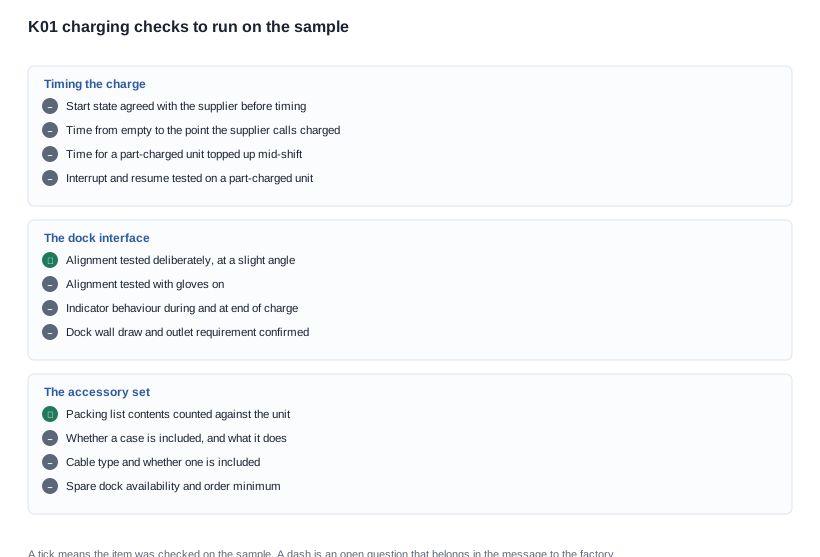
Measure the charge from a defined start. Ask the supplier for the test condition, then reproduce it: note the state of the unit before charging, time to the point the supplier calls it charged, and repeat. If the supplier will not state the condition, record that fact — an unconditioned measurement is still better than none, provided it is labelled as yours.
Time the first charge and a re-charge. The first charge after a full discharge and a charge part-way through a working day are different operations, and the difference is the number a deployment plan runs on.
Test the interruption behaviour. Pull the unit off the dock mid-charge, put it back, and see whether it resumes and whether the indicator changes. Do it with a unit that is part-charged rather than empty, because that is the case that occurs in practice.
Test the alignment, twice. Once deliberately, at a slight angle and with the unit handed over quickly, and once with gloves on. The first test finds a poor interface; the second finds a real operating condition.
Count what is in the box and what you need to keep. Units, docks, cables, and any case, counted against the packing list. Then write down what a site needs to hold as spares, and ask the minimum order quantity for each of those lines.
Ask what the indicator does. Whether there is a charge indicator at all, what it shows during charging, and what it shows at completion are not published, and they are the difference between a charging routine that works and one that depends on someone remembering.
Where CYNRIN stands on K01 charging
On the charging line for this model, our position is that the published row is a true and useful summary and that everything a deployment plan needs beyond it has to come from the factory in writing. We publish the configuration as it stands — magnetic charging, two cells of 90 mAh, a charge time of two hours or less as a ceiling, a rated runtime of about eight hours, Bluetooth V5.3 — and we do not derive a total capacity from it, and we do not describe the ceiling as a duration.
We will not publish a charging-case capacity, a dock specification, a cable type or a partial-charge behaviour for this model, because the catalogue publishes none of them. We will not present a derived total as though it were a published figure, and we will not describe the charge time as under two hours when what is published is two hours or less.
What we can do is state the configuration precisely, mark the open questions clearly, and put a specific list in front of the factory so that the answers arrive in writing rather than in a conversation. Tell us the deployment shape — how many units per site, how many sites, what the recharge break looks like — and we will come back with the published position and the list of what still has to be established before the order.


