
Which channel the K02 smart glasses best for is settled by five published rows and by nothing else. The K02 catalogue page carries a Bluetooth version, a cell configuration, a rated endurance, a charge time and a charging method — and it carries no feature row at all. That combination makes the K02 unusually easy to place inside a range and unusually hard to describe in a product page. A procurement team working against a channel requirement can read the five rows, put the K02 next to the requirement, and reach a decision on paper. A team that needs a frame weight, a charging case, a control method or a certificate number cannot reach that decision from any catalogue page, because the K02 page does not publish those rows.
What follows is the matching method in the order it should be used: the published rows first, the position among the eight audio models second, the two rows that decide the K02 for most channels third, the items the catalogue cannot settle fourth, and a channel-to-model matching sequence last. Nothing here is a price tier and nothing here is a recommendation to buy one specific model. The catalogue publishes no unit prices, no minimum order quantities and no lead times, so every match below is made on published specification rows and on the questions a buyer has to put to a supplier in writing.
What the K02 publishes and who it suits
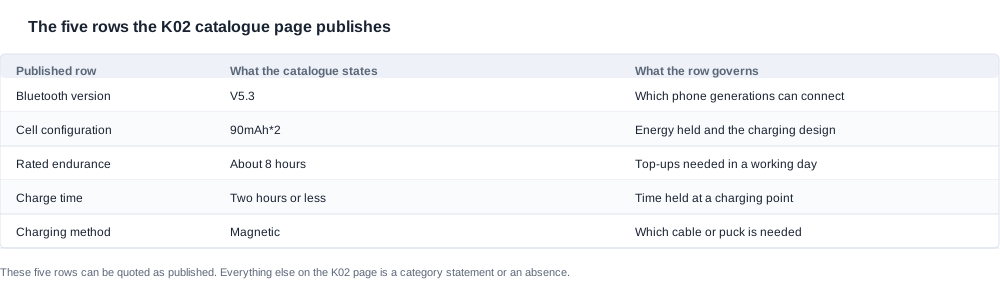
Five rows is the whole of the K02 specification that can be quoted without a supplier conversation. Everything else attached to this model is either a category statement or an absence, and the difference between those two things decides how a buyer should treat the page.
The table below reproduces the K02 rows as published and names what each one governs once it reaches a purchase order. The middle column is the catalogue value; the third column is the commercial reading of that value, not an additional catalogue claim.
| Published row | What the catalogue states for the K02 | What the row governs in a buying decision |
|---|---|---|
| Bluetooth version | V5.3 | Which phone generations in the channel can connect |
| Cell configuration | 90mAh*2 | Energy held and the charging design built around it |
| Rated endurance | About 8 hours | How many top-ups a working day needs |
| Charge time | Two hours or less | How long the product occupies a charging point |
| Charging method | Magnetic | Which cable or puck the customer has to find |
Read as a set, the five rows describe a product with a two-cell energy store, a long stated endurance, magnetic charging and a Bluetooth token. They do not describe a product with any named acoustic behaviour, any frame or temple descriptor, any control method, any camera and any sensing hardware. That is not an omission in this article; it is the state of the page. The K02 catalogue page has no feature row, and the same is true of four other audio models — K01, D12, LC-105-1 and LC-105-2 — so five of the eight audio models publish standard rows only. The published K02 specification list sets out the same rows in the order the catalogue uses them.
A channel for which the K02 can be assessed on paper is therefore a channel whose requirement lands on one of those five rows. When the buying condition is a cell configuration, a rated endurance, a charge time, a charging method or a Bluetooth version, the K02 can be put against it immediately and the answer is on the page. When the buying condition is something else — a named acoustic descriptor, a detachable temple, a control method, an ingress rating, a weight, a charging case, a price or a certificate — the K02 page cannot answer it, and no further reading of the five rows will produce an answer. Channels that sell on a named feature should register that the K02 publishes none: the three audio models that do publish a feature row are D11, G07 and YK12, and each of them names something the K02 page does not.
None of this makes the K02 a weak model to source. It makes it a model to source with a specific question list, and the list is short because the published rows are short. Read as shortlist criteria, the five published rows are the whole of the K02 evaluation, and every other term in the requirement becomes a question for the supplier.
Where the K02 sits among the eight audio models
The audio tier of the catalogue holds eight models: D12 and LC-105-2, YK12 and K01, D11 and LC-105-1, and K02 and G07. Each of the eight publishes a cell configuration, a rated endurance, a charge time, a charging method and a Bluetooth version, which makes the tier directly comparable on those five rows and on nothing else.
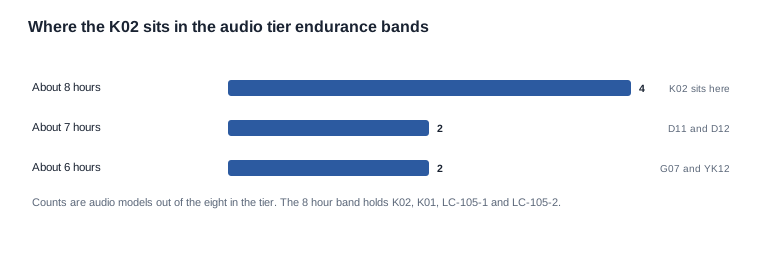
On endurance the eight divide into three bands. Four models publish about 8 hours — K02, K01, LC-105-1 and LC-105-2. Two publish about 7 hours — D11 and D12. Two publish about 6 hours — G07 and YK12. The K02 therefore sits in the band that four of the eight models share, and it shares it with the K01, whose five published rows are identical to its own.
The cell configuration separates the models more clearly than the endurance figure does. Two audio models publish 90mAh*2 — the K02 and the K01, whose rows are otherwise identical to each other.
A further four audio models publish 55mAh*2 — LC-105-1, LC-105-2, G07 and YK12 — and inside that group of four the stated endurance is not one figure. LC-105-1 and LC-105-2 publish about 8 hours, while G07 and YK12 publish about 6 hours. One cell configuration inside the audio tier therefore spans a stated endurance range of roughly six to eight hours, and neither figure carries a test condition, so a buyer comparing the two is comparing two claims rather than two measurements.
The about 8 hour figure is also wider than the audio tier. Across the catalogue, six models publish it — K01, K02, LC-105-1 and LC-105-2 in the audio tier, plus the YKC02 and ZH12 sport models — and they do not share a single cell configuration. Four configurations are involved: two 90 mAh cells, two 55 mAh cells, two 70 mAh cells and one 100 mAh cell. YKC02 publishes 70mAh*2 and ZH12 publishes 100 mAh, and neither publishes an endurance test condition either. No model on that list states the volume level, the audio profile, the ambient conditions or the point at which the endurance clock stops, so the figure cannot be compared across models on the evidence available.
Charging divides the tier one way and case capacity not at all. Six of the eight audio models publish magnetic charging — K02 and LC-105-1, G07 and K01, and LC-105-2 and YK12 — while D11 and D12 are the only audio models that publish a Type-C charging row. Across all eight there is no charging-case row: the catalogue publishes no case capacity for any audio model, which is an absence of a published row rather than a statement that no case exists. There is also no IP row anywhere in the tier. An IP54 marking appears on the V06 and S7 models and on no audio model, so the correct sentence about the K02 is that the catalogue publishes no ingress rating for it, not that it carries one or lacks one.
Positioned that way, the K02 publishes 90mAh*2, about 8 hours, magnetic charging and Bluetooth V5.3, and carries no feature row — the same five rows and the same absence as the K01. That is a workable position for a channel that specifies on published rows and a hard one for a channel that needs a named feature. The audio tier selection note works through the same eight models on the same rows, and the endurance comparison across the range sets the three bands out in one place.

The two rows that decide the K02 for most channels
Three of the five K02 rows cannot decide the model, because a buyer comparing them against the K01 learns nothing: the cell configuration, the rated endurance and the charge time are published identically on both models. What remains decides both the channel requirement and the model choice, and it comes down to the charging-method row and the Bluetooth-version row. Those two rows decide the K02 for most channels, and they work in opposite directions.
The charging-method row is the one that removes models. A channel whose customers expect to charge from a USB-C socket has a requirement that only D11 and D12 satisfy inside the audio tier, because those are the only two audio models publishing a Type-C row. On that requirement the K02 is not a candidate, and no amount of cell configuration changes the answer. The remaining six audio models, the K02 among them, publish magnetic charging, which means the customer needs a magnetic puck and the lead that reaches it, and a channel with an existing cable inventory has to be told that before the sample is shipped rather than after the first complaint.
The Bluetooth-version row cuts the other way, and it is the one a channel is most likely to forget. The K02 and the K01 publish V5.3, while the other six audio models publish V5.4. A brand that has already written a compatibility statement, a product page or a retailer listing naming a Bluetooth version is naming a row, and the K02 sits on the earlier token of the two. That row publishes a version token and nothing else — no profile list, no count of connected devices, no multi-device behaviour and no test condition — so a channel with a compatibility claim to defend has a supplier question to ask rather than a published answer to quote.
The two rows also fail in different ways, which is why they belong at the front of a shortlist rather than at the end of a questionnaire. A charging-method mismatch is visible to a customer in the first minute of use and produces a returns conversation. A Bluetooth-version problem is invisible until a device refuses to connect, and it produces a support ticket that arrives long after the order. Neither is a quality fault and both are specification faults. The K02 and K01 published row comparison shows how little separates the two K models on paper, and the K02 charging options note sets the magnetic row in context.
Everything else the K02 page does not publish belongs to the next section, because the failure mode there is different: those items are not contested, they are simply absent from the catalogue and have to be requested.
What a K02 buyer cannot settle from the catalogue
Several items a buyer normally expects in a specification sheet are absent for the K02, and several are absent for every model. Precision matters more here than anywhere else in the file, because a blank in a catalogue is easy to misread in two opposite directions — as a defect in the product, or as permission to assume.
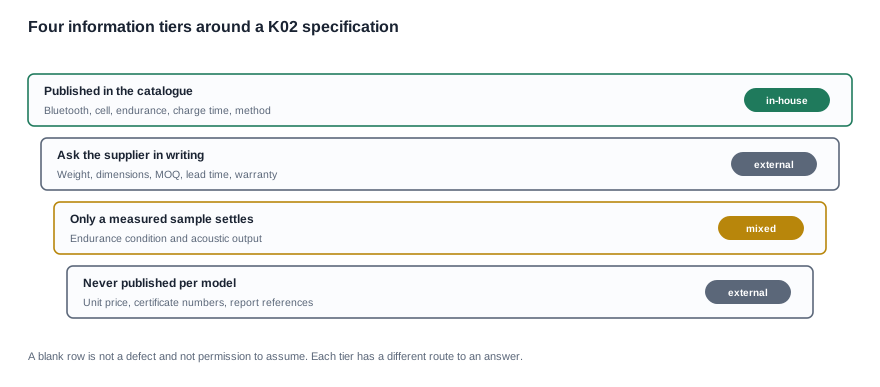
Four tiers are worth keeping apart. The first tier is what the catalogue publishes and a specification can quote directly. The second tier is what a supplier can be asked for in writing and will normally answer. The third tier is what only a measured sample can settle. The fourth tier is what the catalogue does not publish per model at all, and what a buyer has to define for itself before the question can even be asked.
The first tier for the K02 is the five rows in the table above. The second tier holds the ordinary commercial and physical questions that any audio glasses order has to settle: frame weight, frame dimensions, the minimum order quantity, the lead time, the warranty terms and the price for the configuration being ordered. None of these is unusual or confidential; they are simply not in the catalogue, and every one of them has to reach a purchase order as a written answer rather than an assumption carried across from a neighbouring model.
The third tier cannot be answered by any document, only by a measurement taken under agreed conditions. Endurance belongs here: the about 8 hours published for the K02 is a nominal figure with no test condition, so the only defensible comparison is a sample run against a protocol written down before the run starts, with the volume level, the audio profile, the ambient conditions and the end point all named in advance. Acoustic output belongs in the same tier, because it is a property of a physical unit, it varies between units, and the catalogue publishes no acoustic figure for the K02.
The fourth tier has to be defined by the buyer, and three examples show how. The catalogue publishes a weight for one model only in the whole range, and that figure belongs to the MT6 glasses body; it cannot be carried across to the K02, so any specification needing a K02 weight has to ask for it. The catalogue publishes no IP row for the K02 or for any audio model, so an ingress requirement cannot be answered from the page and must never be written into a specification as a rating the product either does or does not carry. On certification, the catalogue text contains no reference to CE, FCC or RoHS and there is no per-model certification row anywhere; the frameworks that can be named are the Radio Equipment Directive (EU) 2014/53/EU and the EMC Directive (EU) 2014/32/EU, so a per-model conformity claim has to be requested as a document and checked against the destination market before it is printed.
Those four tiers translate into a checklist of supplier questions, and the order of that checklist matters more than its length.
- Frame weight in grams for the K02 body, with the battery installed and any case excluded.
- Frame dimensions and temple length, so the geometry can be checked against the eyewear the channel already sells.
- The endurance test condition: volume level, audio profile, ambient conditions, and the point that ends the endurance clock.
- Whether a charging case is supplied with this configuration, and if so its capacity and its own runtime.
- The minimum order quantity, the lead time, the warranty terms and the quotation for the ordered configuration.
- The conformity documents held for this model, referenced to the destination market and to the Radio Equipment Directive (EU) 2014/53/EU and the EMC Directive (EU) 2014/32/EU.
Every one of those is a request for a number or a document the catalogue does not carry, which means what to ask, and in what order, is part of the specification rather than a courtesy. None of them can be answered from a product page, and none of them should be answered by comparison with a neighbouring model.
The K02 smart glasses best for: matching a channel to the model
Matching a channel to the K02 reduces to three questions, and the order matters because each answer removes a set of models. This is not a price tier and not a recommendation to buy a particular model. The catalogue publishes no unit prices, no minimum order quantities and no lead times, so the matching below is made on published rows and on the questions a buyer has to get answered in writing.
The first question is whether the customer's charging expectation is Type-C. If it is, the K02 leaves the shortlist, because the only audio models publishing a Type-C row are D11 and D12. If magnetic charging is accepted, the K02 stays in and the channel inherits a magnetic-puck instruction that has to reach the customer before the first delivery. The second question is how many top-ups a working day needs. The K02 publishes about 8 hours, shared in the audio tier with K01, LC-105-1 and LC-105-2, while D11 and D12 publish about 7 hours and G07 and YK12 publish about 6 hours; whether about 8 hours covers a working day depends on a test condition the catalogue does not publish. The third question is whether the pack has to contain a charging case and a dock. The catalogue publishes no charging-case row for any audio model, so this question cannot be answered from the range at all, and it has to go to the supplier in writing before the sample programme is scoped.
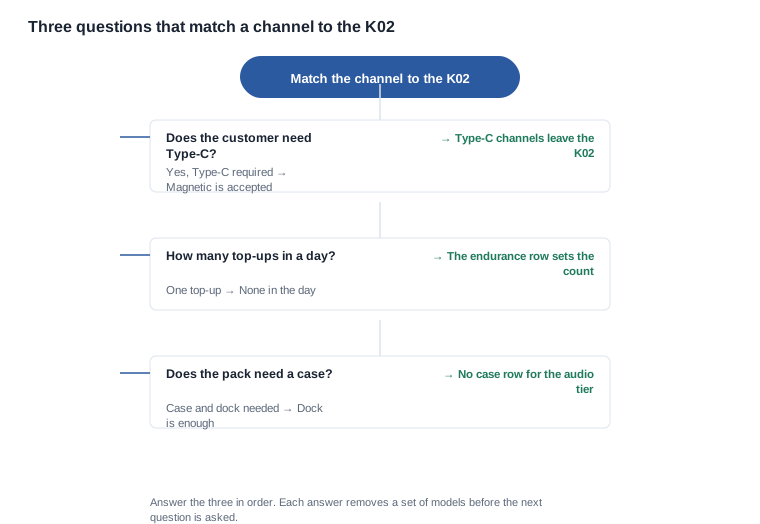
Running the matching is a short sequence, and each step removes work rather than adding paragraphs to a file.
- Write the channel requirement as one sentence with no product name in it.
- Map every term of that sentence to the single catalogue row that would answer it.
- Mark the terms for which the catalogue publishes no row at all.
- Apply the charging-method row and the Bluetooth-version row, because those two eliminate models faster than the rest.
- Send the open rows to the supplier as written questions and version the answers.
- Attach the answers to the specification sheet, so the file carries evidence rather than an assertion.
Two points close the matching for a channel that has reached the K02 on published rows. First, the published rows are the only part of the specification that can be quoted, and quoting them accurately is what keeps a listing defensible when a customer compares two products side by side. Second, the unpublished rows are not an obstacle to ordering; they are the content of the supplier conversation, and a buyer who asks for them in writing before the sample is ordered converts four open questions into a finished specification sheet.
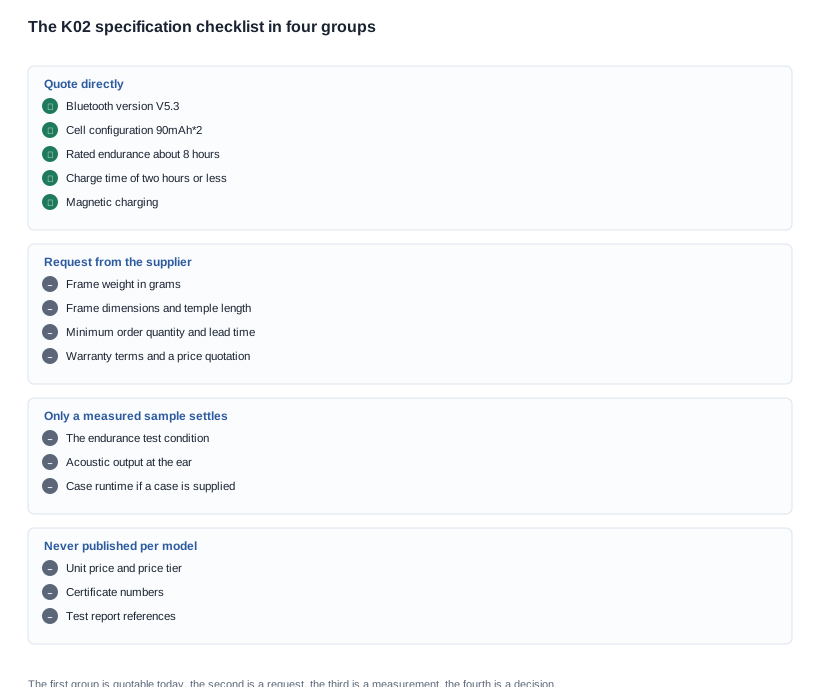
The checklist above is the same sequence written as a sheet a sourcing team can work from: the first group is quotable today, the second group is a request, the third group is a measurement, and the fourth group is a decision the buyer has to make before it can put the question.
Related reading
- This model's published figures — K02 smart glasses specifications and features
- The nominal endurance figure in context — K02 smart glasses battery life
- The charging row in context — K02 smart glasses charging options
- The same rows across the range — Bluetooth audio glasses which model to pick
- What the catalogue cannot settle — K02 smart glasses limitations
Send us the channel, the requirement it has to meet and the destination markets, and we will answer with the published K02 rows that decide it and the items that stay open until a supplier answers in writing.


