

K02 smart glasses charging options come down to a single published method word: magnetic. Around it the catalogue gives you three numbers — 90mAh*2 cells, a charge time of two hours or less, and a stated endurance of about eight hours. The numbers can be quoted in a datasheet. The word is not a description of a charging system; it is a label for one end of a chain, and it answers exactly one question — the frame takes its charge through a magnetic contact rather than through a plug built into the frame's own body.
For a buyer, that is a thin specification for the part of the product that decides what ships in the box, what the carton weighs, what a customer has to own in order to recharge what they bought, and what your aftersales stock has to cover. This article sets out what the K02's charging rows do establish, the seven items the charging row leaves open, what those open items cost commercially, and the questions that close them before a purchase order is placed.
What the K02 charging row actually specifies
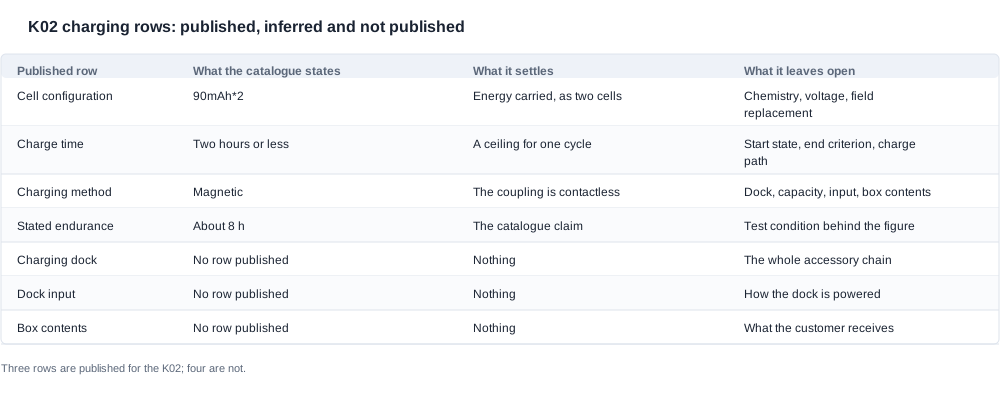
Five published rows touch charging and battery behaviour on the K02's catalogue page, and the gaps between them matter more than the rows themselves.
| Published row | What the catalogue states | What it settles | What it leaves open |
|---|---|---|---|
| Cell configuration | 90mAh*2 | Energy carried in the frame, as two cells | Cell chemistry, voltage, and whether the cells are field-replaceable |
| Charge time | Two hours or less | A published ceiling for one charge cycle | Start state, end criterion, and the path the charge takes |
| Charging method | Magnetic | The coupling is contactless | The dock, its capacity, its input, and the box contents |
| Stated endurance | About 8 h | The catalogue's endurance claim | Test conditions; the same figure appears on models with different cell configurations |
| Charging dock | No row published | Nothing | The whole accessory chain |
| Input interface of the dock | No row published | Nothing | How the dock is powered, and whether a second device is needed |
| Box contents | No row published | Nothing | What the customer receives, and what the carton weighs |
Three observations follow from that table, and they set up everything else in this article.
A method word is not a topology
"Magnetic" names the coupling and stops there. It does not tell you what the frame seats on. A magnetic arrangement in practice can be several different products: a fixed dock that plugs into a wall, a cradle that passes a wall supply straight through, a portable unit that stores its own charge and doubles as storage, or a pad shared between several models in the same programme. Each of those leads to a different box, a different bill of materials, a different recharge routine for the end customer, and a different aftersales obligation.
Our catalogue does have a convention for making that distinction. On some models the charging row is expanded with additional wording, and on others it is left at the method alone. Because the K02's row carries the method alone, the catalogue provides no basis for claiming anything about what the frame seats on, what that item contains, or whether it is included in the box. The honest reading of "magnetic" on this model is: the frame charges without a plug, and everything that follows from that statement is unpublished.
That is not a criticism of the model. It is a statement about what a one-word row can carry, and about why a buyer who treats the row as complete will build an accessory plan on an assumption rather than on a fact. It is also why the item that mates with the frame has to be treated as a specified line item in your own purchase documentation, with its own model number, its own packing list and its own service path.
The two-hour ceiling has an unstated measurement path
The charge time row reads two hours or less, with no start state, no end criterion and no test condition attached. On a frame that charges through a plug, a published duration is at least continuous with something a buyer can picture. On a frame that charges through a magnetic contact, there are at least three measurement paths the row could be referring to, and the catalogue does not say which one it used: charging the frame from an already-powered dock, charging the frame end to end from a wall supply, or a bench figure taken with instrumented equipment.
The number is publishable as a catalogue figure. It is not publishable as "your customer goes from flat to full in two hours", because that sentence asserts a path the row does not state. This is the same discipline the K02 battery life guide applies to the endurance row, applied here to the charging row instead: quote what the catalogue published, and treat the conditions behind it as an open item rather than as part of the claim.
The same caution applies to the cell configuration. The published row is 90mAh*2, which means two cells of that rating; read as a single figure it would be a derived number rather than a catalogue one, and any total quoted from it has to be marked as derived so it is never mistaken for an official specification.
The two-hour figure is the catalogue default, not a differentiator
Across the catalogue the two-hour ceiling is the norm. The large majority of models publish two hours or less, and only two models publish a shorter figure of roughly one hour — the D17 and the ZH12, both of which sit outside the audio range. Inside the eight audio models there is therefore no duration advantage to buy. The K02's charging duration is not a selling point and not a reason to prefer it over another audio model; it is a constant.
That matters for how you spend negotiating capital. If every model in the family charges in about the same time, then the only charging question worth raising with a supplier is the one the catalogue leaves open — the accessory chain. The audio range buying guide makes the same point about model selection generally: the published rows settle very little, and the buyer's own supply chain settles most of it.
The endurance figure is a family label, not a ranking
About eight hours appears on six models across four different cell configurations in this catalogue, including models that charge by an entirely different method. That spread is why the eight-hour figure on the K02 cannot be used to rank it against any other model, and why a separate method for comparing battery life exists. The same logic applies on the charging side: a single method word, repeated across six models, is a category convention rather than a product claim. The full grid is laid out in the camera and audio battery comparison.
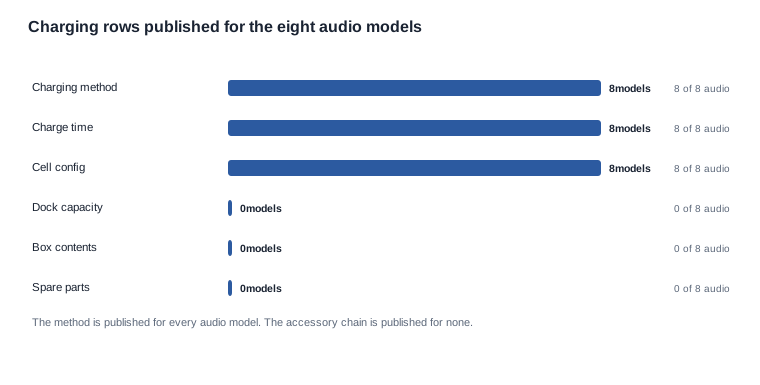
That chart is the whole argument in one picture. Every audio model publishes a charging method, a charge time and a cell configuration. Not one of them publishes a dock capacity, a box contents list or a spare-parts arrangement. The gap is not unique to the K02, and that is exactly why it is a purchasing problem rather than a product defect: the accessory chain is yours to specify, price and support whichever magnetic model you choose, and it will stay that way until a supplier commits to writing it down.

The seven items the K02 charging row leaves open
Everything below sits on the accessory and packaging side of the chain. None of it is published for this model, and none of it can be inferred from the magnetic method word.
- What the frame physically seats on. Is it a dock, a cradle, a pad, a case? What are its dimensions, its material, its weight, and does it have a lid, a hinge, a status light or a connector? This is the item a customer will look for on the shelf, and it defines the recharge routine the customer has to learn.
- Whether that item ships in the box. Is a complete unit supplied with everything needed to charge from a wall socket, or is the frame supplied on its own with the dock sold separately? This single answer changes the unit cost, the carton plan, the onboarding material and the return rate.
- Whether the item stores energy, and if so how much. A passive cradle passes a supply through and stores nothing. A unit that holds a charge of its own means a capacity figure, a cell type, and a second cycle in the customer's routine. The K02's catalogue row carries no capacity for any such item.
- What powers the dock. If the dock needs an input of its own — a wall adapter, a USB-C port, a DC barrel — then the input specification, the supplied cable and the supplied adapter are three more entries on the packing list and three more entries on your warranty exposure.
- Whether the dock self-charges, and from what. A dock that draws from the wall is one device in the customer's home. A dock that has to be charged separately, and then holds enough charge for one or more frame charges, is a second device with its own failure modes, its own recharge time and its own stock-keeping requirement.
- How long the dock itself takes to charge. If it stores energy, its own charge time would be a published figure in a well-specified accessory programme. Here it is unpublished, so the total time from an empty unit to a usable frame is unknown.
- Whether spares can be bought. Can the dock be ordered on its own, and on what terms? A dock that is required for the product to function is not an accessory — it is a warranty dependency, and the catalogue publishes no spare-parts row for this model.
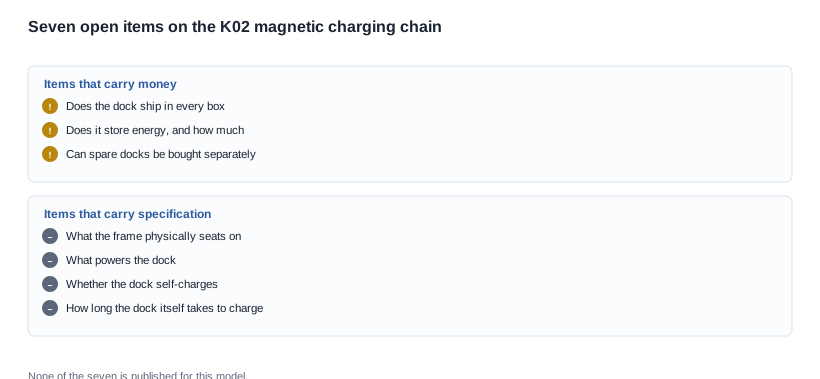
These seven items are not equal in commercial weight, and treating them as equal is how a quotation turns into a surprise on the first production run.
Items 2, 3 and 7 carry money. They decide whether a second physical item exists in the box, whether it has a cell inside it, and whether you can replace it when it fails. Each one changes unit cost, unit weight, freight class or aftersales stock, and none can be answered from the catalogue page.
Items 1, 4, 5 and 6 carry specification. They change what you write on the datasheet, what you write on the landing page, and what your support team can promise a customer who asks why the frames will not charge from a USB port. These are cheap to resolve: each is answerable in one email, and an answer that arrives before the order costs nothing.
A useful discipline for the buyer is to treat the published method word as the visible tip of a longer chain, and to price the whole chain before the unit price is agreed. The K02 value assessment follows the same logic on the frame itself: what a product actually costs the buyer is the product plus everything the buyer has to supply around it.
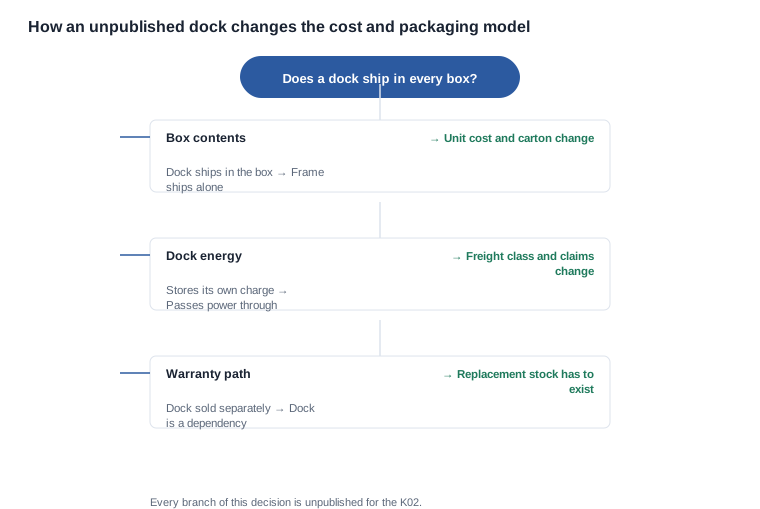
How an unpublished dock changes the cost, packaging and service model
Each open item propagates. Nothing here stays inside the charging category.
Landed cost and the carton
If a dock ships in every box, it is part of the bill of materials: unit cost, unit weight, inner box, carton dimensions, and — because freight is charged on the greater of actual and volumetric weight — the cubic volume of the pack becomes a cost line of its own. Any cell inside that dock also puts lithium in the package, which adds transport documentation obligations and can restrict carrier and routing options for the whole shipment rather than for one line on it.
If no dock ships, the customer receives a product that cannot be recharged, unless they can buy a dock from somewhere. The catalogue publishes no accessory line for this model, so the practical answer is that nobody can. Both branches cost money; the buyer has to know which one it is before the order, not after the cartons are sealed.
Packaging, printed materials and the retail shelf
Box contents drive everything downstream of them: the quick-start guide that has to explain charging, the regulatory and product labelling for the specific packaged configuration, the carton artwork, and the pallet maths. They also drive the retail story. A frame that charges from a standard USB-C supply can be displayed and recharged on a shelf a retailer already owns; a frame that needs a proprietary dock needs that dock on the shelf, or the retailer is demonstrating a product that will not charge in front of the shopper. For a channel partner that is a merchandising requirement before it is a technical detail, and it is the kind of thing a retail buyer discovers during the first shop-floor review rather than during your product meeting.
After-sales, warranty and replacement stock
Once a dock is required for the product to work, a failed dock becomes a warranty event rather than an accessory sale. Replacement stock then has to exist in the quantity your installed base generates, at a lead time you control, with a packaging specification that matches what you already ship. The catalogue publishes no spare-parts row for the K02, so the whole aftersales path for this accessory is a decision you make and a question you have to ask.
A second accessory chain, if your infrastructure is already standardised
Within the eight audio models, six publish magnetic charging and only the D11 and the D12 publish Type-C. Two models out of eight is a minority position on the interface question. If your operation already runs on one charging ecosystem — a common USB-C spare-cable SKU, a shared charging cabinet, one approved adapter in the pack, one supplier for power accessories — then a magnetic model forces you to run a second chain alongside it, and the minority position is what makes that chain awkward rather than what makes it easy. The published rows for the K01 are the same as for the K02, so all seven open items apply identically to it and charging cannot be used to separate the two models — it is a category-level decision you settle once for whichever magnetic model you take. The K01 and K02 specification comparison covers the published rows themselves.
Compliance files that travel with the packaged configuration
If a dock is supplied in the box, the packaged configuration should appear in your technical file, and any cell inside it carries its own transport documentation obligation. In the European Union the importer's conformity obligations sit under the Radio Equipment Directive (EU) 2014/53/EU for radio equipment, with EMC governed separately under 2014/32/EU, and the duty to hold that file belongs to the party placing the product on the market. Our catalogue carries a company-level export certification page and publishes no per-model certification row, so none of these documents arrives attached to the specification. They have to be requested, with lead time, alongside the accessory answers in section four.

Questions to put to the supplier before ordering the K02
This list is the core procurement deliverable of this article. It is ordered the way a quotation should be built: physical item first, then what it contains, then how it is powered, then what it costs to support.
| Ask the supplier | The answer you need | Why it changes the order |
|---|---|---|
| What physical item does the magnetic contact mate with? | Form factor, dimensions, weight, materials | Decides the accessory SKU and the shelf story |
| Does that item ship with every unit? | Yes or no, and in what packaging | Decides unit cost, carton and customer onboarding |
| Does it store energy, and how much? | Cell capacity, chemistry, and whether it is a lithium cell | Decides freight class, transport paperwork and product claims |
| What powers it, and what ships to power it? | Input specification, cable and adapter included or not | Decides the packing list and the spare-cable strategy |
| Does it charge on its own, and how long does that take? | Self-charge behaviour and the dock's own charge time | Decides the total time from empty to usable |
| Can the dock be ordered separately? | Commercial terms, packaging, and availability | Decides the warranty replacement path |
| Which measurement does the two-hour figure describe? | Frame only, dock already charged, or end to end | Decides what the landing page may claim |
| What is in the box and what are the packed weights? | Exact box contents, unit weight, carton dimensions | Decides freight cost and the shipping documentation |
- Ask for the answers in writing, attached to the quotation. A verbal answer about box contents is worth nothing when a retailer asks for a packing list, and it is worth nothing again when a freight forwarder asks for the battery declaration. Attach the answers to the order record so that a later purchase order inherits them instead of re-opening them.
- Ask for a spare-part quotation alongside the product quotation, not later. If the dock is a functional dependency, the replacement cost and the supply lead time belong in the same negotiation as the unit price. A dock that can only be bought in large commercial batches is a different supply programme from a dock that ships inside every carton.
- Ask which of the answers can be printed on a datasheet. Some suppliers will confirm the box contents privately and refuse to publish it. That is legitimate, but it changes your own materials: your specification sheet then has to describe the charging method and the contents in your own words, and it must not imply a dock specification you cannot show.
- Ask for a sample unit that includes everything the customer would receive. A frame sent on its own for evaluation answers none of these questions. If the dock is not part of the standard box, order one separately before committing to volume.
- Ask what the supplier will sign. The cleanest outcome is a written packing list and an accessory specification that both attach to the purchase order and travel with the conformity file, so that a change of production batch does not quietly change what is in the box.
Two red flags to expect in a charging answer
Two answers deserve a straight response before you sign anything.
"The dock is the same as the other model." If the answer compares this model's dock to a dock on another model without giving this model's own specification, then the accessory is shared but unconfirmed, and your responsibility for it is still yours. Ask for the specification of the item that ships with this model.
"It charges in two hours like everything else." That answer treats the duration as a substitute for the topology. It is not one. Duration tells you nothing about what the customer owns, what the carton contains, or what the aftersales stock has to cover. If the topology is not written down, the cost model is not finished.
There is also a third possibility worth pricing in early: the supplier may not be able to answer several of these questions at all, because the model is early in its life and the accessory is still being finalised. That is a normal commercial answer, and the correct response is not to abandon the model but to convert the open items into contract terms. The dock specification becomes a deliverable the supplier owes before shipment, and the packing list becomes an agreed document rather than an assumption, so the risk moves from your balance sheet to theirs.
Settling the charging chain on a K02 sample unit
A sample is the cheapest instrument available here, and most of the seven open items can be closed on one unit within an afternoon.
- Order the full retail pack. If the dock is not in the standard box, request it as a separate sample item alongside the frame. A frame on its own tells you nothing about the charging chain.
- Time both temples separately from empty. Record the time for each side, not the pair. If one side charges measurably slower from the same seating position, that is a tolerance or seating observation worth recording before volume, and it is exactly the kind of finding that never appears in a specification sheet.
- Time the dock, if it stores energy. Charge it from empty on its own and record the duration. That single number converts item 6 from an open question into a published figure you can put on your own datasheet.
- Count what the dock delivers. How many complete frame charges does one fully charged dock actually provide? The catalogue number would be a claim; the count is a measurement, and the difference between the two is the difference between a warranty claim you can defend and one you cannot.
- Check what happens with an empty dock. If it holds no charge of its own, confirm that the frame still charges when the dock is connected to a supply, and note whether it charges faster or slower than through a pre-charged dock. That observation tells you whether the two-hour figure can be described as a wall-to-frame figure.
- Weigh and measure the pack. Unit weight with the dock, box dimensions, and the carton. These become your freight inputs, and they are the numbers most likely to differ from any assumption you made when the price was agreed.
- Photograph everything and keep it with the golden sample. The box contents, the underside of the dock, the connector markings and the label text. Labels frequently carry the input specification and the model code, and they are the cheapest document you will ever obtain for an accessory nobody has written down.

Those seven steps convert an open item into a decision, and the decision has a shape. If the dock ships in the box, the unit cost and the carton plan now have real numbers behind them, and the customer receives a complete product. If the dock does not ship, you have two commercially viable routes — source the dock as a second, separately quoted SKU with its own warranty line, or move to a model that publishes its charging interface — and either one is a decision you can defend in a meeting. What is not defensible is leaving the item unpriced and discovering it at the shipping stage, because at that point the alternatives are a re-quote, a re-tooled carton, or a support line full of products that will not charge.
The same discipline applies to the catalogue row itself. We publish one charging method word for the K02, and we do not estimate the seven items behind it. If you need the charging chain closed in writing before the first order, send us the eight questions in the table above and we will mark which ones the catalogue can answer today and which have to come from the model owner.
Before you order: the criteria that decide it
Before you order, four criteria decide whether the K02 goes on your shortlist, and each one is answerable by the supplier in writing rather than by inference.
- Is the packing list complete and confirmed? A packing list that arrives in writing settles the unit cost, the carton plan, the freight class and the customer onboarding in a single document. If the supplier will not confirm the box contents, your datasheet cannot claim them and your landing page must not imply them either. Your buyer should ask for this before the order, not after the first production run, because it is the one answer that changes every other number.
- Is the accessory a supplied part or a customer purchase? This one changes the total cost of the programme. A supplied part is a cost you carry in every unit and can then be quoted as part of the product. A customer purchase is a support load, an adoption risk and a source of returns you did not plan for, and it usually needs its own explanation on the product page.
- Is the charge path stated in the same terms the catalogue used? If the supplier will say which measurement the two-hour figure describes, you can publish the figure accurately. If not, publish the figure as the catalogue's figure and describe the method in your own words. There is no third option in which a landing page implies a path nobody has confirmed.
- Can a spare be obtained on terms that match the product? The single most common pitfall in an accessory-led programme is discovering at the first warranty claim that the replacement path is slower than the customer expects, because nobody negotiated it. Ask how to evaluate the answer: a quoted lead time and a quoted supply arrangement in writing is what closes it.
Those four criteria are also the due diligence checklist for the charging line, and they are deliberately narrow. They do not ask the supplier to describe the product, describe the technology or explain the strategy; they ask for four documents and four answers, and every one of them can be attached to the purchase order. The wrong approach is to treat a one-word charging row as if it closed the accessory question, and the wrong response to that mistake is to negotiate the wrong things — the two-hour duration, the Bluetooth version and the endurance figure — none of which changes a single line of your cost model or your carton.
Once the four answers are in writing, the total cost of the charging line is computable, the packaging is settled, the warranty path has a supply arrangement behind it, and the datasheet can carry a charging line that is accurate. The signs that this has been done are easy to spot in a document review: the packing list exists, the accessory has a specification, the spare arrangement is priced, and the charge path is described rather than implied. If those four are present, the buyer can evaluate the model against any competitor on the same basis — which is the only comparison worth making on a charging line where every published row is a constant.
Where to go next on this charging chain
- How the K02's published battery rows should be read — K02 battery life
- The published rows of the K01 and the K02 side by side — K01 vs K02 specification comparison
- Where the K02 sits against the rest of the audio range — K02 comparisons
- Choosing across the audio models — Bluetooth audio glasses model guide
- The audio range's charging landscape — Bluetooth audio glasses charging options
- The full Bluetooth audio range — Bluetooth audio glasses


