
K02 smart glasses common questions arrive in a narrow band. A channel buyer reads the catalogue page, finds five specification rows and no feature line, and then asks the same cluster of things: how long it runs, how long it charges, what the charging interface is, how it differs from the K01, what the weight is, and which documents travel with the goods. Every one of those questions is legitimate, and every one of them lands on a different layer of published information. Some are answered by the rows themselves. Some are answered by knowing what the catalogue deliberately does not print for this model. Some cannot be answered by any document at all and need a sample unit on a bench.
That three-layer structure is the whole point of this article. The K02 is an unusually clean case because the page carries so little: the radio generation, the cell configuration, the rated runtime, the ceiling on charge time and the charging method. It also publishes no feature row of any kind, so there is no marketing phrase that has to be reinterpreted before it can be reused on a listing. What a procurement team gets in exchange for that thinness is a specification that can be quoted identically on every order for the same configuration, and a request list that does not change from one buyer to the next.
Two points frame everything below. First, the K01 and the K02 publish rows that are identical in every respect the catalogue prints — the same radio generation, the same cell configuration, the same rated runtime, the same charge ceiling and the same charging method. The catalogue publishes no difference between the two, which makes the difference itself a question rather than a row. Second, the runtime figure the K02 carries is a rating, not a measurement: six models across this catalogue print roughly eight hours, they do it on four different cell configurations, and not one of them publishes the test condition that produced the number.
What the K02 catalogue page publishes
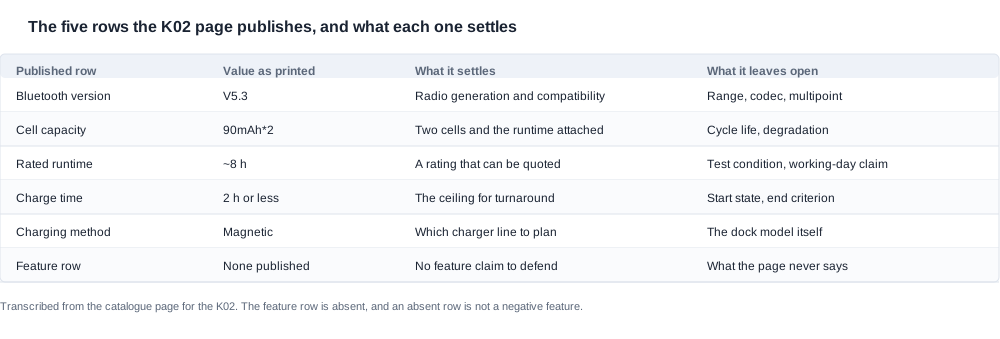
Inside the Bluetooth audio glasses range, the K02 catalogue page prints five specification rows and stops there. Every one of them can be quoted as published, provided the wording matches what the page actually says and the two rated values are presented as ratings rather than as guarantees.
The five rows the K02 page prints
The radio row reads V5.3. The cell row reads 90mAh*2, which is the catalogue's own way of printing a per-cell figure with the cell count attached, and it should be reproduced in that form rather than converted into a bare total. The runtime row reads approximately eight hours. The charge-time row reads two hours or less, which is a ceiling and not a schedule. The charging-method row reads magnetic, which places the model on the magnetic side of the audio range and away from the two models that use a Type-C interface.
The runtime number deserves one qualification before it goes anywhere near a listing or a product page. Roughly eight hours appears on six models in this catalogue — the K02 and the LC-105-1, the ZH12 and the LC-105-2, and the YKC02 and the K01 — and those six spread the figure across four cell configurations, from 90mAh2 and 55mAh2 to 70mAh*2 and a single 100 mAh cell. A rating that survives that much variation in the hardware underneath it is describing a duty cycle, not a battery, and it cannot be converted into a working-day claim or used to rank the K02 against another model.
The charge-time row needs the opposite treatment. Two hours or less is an upper bound on the time a full charge takes, and the useful commercial question is what the turnaround looks like between one charge and the next, not how long the frame sits on the pad. The catalogue publishes no starting state and no end criterion, so the row cannot be turned into a per-shift interruption figure either.
What the K02 page leaves off
The absence of a feature row is the single most useful fact on this page for a sourcing team. The K02 publishes no selling descriptor — no acoustic claim, no temple description, no touch behaviour, no colour list and no charging-case capacity — and a product page has to be written from the five specification rows alone. That constraint is what keeps the page safe to publish.
It also means the K02 cannot borrow language from its neighbours. Three of the eight audio models publish a feature row: the D11 with surround sound and long endurance, the G07 with an ultra-slim body and detachable temples, and the YK12 with surround sound and a slim temple. The other five pages, including the K02 and the K01, print the five standard rows and nothing else.
The comparison below is the frame of reference for any figure the K02 does publish, because it puts each printed value next to the values it is most often confused with.
| Model | Cell as printed | Runtime as printed | Charging | Bluetooth | Feature row published |
|---|---|---|---|---|---|
| K02 | 90mAh*2 | ~8 h | Magnetic | V5.3 | No feature row |
| K01 | 90mAh*2 | ~8 h | Magnetic | V5.3 | No feature row |
| D11 | 100 mAh | ~7 h | Type C | V5.4 | Surround sound, long endurance |
| D12 | 100 mAh | ~7 h | Type C | V5.4 | No feature row |
| LC-105-1 | 55mAh*2 | ~8 h | Magnetic | V5.4 | No feature row |
| LC-105-2 | 55mAh*2 | ~8 h | Magnetic | V5.4 | No feature row |
| G07 | 55mAh*2 | ~6 h | Magnetic | V5.4 | Ultra-slim, detachable temples |
| YK12 | 55mAh*2 | ~6 h | Magnetic | V5.4 | Surround Sound, Slim Temple |
The cell column is worth reading as a tier structure rather than as a scorecard. Two audio models run on 90mAh2, four run on 55mAh2, and the D11 and the D12 run on a single 100 mAh cell. The runtime column splits into three bands across the same eight models: roughly eight hours for four of them, roughly seven hours for the D11 and the D12, and roughly six hours for the G07 and the YK12. Those bands are groupings for a shortlist, not verdicts, because no published figure comes with its protocol attached.
The charging pattern inside the audio range
Charging splits the eight audio models into two camps, and the K02 sits in the larger one. Only the D11 and the D12 publish a Type-C interface; magnetic charging is the default across the rest of the audio side. That single fact decides the accessory line a buyer has to source, because a parcel assembled on the assumption of a USB-C cable arrives with the wrong cable in it, and a listing that describes USB-C charging on the K02 describes an interface the model does not have.
Two absences run across the whole audio group. The group publishes no charging-case row at all, which is an unpublished row rather than a stated absence, and the group publishes no ingress-protection row, while the catalogue's only IP54 markings belong to the V06 and the S7. A buyer who asks whether the K02 ships with a case, or whether it carries an IP rating, has to put both to the supplier; the page cannot answer either question.
The questions the published rows answer
Most of what a buyer wants to know in the first conversation about the K02 is answerable from the five rows, and it is worth separating that clearly from what is not. The boundary between the two is easy to draw: a published row answers a question about a characteristic, and it does not answer a question about a condition, a protocol or a commercial term.
Runtime, charging, cells and radio
How long does the K02 run on one charge? The published answer is a rated runtime of approximately eight hours, and the published form of that answer has to carry the word rating. The page does not state a test volume, a codec, a radio state or a temperature, and it does not state how the cell was conditioned before the run. This matters commercially because the same catalogue prints roughly six hours for the G07 and the YK12 on the same 55mAh*2 cells that the LC-105-1 and the LC-105-2 pair carries at roughly eight hours. Two configurations with identical cells and identical charging cannot differ by two hours for a reason visible on the page, so what the K02 publishes is a rating under a protocol nobody has shown.
How long does charging take? The published answer is a charge time of two hours or less. That wording is deliberate and should be preserved in any document quoting it, because two hours or less permits exactly two hours while a phrasing that implies a shorter time does not. For planning purposes the row supports one decision — how quickly a unit returns to stock — and it does not support a second one, because the catalogue publishes neither the state the charge starts from nor the point at which the charge is treated as finished.
How does the K02 charge? The published answer is magnetic charging. Within the audio range that puts the K02 alongside the K01 and the YK12, the LC-105-2 and the G07, and the LC-105-1, with only the D11 and the D12 on a Type-C interface. The accessory implication is concrete enough to write into the buying checklist: the magnetic pad is a line item that has to be costed, packed and replaced, and it is not the same line item as a cable.
What is the cell configuration? The published answer is 90mAh*2, two cells of 90 mAh each. Three consequences follow for procurement. The runtime figure is a two-cell figure rather than a single-cell one. The parcel carries two lithium cells, which changes how the shipment is described and documented for transport. And there is no single-cell variant on this page, so a second unit for evaluation is bought as the paired configuration rather than as a cell swap.
Which Bluetooth version does the K02 run? The published answer is V5.3, and that is exactly the extent of the row. The version settles which radio generation the product speaks, which is a compatibility question a procurement team has to answer. It says nothing about range, codec behaviour, multipoint handling or how many connected devices the radio will hold, and it is not a compliance answer either, since the catalogue publishes no per-model certification row to attach it to.
When the missing row is the answer
Does the K02 record anything? Nothing in the catalogue suggests that it does, and the cleanest evidence for that is the way the pages are laid out rather than any wording on the K02 page itself. Imaging lines exist only where a camera is fitted, and none of the eight audio models carries one. A question of this kind therefore has an unambiguous answer for a procurement team: there is no camera and so there is no resolution to ask about. What remains is alignment work rather than engineering work — the box art, the listing copy, the printed insert and what the customer expects to find all have to describe the same product.
What feature does the catalogue publish for the K02? The published answer is that there is no feature row. This is a position, not a gap in the documentation, and the practical consequence for a brand is that the product page has to be assembled from the specification rows alone. It also means the K02 cannot inherit the surround-sound line that the D11 carries or the slim-temple lines that the G07 and the YK12 carry, because inheriting a published feature from a different model is a claim the K02's own page does not support.
How does the K02 differ from the K01? On the published rows, it does not. The radio generation, the rated runtime, the cell configuration, the charge ceiling and the charging method are printed identically for the two models, and the catalogue publishes no distinguishing line for either. A buyer comparing them is therefore comparing names rather than specifications, and the way to choose between them is to obtain the difference in writing before either one is shortlisted. Whether that difference is a product change, a packaging tier, a colourway or nothing at all is exactly what the catalogue does not say. The K02 against K01 comparison sets out what each possible answer means for how the two models would be stocked and listed. A buyer arriving from the other direction reaches the same published rows through the K01 against K02 comparison, which is written from the opposite side.
The questions the published rows do not answer
Everything below is a question the K02 page cannot close, either because the row does not exist for this model or because the numbers that do exist belong to other models. Each item names the party who can resolve it, the form of the answer that counts, and the decision it settles.
Documents that close the remaining gaps
What does the frame weigh? No weight is published for the K02, and none is published for the other audio models either. The catalogue's one published weight, 158 g, belongs to the MT6 glasses body — a camera model that carries a camera and a battery, and its figure does not transfer to an audio frame. The weight closes with either a written specification naming the K02 or a sample weighed with its cells fitted, and it decides the parcel weight, the freight class and whether any lightness claim on the packaging can be quantified at all.
Is a charging case available? The catalogue publishes no charging-case row for the audio group, which means the row is unpublished rather than stated as absent; case capacities elsewhere in the catalogue belong to camera models and say nothing about the K02. The question closes with an accessory or packing list that names the model, and it should also ask for the case's own interface, charge time and weight if one exists. It decides whether a second lithium cell enters every parcel, what that does to freight and transport paperwork, and whether the case is a channel accessory line or a cost the brand absorbs.
Does the K02 carry an ingress rating? No ingress row is published for any audio model, and the catalogue's IP54 markings belong to the V06 and the S7. An unstated rating is an absent one rather than a low one, so a channel that requires a rating before it will list the product cannot be served from this page. It closes with a test report that names the K02, and it decides whether the packaging may make any statement about sweat, rain or dust.
Which certificates cover the K02? The catalogue has nothing model-specific to point at: no certification line sits against the K02 page or against any other model page, and the terms CE, FCC and RoHS appear nowhere in the catalogue text. Two frameworks can be named in a document without overstating what they prove — the Radio Equipment Directive (EU) 2014/53/EU for radio equipment and EMC 2014/32/EU for electromagnetic compatibility — and they describe a market-access route rather than a status for this model. Coverage under any of them attaches to a named designation on a dated document, so paperwork issued for one model does not extend to the K02. Give this request the earliest slot in an enquiry, because the document has to exist before the goods can move, and the K02 certification status note maps each document to the question it settles.
Can the K02 carry a private label? The catalogue publishes nothing on customisation for this model, so the scope of what may be changed has to be put in writing rather than inferred. The request should set out colourway, lens, packaging and logo placement separately, and ask which of those four carry tooling costs of their own. Beneath this request sits the open K02-versus-K01 question, and the two fit together: two models carrying identical published rows is exactly the situation in which a packaging or colour difference is the most economical way to run two distinct items.
Bench checks no catalogue row can replace
How does it sound, and is there a microphone for calls? The K02 page publishes no acoustic figures at all — no driver size, no frequency response, no sound-field description and no microphone specification. The silence is a group property rather than a quirk of this page, since the other audio models are equally unquantified. Two things can close the gap, and they are of different kinds: a written acoustic and microphone specification from the factory, which states what the design intends, and a recording taken on a sample unit, which shows what the frame actually does in an occupied room. What comes out of that decides the wording a listing may use about sound and call quality.
How many charge cycles does a cell survive? No cycle life is published for any model here, and the K02's rating carries no degradation curve with it. The question closes with a cycle figure tied to a stated test condition and a capacity threshold, and it decides what a warranty return costs after a year or two on a retail shelf.
What are the frame and temple dimensions? No dimensions or adjustability figures are published for the K02. This closes with a dimensioned drawing or a spec sheet naming the model, and it decides whether the frame can be offered to a channel that specifies head geometry, as well as what the retail box artwork can say.
How is the frame controlled? The catalogue publishes no touch row for any model, so the control method for the K02 is unspecified rather than absent. Whether the temple carries a touch surface, how it is configured, and whether a companion application exists with the phone systems it supports are all supplier questions, and they decide whether an instruction leaflet can be written at all.
The commercial terms that the catalogue does not publish
Minimum order quantity (MOQ), lead time, production capacity, warranty terms and unit price are not published for the K02 or for any other model here. That is not a defect in the page — it is the correct arrangement, because those figures are only meaningful against a named configuration. The way to handle them is to ask for a quotation that states the configuration it applies to, so that two quotations can be compared on the same basis. Nothing in this article puts a number on any of those terms, and no figure should be inferred from the absence of one.
A pattern worth naming runs through the way these requests come back. Query the battery life of the K02 and the reply simply restates the printed rating, which advances nothing. Query the protocol behind that rating and the reply gives a volume level, a codec, a radio state and a sample count. Query the certificates and you get whatever the factory holds for the platform. Query which paper names the K02 and you get paper that can be filed. A single principle handles both cases: an answer only counts when it names the model and the condition it was measured under. That principle is the entire due diligence on this model, and what it buys is narrow but real — a specification that survives being defended line by line, in exchange for a page that carries less than a competitor's does.
The questions to put to the supplier about the K02
A supplier enquiry about this model fails in two ways. It fails when the reply is a generic specification sheet that never names the model, in which case the answer describes whichever platform the sheet was written for. And it fails when fifteen questions arrive in one message and every one of them comes back partially answered. The request that works is short, numbered, model-specific, and ordered by how much each answer closes.
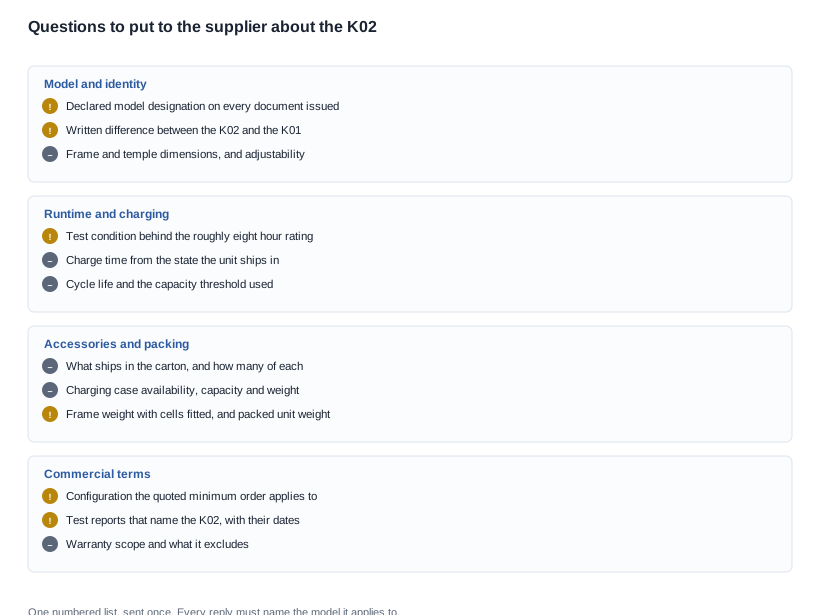
Model and identity
- Which model designation will appear on the documents you issue for the K02, and how does it differ from the designation used for the K01?
- What, in writing, distinguishes the K02 from the K01 — is it a product change, a packaging change, a colourway, or a difference with no hardware consequence at all?
- Which frame dimensions and adjustability figures apply to the K02, and in what drawing format will you provide them?
Runtime and charging conditions
- Under what test condition was the approximately eight-hour rating for the K02 measured — volume, codec, radio state, temperature and sample count?
- Is that rating taken on the production configuration, and does the same condition reproduce for a second unit from the same batch?
- What is the charge time for the K02 from the state the unit ships in, and what end criterion defines a full charge?
- How many charge cycles do the K02 cells survive, and at what capacity threshold is that cycle count measured?
Accessories and packing
- What ships in the box with the K02 — a magnetic charging pad, a cable, a case, or nothing — and how many units of each are included per carton?
- Is a charging case available for the K02, and if so what are its capacity, interface, charge time and weight?
- What is the weight of the K02 with its cells fitted, and what is the weight of the packed unit including the retail carton?
Commercial terms
- Which configurations are available for the K02, and what do the minimum order quantity and lead time apply to in each case?
- Which test reports or declarations name the K02 specifically, what are their dates, and what model designations do they cover?
- What warranty terms are available for the K02, and what does the warranty exclude?
- What customisation is possible on the K02 — colourway, lens, packaging, logo placement — and which of those changes carry tooling?
Every one of those requests is routed the same way: check whether a published row already answers it, ask for the document when it does not, and reserve the bench for what only a sample unit can settle.
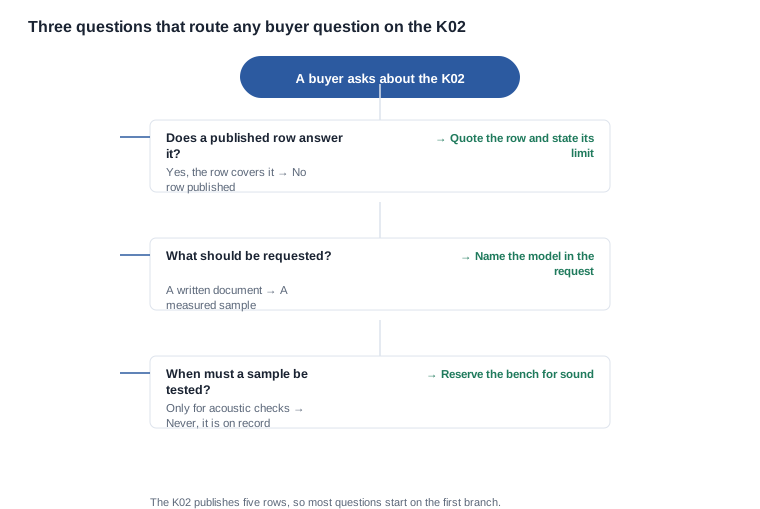

The fourteen questions listed above are sequenced by how much each answer unlocks, not by the order in which a buyer tends to think of them. The two that sit at the top change the form of the order rather than its detail. Whether the K02 and the K01 differ decides if the range is one stocked item or two, and the endurance protocol decides if the runtime figure can be presented as a full working day or has to stay a rating with its conditions attached. Each of those two is answerable in a single sentence by a supplier who knows the model, and each is among the ones most often left unanswered.
Three red flags recur in replies to this kind of request, and each is cheap to catch before an order is placed. A runtime figure delivered with no condition attached repeats what the catalogue already carries. A certificate or test report naming a different model designation does not cover the K02. A frame weight with no statement about whether the cells were fitted gives a number that describes a frame rather than a parcel, and only the second of those is what the freight agent will weigh.
The K02 common questions, answered from the catalogue
The information about the K02 sits in four layers, and the commercial mistakes come from treating one layer as if it contained the next.
What a buyer can state today
The catalogue answers the radio generation, the cell configuration, the rated runtime, the charge ceiling, the charging method, the absence of a feature row, the absence of a camera row and the absence of an ingress row. Those eight statements can go onto a product page, a tender response or a distributor line sheet without any further reference, provided the runtime is marked as a rating and the charge time is marked as a ceiling.
What to request next
Weight, charging-case details, ingress rating, certification coverage, acoustic and microphone figures, cycle life, dimensions, control method and every commercial term sit in the second layer. Each one is a written request, and each one arrives with a named model attached or it does not arrive in a usable form. The K02's own published row is what makes this layer tractable: because the page already fixes the radio, the cells, the runtime and the charging method, a supplier can fill the rest of the sheet without re-opening anything that is already settled.
What to verify on a sample
The third layer is the one that only a sample unit can produce, and it is smaller than buyers expect. Sound in a real room, the behaviour of the frame across a full shift, and the timing of an actual charge all belong here. None of them can be closed by a document, and each one settles a claim that would otherwise be asserted without evidence. A recording made on a sample is also what converts an acoustic description into something a listing can say truthfully.
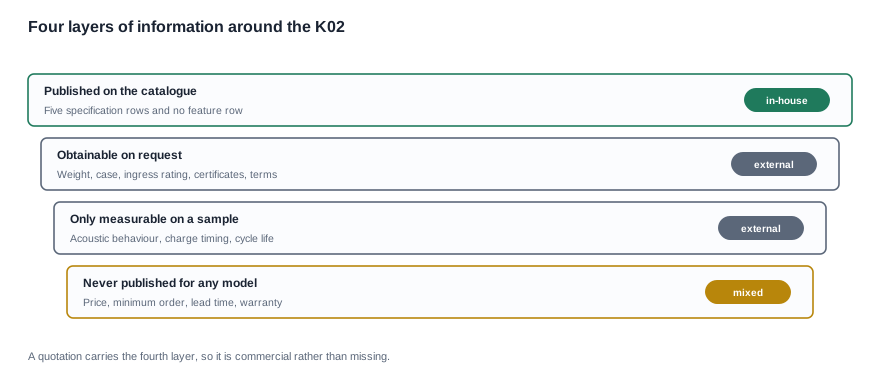
The layer that never appears in writing
The fourth layer holds the items no document in this catalogue will ever carry: the price a specific configuration is sold at, the minimum order quantity that applies to it, the lead time behind it, the warranty term attached to it and the certificate numbers that would evidence its compliance. These are not withheld — they are commercial terms that a quotation creates for a named configuration, and the way to get them is to ask for a quotation that states which configuration it covers. A comparison between two suppliers only becomes meaningful when both quotations name the same configuration, the same accessory set and the same documentation scope.
What we publish and what we keep off the record
Two commitments frame how we handle this model in writing. We publish the cell configuration, the radio version, the charge ceiling, the stated endurance and the charging method for the K02, and we keep publishing them in the same form for every model, so that any comparison a buyer builds between them stays fair. And we do not publish a weight, a dimension, an acoustic figure, an ingress rating, a price, a minimum order quantity, a lead time, a warranty period or a certificate number — for the K02 exactly as for every other model in the catalogue — because we would rather answer plainly than quote a figure that cannot be traced to a document.
What we can do instead is quote against a specified quantity and configuration, state which configurations exist and which do not, and tell a buyer before an order which figures have to arrive through a written request, which can be closed by a sample on the bench, and which are a trade-off the buyer has to evaluate for itself. That is the criteria we ask our own team to work to, and it is what a buyer can hold us to.
The result is that a K02 sourcing file can be assembled from two sources: the five published rows that go straight into the specification, and a request list whose fourteen items close everything else. Between them they cover the questions that decide whether the model can be listed, shipped and supported. The K02 limitations note collects the same boundaries in one place, and what to check before ordering the K02 turns them into a pre-order sequence.
Related reading
- The rows this article is built on — K02 against K01
- The boundaries in one list — K02 limitations
- The published specification — K02 specifications and features
- The pre-order sequence — what to check before ordering the K02
- How the range divides by platform — which model to pick
The K02 is one of the few models in this catalogue whose specification can be quoted without interpretation, and the K02 smart glasses common questions it raises are answerable in full once the five published rows and the fourteen requests are kept apart.


