
A buyer comparing two smart glasses models in the same camera range rarely runs out of specification rows. They run out of a way to decide which row matters for the programme they are actually building. The KY06 and the CY05 both sit in the AI camera glasses category on the CYNRIN catalogue, and the published rows for the two of them look close enough that the decision cannot be made from a headline specification table alone. This article lays the published rows side by side, reads what a buyer can and cannot conclude from them, and shows where each model fits a different purchasing conversation.
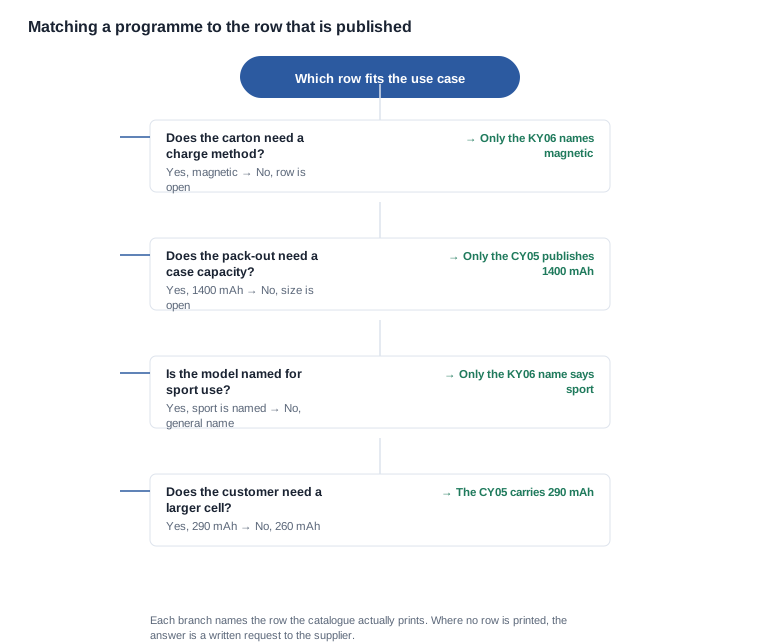
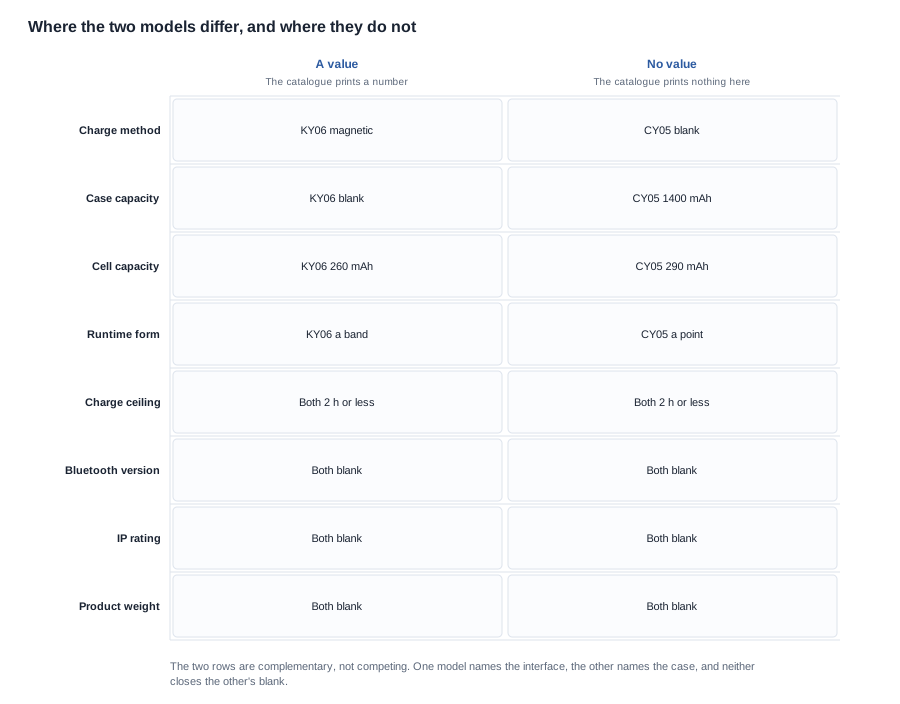
The short version is that the KY06 is the row set that publishes a charging method and leaves the case capacity open, while the CY05 is the row set that publishes a case capacity and leaves the charging method open. That single difference in what is disclosed changes which questions a procurement conversation can settle quickly and which ones have to be escalated to a written request. Everything else in the published comparison sits close enough that a buyer should treat it as a set of programme-level commitments rather than a product race.
What the catalogue publishes for the KY06 and the CY05
The CYNRIN product catalogue publishes a camera glasses range in a single consistent table format. Each model carries a model code, a full product name, a battery cell capacity, a stated runtime, a stated charging time, a charging method line, and a Bluetooth line. Reading the two rows that matter for this comparison gives the following published entries.
The KY06 is published as the KY06 AI camera sport glasses, and the sport descriptor is part of the product name itself. Its published cell capacity is 260 mAh, its published runtime is a range of 6~8 h, and its published charging time is ≤2 h. The charging method line for the KY06 is published as magnetic charging plus a charging case, with the case capacity itself marked as not published in the catalogue table. The Bluetooth column for the KY06 carries no version figure.
The CY05 is published as the CY05 AI camera glasses. Its published cell capacity is 290 mAh, its published runtime is approximately ~7 h, and its published charging time is ≤2 h. The charging method line for the CY05 is published as a charging method that the catalogue does not state, together with a charging case whose capacity is published as 1400 mAh. The Bluetooth column for the CY05 also carries no version figure.
Two observations matter more than the third one.
First, the cell capacities are close but not identical. The KY06 carries a 260 mAh cell and the CY05 carries a 290 mAh cell. That is a 30 mAh difference, and it is not possible to derive a runtime advantage from it in either direction because the published runtimes are stated as different kinds of number. A range of 6~8 h and an approximation of ~7 h overlap substantially; the CY05's nominal cell is larger, but the published runtime bands do not separate the two models in any way a buyer could put in a purchase order.
Second, and this is the point the whole comparison turns on, the disclosure pattern is inverted between the two rows. For the KY06 the catalogue publishes how the device charges — magnetic charging with a charging case — and declines to publish the case capacity. For the CY05 the catalogue publishes how much the case holds — 1400 mAh — and declines to publish the charging method. A buyer who works in charging-method terms, for example a programme built around magnetic pucks already in the packing line, gets more usable information from the KY06 row. A buyer who works in pack-out terms, where the case capacity drives how many cycles a customer gets before a wall socket, gets more usable information from the CY05 row.
Third, the KY06's full published name carries a sport descriptor that the CY05's does not. That word is part of the product name as published, and it is the only indication in the published table that the KY06 is positioned as an activity-facing model rather than a general camera glasses model. Readers looking for the underlying positioning logic should read the KY06 smart glasses specifications and features page, which sits alongside the row data, and compare it with the CY05 smart glasses specifications and features page.
The two rows side by side, and what a buyer can read from them
The following comparison collects only the values that the catalogue actually publishes for these two models. Where a cell reads "not published", that is the catalogue's position and not an editorial judgement.
| Row | KY06 | CY05 |
|---|---|---|
| Published name | KY06 AI camera sport glasses | CY05 AI camera glasses |
| Cell capacity | 260 mAh | 290 mAh |
| Runtime | 6~8 h | ~7 h |
| Charging time | ≤2 h | ≤2 h |
| Charging method | Magnetic + case | Not published |
| Case capacity | Not published | 1400 mAh |
| Bluetooth version | Not published | Not published |
| IP rating | Not published | Not published |
| Weight | Not published | Not published |
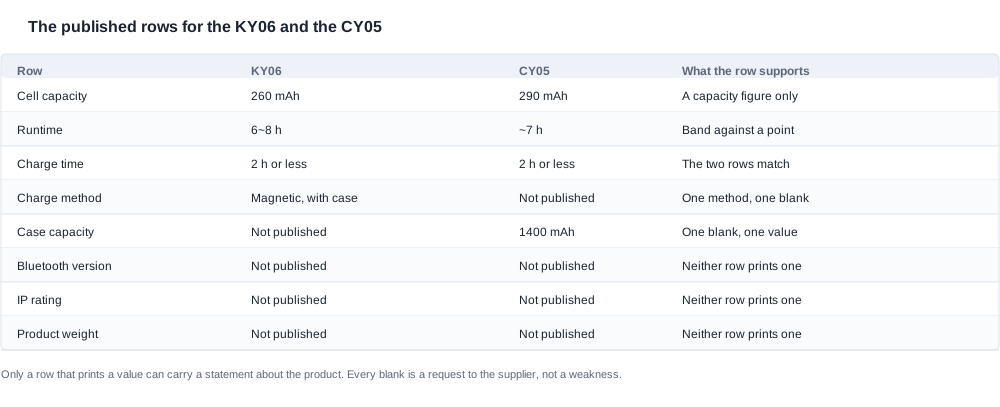
There is one thing this table does not contain that a buyer will look for and should know is missing: the IP protection rating. The catalogue publishes an IP rating for only two models in the whole range, and neither the KY06 nor the CY05 is one of them. That means the row set gives a buyer no basis at all for a wet-environment claim, and any programme that needs one has to ask for it in writing before the first bulk order. The sport smart glasses water resistance options article covers which models in the range carry a published IP figure and what it means for an activity-facing programme.
The same gap applies to weight. The only published weight in the range belongs to a different model entirely, so both the KY06 and the CY05 arrive at the buyer as an unpublished figure. For a channel business shipping to end customers who wear glasses all day, that is a support-contact risk rather than a specification failure: a customer asking "how heavy are they" cannot be answered from the catalogue.
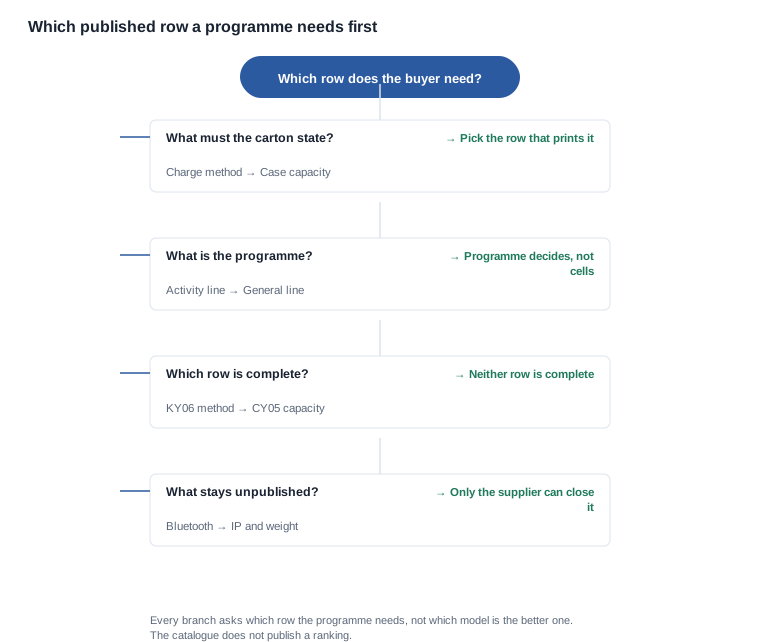
What the table does support is a programme-level conclusion, and it is worth stating it plainly rather than hedging it. Between these two rows, the published difference a buyer can act on is the disclosure pattern, not a performance gap. If the programme is a general-purpose camera glasses line with a straightforward pack-out, the CY05 row is the more complete one because it publishes a case capacity that can be used in retail copy and in a packaging spec without an internal legal review. If the programme is a sport or activity line where the charging interface has to work with existing fixtures or where a buyer wants to describe the charging experience rather than the packed endurance, the KY06 row is the more complete one because it names magnetic charging.
We will not present a specification difference the catalogue does not publish, so a buyer choosing between the KY06 and the CY05 should decide from the programme they are actually running and ask for the unpublished rows in writing.
Two programmes, two different purchasing conversations
Two concrete programme shapes show how the same pair of rows produces two entirely different procurement conversations. These are not product recommendations; they are worked examples of how a buyer can use published data to structure a supplier conversation.
Programme A — a channel brand shipping an activity camera glasses line. This buyer is building a retail product that a customer wears while moving, and the packing line already uses magnetic charging trays for other accessories. The KY06 row gives them what they need to write the charging spec: magnetic charging plus a charging case, charging within ≤2 h, a 260 mAh cell, and a 6~8 h runtime range they can express as a band rather than a promise. What they cannot write is the case capacity, the weight, the IP rating, the Bluetooth version, or the lens and colour options. The useful first question to the supplier is not "how good is the KY06" but "publish the case capacity and the weight in writing, and state whether the 6~8 h figure is measured with the case charged or not". The runtime condition question matters because a range with an unstated test condition is not a comparable range.
Programme B — a distributor building a general camera glasses catalogue. This buyer wants to stack shelves with several models and needs packaging-level endurance numbers for the retail listing. The CY05 row publishes a 1400 mAh charging case, which is the number this buyer can put in front of a retail buyer without a caveat. Their gaps are the mirror image of Programme A's: they do not know how the device charges, so they cannot yet write a "charges in ≤2 hours" line that means anything to a customer who asks "how do I charge it", and they have no case cycle count to quote because the relationship between the 1400 mAh case and the 290 mAh cell is not published.
Both programmes then converge on the same short list of written questions, and a buyer who puts these on the purchase order will get better answers than a buyer who asks them in a call.
- Ask for the KY06 charging case capacity in writing, and ask whether the case is included in the retail box or sold as an accessory — this changes the landed cost per unit and the packaging spec.
- Ask for the CY05 charging method in writing — wired, wireless, or a dedicated dock — because the published ≤2 h figure is meaningless to a customer without the method.
- Ask for the test condition behind each runtime figure: continuous video capture, intermittent capture, or standby, and with which feature set enabled.
- Ask for the weight of each model excluding and including the charging case, and for the IP protection rating or an explicit confirmation that none is claimed.
- Ask which Bluetooth version is fitted, since the catalogue publishes the column without a figure for camera glasses models.
- Ask for the certification and compliance documents that apply to the destination market, in the form of a technical file you can review before the first purchase order.
Those six questions are the same in both programmes and they are the questions that convert an incomplete row into a buyable specification. The AI camera glasses battery comparison article sets out the runtime figures for the wider range; the V06 smart glasses how it compares article shows how a model-level comparison is normally structured across this catalogue.
A useful discipline for both programmes is to separate what a supplier asserts from what a supplier documents. A factory representative saying "the battery is good for a full day" is an assertion. A written line stating "6~8 h under continuous video capture at default settings, measured at room temperature" is a document, and it is the version that survives a customer complaint. When you ask for the runtime condition, you are asking the supplier to convert an assertion into a document. That single step removes most of the risk in a camera glasses programme before tooling, samples, or a bulk order are discussed.

A buyer checklist for evaluating the KY06 and the CY05
The following checklist is written so that it can be attached to a purchase order as a written request to the supplier, and so that it can be answered line by line. It is deliberately ordered the way a buyer should work: technical rows first, then programme fit, then commercial rows, then the documents that support everything above. Working through it before you order is cheaper than working through it after a first bulk order has already been produced against an unstated assumption.
The questions to ask fall into one of two shapes. Some of them are answerable from a supplier's own records in a single line — the case capacity, the connector, the weight, the Bluetooth version — and those should simply be requested. The rest are decisions that need a criterion attached before the answer has meaning: the runtime condition, the packing tolerance, the inspection points. A buyer who knows which shape a question belongs to can evaluate the response properly, because a one-line answer can be checked for internal consistency while a criterion-based answer has to be judged against a standard the buyer has already set.
Technical rows to request in writing
- Charging case capacity for the KY06, stated in mAh, and whether the case is supplied in the retail box.
- Charging method for the CY05, stated as wired, wireless, or dock, with the connector type.
- The runtime test condition for both models: continuous video capture, intermittent capture, or standby, with the enabled feature list.
- Product weight for both models, excluding and including the case, measured with the case empty and charged.
- The IP protection rating for both models, or a written statement that no rating is claimed.
- The Bluetooth version fitted to both models.
- The screen and lens configuration for both models, and the available colour options, if any.
Programme and compliance rows to request
- The declaration of conformity and the applicable certification documents for the destination market, in the form of a technical file you can file.
- The packaging configuration for a private label programme, including the retail box artwork requirement, the accessory list, and the minimum order quantity.
- The quality control plan, including the incoming inspection points, the sampling standard, and the criteria for a lot to pass or fail.
- Whether a factory audit is permitted before the first bulk order, and who conducts it.
Commercial rows to request
- A formal quotation covering the model, the private label packaging, and the accessory configuration.
- The lead time per model, split into sample order lead time and bulk order lead time, and what changes it.
- The payment terms, the deposit percentage, and the balance terms.
- The incoterms to be used, and the shipment method for the first container.
- The warranty period and the remedy if a lot fails the agreed criteria.
- The contract terms covering specification freeze, tooling ownership, and the process for a change request after the first purchase order.
This is where most of the negotiating leverage sits, and it is worth being clear that a negotiation conducted on technical rows alone is a negotiation the buyer is likely to lose. When two models publish nearly identical battery figures, the differentiator a supplier can actually concede is usually commercial: a lower minimum order quantity on a private label packaging configuration, a shorter sample order lead time, a deposit structure staged against inspection, or a warranty window that reflects the failure modes of the actual programme. A buyer who arrives with the seven technical questions answered and the six commercial questions prepared can negotiate on something real.
The trade-off to watch is between depth of documentation and time to market. A buyer who insists on every possible document before the sample order will usually lose the season that the sample was meant to protect. A better sequence is: settle the runtime condition, the charging method and the case configuration in writing first because those three change the product you are buying; then settle the commercial rows on the quotation; then collect the compliance file and the quality control plan as a condition of the first bulk order, with the contract carrying the specification freeze and the warranty remedy. That ordering keeps the risk where it is cheapest to carry it.
A final point on due diligence for any camera glasses programme: the catalogue page for this range is an image-led page, and the certification information behind it is presented visually rather than as a per-model list of documents. That means a buyer cannot confirm, from the catalogue alone, which specific test reports exist for which model code. The reasonable response is not to assume either presence or absence, but to request the actual documents and check that the model code on each report matches the model code being ordered. A declaration for one model in a family is not automatically a declaration for the model in your purchase order.
Where CYNRIN places the KY06 and the CY05 in a camera range
The two models sit inside a broader range that a buyer may also be evaluating, and the published table makes their position clear. The KY06 is the row that publishes magnetic charging as a named method and that carries the sport descriptor in its product name. The CY05 is the row that publishes a 1400 mAh charging case and sits alongside two other camera glasses models with the same cell capacity and the same runtime band.
That shared 290 mAh / ~7 h / ≤2 h profile across several rows means a buyer is not choosing the CY05 on battery specification. If battery endurance is the deciding criterion, the published data does not separate the candidates and the decision has to be made on programme fit, on packaging, or on a figure only the supplier can provide in writing. This is why a matrix works better than a ranking here.
The matrix works like this: write the requirement you are actually buying for on one axis, and the two models on the other. Then mark, per cell, whether the published catalogue data settles that cell, whether the supplier's written answer is needed, or whether the requirement is simply not something the catalogue covers.
| Programme requirement | KY06 | CY05 |
|---|---|---|
| Name the charging method | Published | Needs written answer |
| Quote case capacity | Needs written answer | Published |
| Quote runtime band | Published | Published |
| Quote charging time ceiling | Published | Published |
| Quote Bluetooth version | Needs written answer | Needs written answer |
| Quote IP rating | Needs written answer | Needs written answer |
| Quote product weight | Needs written answer | Needs written answer |
| Position as activity line | Published in name | Not indicated |
| Build retail pack-out spec | Needs written answer | Published |
| Scale MOQ and lead time | Needs written answer | Needs written answer |
The bottom row applies to both models equally, and it is the row that most often gets skipped. The catalogue publishes no minimum order quantity, no lead time, no sample order terms, no warranty period, no deposit structure, no payment terms, and no incoterms for any model. A buyer who reaches a technical decision first and a commercial one later will typically lose more time than one who requests the commercial rows in the same written request as the technical rows. The OEM-ready platforms and pricing tiers article and the OEM-ready platforms which models are ready article cover how readiness and tiering are approached across the range, and the KY06 battery life article covers how the KY06's runtime band should be expressed in listing copy.
The practical close is this. Between the KY06 and the CY05, the catalogue supports a programme decision for an activity-facing line and a programme decision for a catalogue-stacking line, and it does not support a performance verdict. Decide which programme you are running, take the published row that matches it, and treat the remaining cells on the matrix as a written request attached to your quality control plan and your technical file.
One last piece of guidance for anyone running this comparison internally. Write down the three requirements that would make you abandon the model you first preferred, before you open the supplier conversation. If the answers come back positive, the published rows were never going to decide it anyway. If they come back negative, you have a written reason on record rather than a hunch, and you can start the second model conversation with the same checklist. Buyers who do this consistently report that the published catalogue rows become useful rather than frustrating, because the rows stop being the argument and start being the shared starting point. The KY06 and the CY05 rows are both good starting points; they are simply starting points, and the specification that makes either one buyable is the one the supplier has to put in writing for you.
Knowing what to ask is only half of the work, because there is a second half in how to evaluate what comes back. Three checks are worth applying to every written answer on this checklist. First, consistency: does the answer agree with the published rows it is meant to complete, or does it contradict them? An answer that quietly changes the charging time or the cell capacity is not an additional data point, it is a different product, and it needs to be reconciled before it enters the technical file. Second, specificity: an answer that could apply to any model in the range is not yet an answer, and the follow-up question should name the model code. Third, durability: is this a fact that will hold across the production run, or is it a property of the current sample? A factory audit will usually tell you which of the two you are holding, and that is exactly the question worth asking when the answer arrives. Applying those three checks is what separates a usable specification sheet from a folder of supplier statements, and it is the difference between a comparison that survives a customer complaint and one that does not.


