

Two model names, one catalogue, and a question a buyer cannot answer from the document: which one is the tier above the other, and what does the gap between them cost. The KY06 and the CY03 are both camera-equipped smart glasses from the same OEM range, both sold into the same channel conversations, and both listed with the same short set of specification fields. What a buyer has in place of a price is a difference in published rows, and this article is about how far those rows can honestly be pushed.
There are three layers to the answer and they have to be kept apart. The first is what the catalogue actually publishes for each model. The second is why no price, MOQ, lead time, warranty period or certification scope is published for either one, and what a buyer is entitled to conclude from that silence. The third is the commercial work that happens outside the document: a written quotation per model against an identical configuration, a like-for-like cost comparison built from those two quotations, and a purchase order that locks down what the comparison assumed.
We will not publish a unit price the catalogue does not state, so a buyer positioning the KY06 against the CY03 should cost both from written quotations against the same configuration. Nothing in this article converts a specification row into a price, and no figure appears here that is not a published value, a stated range, an upper bound, or a documented gap.
What the catalogue publishes for the KY06 and the CY03
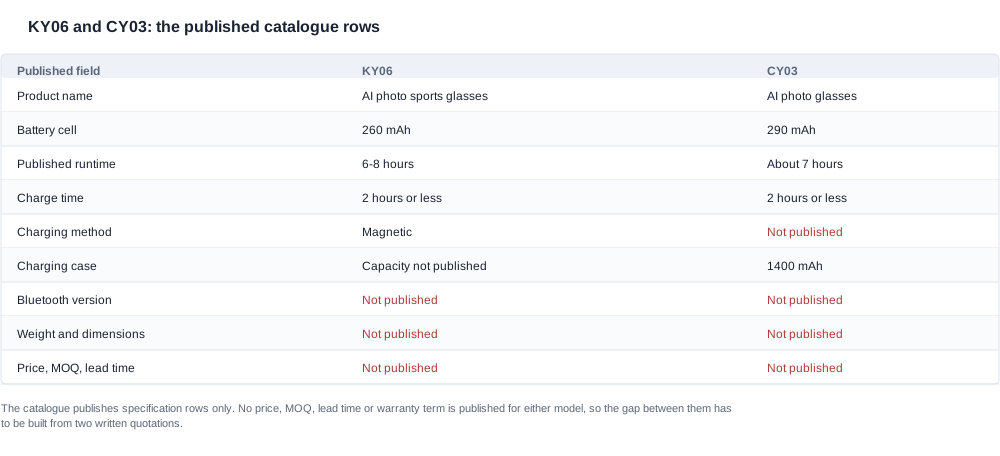
The catalogue lists the KY06 as an AI photo sports glasses model and the CY03 as an AI photo glasses model. Both rows are published in the same format with the same fields, and both are short. Below is the complete published position for the two models, including the fields where the catalogue says nothing.
| Published field | KY06 | CY03 |
|---|---|---|
| Product name | KY06 AI photo sports glasses | CY03 AI photo glasses |
| Battery cell | 260 mAh | 290 mAh |
| Published runtime | 6-8 hours | About 7 hours |
| Charge time | 2 hours or less | 2 hours or less |
| Charging method | Magnetic | Not published |
| Charging case | Included, capacity not published | 1400 mAh |
| Bluetooth version | Not published | Not published |
| Water and dust rating | Not published | Not published |
| Device weight | Not published | Not published |
| Price and MOQ | Not published | Not published |
| Lead time | Not published | Not published |
Three things stand out in that table, and they matter more than the cell difference.
The runtime is a range on one side and an approximation on the other. The KY06 publishes 6-8 hours and the CY03 publishes about 7 hours. A range set against an approximation is not a comparison, because the document does not state the test condition either figure was measured under, so they cannot be ranked against each other with any confidence. The battery life comparison method covers what to ask a supplier so that two published figures become comparable numbers.
The charging rows run in the opposite direction from the usual expectation. The KY06 publishes its charging method, magnetic, and it has a charging case whose capacity is not published. The CY03 publishes a case at 1400 mAh and leaves the charging method itself unpublished. The model that looks more fully documented on the case is therefore the model whose cable and dock arrangement a buyer cannot yet write into a logistics plan, and the model that documents its method does not document what that method buys in total stored charge. The charging case options analysis covers what each of these configurations does to the delivered cost of a pair.
Everything that would justify a price gap on specification is missing on both models. There is no published weight, no published dimension, no published lens or frame material, no published colour list, no published camera resolution, and no published water and dust rating for either model. Some other models in the same range do carry a published rating; these two do not, and that absence is not a gap to be filled by inference. There is no certification row either. The export certification page in the catalogue is an image page without a per-model line, so no certification or compliance claim can be attached to either model from the documentation alone.
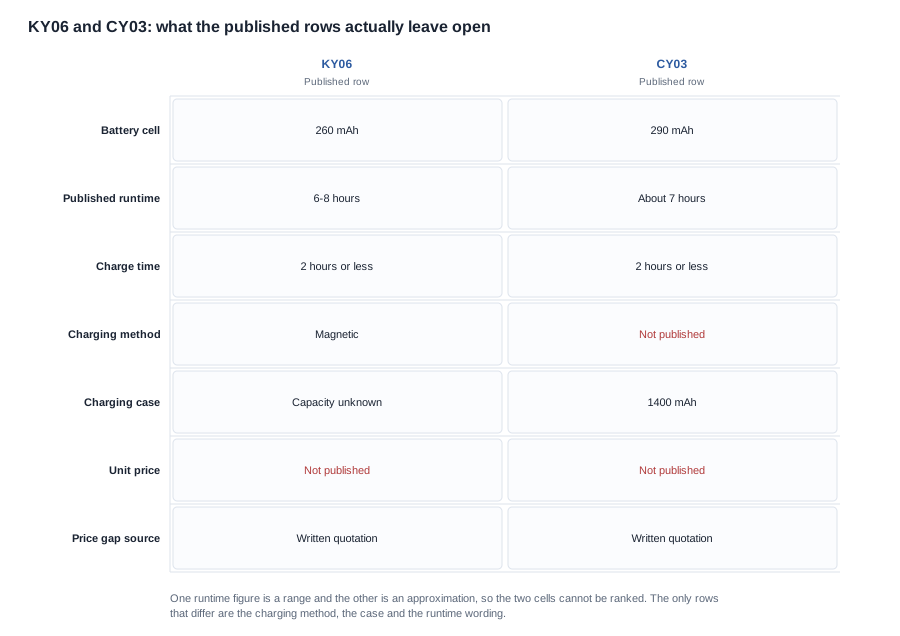
What remains as a possible differentiator is small but real. The KY06 carries a sport positioning and a magnetic charging method with a case of unpublished capacity. The CY03 sits on the 290 mAh cell platform with a documented 1400 mAh case. Those are the only two things that differ between them, and both are commercial arguments rather than specification arguments. The published rows for each model are set out in more detail in KY06 specifications and features and in CY03 specifications and features. The platform structure that decides which of the two a multi-model brand programme should invest in is covered in which models are OEM ready and in scaling up across the platform.
The honest summary of this section is that the two models are closer together than their positions in the range suggest. A 30 mAh cell difference, one published charging method against one published case capacity, and a sport label on one of them. That is not a specification ladder that supports a price ladder, and a buyer who builds a price gap on these rows alone is building on a foundation of one missing field.

Why no published price exists for either model
The absence of price is not an oversight in the catalogue and it is not a piece of commercial restraint. It is what a specification catalogue is for. A published price is only meaningful if the configuration behind it is fixed, and the configuration behind an OEM smart glasses model is not fixed until a buyer has answered a set of questions that only the buyer can answer.
Four of those questions are structural, and they are the reason a single number per model would mislead more than it helps.
Configuration. Does the quotation include the charging case, and which case? The KY06 has a case whose capacity is not published; the CY03 has a case published at 1400 mAh. A quoted price for the device alone and a quoted price for the device with the case are different products with different parcels, different weights and different shipping volumes, and the difference between them is invisible in a catalogue row.
Branding. A private label unit carries a different cost structure from an unbranded one. Whether the logo is printed, moulded into the temple, laser-etched or applied as a separate part affects tooling cost and unit cost differently, and the tooling cost lands on one order rather than on the run. A buyer who compares a branded quotation for the KY06 against an unbranded quotation for the CY03 is comparing two different contracts.
Volume. The price of a unit in a sample order is not the price of a unit in a bulk order, and the curve between them is a negotiation rather than a published function. MOQ, tier breaks and the volume at which each tier starts are all commercial terms, and all of them are quoted per model. A comparison built on a small-sample price for one model and a tier price for the other is not a price positioning at all.
Timing and destination. Lead time, shipment frequency, incoterms, payment terms and deposit structure depend on the production schedule, on the destination market and on the payment risk, and all of them are negotiated against a specific order rather than published against a model.
This is not an argument that the information is unavailable. It is an argument that the information is per-order, and that the two models have to be quoted under the same conditions for the comparison to mean anything. Ask a supplier for the catalogue price and you will get the price for the simplest possible configuration, at the smallest possible volume, on the standard commercial terms. That is a real number and it is a useless comparison.
There is a second reason to be careful with price signals that come from outside the document. A price gap between two models in the same range is sometimes readable from their position in the range itself: a later model, a smaller cell, a sport positioning, a different platform. That inference is worth forming and worth testing, but it is an inference. It has to be checked against the quotation rather than used in place of it, and the risk of treating it as fact is that a buyer commits to a business model, and to a shelf price for it, before knowing what the goods actually cost to buy.
That is the trade-off in any position plan. A published price gives a fast answer and a fragile one. A quotation gives a slow answer and a defensible one. The slow answer costs a few weeks of supplier correspondence and one sample order, and it is the only answer that survives a due diligence review by an investor, a distributor or a bank that is financing the inventory against it.
The same discipline applies to the supporting commercial terms, and each of them has to be asked for explicitly rather than inferred from a price:
- MOQ per model, and whether it differs between the two.
- Lead time in weeks, and whether it runs from order or from artwork approval.
- Warranty period, what it covers, and whether the case and charging accessories are inside it.
- Certification and compliance scope for the destination market, asked as a document request rather than as a yes or no.
- Payment terms, deposit percentage, and the balance structure on shipment.
- Incoterms, and who carries cost and risk between the factory and the destination.
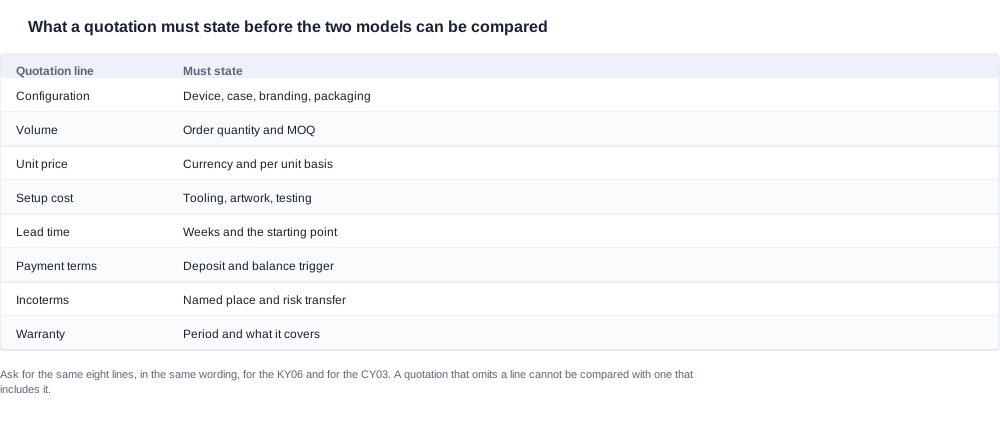
These are the questions to ask a supplier before a price is meaningful, and they are the same questions for both models. Asking them once, in identical words, for the KY06 and for the CY03 is what makes two quotations comparable rather than merely adjacent.

Building a cost comparison from a written quotation
Once two quotations arrive, the comparison is arithmetic, but only if the two are built on the same basis. The work described so far is what makes the arithmetic meaningful; this section is the arithmetic itself, and the method for how to evaluate two supplier quotations when the only hard data is a catalogue row.
The first step is to fix the configuration baseline before comparing anything, and to write it as one line that both suppliers have confirmed in writing. For a pair of camera glasses from this range that line is usually: device, charging case in or out, charging method, private label or unbranded, packaging, destination market, order volume, delivery term. If a supplier has quoted a configuration you have not specified, that quote is not comparable to anything, and the fastest way to lose an afternoon is to compare a unit price that includes the case against one that does not.
The second step is to separate the cost of the run from the cost of the setup. Tooling, artwork, sample builds, custom packaging development and certification testing are one-off costs that land on the first order and are spread across the run only if the run is large enough to absorb them. This is where most price comparisons in this category go wrong. A model that looks cheaper per unit can be materially more expensive in total if it carries a setup cost the other one does not, and a model that looks more expensive can be cheaper once the tooling is divided across a larger volume. Break the quotation into three parts and keep them apart: the one-time setup cost, the recurring unit cost, and the costs that depend on the order rather than on the product, such as freight, insurance and inspection.
The third step is to normalise the commercial terms so that the unit prices are comparable at all. Payment terms with a deposit shift the effective cost of a unit, and so do incoterms, because an ex-works quotation hides the freight and the risk that a delivered quotation includes. Freight is part of the cost of the goods rather than an extra, and a buyer who compares two ex-works numbers and then adds a shipping estimate from a general rate card is comparing a quote against a guess.
The fourth step is to write down the criteria before the numbers arrive, so that the comparison cannot be rationalised after the fact. A workable set of criteria for this pair is short and specific:
- The unit price for the same configuration, at the same order volume, on the same delivery term.
- The one-time setup cost, itemised, with tooling separated from artwork and from certification testing.
- The total cost of ownership across the warranty period, including the case and the charging accessories.
- The lead time commitment, and what happens to it if the order is split across two shipments.
- The quality control regime on the line: incoming inspection, functional testing of the camera and of the charging path, and the acceptable defect rate.
- The compliance and certification scope for the destination market, with the document that has to arrive with the goods.
- The payment structure, the deposit, and the balance on shipment.
- The warranty term and the replacement policy for units that fail in the field.
The fifth step is to interrogate the gap rather than the number. A quotation that arrives without an itemised breakdown tells you less than one that does, and the missing lines are where the risk sits. Ask which lines are excluded, which are provisional, and which are subject to change once the sample order is built. Ask whether the price includes the charging case and, because the case capacity for the KY06 is not published, ask for the written specification of the case that will actually ship with it. A quotation that cannot answer that question is a quotation that cannot yet be compared with the CY03.
There is also a version of this comparison that does not need two separate supplier conversations. A single supplier asked to quote both models against the same configuration produces two numbers in one format, and the difference between them is far more informative than either number alone, because the supplier has already priced the shared elements. If the supplier is an OEM factory rather than a trading company, that structure is normal for them and it is the fastest route to a defensible comparison. If the supplier is a distributor, the same request still works, but add a question about who the factory is and which part of the chain is being quoted, because a distributor price and a factory price are not the same product at different margins.
The last step is the one most buyers skip, which is converting the comparison into a decision that can survive being checked. Write the reasoning down: why the gap is what it is, which parts of it are configuration-driven and which are volume-driven, and what would have to change for the other model to be the better choice. A buyer who can explain the gap in a paragraph, and who holds the quotations behind it, can negotiate against it. A buyer with a number and no reasoning can only accept it.
Two questions to ask before the comparison is used in a business case. First, does the supplier allow a factory audit or a third-party inspection of the line that will build the order, and is that inspection a contractual right or a courtesy? Second, what happens to the price if the specification changes during production, which is the most common reason a quoted cost turns out not to be the cost. Both answers belong in the file next to the quotations, because both change how much weight the comparison can carry. Where a supplier is transparent about them, the gap between its quotation and a competing one is easier to read, because it is a difference in what is being promised rather than a difference in what is being left out.
A good cost comparison is also a document that somebody else can check. A buyer who cannot hand the quotations, the criteria and the arithmetic to a colleague, an investor or a bank has not finished the work, and the risk of that shows up later as a dispute about what was actually agreed. Keeping the comparison in one place, with the quotations attached, is cheap and it is the difference between a position that was decided and a position that was guessed.

What to put into the purchase order once the quotation arrives
A purchase order is where the assumptions behind the comparison stop being assumptions. Every figure the comparison used has to appear in the order, in the same wording, or the order and the comparison drift apart and the drift is discovered at the point of delivery rather than at the point of signing. The AI camera glasses price comparison covers the cost-driver side of the same question, and the checklist below is the version to work through before you order.
The commercial terms, first. The configuration line, the unit price, the currency, the MOQ, the lead time with its starting point, the payment terms, the deposit percentage, the balance trigger, and the incoterms with the named place. The warranty period and what it covers. None of this is unusual, and the point is that every term the comparison assumed is stated rather than inherited from a previous order.
The product definition, second, in a form that a person who was not in the negotiation can read. The model name and the case that ships with it. The charging method, including the case capacity where it is published and a written specification where it is not. The runtime figure and the test condition it was measured under, in the same words the catalogue used, so that a range on one model and an approximation on the other are no longer compared without a condition. The published values that were used in the comparison, listed as published values rather than as marketing copy.
The documentation, third. The technical file that belongs to the order, the declaration of conformity for the destination market, and the certification and compliance documents that were requested during the quotation stage. Asking for these at purchase order stage rather than at sample stage is what prevents a shipment arriving without the paperwork needed to sell the product. Nothing in that list should be treated as standard until the document has been seen.
The quality terms, fourth. The inspection standard on the production run, what the acceptable defect rate is, who performs the inspection, and what happens when a batch fails it. The sample stage comes before this one and is where most of the unknowns are closed. A pre-shipment inspection is worth the fee on a first order and on any order where the configuration has changed, because the failure it catches is far more expensive than the inspection.
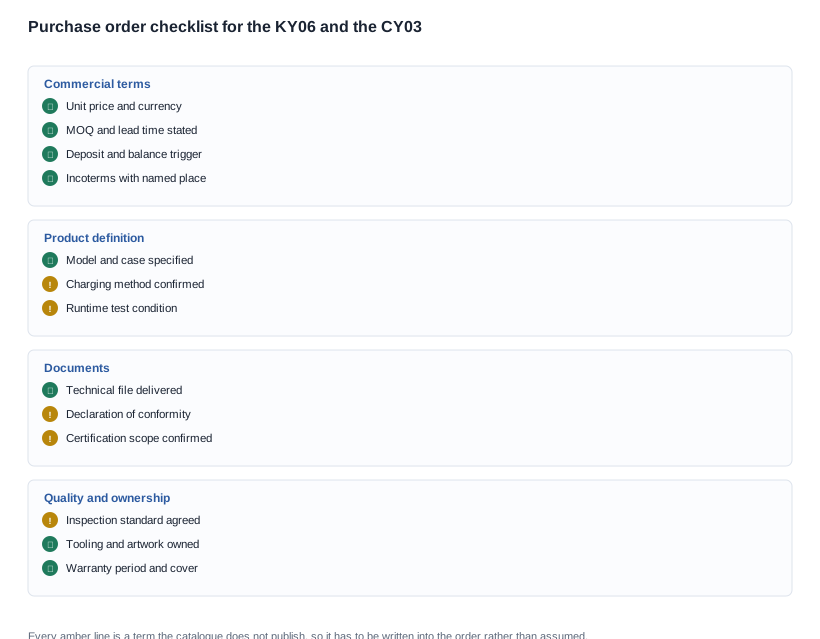
The behaviours, fifth. Which party owns the tooling and the artwork, what happens to them if the brand changes supplier, and how long the supplier is required to hold and service the parts. The audit right, if the brand wants one, and the notice period for it.
The trade-off, explicitly. If the KY06 is chosen because its parcel is lighter and its platform is one the brand has already invested in, that is a legitimate reason and it belongs in the file, because it is what makes the price gap defensible later. If it is chosen because the quotation was lower, then the reason is the quotation and it should be stated that way, with the quotation attached.
One closing caution. A purchase order is not a substitute for due diligence. The documents that arrive with the first shipment, and the factory visit that confirms the line behind them, are what turn a quoted configuration into a repeatable one. The catalogue gives a buyer published rows and nothing else. The comparison, the negotiation and the order are what a buyer builds on top of them.
If you want the two models costed against the same configuration, send the configuration, the order volume, the destination market and the delivery term, and we will return both quotations with the line items that produced them. The rest of the camera glasses range is in AI camera glasses.


