

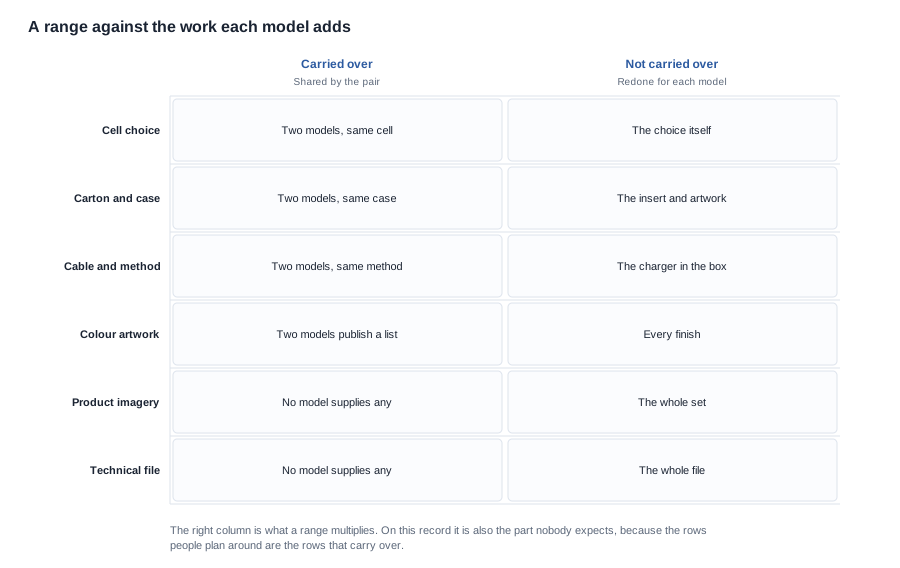
Every additional model in a range multiplies five things: the artwork, the packaging, the accessory list, the compliance file and the stock. The question a range plan has to answer is which of those five multiply less than the model count, and the honest answer for this catalogue is narrower than the usual framing suggests. The rows that genuinely carry over between models are the published specification rows: the cell capacity, the case configuration, the charge method, and in a small number of cases the colour list. The rows that multiply one for one with the model count are the ones nobody plans around, because they are the ones that do not look like a range decision: the product imagery, the technical file, and the compliance file, because the product record states for all twenty-eight models that no product photographs, no video and no detection reports have been supplied. So the work a second model adds is larger than the work the shared rows save, and the useful planning tool is a count of which rows are shared rather than an assumption that a shared cell means a shared build.
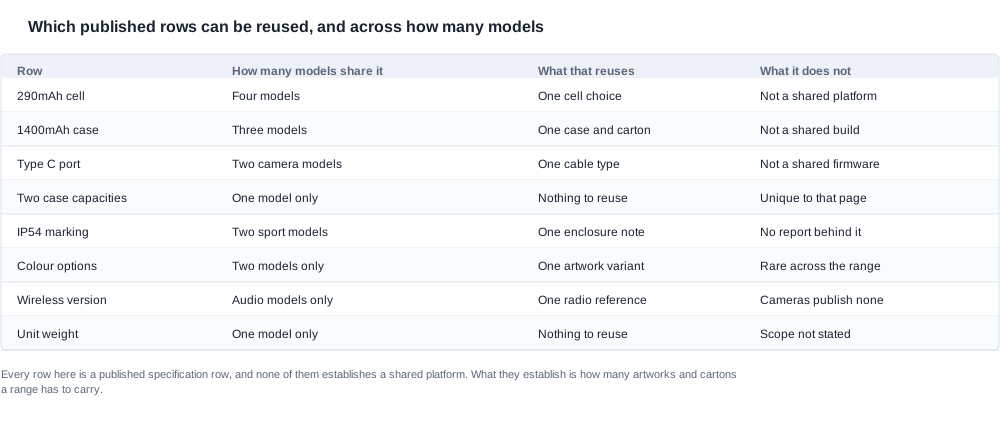
Which published rows can be reused, and across how many models
The table below lists the rows a range plan can actually build on, and for each one, how many models share it and what sharing it does and does not buy.
| Row | How many models share it | What that reuses | What it does not |
|---|---|---|---|
| 290mAh cell | Four models | One cell choice | Not a shared platform |
| 1400mAh case | Three models | One case and carton | Not a shared build |
| Type C port | Two camera models | One cable type | Not a shared firmware |
| Two case capacities | One model only | Nothing to reuse | Unique to that page |
| IP54 marking | Two sport models | One enclosure note | No report behind it |
| Colour options | Two models only | One artwork variant | Rare across the range |
| Wireless version | Audio models only | One radio reference | Cameras publish none |
| Unit weight | One model only | Nothing to reuse | Scope not stated |
The right-hand column is the important one, and it says the same thing eight times in different words. A shared cell row is a shared cell row. Three camera models publishing a one thousand four hundred milliamp hour case is three pages with the same number on them, and it lets a brand carry one carton and one insert across them. It does not establish that the three models share a firmware branch, an application, an accessory family, a production qualification or a supply arrangement, because the catalogue does not state any of those, and a range plan that assumes them is a plan built on something the documentation does not contain.
Two rows in that table are worth pulling out because they are commonly treated as reusable and are not. The first is the wireless version. The audio models publish it, splitting into two on one version and six on another, and the camera models publish none of it at all, eleven pages with no radio row. So a range that spans both categories cannot carry one radio reference across, and even within the audio category the two version groups have to be checked against each other before a single reference can be reused. The second is the colour list. It is the row most people plan a merchandising ladder around, and it is the thinnest in the catalogue: two models publish one, one with three entries and one with four, and the remaining twenty-six publish nothing at all. A colour-led range plan for this catalogue is not a selection from a list, it is a request, and the request has to be made per model.
The two rows at the bottom are the ones that make a range plan honest. One model publishes two case capacities, which is unique among the camera range, so it has nothing to reuse in the case column and everything to establish. And one model in the whole catalogue publishes a weight, on the same image caption as a foldable charging case, which means the scope of that figure is unstated and the whole weight column of a range plan has no benchmark to work from.
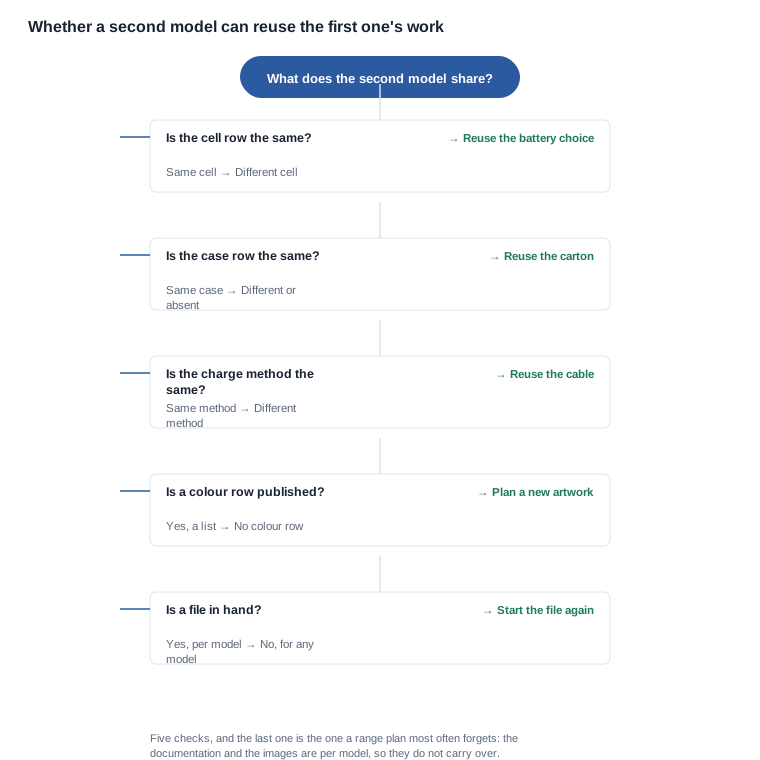
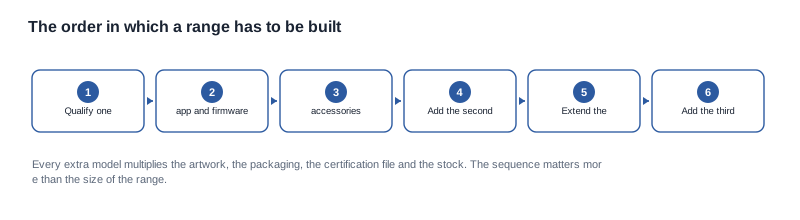
The six OEM ready platforms stages, and the order that keeps the work down
The first stage is qualifying one model properly, and the word properly is doing the work. One model with its specification rows, its images, its packaging and its compliance file all in agreement with each other. This is where the platform gaps become visible at a point when they are cheap to close, and for this catalogue the gaps are not subtle: no model in the range has a detection report, so the compliance file starts from nothing rather than from a template. The model readiness overview sets out what the record actually carries for each model, and the partnering guide covers the stage sequence around it.
The second stage is the one most range plans get wrong, because they build it on an assumption the documentation does not support. The usual second stage is proving the application and the firmware once so that later models inherit them, and the underlying idea is sound. But the catalogue publishes no firmware row, no application row, no device naming row and no compatibility statement for any model, and the camera pages publish no wireless version at all, so there is no published shared asset to inherit, and no way to verify one. What can be done is narrower and still worth doing: confirm in writing which rows a second model shares with the first, and treat everything else as something to be established for that model. The AI feature notes cover the questions that have to be answered before an AI capability is attached to a shared basis, and the same discipline applies to any capability that is meant to carry across a range.
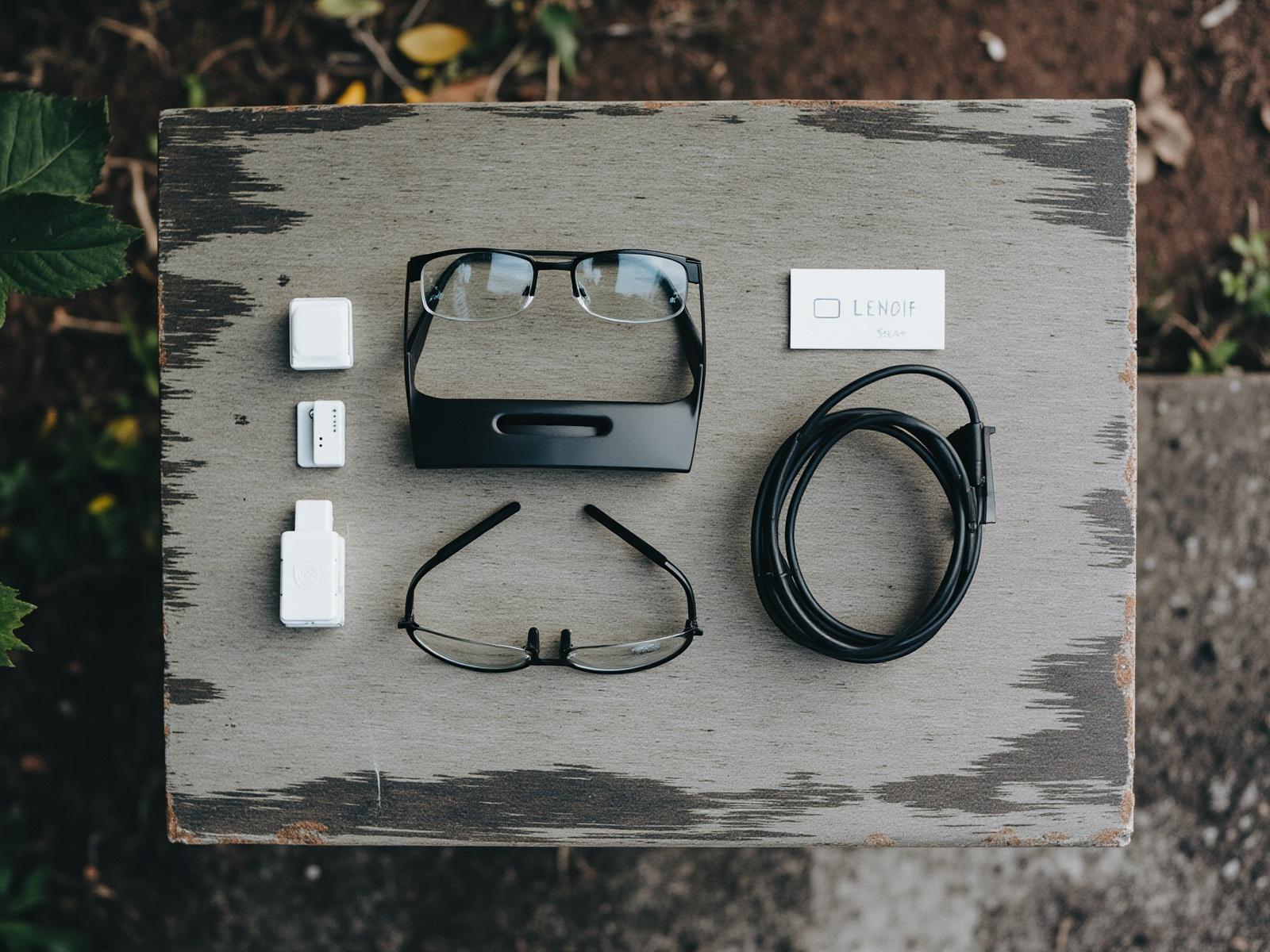
The third stage is locking the accessory set, and the catalogue makes this unusually concrete because the charge method splits the camera range several ways. Two camera models state a Type C port, in different rows and with different wording. Five state a magnetic charge, in three different wordings, and two of those name a charging case in the same row. Four camera models publish no charge method at all, which means their accessory is an open question rather than a known row. And the case situation splits four ways as well, from a page publishing two capacities down to a page with no case row at all. So the accessory plan is a per-model question, and the amount of it that can be shared is determined by which of those rows match. The Bluetooth audio glasses charging options piece covers the accessory economics, and the sport packaging options piece covers how features land in the box.
The fourth stage is adding the second model, and the criterion for choosing it is that it should test a new tier rather than duplicate the first. The published differences available for that are specific and few, and the criteria for a second model are these five.
- A new resolution tier. The camera range splits three and eight on the pixel count, so a thirteen megapixel model opens a tier an eight megapixel model does not reach.
- A new case configuration. One camera page publishes two capacities where the rest publish one or none, so it is the only model in the range that can offer a case choice.
- A new colour list. Two models publish one, so either of them can carry a merchandising ladder that no other model can.
- A new feature line. The sport pages publish feature lines the other categories do not, including an ingress marking and a removable inner frame.
- A new charge method. A model that charges differently from the first needs its own cable and its own carton.
What a model cannot add, on this record, is a shared application or a shared firmware, because nothing in the documentation establishes either, and a second model that is expected to inherit one is a second model with an open dependency that the plan has not costed. The criteria are all about published rows, and they are all checkable against a catalogue page, which is what makes them usable in a plan rather than merely arguable in a meeting.
The fifth stage is extending the colourways, and the arithmetic is worth doing because it is the one place where the multiplication is visible in the record itself. Three published colours on one model means three artworks, three cartons and three print setups for one product, and four means four of each. On a range where twenty-six models publish no colour list, the colour plan is a request rather than a selection. The OEM ready brand guidelines covers the mapping step where the hardware constrains the design.
The sixth stage is adding a third platform, and the honest framing here is the one the record forces. A third platform is a third set of everything that is per model, and there is no published evidence that any of the per-model work carries over, because the only things that carry over are the published rows and the per-model work is not a row. So the decision to add one should be made on whether a tier the business needs is unreachable from the models already in the range, and not on whether a further model exists. The OEM ready pricing tiers piece covers the commercial structure around this decision, and the inventory planning notes cover the stock consequences.
There is one further stage that is easy to omit and expensive to omit, and it is the stage where the range is actually reviewed. A range plan is a document that gets outdated the first time a model is added, and the review that catches it is cheap. For this catalogue the review has a specific form, because the record changes in ways a plan cannot see. A model that had no colour row gets one published, and the artwork count changes. A model whose capacity correspondence was unresolved gets a mapping, and the packaging count changes. A model that had no code issued gets one, and the identity of everything downstream of it changes. A model whose classification was open gets settled. The review is therefore a re-read of each model's page against the plan, and on this record it is a task that can be done in an afternoon, because what it produces is a number: how many artworks, how many cartons, how many files, and how many of each are still open.

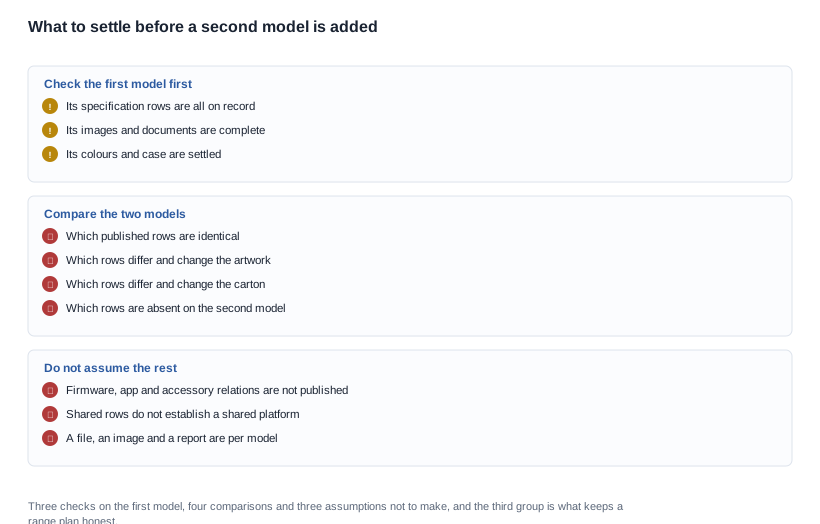
What a range plan has to write down
Three things, and the third is the one that is usually missing.
First, the list of shared rows between each pair of models in the range, taken from their own catalogue pages rather than from a family resemblance. The cell row, the case row, the charge method row, the pixel tier, the colour row. A pair that shares all five is a pair that can share a carton and an artwork, subject to the two models being distinguishable on the unit itself, which on this record means a code and a configuration rather than a name.
Second, the count of artwork variants and carton variants the range implies, and which models contribute to each. This is a number a buyer can calculate from the record today, because the colour rows are published and the case rows are published, and it is the number that determines whether the range is one packaging job or five.
Third, and this is the part a range plan usually does not contain, the list of things that are per model and cannot be inherited: the imagery, the technical file, the compliance file, and any capability that is meant to work across the range but has no published basis on which to inherit it. On this record that list is the same length for every model, and it is the largest single item in the plan. A range plan that does not name it will discover it at the point where a second model's packaging is already printed and its file is still empty.
The trade-off worth naming is between adding models and adding depth, and it is a trade-off in workload rather than in cost. Adding a second model on rows that match the first multiplies the artwork count by whatever the colour and case rows say and multiplies the file count by one. Adding depth to a single model, meaning a second colour, a second case capacity or a second configuration of a model that already publishes a choice, multiplies the artwork count by one and the file count by one as well, but it multiplies the per-unit stock instead. Which of those is cheaper depends on how many units each configuration carries and on whether the channel can hold the stock, and neither of those numbers is in the record, which is why the answer has to come from the buyer's own plan rather than from this catalogue. What the record does decide is the shape of the multiplication, and the shape is the same either way: the per-model work is per model, and only the published rows carry over.
The criteria for deciding which of the two to do, then, are these four. Does the range need to reach a tier that the models already in it cannot reach, which is the case for a new resolution or a new charge method and not the case for a second colour. Does the channel need to offer the same product in more than one configuration to the same customer, which is the case for a second colour and not for a second model. How much per-model work is already open, because a range plan with three unissued model codes and three empty files is not ready for a fourth model of any kind. And whether the stock consequence is acceptable, which is the only one of the four that the catalogue cannot inform.

What we can and cannot commit to
The order of a range matters more than its size, and the order has to be built from the rows the documentation carries rather than from an assumption about which models belong together. We will state which published rows a set of models share, and we will say plainly that shared rows do not establish a shared platform, because the catalogue publishes no firmware, application, accessory or supply relationship for any model and none of those relationships can be inferred from a shared cell figure. We will not represent a model as ready for a configuration its page does not document, and where the record is incomplete, as it is for minimum order quantity, lead time, unit cost and the certification numbers for specific models, we will say it is incomplete rather than offer an estimate that later becomes a commitment. And we will not treat the two camera models that publish a Type C port, or the three that publish the same case capacity, as a family, because the record does not make them one.
What the record does support is a range plan that counts. How many artwork variants the colour rows imply. How many carton variants the case rows imply. Which models can share a cable, which can share a case, and which have to be asked about. And which of those numbers go up one for one with the model count, which on this record is the larger group. A buyer who works that way reaches the market with a plan that matches the documentation, and the sample before bulk notes cover the stage where the first model is proved rather than promised. There is a practical reason for doing the counting before the range is committed rather than after, and it is that every one of these numbers is cheap to produce and expensive to discover late. The colour count comes from two catalogue rows. The carton count comes from five camera pages. The file count is one per model and is the same for all of them. The open items come from the record's own flags, which are already written down on the pages and do not require anyone to remember them. So the range plan can be assembled from the documentation in an afternoon, and the trade-off between the second model and the second configuration can be argued with numbers on both sides rather than with intuition about which feels cheaper. The one thing the counting cannot settle is how many units each configuration carries, because that is the buyer's own commercial model, and it is also the only input that decides whether adding depth is the right answer. What the counting does is make the question explicit at the point where it is still cheap to change the plan. The order of the two is what a range plan is actually deciding.
Send us the tiers you plan to cover and the volumes per market, and we will tell you which published rows your models share, how many packaging SKUs the range implies, which parts of the work are per model rather than shared, and which of them you should settle before the artwork is locked.


