

A costed answer for this model cannot be written from the catalogue, because the catalogue publishes no commercial term of any kind — no price, no order minimum, no lead time, no warranty period and no certification number. What it does publish is a short hardware sheet: 13 MP, a 290 mAh frame cell, a charge time of two hours or less, a rated endurance of about seven hours, a charging interface named as Type C, a charging case offered at 900 mAh or 1400 mAh, and two variant names printed beside those two capacities.
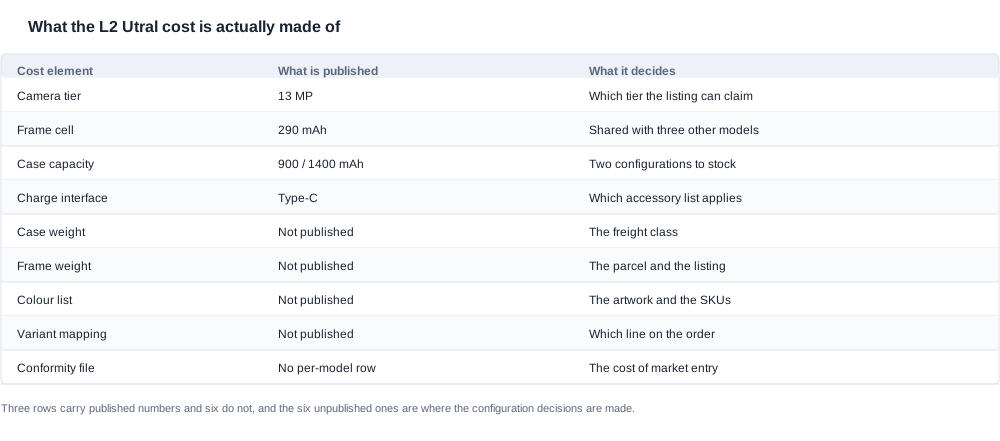
That leaves a more useful question than a verdict. Which cost elements does this model actually touch, which of them are still blank, and what has to be written on a quotation before two of them can be compared at all. The answer runs through three published numbers, six unpublished ones, and one structural fact that changes how any quotation for this model should be read: two published case capacities mean two configurations, and a unit price without a configuration attached is not a number a buyer can act on.
L2 Utral smart glasses value for money: what the cost is made of
The three published numbers that touch a cost decision
The first is the case capacity row, and it is the only row on this page that changes what a buyer has to produce. Two values in one row means two configurations to stock, two carton specifications, two accessory lists and two configurations of the same model to carry as spares. Across the camera range, only five models publish a case capacity at all, two more name a case without publishing its size, and four carry no case row — so this model is the only one where the case is a published choice rather than a published fact.
The second is the charging interface, named as Type C. What it decides is the accessory list: whether a cable has to travel in the box, whether a case is a charging path or an item that sits beside one, and what a customer needs in the first hour. The page does not say where the port sits, so even this row does not close the accessory question by itself.
The third is the pixel tier. At 13 MP the model sits in the upper of two published tiers, alongside two others. A pixel tier is a positioning fact rather than a cost fact, and it is worth holding at that level: a tier can be stated, an image quality advantage cannot, because the sensor model, the field of view, the video format and the frame rate are not published for this model or for any other camera model in the range.
What the remaining published rows do not decide
The cell figure of 290 mAh and the rated endurance of about seven hours are shared with three other camera models, so they do not separate this model from its neighbours and they do not separate the two configurations of this model from each other. The same is true of the two-hour charge ceiling, which is a ceiling rather than a duration and carries no start state.
What they do decide is the arithmetic that a buyer can safely do without any further information: how much stored energy the frame carries relative to the case, and therefore what the case is for. Taking the published frame cell as the base, the 900 mAh case is roughly 3.1 times it and the 1400 mAh case roughly 4.8 times it. Those are ratios of published numbers rather than published figures, and the usable fraction is lower than the raw capacity because the conversion losses in a dock and the behaviour of a partly depleted frame are both unknown. The honest way to hold the comparison is stored energy, not additional runtime, and to promise nothing beyond it until a sample is measured. The battery life breakdown for this model covers the runtime side of that arithmetic.

Six cost drivers with no published number
Weight, dimensions and the freight class
The frame weight is not published for this model, and the only weight figure in the whole catalogue belongs to a different model, on a different cell, with a foldable case. It cannot be borrowed as a proxy, so the packed weight of each configuration is a measurement rather than a figure, and the freight class, the carton specification and the listing shipping weight all follow from it. The shipping weight analysis covers how that number flows into the delivered cost.
The case as an object in the parcel
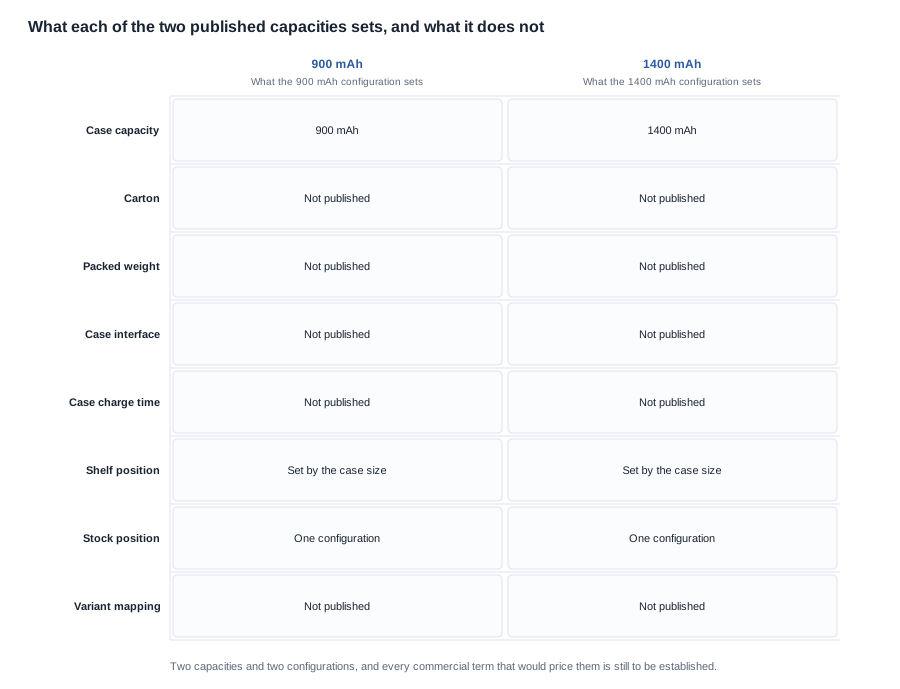
The capacity is the only thing published about either case. Its weight, its dimensions, its own interface, its own charge time and whether it is a power source or a cradle are all unpublished, and the difference matters because a case is a second cell, a housing, a connector and possibly a hinge, travelling in the same carton as the frame. Two case capacities are therefore two different parcels rather than one parcel in two sizes, and the number that decides the freight class is the one nobody has published.
Colour, artwork and the number of stock lines
No colour list is published for this model, and the camera range publishes one for only two of its eleven models. A colour list is not a cosmetic question: each additional colourway is a packaging line, an artwork revision, a stock position and a minimum quantity. Combined with the two case capacities, the count of production configurations is the product of the two, and it is the count that a buying plan has to carry.
Protection, and what may be claimed
An ingress marking is published for two camera models in the range, neither of them this one. So there is no protection statement to make, no durability line to put on a listing, and no basis for a channel that needs one — and a buyer whose brief needs one has to obtain the answer as a document item or design around it. The IP ratings and durability page covers what such a marking would and would not settle if it arrives.
The conformity file, per model and per market
The catalogue carries an export certification page at company level whose content is presented as images, and it carries no per-model certification row. For a model sold into a market, the file has to be assembled per model and per market: the conformity regime, the certificate numbers, the test reports, the signatory, the labelling and packaging instructions. The certification coverage notes set out how to check what arrives and what it actually covers, and the cost of that file is a per-model cost that never appears in a product listing.
The rows that will not decide a cost but decide a claim
Three more rows are empty and each one governs what may be written. The Bluetooth version is not published for any camera model in the range, so a specification that names a radio version has to obtain it. The frame weight and the dimensions are already noted above, and the sensor and video rows decide whether any image quality statement can be made at all. None of them is a cost line on a quotation, and all three are lines on a listing.

Two capacities means two configurations, not two price points
The difference that gets lost on a quotation
Two published capacities on one model are sometimes read as two price points, and the reading is convenient enough to be dangerous. A price point is a number on a price list. A configuration is a set of decisions: which case, which variant name, which carton, which artwork, which accessory list, which stock position. The second configuration carries its own packaging, its own minimum quantities and its own spare-parts stream, and those are commitments rather than parameters.
The practical consequence is that a quotation for this model has to name the configuration on every line. A unit price with no configuration attached is not comparable with another unit price, because the two may be for different boxes, different cases and different artwork. And because the two variant names sit beside the two capacities without a published correspondence, the configuration line has to carry both: a name and a capacity, written out in full, matching the carton and the packing list character for character.
Why the smaller capacity is not automatically the simpler programme
A buyer who assumes the smaller case is the simpler commercial choice is making a procurement decision on an assumption, and the assumption lands on a carton. The smaller case reduces one dimension of the parcel and leaves every other cost line exactly where it was, while the larger case adds a second configuration to stock. Which of the two produces a better delivered cost is a function of volume, channel mix, carton design and freight terms, and none of those four is published for this model.
The published fact is narrower and still useful: this is the only model in the camera range that publishes two case capacities, and the only one that carries a variant-name line. A buyer comparing it against the models around it is therefore comparing a two-configuration platform with a one-configuration platform, and the quotation is where that difference either shows up or does not.
How to evaluate a quotation that covers two configurations
When a quotation covers both case capacities, the question is not which of the two is better but whether the two lines are readable. The criteria are short. Each line names the configuration, which means the case capacity and the variant name, written out in full. Each line carries its own order minimum, because two configurations rarely share one. And each line carries the commercial terms, because a quotation that prices one configuration and describes the other is not a two-configuration quotation.
How to evaluate what arrives is a question about internal consistency rather than about the numbers. If the two lines differ only in the capacity and nothing else, that is worth asking about, because the carton, the artwork and the accessory list are not the same object in two sizes. If one of the two lines has a minimum and the other does not, the one without it is a line that has not been configured. And if the variant names appear anywhere other than on the model line, the document has separated the model from its configuration, which is the ambiguity the catalogue leaves open and the quotation was supposed to close.
The red flags in a camera-range quotation
Four things in a quotation for this model are worth a question rather than a signature. A unit price with no configuration attached, because two configurations exist and the price is only meaningful against one of them. A lead time with no starting point, because a lead time measured from order confirmation and a lead time measured from artwork approval are different numbers with the same name. A certification reference that names a model string that does not match the packing list, because the two variant names make it possible to write a file against the wrong one. And a warranty period offered with no defect allowance attached, because a warranty without an acceptance criterion is a promise without a procedure behind it.
None of these four is a reason to stop. All four are reasons to ask before you commit, and each one closes with a line on the document rather than with a conversation.
The five lines that decide whether two quotations can be compared
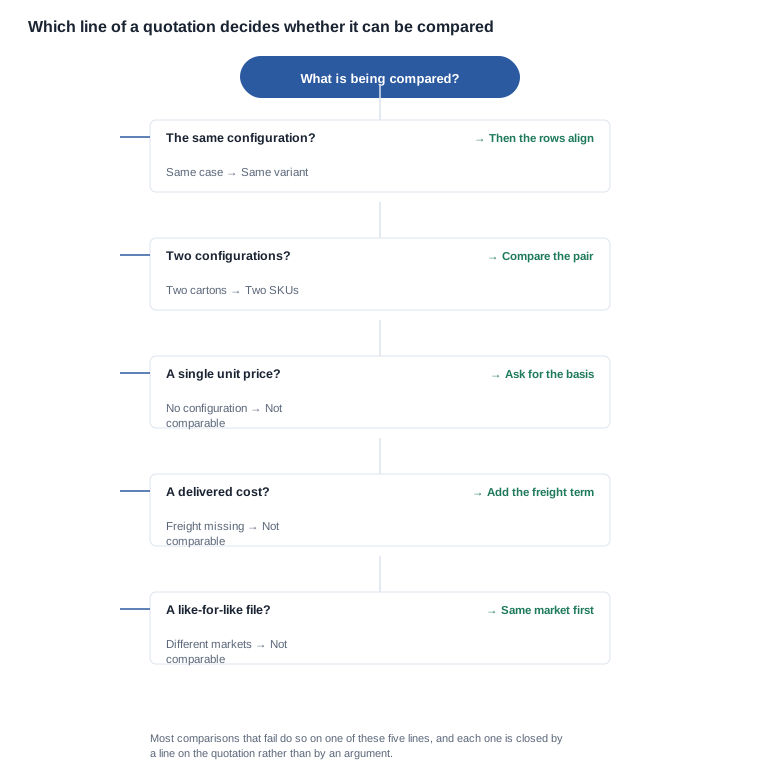
Five checks decide whether two quotations for camera products can be set against each other, and each one is closed by a line on the document rather than by an argument. Do they describe the same configuration, including the case capacity and the variant name. Are they one configuration each or two configurations each, because a pair has to be compared with a pair. Does the unit price carry its configuration, and if not, the quotations are not comparable yet. Does the delivered cost include the freight term and the incoterm, or is one of them quoted ex-works and the other delivered. And is the conformity file for the same market, because a file built for one market does not cover another.
None of these five is unusual, and all five are routinely skipped, because a comparison between two products with different configurations feels like a judgement rather than a mismatch. The pricing checklist for an OEM programme sets out the commercial terms that have to appear on the same sheet, and the packaging options analysis covers the line that most often turns out to be missing.

How to put two quotations on the same basis
The six questions that turn a quotation into a costed answer
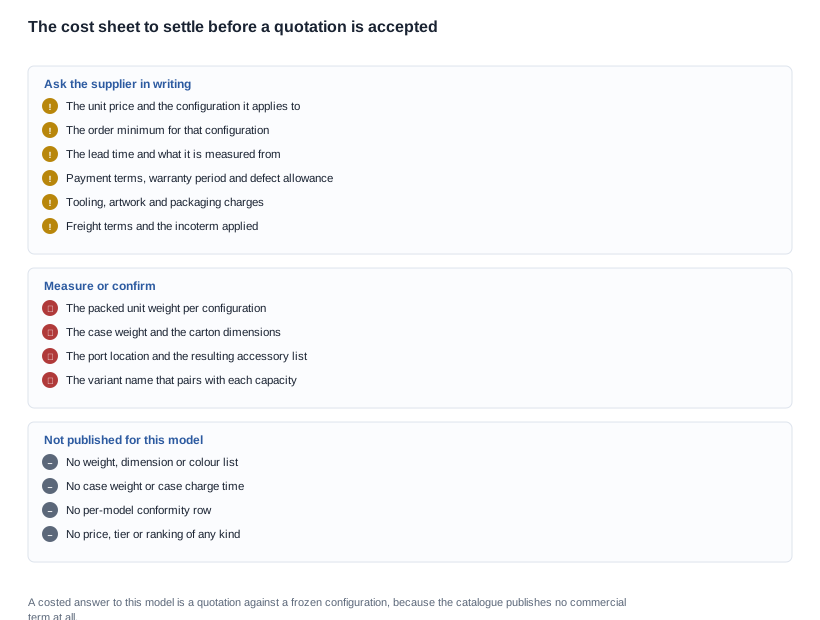
Six questions apply to every quotation for this model, and they are the same six for either case capacity. The unit price and the configuration it applies to. The order minimum for that configuration. The lead time and what it is measured from. Payment terms, warranty period and defect allowance. Tooling, artwork and packaging charges. And the freight terms with the incoterm applied.
Four more come from measurement rather than from a document, and they are the ones that make the delivered cost a number rather than an estimate: the packed unit weight of the configuration being ordered, the case weight and the carton dimensions, the location of the charging port and therefore the accessory list, and the variant name that pairs with each capacity.
The order in which to close them
A shortlist of two configurations from the same model is not a shortlist of two products, and the sequence in which the questions are asked matters more than the number of them. The configuration is settled first, because the configuration determines the case, the carton, the artwork and the accessory list, and everything below it is a consequence. The variant name pairing is settled at the same time, because it has to travel on the same line of the purchase order as the capacity.
The commercial terms come next, and they are asked against the frozen configuration rather than against the model: the unit price for that configuration, the order minimum for it, the lead time measured from a stated point, the payment terms, the warranty period and the defect allowance, and the freight term with the incoterm applied. Then the measurements, because a packed unit can be weighed and a port can be located, and both of those close more of the delivered cost than any additional document will.
The last two items are the ones a buyer is most likely to leave open, and both have a deadline attached to them. The packed weights have to be measured before the carton is drawn, because a carton is the one thing in a launch that cannot be re-specified after the first production run. The conformity file has to be requested before the artwork is finalised, because the designation on the file and the designation on the carton have to be the same string. Before you commit to either configuration, the criteria for both are the same: the configuration is named, the numbers carry their states, and the open items are recorded rather than assumed.
What our own published rows can and cannot carry into a costing exercise
The published specification list for this model is the honest baseline for what may be written into a costing, and the published L1 Pro specification list is the same for the model it shares the 290 mAh platform with. Between them they establish which rows are identical and which are not, which is the part of any comparison that can be settled without a single new fact.
What cannot be carried into a costing is anything commercial. There is no published price, no published tier, no published minimum, no published lead time, no published warranty period and no published certificate number for this model or for any other in the range. A costing exercise that contains any of those numbers is not using the catalogue; it is using a supplier's figure that has not been requested, or an assumption that has not been tested.
What we publish, and what we do not
The published rows describe the product and the unpublished rows describe the programme, and the two have to be kept apart in any costing exercise. We will publish the 13 MP as a resolution, the 290 mAh as a cell figure, the two-hour figure as a ceiling, the seven hours as a rating, the two case capacities as two published values, and the two variant names as two names without a published correspondence. We will not quote a weight, a dimension, a colour, an ingress marking, a case interface, a certificate number, a price or a lead time that the source does not contain, and we will not convert a published row into a commercial conclusion.
That is not a refusal to help with a costing; it is the reason a costing on this model has to be built against a frozen configuration and a written quotation, because that is the only basis on which the numbers mean anything. Send us the target market, the expected volume and the configuration you need, and we will tell you which rows are settled, which are blank, and which of the blanks a single measurement or a single message closes.
Related reading
- Published figures for the sibling model — L1 Pro smart glasses specifications
- Case configuration and the accessory cost — AI camera glasses packaging options
- Building the commercial case — smart glasses pricing checklist


