
Two camera models sit on the same 290 mAh platform, publish the same charge-time ceiling, publish the same rated endurance, and differ in three rows that a buyer can actually act on. The camera tier differs, 13 MP against 8 MP. The charging row differs in kind, because one page names a Type C interface and the other carries no charging-method row at all. And the case row differs in shape, because one page prints two capacities in a single row and the other prints one.
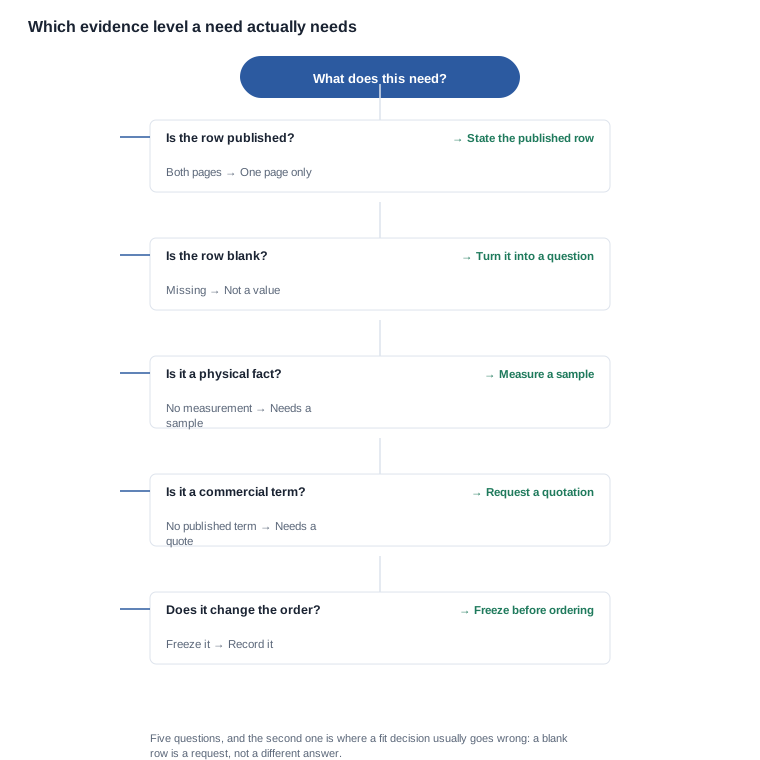
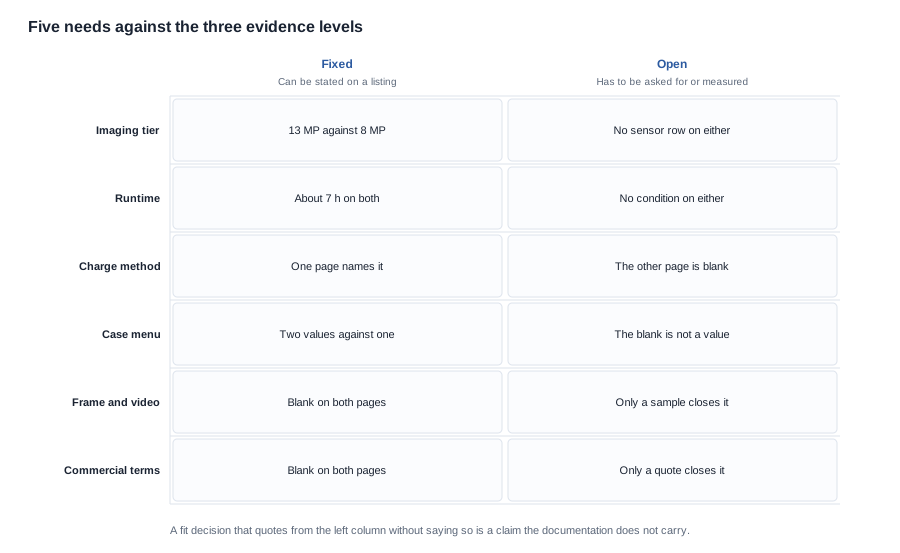
That is a short list, and it is shorter than the number of differences a typical camera comparison presents. What makes it usable is not the shortness but the structure. Each need a channel has — imaging, endurance, charging, packaging, compliance — lands on a specific published row, and each of those rows is available in one of three states: published on both pages, published on one page only, or not published on either. A need that lands on a published row can be stated; a need that lands on a one-sided row becomes a question; a need that lands on a blank becomes a measurement or a document.
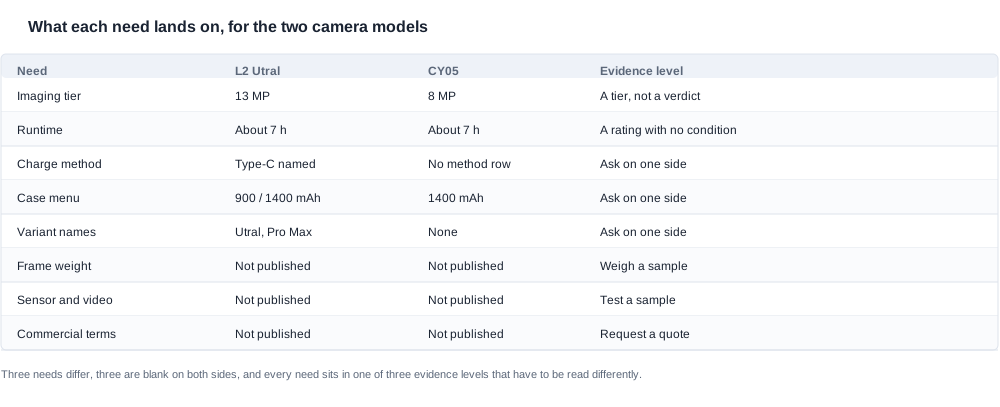
L2 Utral smart glasses vs CY05 use case fit: five needs and the rows behind them
The three states a need can be in
The first state is the easy one: both pages publish the row, so the two figures can be placed next to each other and quoted. The runtime row is in this state, with about seven hours on both pages.
The second state is the one that catches people out. One page publishes a row and the other does not, and the blank is easily read as a different value rather than as a missing one. That is exactly the case for the charging row on the CY05: the page carries five rows — camera, cell, charge time, endurance and case capacity — and no charging-method row, and in the camera range four models are in that position. A blank row is a request, and it is not a second answer.
The third state is the one with no documents at all. The sensor model, the field of view, the video format and the frame rate are not published for either model; neither is the frame weight, the dimensions, the colour list, the ingress position or the storage behaviour. Those needs are closed by a sample or by a supplier's written reply, and no comparison table can substitute for either.
Why the state matters more than the difference
A comparison that reports only the differences tells a buyer which model is further along on three rows. A comparison that also reports the state tells a buyer which of their needs are already settled and which are still outstanding, and that is the list a purchase order is built from. The second list is the more useful one, because it is the list of things that have to happen before the order.
The practical test for any row in a comparison like this is simple: if the answer would change if the model, the batch or the market changed, then the row does not belong on a product page. It belongs in a request, a measurement or a term.
What the four published differences actually are
For the record, the differences between these two pages are: the camera row, the charging row, the case row, and the presence or absence of a variant-name line. The cell, the charge-time ceiling and the endurance figure are identical, and the two model pages together publish four rows that the other camera models share. The published L2 Utral specification list and the published CY05 specification list are the two baselines this comparison is drawn from.

The four questions a use-case decision starts from
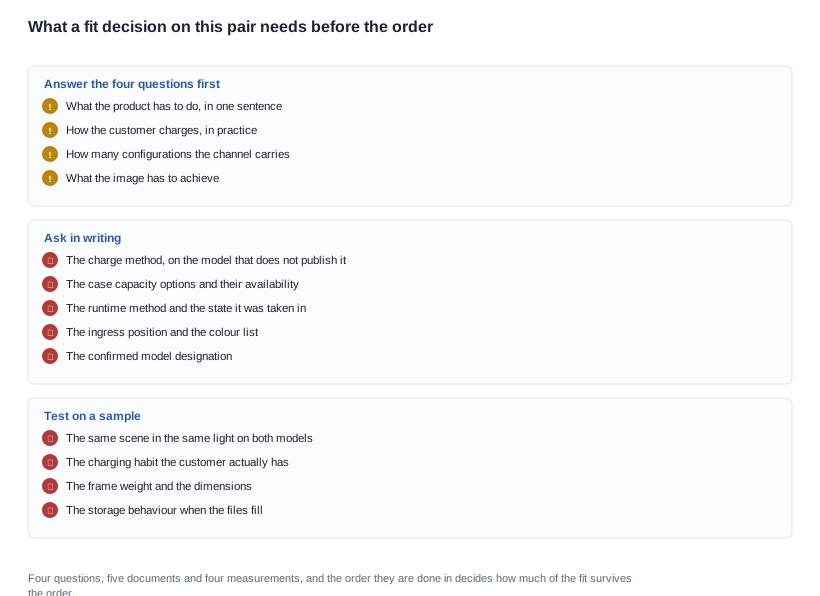
What the product has to do, in one sentence
Before any row can be compared, the use has to be written down, because different uses point at different rows. A product sold to create content, a product sold to document work, a product sold to record an inspection, and a product sold as a general camera all put their weight on different lines, and only some of those lines are published for either model. The test is whether the sentence names an outcome — for example, that a recording has to survive a full shift, or that files have to be transferred at the end of a day — because an outcome can be tested against a row, and a category cannot.
How the customer charges, in practice
The second question is about the charging habit rather than the charging method, and the two are not the same. Whether a customer charges deliberately at a desk or opportunistically between other things changes which arrangement a channel should prefer, and it also changes what the instructions have to say and what the support content has to cover. A method can be published while the habit is unknown, so the question belongs to the buyer, not to the catalogue.
For this pair the question has a second half. The L2 Utral page names an interface and the CY05 page names no method, so for one of the two models the charging question cannot even be asked of the catalogue and has to be asked of the supplier. A use-case decision that treats that as a difference in the product is building on a blank.
How many configurations the channel carries
The third question is commercial and it is the one the case row is about. One published capacity on a page is one configuration, and two published capacities in one row are two configurations, which means two carton specifications, two accessory lists, two stock positions and two configurations of spare part. The L2 Utral is the only camera model in the range that publishes two case capacities, and the two variant names printed beside them are not matched to them.
So the question for a channel is not which case to take but how many configurations the operation can carry, and that number decides whether the published menu on one page is an option or an obligation. The L2 Utral best-for analysis works through how the higher tier sits in a range, and the CY05 common questions sets out the gaps on the other model of this pair.
What the image has to achieve
The fourth question is the only one that a sample settles rather than a document, and it is the one most often left vague. A tier on a page is not a verdict: 13 MP against 8 MP is a statement about which tier a model sits in, and the sensor model, the field of view, the video format and the frame rate are not published for either model, so the tier cannot be converted into a picture. What the image has to achieve has to be written as something observable — how it behaves indoors, how it behaves in low light, whether a recording can run for the length of a shift — and then it can be tested.
Imaging: a tier on the page and a verdict only in the hand
What the camera row supports
The camera row reads 13 MP on one page and 8 MP on the other, and in the camera range eight models publish 8 MP while three publish 13 MP. That is the whole of the imaging information on both pages, and it is enough for a tier statement and nothing beyond one.
The distinction matters because the two things a buyer usually wants from a camera row are different. A tier statement is a positioning fact, and it can be written on a listing with no supporting document at all. An image quality claim is an output claim, and producing one needs the sensor and the lens, neither of which is published. A pixel count without a sensor behind it cannot be converted into a picture, and the camera and imaging guidance covers why the resolution row is an input to an imaging chain rather than a result from it.
How to test it
The test that closes the imaging question is the same for both models and it is simple to run: hold a sample of each, put both through the same scene in the same light, and record what comes out. The criteria are the conditions rather than the picture — an indoor scene, a low-light scene, a scene with movement in it, and a recording long enough to show whether the frame keeps running or stops. What a buyer is examining is not a judgement about which is better but a set of observations that can be turned into a claim or refused.
That distinction is what keeps a comparison honest. A buyer who has run the test can say what the product does in a specific condition, and a buyer who has not can only say which tier the model sits in. Both statements are defensible; only the first one supports a listing.
The rows that limit any imaging claim
Four rows limit what can be said about the image on either model: the sensor model, the field of view, the video format and the frame rate. A fifth, the storage arrangement, limits what can be said about a recording rather than about a picture, because it decides whether a recording stops silently when the storage fills. A sixth, the ingress position, is unpublished for both models and therefore cannot appear in a durability line either.
None of these can be closed by a comparison, because they are not comparisons — they are facts about one product each. They belong on the request list, and the request list for the two models is almost identical, which is one of the useful things a shared platform delivers.
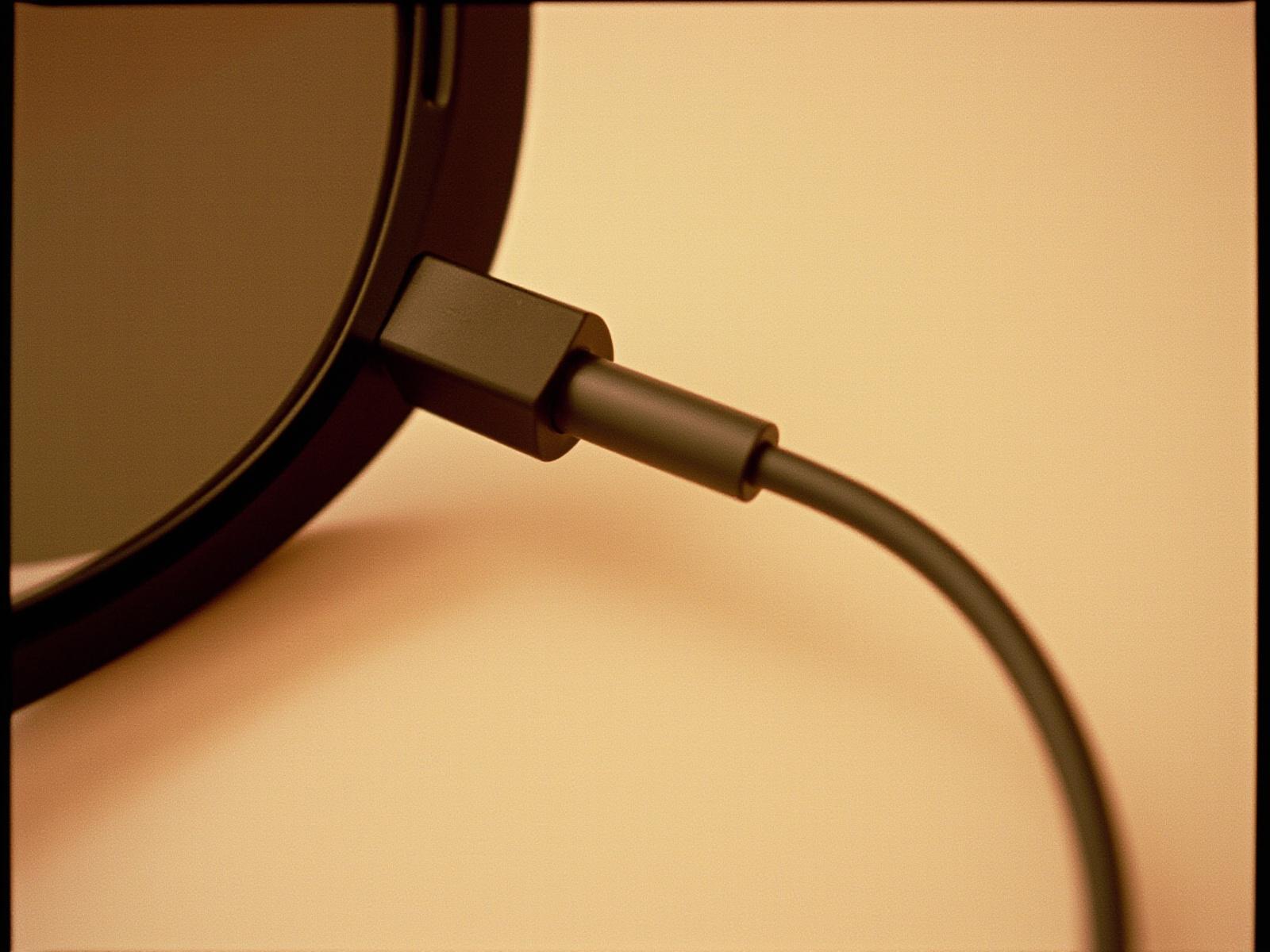
Charging and packaging, where one page names a method and one does not
The charging row, side by side
The L2 Utral page carries a feature line naming a Type C charging interface. The CY05 page carries no charging-method row, and the camera range contains four models in that position. So the honest reading of this pair is that one model has a named method on the page and the other has an open question, and the open question has to go to a supplier.
The request is short: which interface the frame charges over, whether a cable or a case is the charging path, whether anything has to be supplied in the box, and what the arrangement is physically. That last one matters because a named interface says nothing about where it sits or how the customer connects it, and the two possible answers lead to different accessory lists, different instructions and different support scripts.
The case row, and what a single printed value does not settle
The case rows differ in a way that is easy to state and easy to misread. The L2 Utral prints two values, 900 mAh and 1400 mAh. The CY05 prints one, 1400 mAh. A page that prints one value has not published that only one value exists, so the statement that can be made about the CY05 is that the catalogue lists 1400 mAh, and the statement that cannot be made is that 1400 mAh is the only case available for that model.
That distinction is worth keeping in a comparison document, because a filled-in cell and an empty cell mean different things. On the two-value side, the menu is published and the correspondence is not, so the configuration has to be settled before the artwork. On the one-value side, the capacity is published and the range of options is not, so the option has to be requested before the ordering plan is fixed.
What the packaging consequence is
Two configurations and one configuration produce different programmes, and the difference is not a difference in the frames. It is two carton specifications, two accessory lists, two stock positions and two spare-parts streams, on one side, and one of each on the other. Which of those a channel should carry is a function of volume, channel mix and packaging design, and none of those three is published for either model.
What a use-case decision therefore produces is a decision about configuration count, and that decision has to be made before the quotation is accepted rather than after the first carton is printed. The criteria for it are the volume split between the channels, whether the supplier can schedule both configurations together, and whether the packaging artwork can carry two box sizes.

The runtime row and the rows that nobody publishes
Seven hours, on both pages, with no condition
The endurance row reads about seven hours on both pages, which puts it in the first state: publishable, quotable, and identical. It also puts it in the third state in a different sense, because the condition behind the figure is not published for either model, and a rating without a condition is a rating rather than a duration.
The condition is not a technicality on a camera platform, because the camera is the dominant load and whether it was recording during the measurement is the difference between two products. So the question to ask is the same on both sides and in the same words: what was active, at what volume, in what temperature, over how many units, and from what state the charge cycle began. If the two suppliers answer in materially different ways, the two figures are not comparable, and that is worth knowing before either number is quoted anywhere.
The rows that are blank on both sides
Eight rows are blank on both pages, and because they are blank on both sides they are also the cheapest part of the comparison to close. One request for the imaging rows, one weighing session for the frame and the case, one question about protection and colour, one for the storage behaviour, and one for the radio version, and the answers apply to whichever of the two models is chosen. The buyer checklist for the KY06 is the sample-stage version of the same list for a neighbouring model, and the L2 Utral limitations analysis sets out the full gap set for this one.
The commercial terms, which are blank on both sides as well
No price, order minimum, lead time, payment term, warranty period or certificate number is published for either model. That means a use-case decision cannot end in a value statement, because there is nothing published to value. It ends in a request list, and the request list is what the pricing structure sheet sets out the terms against.
The five needs a channel usually starts from
In practice a channel arrives with a short list of needs rather than a specification, and the useful thing a comparison can do is sort that list by the row each need lands on. Content creation puts weight on the imaging rows, and the imaging rows are the ones with the largest gap between what is published and what a customer will see. Documentation and inspection put weight on endurance and on storage behaviour, and the endurance row is published while the storage behaviour is not, so half of that need is answerable today and half is not. Long-shift and outdoor use put weight on the protection and the endurance conditions, and neither is published. Multi-channel retail puts weight on configuration count, which is where the two case menus differ from each other.
That sorting is what turns a list of needs into a request list with an order attached to it. The needs that land on published rows can be written into a specification today. The needs that land on one-sided rows have to become a question per model, and they have to be asked separately because the two models are missing different things. The needs that land on blank rows have to become a measurement, and the measurements have deadlines attached to them that run ahead of the artwork.
The criteria for deciding which kind a need is, are worth writing down before the comparison starts rather than after it: if the answer is the same whatever the configuration, it belongs on a product page; if it changes with the configuration, it belongs in a term; and if it has to be seen to be believed, it belongs in a sample.
The terms worth asking for, and the position we take
What to ask and what to write down
The requests split into three groups, and they are worth sending together rather than in sequence. The shared group is the five questions that apply to both models, sent in identical wording so the answers can be compared side by side. The model-specific group is three questions for the L2 Utral — which of the two printed names pairs with which capacity, where the charging interface sits, and whether the case is a power source or a cradle — and three for the CY05 — the charging method, whether a second case capacity exists, and the case weight and interface.
Then there are the four measurements that no document replaces: the same scene in the same light on both models, the charging habit the customer actually has, the frame weight and the dimensions, and what happens to a recording when the storage fills. The camera imaging guidance covers what to shoot and what to examine, and the sequence matters, because a sample that arrives after the artwork is drawn has already missed its deadline.
Our position on the use case
These two models can be compared on four published rows and on nothing else, and a use-case decision is a mapping from needs to rows rather than a preference between models. We will state the camera tiers, the shared cell and endurance figures, the named interface on one page, the two case capacities on one page, the single printed capacity on the other, and the two variant names printed beside the first pair. We will not state a charging method for the model whose page does not publish one, we will not describe a single printed case capacity as the only one available, and we will not present a pixel tier as an image quality claim.
We will also not quote a price, an order minimum, a lead time or a certificate number, because the catalogue publishes none of them for either model, and we will not fill a blank with a value taken from a neighbouring model. What we can do is tell you which rows are settled on each model, which are open, and which of the open ones a single reply closes.
If you tell us the use case, the channel, the volume and the target market, we will come back with what is available and what is not. The camera family is on the AI camera glasses range page, and where the higher tier sits in a range is covered in L2 Utral best for.
Related reading
- Where the higher tier fits in a range — L2 Utral best for
- What the lower tier's documentation covers — CY05 common questions
- How a camera product should be tested — camera imaging


