
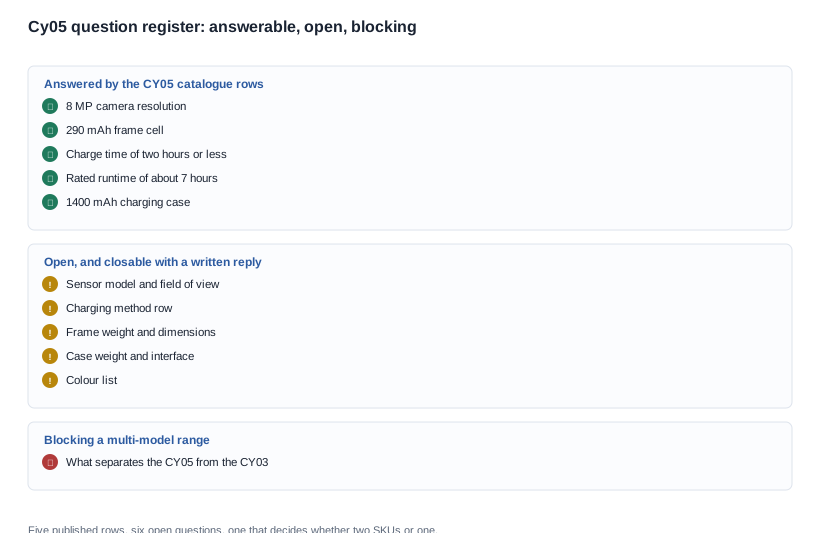
Twelve questions come up in nearly every conversation about the CY05, and the useful thing about the list is that our catalogue answers five of them outright, leaves six open to a single written request, and leaves one open that matters more than the other eleven combined. That last one — what actually separates the CY05 from the CY03 — is the question to send before anything else, because the two models publish identical specifications and a brand that orders both without an answer is buying a range it cannot explain to a customer or to a channel partner.
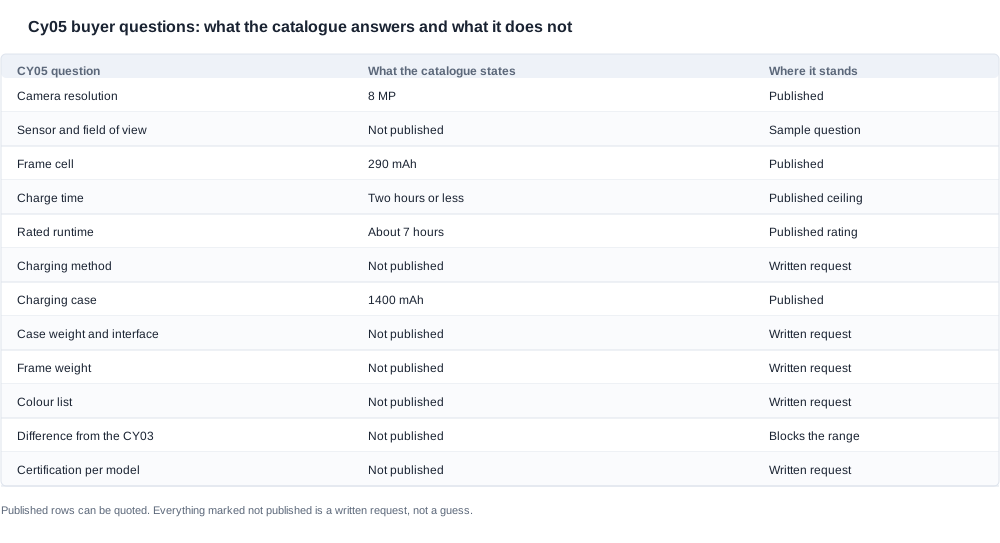
The point of this page is not to list questions a buyer ought to have thought of. It is to sort them: which ones our published documentation settles, which ones a single written request closes, which ones only a sample unit can answer, and which one is a range-structure decision that has to be taken before a purchase order is drafted rather than after it ships.
Cy05 common questions: the five answered, the six closable and the one to decide first
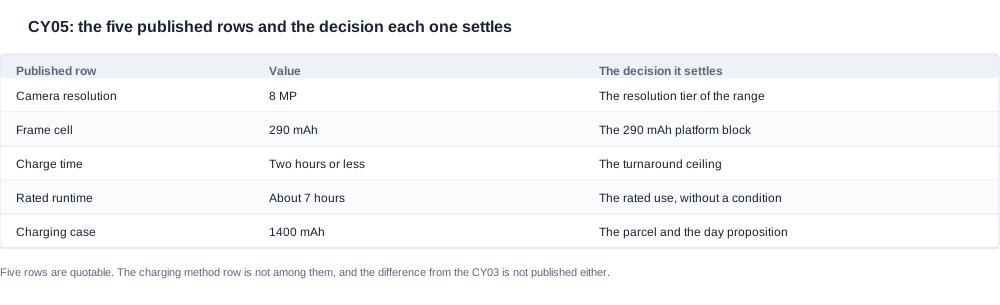
The CY05 catalogue entry carries five rows a buyer can quote without qualification: an 8-megapixel camera resolution, a 290 mAh frame cell, a charge time of two hours or less, a rated runtime of about seven hours, and a 1400 mAh charging case. That is the whole published surface for this model. Everything else a buyer normally asks — sensor, field of view, video format, frame rate, frame weight, frame dimensions, charging method, case weight, case interface, colour list, endurance test condition, storage arrangement, and the certification position for this designation in any destination market — is either absent from the catalogue or covered only by a company-level page that does not describe individual models.
Three of those published rows are structural rather than descriptive, and it is worth naming which is which before anything else on this page. The 290 mAh cell and the two-hour charge ceiling describe the power block. The 1400 mAh case describes the accessory that travels with the product. The eight megapixels describes a resolution tier. Only the first of those three tells you something about the object you are buying, and the second two together tell you something about the parcel and the retail proposition. Nothing in the published sheet describes how the camera performs, how the product looks, or how it feels in the hand.
The five questions our documentation settles without a caveat
These are the ones where we can hand a procurement manager a number rather than a request. How much is the battery? 290 mAh. How long does it take to charge? A published ceiling of two hours or less, which is a ceiling rather than a promise and should be written that way in a specification. How long does it run? A rated figure of about seven hours, published without a test condition. Is there a charging case? Yes, and its capacity is 1400 mAh. What is the camera resolution? Eight megapixels, as a resolution and not as an image quality statement.
That is genuinely more than most catalogue rows in this family give a buyer, and a buyer working from these five numbers can already scope a range structure, a case strategy and a power budget. What those five cannot do is support a product page, because the three rows that would carry a product page — how the camera performs, how the frame is built, and what the customer receives in the box — are precisely the ones that are missing.
The six questions one written request closes
The remaining open items are open in a specific way. They are not contested and they are not ambiguous; they are simply not written down in a document we can forward. That is a materially easier problem than a disagreement, because the remedy is a single message rather than a negotiation.
The six are the sensor model and field of view, the charging method row, the frame weight and dimensions, the case weight and charging interface, the colour list, and the endurance test condition behind the seven-hour figure. Each of them can be put into a message that takes a paragraph, and each of them has a verification method that does not depend on trusting a marketing document: the sensor and field of view can be checked against a sample unit's output, the charging method by looking at the port on the delivered hardware, the frame weight on a scale, the dimensions with calipers, the colour list against the colour samples supplied, and the endurance condition by running the product for a shift and logging the result.
The one question that is a decision rather than a request
The difference between the CY05 and the CY03 is not a request. It is a decision about whether your range has one line or two, and it is the only one of the twelve questions where the answer changes what you order rather than what you write on the product page.
The two models publish the same five rows — 8 MP, 290 mAh, two hours or less, about seven hours, 1400 mAh case — and our catalogue does not state what differs between them. There are three possible explanations and each one leads somewhere different: the two are the same product under two designations, in which case a second SKU is freight you are paying for; the two are the same platform with a commercial difference such as a colourway, a packing format or a supply arrangement, in which case two SKUs is legitimate merchandising; or a real specification difference exists and has not been published, in which case your differentiation is currently invisible to your customers and to your own sales team.
What the 8 MP camera row on the CY05 does and does not settle
Eight megapixels is a resolution tier, and it is the row most often over-read in this category. It settles the class of image the camera can produce and nothing else. It does not settle how large the sensor is, how much light it gathers, how wide the frame of view is, how it behaves in low light, what format the video is written in, what frame rate it records at, or where the files go and what happens when they run out.
The field of view is the omission that decides whether the product can do the thing a camera glasses product is bought for. A narrow field of view produces a first-person recording that looks at a slice of the world; a wide one captures the scene a person is actually standing in. Two products can both publish eight megapixels and differ so much in usable first-person video that they belong in different categories. Without the number, a buyer cannot tell which of those two they are ordering, and no amount of reading the resolution row will tell them.
The sensor model is the second omission, and it matters because a megapixel count is a count of pixels, not a measure of their size. Thirteen megapixels spread across small pixels can produce a worse image than eight megapixels spread across large ones. We publish eight megapixels for the CY05 because that is the row in the source, and we will not convert it into a picture quality claim, because the evidence that would let us do that is not in the document.
Why a sample unit settles this faster than any document
The camera questions are the clearest case for a sample order rather than a written request, and it is worth saying why. A written request produces a datasheet row, which is exactly the kind of evidence that produced the gap in the first place. A sample unit produces a captured file, a measured field of view and an observed low-light result, and those are the artefacts that survive into a product page without anyone having to take the supplier's word for a claim.
The practical method is short. Order one unit. Capture a still and a clip in the conditions your product brief describes — indoors under office lighting, outdoors in daylight, and indoors in the evening. Note what the frame of view feels like against the scene you need to capture. Transfer the files and observe the behaviour when storage fills, because silent recording stoppages are among the most common reasons a camera glasses unit comes back. Record what you find, and keep it with the product file. The camera imaging guidance sets out the longer test method, and the AI camera glasses buying guide covers the category-level questions a sample stage should answer before it closes.
The CY05 power block and the 1400 mAh case that ships in the box
The CY05's power block is shared, row for row, with the L2 Utral and the L1 Pro, and the CY03: a 290 mAh frame cell, a published charge ceiling of two hours or less, and a rated runtime of about seven hours. That sharing is why a multi-model camera range is affordable to qualify, and it is also why the published rows cannot tell you which of the four to order.
Two cautions belong with those rows. First, the charge time is a ceiling, so it should be written as two hours or less rather than as under two hours, because a ceiling permits exactly two hours and the stricter phrasing does not. Second, the seven-hour runtime is a rating with no published test condition, and on a product with a camera in it the camera is the dominant load. The question worth asking is not how many hours the battery holds but what was running while it was measured. The battery life analysis for the CY05 takes the figure in more detail, and the method for comparing battery life sets out what to put in writing.
The case is a product decision before it is a logistics decision
The 1400 mAh case is the largest published case capacity in the camera family, and it is roughly five times the frame cell — a derived comparison, not a published figure. A buyer should treat it as one of three things at once.
It is a retail proposition, because a case of that size is what allows a customer to buy the product for a working day rather than for an hour. It is a parcel decision, because a second lithium cell in every unit changes the packed weight, the carton, the volumetric calculation and the freight class. It is a paperwork decision, because the battery transport documentation has to cover that second cell. The charging case options analysis covers the economics of the accessory and the shipping weight breakdown covers the parcel arithmetic.
What is not published is the case's own mass, its dimensions, whether it charges over a separate cable, and how long the case itself takes to charge. Those four items decide whether the customer receives one accessory or two, and they decide the shipping weight line on your cost model. The packaging options piece covers how the presence of the case changes the pack design.
The charging method is the row most often assumed and most often wrong
Here is a point that catches buyers out regularly and is worth stating without hedging. The CY05 catalogue entry publishes five rows: pixel count, cell capacity, charge time, runtime and charging case capacity. It does not publish a charging method row. The same is true of the L1 Pro and the MT6, and the CY03. Across the twenty-eight models our catalogue publishes, seventeen carry magnetic charging, seven carry a Type-C interface, and four — the MT6 and the CY05, and the L1 Pro and the CY03 — carry no charging method row at all. The CY05 is in that last group, because the row is simply not there.
The consequence is practical rather than pedantic. If the frame charges magnetically, the box needs a dock or a pad and the customer has to learn a charging orientation; if it charges over Type-C, the customer can replace a lost cable anywhere and the parcel does not need a proprietary accessory. A buyer who assumes magnetic for the CY05 is designing an accessory chain on an assumption, and a buyer who assumes Type-C for the CY05 is designing a retail proposition on an assumption. Both are closed by one line in a written reply, which is why the charging method sits on the question list rather than in the specification.

Which CY05 question stops the order and which ones can run in parallel
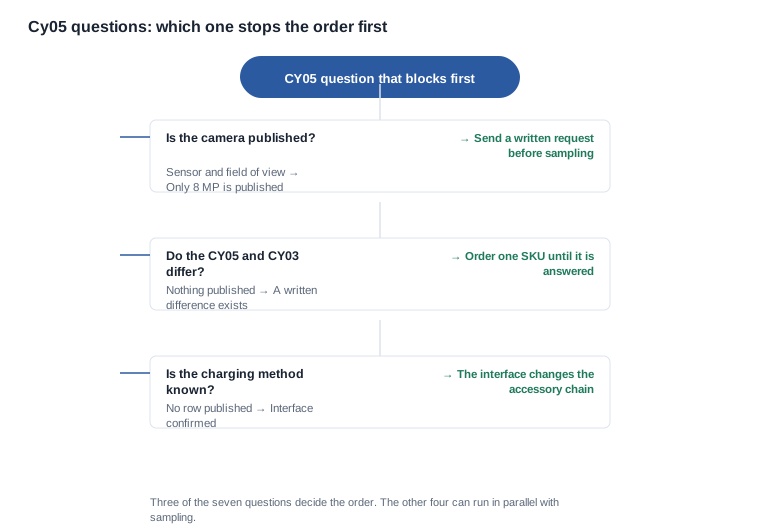
Not every open item deserves the same amount of attention before a purchase order, and a buyer who treats them as equally urgent will delay an order that could proceed. Three of the questions are genuinely on the critical path, and the rest can be handled in parallel with sampling.
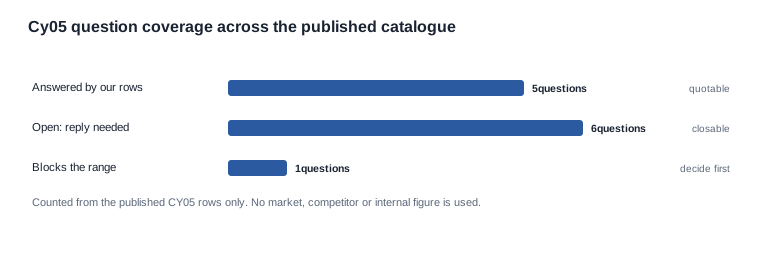
The difference from the CY03 is the critical-path item, because it determines whether the order contains one SKU or two and it determines what goes on the packaging artwork. Nothing else on the list can be closed after the artwork is committed and still have a clean outcome.
The camera specification is on the critical path if your product brief involves first-person video. If the brief is stills only, the eight-megapixel row is enough to start and the sensor question can wait for the sample stage. If the brief is video, the field of view and the storage behaviour both change the product and both need to be known before the listing copy is written.
The charging method is on the critical path for the accessory and packaging design, because the box contents and the customer instruction card both depend on it. It is also the cheapest of the three to close.
Everything else — frame weight, frame dimensions, the case interface, the colour list, the endurance condition — can run in parallel with a sample order and a quotation. None of them changes what you order, and each of them is better answered by a measurement than by a document. The CY05 buyer review checklist converts the same list into a sample-stage plan, and the charging options analysis for the CY05 handles the accessory questions separately.
Closing the CY05 questions: one request, one sample, acceptance criteria
The fastest way to close all twelve is to treat them as three different activities rather than one long correspondence. Each has a different output, a different owner and a different point at which it stops.

The written request carries the questions that a document can answer: sensor model, field of view, video format, frame rate, the charging method, the case weight, the case interface and charge time, the colour list, the frame weight and dimensions, the endurance test condition, and the difference between the CY05 and the CY03 in the supplier's own words. The important detail is to ask for answers tied to the model designation. A document that names the CY03 does not automatically cover the CY05, even where the two publish identical rows, and a request that does not specify the designation will come back with a family-level answer that does not settle anything.
The sample stage carries the questions that only measurement answers: whether the camera captures what the brief describes, what the field of view feels like in practice, whether files transfer and what happens when storage fills, how the frame sits across a size range, and how the charging routine behaves in a real shift rather than on a bench.
The purchase order carries the items that are now established. Each closed item becomes an acceptance criterion with a stated value, and each remaining open item becomes a documented exception with a named owner and a date. That last step is what stops an open question from turning into a warranty argument six months later, when nobody remembers which side of the conversation it fell on.
A worked sequence for a hypothetical buyer is worth walking through, because it is the shape most of our customers end up running. Assume a brand is planning a two-model camera line for an e-commerce channel, with the CY05 as the volume SKU and a second model still to be chosen. First, the written request goes out with every item on the request list above and a request that answers be tied to model designations. Second, while the answer is pending, one sample unit is ordered, and the sample plan covers capture, transfer, storage exhaustion, the charging routine and the case. Third, the answer arrives; if the CY05 and CY03 difference is a colourway or a packing format, the two-SKU structure is confirmed and the artwork moves forward; if the answer is that nothing differs, the buyer drops to one SKU and the cost model loses a line it was never going to earn from. Fourth, the sample results and the written answers become the acceptance criteria attached to the purchase order.
This is a hypothetical sequence rather than a client project, and it is presented that way deliberately — but the sequence itself is the reusable part, and it applies to any model in this range where the catalogue publishes rows but not the measurements behind them.
Where our CY05 documentation stops, and what we will not fill in
We publish the CY05's five rows, and we publish them as the rows they are. The eight megapixels is a resolution tier, and we will not present it as a picture quality claim, because the sensor model and field of view that would let us make that claim are not in our documentation. The about seven hours is a rated figure, and we will not present it as a working day or convert it into a shift-length promise without the test condition behind it. The two hours is a charge ceiling, and it will be written that way rather than as a stricter bound.
We also do not publish a frame weight for the CY05. The only frame weight our catalogue carries anywhere is 158 g for the MT6 glasses body — the frame itself including its battery and camera, excluding its folding charging case — and that figure belongs to that model alone. It is not a proxy for the CY05, which has a larger cell and a different case, and a buyer who treats it as one will end up with a tolerance problem at the sample stage.
On certification, our catalogue carries a company-level export certification page whose content is images rather than text, and its text contains no reference to CE, FCC or RoHS anywhere. There is no per-model certification row for the CY05 or for any other model. A certification position for this designation, in each destination market you intend to sell into, is therefore written material you have to request rather than a line you can transcribe, and it belongs in the programme plan from the beginning because it is one of the few items whose timeline you cannot compress. The certification status for the camera range sets out the route, and the export documentation checklist lists the paper that has to move with the goods.
What we will do is tell you which questions our documentation can answer and which have to be closed with the factory. The published CY05 specification list is the honest baseline for this model, the commercial case for the CY05 covers what the published rows are worth once they are in a range, and the CY05 and CY03 price positioning analysis handles the question that this page keeps returning to — what to do with two models that publish identical rows.
Related reading
- The five published rows, read one at a time — CY05 smart glasses specifications and features
- Where the CY05 sits among the other camera models — CY05 smart glasses how it compares
- The gap register for this model — CY05 smart glasses limitations
Tell us the market, the channel and the volume, and we will say which of these twelve answers our documentation gives and which have to be closed with the factory.


