

Read the catalogue page for the LC-105-1 next to the page for the K01 and the two sheets look almost interchangeable: each one prints five standard specification rows, and three of those rows carry the same text on both. Only the cell row and the radio row actually move. That is the complete published difference between the two models, and this article is organised around it, one row at a time — what each row states, what a buyer may legitimately infer from it, and what has to be requested in writing before an order is placed.
A row-by-row reading is the right instrument for this pair because a catalogue page is a list of printed values rather than a set of measurements. Every figure quoted below is the way the catalogue presents it, and the distance between a printed value and a tested value is where most sourcing disputes begin. Where two models print the same figure, that equality is a fact about the catalogue and not a measurement of the two products, and reading it as the second is the fastest route to a wrong conclusion.
The scope is deliberately narrow. Unit price, minimum order quantity, lead time, production capacity, warranty terms, certificate numbers, test report numbers, frame weight, dimensions and sensor configurations are not published for either model, so nothing here prices, ranks or recommends a purchase. What it produces instead is a shortlist rule set: which of the five published rows can filter these two models, which of them only generate a question, and which questions must be closed by documents naming the exact model string that will be received.
For the wider position of this model inside the published range, the Bluetooth audio glasses range note sets out the group view; the pages below stay at row level.
The two models and the five rows they publish
Both catalogue pages carry the same five rows in the same order: the Bluetooth version, the battery capacity, the charge time, the rated usage duration and the charging method. The LC-105-1 page adds nothing beyond those five lines, and the K01 page adds nothing beyond those five lines either. Neither page prints a feature row, which in catalogue terms means that neither page publishes an acoustic descriptor, a temple geometry claim or a control-method line.
Set the two pages beside each other and the published content reduces to this: Bluetooth V5.4 against V5.3, a cell configuration of 55mAh2 against 90mAh2, a rated use of about 8 hours on both sides, a charge time of two hours or less on both sides, and magnetic charging on both sides. Four of the five rows are identical in wording, and the fifth differs in two fields. A procurement file built on those rows is a short file, and most of the work in a comparison like this one is establishing which of the remaining rows are blank.
Those five lines are worth understanding as a documentary format rather than as marketing copy. A charge time written as two hours or less is a ceiling, and a ceiling is a different assertion from a charge that completes inside two hours, because the first permits a two-hour charge and the second does not. The same discipline applies to the rated use figure: the catalogue prints a duration and prints no starting state for the battery, no condition that ends the test, no volume level, no codec, no ambient temperature and no sample size. A row that carries no condition is a label, and two identical labels tell you that the catalogue treats two models alike rather than that the two products behave alike.
Each model has a published twin
Every model in this comparison also carries a published twin, and that is the structural reason a specification sheet alone cannot close the file. The LC-105-1 and the LC-105-2 print the same five rows, and the K01 and the K02 print the same five rows. The documentary consequence is direct: a report, a certificate or a quality record written against one member of a pair does not transfer to the other, so a procurement file that quotes a document without checking which model string that document names ends up holding paperwork that proves nothing about the unit in the carton.
The comparison against the K02 is worth reading alongside this one, since the K01 and the K02 differ nowhere at all on the published page. The K01 against the K02 specification comparison covers that pair, and the LC-105-1 against the LC-105-2 battery and charging view covers the other twin.
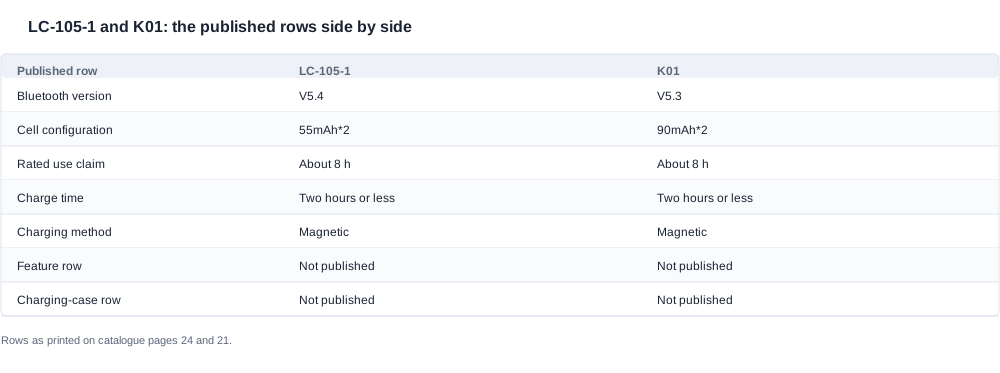
Seven rows are worth reading against each other here, and two of them the catalogue leaves without any content at all. What this table supports is filtering rather than ranking, since that is the entire reach of a published row inside a file like this one.
Rows that are not printed on either page
Two absences apply to both pages simultaneously. The eight audio models in the catalogue publish no charging-case row between them, and they publish no ingress-protection row either; the only IP54 markings in the catalogue sit on the V06 and the S7, which are camera models. Within the audio group, magnetic charging is the default and Type-C appears on the D11 and the D12 only, so an interface requirement written as Type-C removes both models in this comparison before any other row has been read.
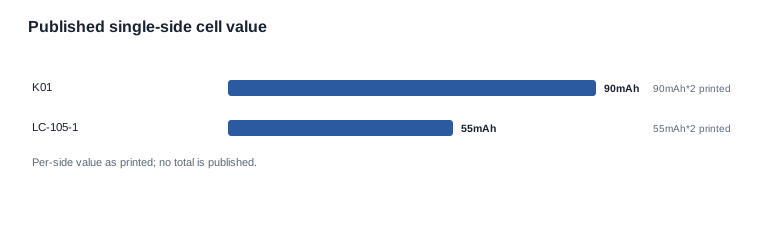
Cell capacity: 90mAh2 against 55mAh2
Of the two rows that genuinely differ, the cell row is the one that changes a purchase, so it deserves the most careful reading. Print the value the way the catalogue prints it: the LC-105-1 page shows 55mAh2 and the K01 page shows 90mAh2, a per-cell value carried together with a cell count. Any comparison sheet should therefore reproduce both parts of the notation rather than collapse it into a single capacity figure that appears in no source document and cannot be checked against one. Set side by side, the LC-105-1's published per-side value is roughly three-fifths of the K01's, and the cell count is the same on both pages. Neither page prints a total, and a total assembled by arithmetic would be a derived value rather than a published one, which is why it does not belong in a row a supplier may be asked to confirm.
What the cell row does not settle
The cell row is not a runtime ranking, and the catalogue contains the counter-example that shows why. The same 90mAh2 configuration appears on the K01 and the K02 carrying an identical rated use of about 8 hours, while the 55mAh2 configuration appears on the G07 and the YK12 with a second published claim of about 6 hours. One configuration therefore carries two different runtime claims inside the same audio group, and the catalogue attaches no condition that would explain the split. The honest reading of the cell row is that it describes the parts inside the frame, not the hours the frame delivers to a buyer.
What the cell row does settle
The cell value is a hard, checkable input, and that is why it behaves differently from the runtime row once a document set already exists. An approved bill of materials, an existing test report or a customer specification that pins the cell configuration will decide the model on its own, because it can be checked line by line against a supplier's cell list. A runtime claim cannot be checked against anything, because no condition is attached to it. So the cell row belongs to the filter stage of a procurement process and the runtime row belongs to the evidence stage, and mixing the two stages is what produces a shortlist argument that a specification sheet cannot support.
Two commercial consequences follow from the cell row. The first is weight: a larger cell usually means a heavier frame, but neither page publishes a weight or a dimension. No frame weight appears on either of these two pages, and the one weight figure the catalogue prints anywhere sits on the MT6 glasses body at 158 g, a camera product whose number cannot be carried across to the frames compared here. Parcel class, packing specification and therefore freight cost stay open for both models, and a freight estimate built on an assumed weight carries a margin of error that belongs in the quotation rather than in the comparison sheet.
The second is documentation. No battery test report number appears for any model in the catalogue, which means the cell evidence has to arrive from the supplier instead: the UN38.3 summary, how many cells sit behind each model string, which cell supplier is used, and the safety paperwork, each carrying a number rather than a description. For a buyer comparing two nearly identical sheets, that is the one place where the cell row becomes something a supplier can be held to: not hours, but paperwork that proves what is inside the frame.

The identical runtime claim and what it does not settle
Both pages print a rated use of about 8 hours, and this row is the clearest available example of a published value that carries no information for this particular pair. Read down the catalogue and six models publish that same about 8 hours claim: the LC-105-1 and the K02, and the LC-105-2 and the K01 in the audio group, and the YKC02 and the ZH12 among the sport models. They span four different cell configurations — 90mAh2, 55mAh2, 70mAh*2 and 100 mAh — and not one of the six publishes a test condition. A figure that survives unchanged across four cell configurations without a stated method is a range convention, and it behaves as a category label rather than as a specification you can compare.
The six questions a runtime figure has to answer
A duration becomes comparable only when these points are fixed, and none of them can be read out of the two catalogue pages:
- Whether either model lasts longer under the conditions a channel actually creates, since no duty cycle is published for either.
- Whether the published figure describes a single cell or the pair, which the two-cell notation leaves open.
- Which event terminated the test, since a low-voltage cutoff and a user-perceived failure are different endpoints.
- The volume level, the codec and the transport used during the run.
- The ambient temperature and the state of the battery when the timing started.
- How many units were measured and how the result was recorded.
Each of these changes what the number is worth, and a runtime figure printed without them is a claim a supplier can reproduce under settings nobody intends to ship. The correct handling of an identical row inside a shortlist is therefore procedural rather than analytical: it is a documentation item, and it should be recorded as such rather than entered into a scoring column.
Closing the row with written conditions
The request that closes this row is short and specific. Ask for the starting state of the battery, the condition that ends the test, the volume level, the codec and transport, the ambient temperature, whether the figure covers one cell or both, and the number of units measured. Ask for it per model string, because the LC-105-1 and the LC-105-2 print the same row and the K01 and the K02 print the same row, so a condition written against a twin does not describe the other model.
The charge time needs the same discipline. Two hours or less is a ceiling on both pages, and it arrives with no starting state, no termination criterion and no indication of how many cycles the cell is rated for. It cannot be converted into an interruption window for a shift, and it cannot be converted into a charging-case turnaround time either, because no audio model in the catalogue publishes a case row.
Two criteria are worth writing into the request list before any quotation arrives: every quoted runtime figure must arrive with its test conditions attached, and a quotation that omits them may be compared only against another quotation that carries the same conditions. Two quotations answering different rows cannot be compared, however similar their totals appear. The red flag in this pair is not a contradiction between the two pages — there is none — it is a comparison sheet that lists eight hours as the reason one model was preferred, since an identical row cannot be a reason.
Bluetooth version, feature rows and the blank columns
The second row that moves is the radio row, and it moves by a single version. Within the audio group two models publish V5.3, the K01 and the K02, while six publish V5.4. The LC-105-1 sits in the V5.4 group and the K01 in the V5.3 group. Nothing further about the radio is published for either of them: no range figure, no codec, no profile, no latency measurement and no power consumption, so the version is the whole of the radio evidence on both pages.
Treat that version as a compatibility input rather than as a capability claim. If a customer specification, a platform requirement or a tender document names a radio version, the row becomes a hard filter and it filters decisively: under a V5.4 requirement the LC-105-1 carries a matching published row and the K01 does not. If no document in the file names a version at all, the entry is documentation housekeeping, and it should not be recorded as an advantage for either model.
There is also a sourcing-consistency reason to hold a single radio baseline across a channel. Because the K01 already shares its printed rows with the K02, a channel that already ships a V5.3 product can keep one radio baseline inside its existing document set by staying with the K01. That is a reason to hold a configuration, not a claim that V5.3 performs better.
What the two blank feature rows withhold
Neither page prints a line beyond the five standard rows, and that is where the comparison loses its ability to separate acoustic description, temple geometry or control behaviour. No feature row appears on five of the eight audio pages — the LC-105-1 and the D12, the K02 and the K01, and the LC-105-2. Three models elsewhere in the group do publish one, and that contrast is what makes the absence visible: the D11 carries a surround-sound line and a long-battery-life line, the G07 publishes an ultra-thin detachable temple, and the YK12 publishes a surround-sound line and a slim-temple line. For the pair in this comparison there is therefore no published acoustic descriptor, no published temple geometry, no published control method and no published charge indicator, and each of those is a blank to be filled from the supplier rather than a feature to be ruled out.
The blank columns can be listed precisely:
- The feature row: no acoustic descriptor, temple geometry claim or control method is printed for either model.
- Touch control: the catalogue publishes no touch row for any model, so whether a temple carries a touch surface and how it is configured is unknown for both pages rather than known to be one kind of control or another.
- The charging-case row: no audio model in the group prints one, so whether a case forms part of the configuration and what capacity it carries remains open for both models.
- The ingress-protection row: the audio group prints none, and the catalogue marks IP54 on the V06 and the S7 only.
- Frame weight and dimensions: not published for either model, which leaves shipping class and parcel size open.
- Commercial and document rows: unit price, minimum order quantity, lead time, production capacity, warranty terms and certificate numbers are all unpublished.
A published figure and an unpublished row are different documents, and the catalogue contains examples of each. The V03 Pro simply has no charging-case row on its page, which is an absence of publication. The eight audio models simply have no case row either, which is an absence of publication too. The correct supplier wording for this pair is that the catalogue publishes no charging-case row, so the case question has to be closed in writing — not that the frames have no case.
Certification is quiet in the same way, and the quietness is verifiable in one direction: the catalogue text contains no reference to CE, FCC or RoHS, and it carries no per-model certification row. What can be written down is the framework a buyer will ask about — the Radio Equipment Directive (EU) 2014/53/EU and the EMC Directive 2014/32/EU — together with the fact that the scope for any specific model has to be confirmed in writing. A buyer who needs a mark for a channel should require the report number and the model string that the report names, since a document covering the LC-105-2 does not cover the LC-105-1. The catalogue's export certification page is image-based, so it cannot be read as per-model evidence either. The K01 certification status note covers what the record does and does not contain on that side.
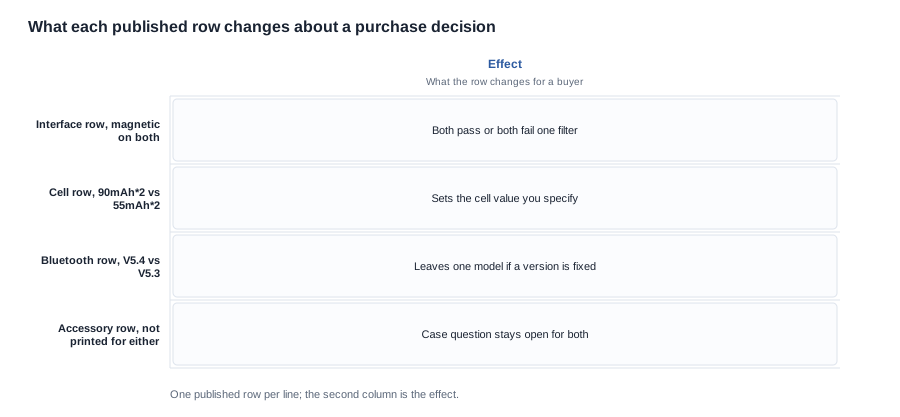
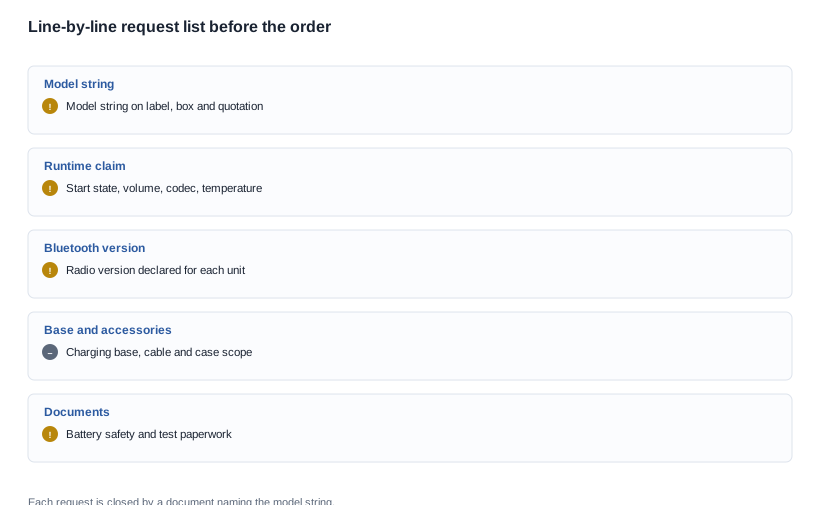
The two graphics above read the same rows in two different directions. The matrix maps each published row to the single purchase decision it can move, and the checklist groups the requests by what each one closes: the model string fixes which documents answer the question, the runtime conditions decide whether the published duration means anything, the radio version settles a compatibility filter, the base and accessory questions decide what the packaging and cable plan must carry, and the file request closes the document trail for everything else.
The LC-105-1 versus K01 spec comparison row by row
Putting the whole comparison onto one working sheet is the practical output of this exercise. The table below carries every row worth reading across the two pages, together with the effect that row has on a purchase.
| Published row | LC-105-1 | K01 | Effect on the purchase decision |
|---|---|---|---|
| Bluetooth version | V5.4 | V5.3 | Filters only when a document names a version |
| Cell configuration | 55mAh*2 | 90mAh*2 | Sets the cell value a bill of materials must match |
| Rated use claim | About 8 h | About 8 h | Carries no information for this pair |
| Charge time | Two hours or less | Two hours or less | A ceiling, not a measured duration |
| Charging method | Magnetic | Magnetic | One interface filter passes or rejects both |
| Feature row | Not published | Not published | Acoustic and temple lines stay blank |
| Charging-case row | Not published | Not published | The case question stays open for both |
| Ingress-protection row | Not published | Not published | No IP marking is published for either |
| Frame weight and dimensions | Not published | Not published | Shipping class and parcel size stay open |
| Unit price, MOQ, lead time, warranty | Not published | Not published | Only a quotation can answer these |
Two of the ten rows carry a difference, and one of those two is a difference only in the radio version number. The other eight rows are identical text, an unprinted row or an unpublished commercial field. A shortlist built on this sheet is therefore a shortlist with two filters and eight documentation items, and that is the honest shape of the comparison rather than a shortfall in it.
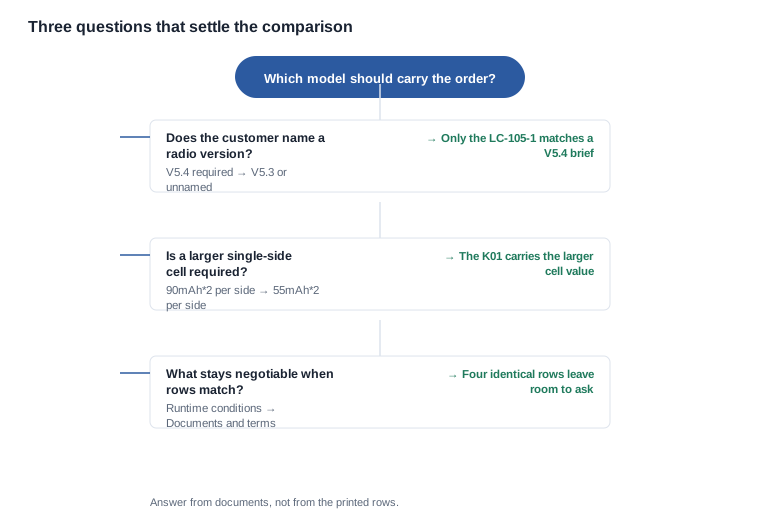
Three questions settle the pair once the rows above are on the sheet. The first is whether any document in your file names a radio version, because if it does, the published row answers it directly and the other model leaves the shortlist. The second is whether the cell configuration has already been fixed by an approved bill of materials, a test report or a customer specification, because if it has, that document decides the model and the runtime claim moves to the documentation list rather than staying a criterion. The third is what remains negotiable once four rows match, and the answer is the set of rows the catalogue leaves open: the runtime conditions, the certification scope, the charging case and accessory scope, the weight and packaging data, and the commercial terms.
Written out as instructions for whoever runs the shortlist, the sheet says:
- When a document calls for Bluetooth 5.4, only the LC-105-1 carries a published row that matches it.
- When the file calls for V5.3 or says nothing about the radio at all, both stay in the running and the version line settles nothing by itself.
- When an approved report or bill of materials already pins the cell configuration, that paper decides which model is ordered, and the runtime figure becomes a document to obtain rather than a criterion to weigh.
- If the configuration is open, do not let a per-cell value carry the weight of an endurance argument, because the catalogue prints a second runtime claim on the same configuration elsewhere in the audio group.
- If the charging method has to be Type-C for a cable plan or a packaging decision, neither model qualifies, since Type-C within the audio group appears on the D11 and the D12 only.
- If the channel needs a charging case or an ingress marking, both models carry the same open question, because the audio group publishes neither row.
- If the quotation is going to carry a certification claim, ask for the report number and for the model string that the report names, since a report covering a twin does not cover the model in the carton.
Read as one comparison sheet rather than as a verdict, the LC-105-1 against K01 specification comparison resolves into two filters and a documentation list. The filters are the radio version and the cell configuration, and each one applies only when a document makes it hard. The documentation list is everything the two pages either print identically or leave blank altogether: the runtime test conditions, the certification scope, the charging case, the accessories, the weight and packaging data, and the commercial terms. Send the two model strings you are holding and the rows you need closed before the order, and we will mark each one as either answered by the published specification or open for the supplier to document.
Related reading
- The same K01 set against its published twin — K01 versus K02 specification comparison
- A third audio model in the same row set — G07 versus K01 specification comparison
- The battery and charging view for the other half of this pair — LC-105-1 versus LC-105-2 battery and charging
- The review list a buyer works through before placing the order — K01 buyer review checklist
- What the documentation record does and does not cover — K01 certification status
Send the two model strings and the published rows you need answered before the order, and we will tell you which of them the catalogue settles and which have to come back from the supplier in writing.


