

MT5 smart glasses vs L2 Utral form factor is decided by one row each: the MT5 publishes magnetic charging, and the L2 Utral publishes a Type-C charging interface. That single difference propagates into the accessory in the box, the carton, the freight class, the customer experience on the first day and the number of packaging variants a channel has to manage. Neither model publishes a frame dimension, a weight, a temple description or a lens specification, so the form factor comparison has to be built from what the documentation does state and from what it explicitly leaves open.
This comparison also contains the only camera-model page in the catalogue that publishes two variant names and two case capacities in the same row, which makes the L2 Utral unusually useful as a reference point for anyone structuring a range.
MT5 smart glasses vs L2 Utral form factor: the interface decides the box
The MT5 interface. Magnetic charging is published as a standard row. A magnetically charging frame cannot be replenished from a wall socket on its own, so an accessory is expected in the box: a case, a pad, or both. The MT5 is documented as shipping with a case, and the capacity of that case is not published. The form factor consequence is that the box contains an accessory whose size and mass nobody has stated, and the carton cannot be finalised from the documentation.
The L2 Utral interface. The page carries a charging-interface row reading Type-C, alongside the standard rows. That means the frame can be charged directly, without a dock or a pad, which is a materially different product architecture: the carton can be small, the customer can use the product on the first day without finding an accessory, and the accessory question becomes an optional upsell rather than a requirement.
What that means commercially. A Type-C frame carries a smaller carton and a simpler in-box story. A magnetic frame carries an accessory that has to be sourced, weighed, described and stocked. Neither statement is a quality judgment; both are freight and packaging statements, and both propagate into every downstream cost.
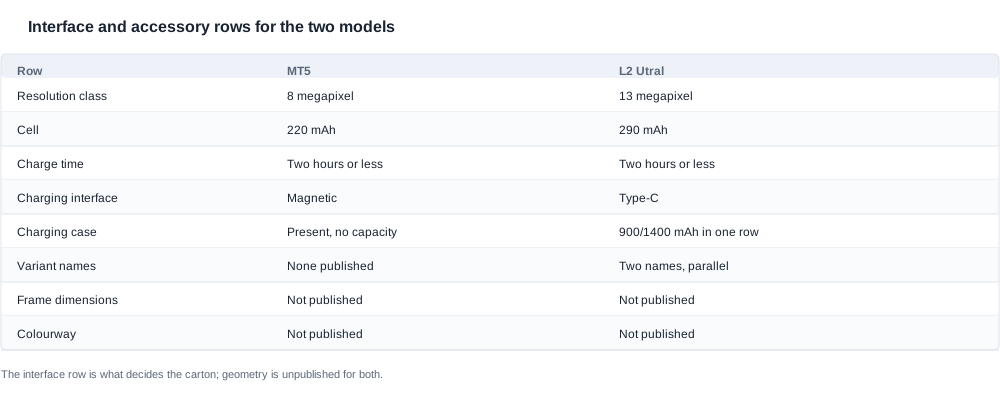
The MT5's case row and the L2 Utral's case row make the contrast sharper rather than softer. The L2 Utral publishes 900 and 1400 mAh in a single row. The MT5 publishes a case with no capacity at all. Across the eleven camera models, five print a case capacity, two are documented with a case and no capacity, and four carry no case row at all — the V06 and the V03, and the S7 and the V03 Pro. So the two models being compared here sit at opposite ends of the documentation spectrum, on the same product category, in the same catalogue.

Two variant names and two capacities, with no stated correspondence
The L2 Utral's page is worth reading closely, because it is the only camera-model page that carries a variant structure, and because the way it is written is easy to misread.
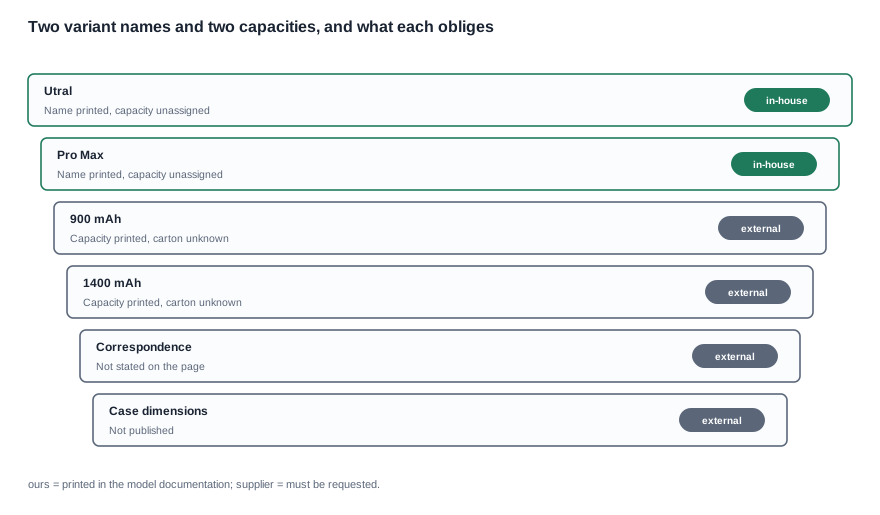
The page presents two names side by side — Utral and Pro Max — as parallel variant designations rather than as a single combined mark. The charging-case row reads 900/1400 mAh, carrying two values in one row. The documentation does not state which capacity corresponds to which name, does not state which of the two is the base configuration, and does not state whether the two are alternatives within one order or separate orderable items.
Three errors follow from that structure, and all three appear in buying conversations:
- Reading the two names as one designation, "Utral Pro Max", which is a single product that does not exist as described on the page.
- Assigning 900 mAh to one name and 1400 mAh to the other, which the documentation never states.
- Treating the two capacities as a base and an upgrade, which implies a price ladder that is not published anywhere.
What the documentation supports is narrower: this page offers two named configurations and two case capacities, and the correspondence between them is not stated. That is enough to plan a range with two configurations. It is not enough to write two product pages, because a product page requires knowing which configuration it describes.
This matters for form factor specifically, because the two capacities almost certainly imply different cartons — a 900 mAh case and a 1400 mAh case are not the same physical object — and the catalogue publishes no dimension, weight or volume for either. A buyer planning two configurations of the same model is planning two packaging SKUs, two sets of artwork, two stock keeping units and two smaller production runs, on the basis of two numbers whose relationship to the two names is undocumented.
The AI camera glasses packaging options piece covers how a two-configuration choice propagates through artwork, cartons and freight, and the AI camera glasses which model to pick overview places this model against the rest of the camera group. The honest reading of the L2 Utral's variant structure is a question to ask rather than a conclusion to draw.

What neither model publishes about its frame
Form factor comparisons normally rest on dimensions, and this catalogue publishes none of them for either model. No frame length, no lens width, no bridge, no temple length, no weight — with one exception that belongs to a different model entirely and cannot be borrowed — and no material description.
The same absence applies to the things a form factor comparison usually turns on. Neither model publishes a lens specification, a lens tint, a photochromic capability, a polarisation, a temple articulation or a hinge. Neither publishes anything about how the frame is adjusted. Neither publishes a colourway: across the whole camera group, only two models print colour rows at all, and the MT5 and the L2 Utral are not among them.
Two consequences follow, and both are worth stating before anyone builds a comparison page around shape.
First, no dimension claim can be made about either model by anyone. If a channel wants to publish a size or a fit-related statement, that has to come from a supplier measurement, and it should arrive with a method attached — measured across which points, on how many samples, in which production batch. A dimension without a method is a drawing, not a measurement.
Second, the term form factor is doing narrower work in this comparison than it usually does. What is being compared here is the charging architecture and the accessory structure, which the documentation does publish, rather than the physical geometry, which it does not. A comparison page that presents these two models as though their shapes were established would be asserting something the source cannot support, and it would be asserting it in the one place where a customer is most likely to test it by putting the product on a face.

Turning the interface difference into a packaging decision
For a buyer, the useful output of this comparison is a packaging decision tree rather than a shape description.
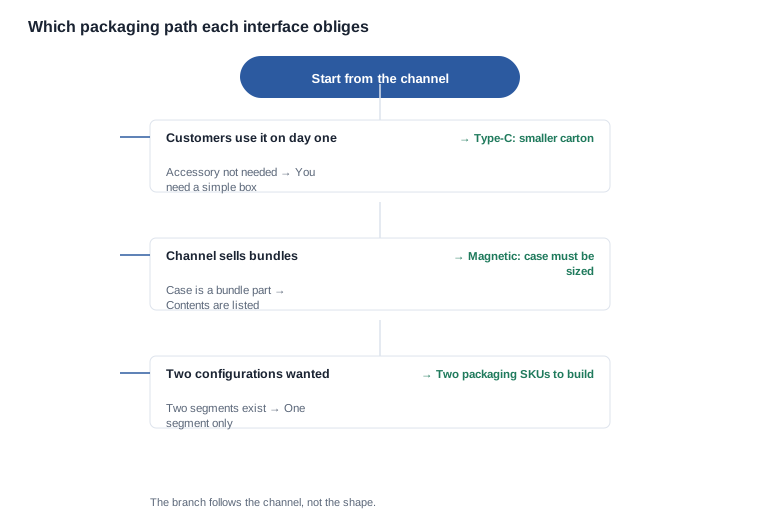
If your channel serves customers who want to use the product immediately. The Type-C architecture is structurally simpler: no accessory is required in the box, the carton is smaller, and there is no in-box item whose specification you cannot describe. That is a real advantage for a channel that competes on readiness rather than on bundle value.
If your channel sells bundles. Then the magnetic architecture may be preferable, because a case is a bundle component rather than a box contents, and a case that cannot be described is a liability inside a bundle where the contents are usually listed individually. This is the trade-off to negotiate deliberately: the MT5's unsized case is a disadvantage if the case is in the box and a disadvantage inside a bundle, and it is only neutral if the case turns out to be worth selling separately once its capacity is known.
If your channel is managing two configurations of one model. The L2 Utral's two variant names and two case capacities create a structure the MT5 does not have. That structure is useful for covering two price points from one platform, and costly in packaging SKUs, artwork, stock and production runs. Whether it is worth it depends entirely on whether you have two distinct customer segments to serve, and not on the numbers themselves.
If your channel ships in volume. Then the accessory decision is a freight decision. A case in every unit is a second lithium cell in every unit, which affects the parcel, the documentation and the transport classification. The AI camera glasses charging case options piece covers the accessory economics across the range, and the shipping weight breakdown covers how the parcel arithmetic resolves once a packed unit has been weighed on a calibrated scale. Neither of those calculations can be completed for the MT5 today, because the case is unsized.
The request set that closes the form factor question
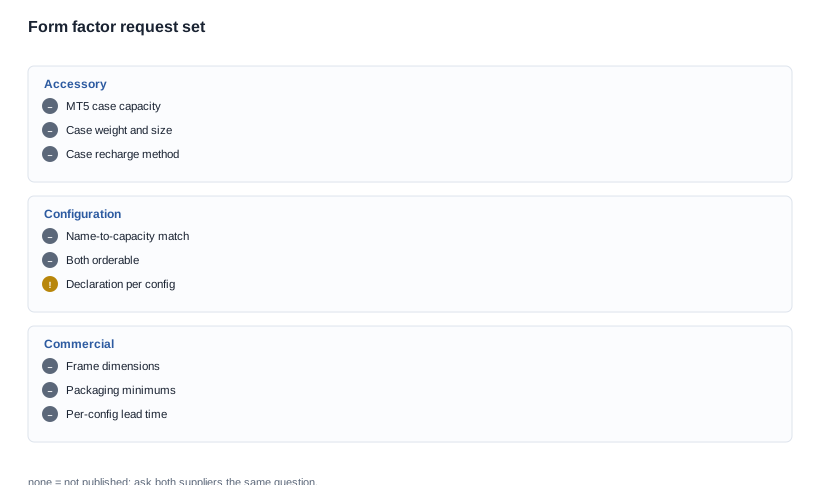
Six questions, asked of both suppliers in the same words, convert this comparison into something a packaging team can act on. Ordered by how much each answer changes the outcome:
- What is the MT5's case capacity, and what are the case weight and external dimensions? Three figures in one request, because all three are missing and all three block the carton.
- Which L2 Utral variant name corresponds to which case capacity? Asked as a direct question rather than inferred. If the correspondence is not defined, ask whether both configurations are orderable and what the order reference is for each.
- What ships in the box with each model? Specifically: does the MT5 ship with a case only, a case and a pad, or a pad with a case available separately; and does the L2 Utral ship with anything beyond the frame.
- What does each case do — recharge the frame, or hold a spare cell? Unpublished for every case in this catalogue, and it determines whether a case-based endurance claim is available at all.
- What are the frame dimensions, and by what method were they measured? Points of measurement, sample size and production batch. A dimension without a method cannot be published responsibly.
- What are the minimum order quantity, lead time, sample policy and packaging minimums for each configuration? None of this is published. On a two-configuration model, each of these may apply per configuration rather than per model, which changes the effective minimum order quantity — a point worth raising explicitly rather than assuming.
Add a seventh item if the channel publishes online: ask whether the configuration and its case capacity will appear in the structured product data rather than only in a PDF. A value that travels with the unit can be checked at receiving; a value that exists only in a document is checked by a person, if at all.
How to evaluate what comes back
A specification request produces responses in four shapes, and only one of them closes an item. A closed answer carries a number, a unit, a test condition and a document reference. A partial answer carries a number and a unit without a condition, which can still be written into a specification if the assumption appears on the face of it. A referred answer points at a distributor listing, a web page or a neighbouring model, which resolves nothing because it cannot be traced back to the model in the purchase order. A restated answer repeats the question back, and the right response is to ask again, more narrowly.
The criteria for sorting a response into one of those four shapes come down to six questions: does it name a measurement, under what condition, by what method, with what tolerance, where is the evidence, and does the evidence name this model or this configuration. Applied to every answer on the list above, those six questions separate a specification from a sales reply without requiring any judgement call.
Three answers on this list are especially likely to arrive in the weak form, and each should be treated as open until the strong form arrives. The case capacity tends to arrive as an approximation rather than a figure. The variant-to-capacity correspondence tends to arrive as an inference — someone will have decided which name goes with which number, and the answer will sound confident. The frame dimensions tend to arrive as a drawing measurement without a method, which is fine internally and unusable on a public page.
Where the commercial terms come from the same organisation as the specification, that is worth noticing. A supplier that quotes minimum order quantity, lead time, sample policy, payment terms and warranty alongside the technical reply is telling you how it operates. A trading company that returns only a datasheet is telling you that the specification annex will have to be negotiated rather than issued, and that negotiation should be scheduled rather than discovered.
Risk, trade-offs and where the decision actually lands
Three risks are specific to comparing these two models, and each is cheap to close before an order and expensive to close after one.
A carton that is finalised around an unsized accessory. The MT5's case has no published capacity, so its weight and volume are unknown, so the carton cannot be finalised. If artwork is produced before a weighed sample arrives, the correction is a reprint. The criteria are simple and should be applied as a rule rather than a preference: no carton artwork is released while a component that ships inside it is unsized.
A two-configuration model treated as one. The L2 Utral offers two names and two capacities with no stated correspondence. A range that assumes a base and an upgrade configuration will eventually stock the wrong pairing, and the error surfaces as a customer who received a different case from the one described. The remedy is to require an order reference per configuration from the supplier before either is listed, and to keep that reference on the purchase order line rather than in a spreadsheet.
A dimension claim without a method. If any part of the channel's material asserts a size, a weight or a fit-related property for either model, that assertion has to come from a measured figure with a stated method. The documentation publishes none for these two models, and the only weight published anywhere in the catalogue belongs to a different model and cannot be transferred.
The trade-offs to negotiate deliberately are these. A supplier who will not print a case capacity may still commit to one contractually, and a contractual commitment is worth more than a published figure for planning purposes because it carries a remedy. A supplier who cannot commit to a packed unit weight can usually commit to a tolerance band. A supplier with no runtime protocol can usually run one on sample units and supply the result. Each is a smaller ask than a public specification change, and each closes the same gap for the same buyer.
The decision this comparison asks for is narrower than it first appears. If your channel needs a small carton and an in-box product the customer can use immediately, the interface difference alone points toward the Type-C architecture. If your channel sells bundles and you intend to list the case contents individually, the unsized case is a problem to close first. If you are managing two price points from one platform, the L2 Utral's variant structure gives you a documented way to do that, provided you establish which capacity goes with which name before you list anything. None of these is a recommendation to buy one model over the other; each is the condition under which one architecture suits a channel better than the other.
One closing piece of practical advice, because form factor decisions are usually made under packaging pressure rather than procurement pressure. Write the carton decision down as a decision, with the reason, the date and the person who made it, and attach the reason to the artwork file. Six months later, when someone asks why one model's carton is larger than the other with a smaller cell, the answer will be on the record rather than reconstructed. The same applies to any assumption carried into production: an assumption with an owner and a date is manageable, and an assumption without either becomes permanent within a single production cycle.
On compliance, the position is the same for both models and is worth stating once. The catalogue holds one export certification page, scoped to the company, and it carries ten patent certificates — eight appearance designs alongside two utility models — with no per-model certification row anywhere. For European Union buyers, the instrument on the buyer side that covers radio equipment is the Radio Equipment Directive (EU) 2014/53/EU; the electromagnetic compatibility directive (EU) 2014/32/EU is a separate requirement and is frequently confused with it. Because the L2 Utral ships in two configurations, ask explicitly whether the declaration covers both configuration references, and check that whatever arrives names the configuration rather than only the model. The published L2 Utral specification list, the L2 Utral battery analysis and the MT5 published baseline are the honest starting sheets for both sides of this comparison.
We will publish the interface rows, the cell values, the charge ceilings, the runtime figures and the case rows exactly as they appear, and we will not extend them into a claim about shape, weight, image quality or cost. The boundary here is a clean one. What the documentation settles is the interface difference, the case-capacity difference and the variant structure. What it does not settle is anything about the physical geometry of either frame, anything about endurance, and anything about cost. A comparison built on those three settled rows is defensible; one built on shape, weight or image quality is not, and the documentation makes that limit unusually easy to state in advance.


