

MT6 smart glasses vs L2 Utral is usually framed as a question about size and weight, and it is worth saying plainly that neither model publishes the dimensions you would need to answer a size question. What the catalogue does publish is a set of structural facts that behave like form-factor information once you read them properly: one model carries a case described as foldable and ultralight, and it is the only page in the camera range that does; the other publishes two variant names and two case capacities without saying which capacity belongs to which name. Neither model publishes a bare frame weight, a temple length, a lens width or a nose bridge figure. This piece works through what the published rows support, what they leave open, and how to structure a comparison when one model's page is structurally richer than the other's.
MT6 smart glasses vs L2 Utral: what form factor actually resolves to
In this catalogue, form factor is documented through four kinds of published fact: whether a model carries a charging case, what the case capacity is, whether the case construction is described, and whether a weight appears. Everything else about physical geometry is unpublished. That is an unusual position for a buyer to be in, and it changes what a useful comparison looks like.
Take the first question. Both models carry a case, and both publish a capacity for it — the MT6 at 1200 mAh with a foldable case, the L2 Utral at two published values, 900 mAh and 1400 mAh, in a single row. So neither model is a no-case product, and the case is not the axis on which they diverge.
Take the construction question. The MT6 page lists portability, ultralight construction and a foldable charging case among its feature descriptors. That is the only camera model page in the range whose case is described as foldable, which makes the fold a structural fact about this model rather than a marketing adjective. The L2 Utral page carries a different kind of descriptor: two variant names, and a charging over Type-C interface row. Neither of those is a geometry fact.
Take the weight question. The MT6 publishes 158 grams. This is the only weight figure anywhere in the catalogue, and its scope is specific — it is the weight of the eyewear body, including the 265 mAh cell and the camera, and excluding the foldable charging case, whose weight is not published. No model in the range publishes a bare frame weight. The L2 Utral publishes no weight of any kind. So the comparison runs in one direction only: one model can support a weight claim, and no comparison against it can currently be constructed from published data.
Take the camera question, because it belongs in a form-factor discussion more often than buyers expect. The MT6 publishes an eight megapixel camera; the L2 Utral publishes thirteen megapixel. Those are the two resolution classes across the eleven camera models — eight models at eight megapixel, three at thirteen. A higher resolution class changes the size and heat profile of the imaging module, and heat has a direct effect on how long a device can run, which is a form-factor problem wearing a battery costume. Neither model publishes the sensor model, so the thermal consequence cannot be quantified from the catalogue.
The honest summary is that these two models differ more in documentation richness than in documented geometry, and that a buyer who wants a size comparison is going to have to measure samples rather than read pages.

Two variant names, two case capacities, no published correspondence
The L2 Utral page is structurally the most detailed of the camera pages, and it is detailed in a way that creates a specific trap.
The page gives two names side by side. They appear as two parallel names in the published text, not as one combined designation. A reader skimming quickly will tend to fuse them into a single longer model name, and a buyer writing a purchase order will then order something that does not exist as named. The safe handling is to refer to them as the two names the page gives, and to describe the model as the L2 Utral while noting that the page also carries a second name.
The same page gives two case capacities in one row: 900 mAh and 1400 mAh. What it does not do is state which of the two names corresponds to which capacity, or which of the two is the base configuration. That correspondence is simply not published, and it is a commercial question rather than a technical one, because it determines what a buyer is ordering when they choose a name on a purchase order.
This is the only camera model page in the range that publishes two case capacities, and it is also the only one that carries variant names at all. That makes it genuinely useful as a precedent when you are building a variant-handling procedure for a range, and it makes it a live risk when you are building a product data feed from it.
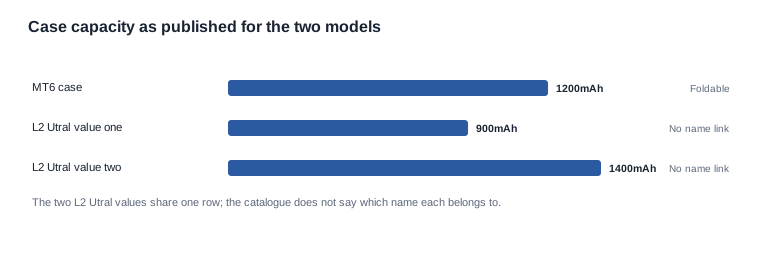
The operational consequence is a rule rather than a paragraph. Any product data record, ERP entry or channel listing built from this page should carry the case capacity as a multi-valued field on the model, with the correspondence to the variant name left explicitly unresolved rather than inferred. The moment someone fills that field in by assumption, a customer ordering the lower-capacity configuration receives the higher-capacity one and the margin assumption behind the price breaks. The catalogue's silence is the correct input to your data model, and reproducing it faithfully is cheaper than correcting it later.
There is a second-order point here. The two capacities describe two different parcels. A 900 mAh case and a 1400 mAh case differ in lithium content and in physical bulk, which affects freight, storage and any regulatory handling attached to the shipped configuration. Neither the dimensions nor the weight of either case is published, so the parcel difference can be described but not calculated. Anything that depends on the calculation — a retailer's shipping tier, a courier's volumetric rate, a warehouse slot — has to be built on measured figures from a sample, or left open.
The published rows for this model are set out in the L2 Utral specification list, and the pre-order checks in the L2 Utral what to check before ordering note cover the same ground from a buying-sequence angle. How case choices behave across the wider camera range is covered in the AI camera glasses charging case options piece.
The charging row: an unpublished interface beside a published one
The charging comparison between these two models is asymmetric, and the asymmetry runs in the opposite direction to what most buyers assume.
The L2 Utral page publishes a charging interface row reading Type-C. That is a documented fact. The MT6 page publishes the cell, the endurance figure, the charge time and a foldable case capacity, and carries no charging method or charging interface row. Across the eleven camera models, four — the CY05 and the L1 Pro, and the MT6 and the CY03 — sit in that unpublished state.
The correct reading is not that the MT6 charges one way and the L2 Utral another. It is that one interface is documented and the other is not, which means the MT6 carries an open question where the L2 Utral does not. For a buyer assembling a service or spare-unit workflow, that difference is worth something concrete: one model can have a documented charging dock and cable named in a repair procedure today, while the other cannot.
There is a second consequence, which is the one that catches procurement teams out. Because a Type-C interface is a standard one, the L2 Utral's charging story is inferable in a way the MT6's is not — a technician will assume the tooling exists. That assumption is reasonable enough that it will not get flagged in review, and it is exactly the kind of undocumented assumption that surfaces after a first production run, when a warehouse discovers that the dock they ordered does not fit the product they received.
On charge time, both models publish the same figure, and it is an upper bound rather than a measured value. Two hours or less allows exactly two hours. Neither page states the state of charge the figure assumes at the start, or the criterion that declares the charge complete, and neither page states how the case itself refills. Those omissions limit what the charge-time row can be used for. It cannot be turned into a shift-length claim, and it cannot be used as a case turnaround figure.
Foldability, hinge risk and the parcel arithmetic
The MT6's foldable case is the one structural feature in this comparison that carries an engineering consequence rather than a convenience one, and it deserves a place in a supplier conversation rather than only in a product description.
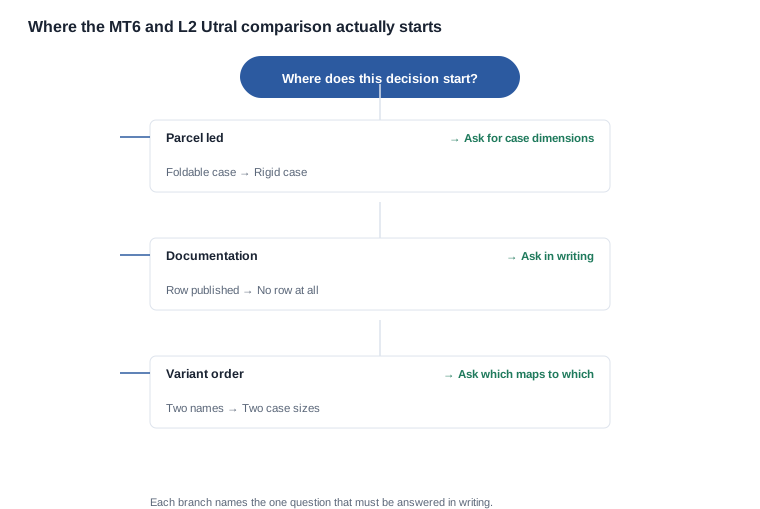
A fold introduces a hinge, and a hinge is both a wear path and a failure mode in transit that a rigid case simply does not carry. In volume distribution this matters in a specific way: the failure does not appear at the factory gate, it appears in transit or in the customer's pocket, and by then the unit is in a returns workflow that is expensive per event. A buyer who is comparing a folding case against a rigid one should therefore ask for the hinge cycle figure — a number of open-close cycles, or a drop and transit standard — rather than accepting a durability adjective. If the supplier cannot produce a figure, that is itself an answer, and it belongs in the evaluation record.
The packing consequence runs the other way. A folding case reduces the volume of the parcel, and volume is what a channel pays freight on when the chargeable weight is volumetric. So the same feature that creates the hinge question reduces the freight bill. Neither direction cancels the other, and a buyer who only counts the freight saving has taken half the trade-off.
The MT6's 158 grams covers the eyewear body. The case that fold contains is a separate 1200 mAh cell, and its weight is not published, which means the packed unit weight for the MT6 cannot be calculated from the catalogue either. The L2 Utral publishes no weight at all, at either level. So on weight, the comparison is one-sided and incomplete at the same time: one figure exists and covers only part of the parcel, and the other model offers nothing.
That is the situation the parcel arithmetic in the AI camera glasses shipping weight note is written for. Its general conclusion is the one that applies here — freight and storage planning for this range runs on measured unit weights, not on catalogue figures, because too few catalogue figures exist.
Building a comparison when one page publishes more than the other
Comparisons between models with unequal documentation fail in a predictable way: the richer page gets treated as the better product. A two-name variant row, a published interface and two case capacities create an impression of depth that is easy to read as engineering maturity, and it is not evidence of that at all. It is evidence about how much a page contains.
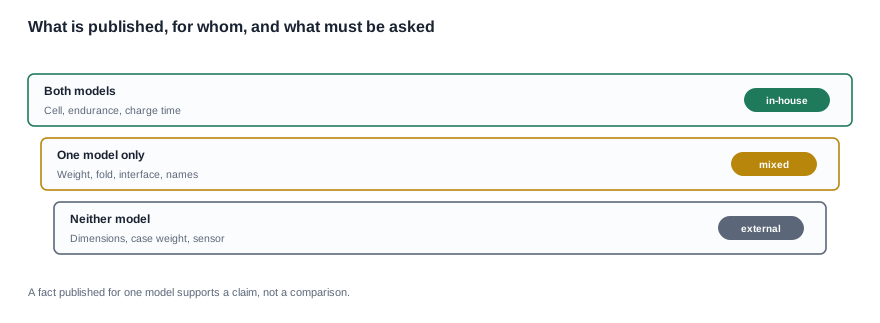
The way to keep the comparison honest is to separate three columns before anyone starts arguing about which model is better. The first column is what is published for both models and therefore comparable — in this case, that is the roughly seven hour endurance figure and the two-hours-or-less charge time, and on both models the camera resolution class, which differs and is comparable. The second column is what is published for only one model, which supports a claim for that model and no comparison — the 158 gram figure, the foldable case construction, the Type-C interface row, the two variant names. The third column is what is published for neither model, and it is the longest: dimensions, frame geometry, bare frame weight, case weight, sensor model, field of view, frame rate, Bluetooth version, and per-model certification.
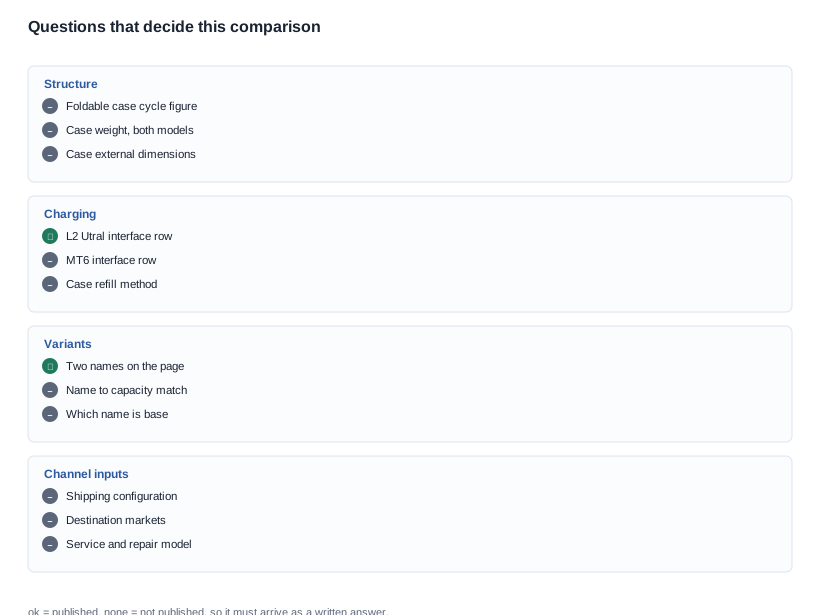
A finding in the second column is an asymmetry, not a verdict. When you take that asymmetry into a commercial model, the useful move is to convert it into a risk line. The MT6's foldable case becomes a transit-return exposure until a hinge figure arrives. The L2 Utral's two unlinked capacities become a data-integrity exposure until the correspondence arrives. The MT6's missing interface row becomes a service-tooling exposure until the interface arrives. Three exposures, each with a named owner and a date, are far easier to manage than a vague sense that one model is more finished than the other.
The same discipline applies to what the catalogue does not say about compliance. There is no per-model certification row anywhere in this range, and the catalogue text names no conformity framework. Its export certification page sits at company level, and what it holds is pictures rather than typed words, carrying ten patent certificates — eight of them appearance designs, two of them utility models — which speaks to intellectual property rather than market access. For either model, a per-model conformity position in a destination market is written material to request, and a brand owner who assumes one exists because a certification page exists in the same document will discover the gap at customs rather than at a factory audit.
The published rows for the MT6 are collected in the MT6 specification list, the constraints of this particular model are treated in the MT6 limitations note, and its position against the wider range is in the MT6 how it compares piece.
Narrowing the choice with four inputs the buyer supplies
Because the catalogue cannot close this comparison, the buyer has to supply the inputs that make it decidable. Four of them do most of the work, and each converts an open question into a measurable one.
The shipping configuration you will actually order decides whether the case is even in the box for your channel. A channel that ships frames only and sells cases separately treats case capacity as a range-level question; a channel that ships the case in the box treats it as a per-model question and moves it to the front of the comparison.
The destinations on your compliance map decide whether the missing per-model certification documentation is a launch blocker or a background item. It is a blocker anywhere the product cannot be sold without a conformity file, and it is a background item nowhere. This catalogue gives you no help on that question, so the answer has to come from your own regulatory scope.
The service model you intend to run decides how much the missing interface row on the MT6 costs you. If spare units are shipped pre-charged and returned unopened, the interface question is close to irrelevant. If you intend to run a repair bench, a charging dock and a cable are line items and the undocumented interface is a procurement task before it is a technical one.
The retail price band and the freight profile of the channel decide whether volumetric size or lithium content dominates the parcel decision, which in turn decides whether a folding case is an advantage or a liability. Without measured case dimensions and case weight for either model, this cannot be calculated, which is why a sample measurement is usually cheaper than a longer email exchange.
Give those four answers to a supplier and the comparison becomes tractable. Leave them unstated and the comparison stays anchored on the two rows that happen to be identical — the endurance figure and the charge time — which is the most common way a two-model evaluation stalls.
A shortlist scoring sheet you can reuse
Most teams stall on this comparison because they score the models rather than the evidence. A scoring sheet that separates the two produces a different answer, and it is reusable across every pair in this range.
Start with four criteria and give each a weight before you look at either model. The first criterion is structural risk — how many published features carry an unquantified failure path, such as a foldable case with no cycle figure. The second is documentation completeness — how many of your seven must-have answers arrived in writing before the purchase order, not after. The third is total cost exposure, meaning freight and storage driven by measured parcel figures rather than by catalogue guesses. The fourth is channel fit, which is the only criterion where your own channel knowledge should outweigh the supplier's documentation.
Against those four criteria, score each model on what the record actually supports. A model that publishes a single distinctive feature and leaves four questions open scores differently from one that publishes more rows but leaves the same four open, and the difference is not visible anywhere except on a sheet like this. When the totals are close, that is a signal to negotiate for information rather than to pick on instinct — ask for the missing figures, put a date on them, and re-run the sheet before you commit.
Three red flags deserve a defined response before they appear in a quotation. A supplier who fuses the two L2 Utral names into a single designation is transcribing rather than reading, which means other rows may be wrong in the same way. A supplier who states the MT6's charging interface without qualification is filling a catalogue gap with an assumption, and that assumption is untestable. A supplier who offers a certification statement at company level when you have asked a per-model question has answered a different question, because a company-level page and a per-model conformity file are not the same document.
Keep the sheet with the quotation file rather than in an email thread. When the first bulk order ships and something turns out to be misaligned — a variant name on the box, a case that does not match the ordered capacity, an interface nobody documented — the sheet is what lets you identify which criterion failed, which criterion was overweighted, and whether the supplier's answer or your weighting was wrong. Without it, the same decision gets re-run from scratch with the same missing information.
Related reading
- The published rows for each model — MT6 specifications and features and L2 Utral specifications and features
- Case economics across the range — AI camera glasses charging case options
- Parcel planning — AI camera glasses shipping weight
- Where this model sits — MT6 smart glasses how it compares
Send us the shipping configuration, the destination markets and the service model you plan to run, and we will tell you which of these open questions have to be closed before this comparison is decidable and which of them can safely wait until after the first sample order.


