

MT6 smart glasses vs V03 is a comparison between two models that sit in the same resolution tier and behave very differently in the documentation. Both publish an eight megapixel camera and both publish a charge time of two hours or less. Beyond that, one model publishes a charging interface, a case capacity, a foldable case construction and the only weight figure in the catalogue, while the other publishes a charging interface and stops there. This is a spec comparison, so the useful version of it is not a verdict — it is an accurate account of which rows exist for each model, which rows are missing, and what a missing row is allowed to mean. That distinction is the whole subject of this piece.
MT6 smart glasses vs V03: same tier, different documentation states
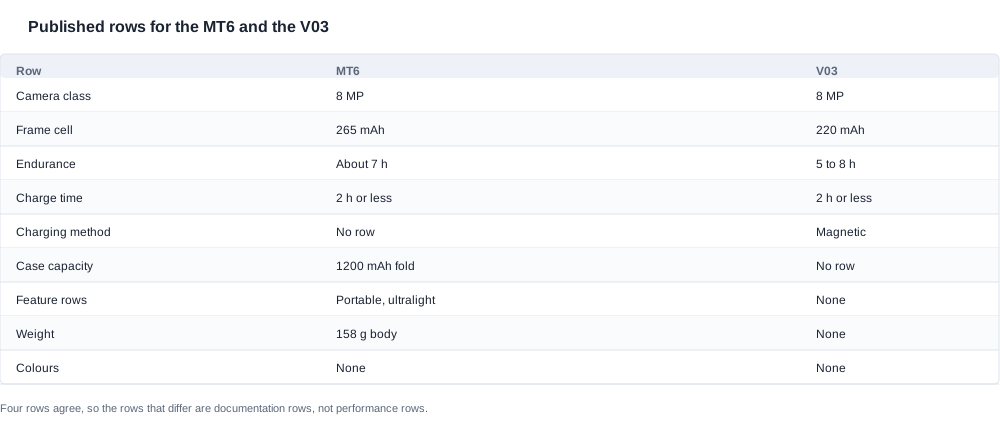
Set the two pages side by side and the first thing you see is how little separates them on the headline rows. The camera class is identical. The charge time is identical. The frame cells sit in the same range at 265 mAh and 220 mAh. The endurance rows read about seven hours on one page and five to eight hours on the other, which look like neighbours until you notice they are different kinds of claim.
What separates the two pages is not the size of the numbers. It is the number of rows each page carries.
The MT6 page publishes the frame cell, the endurance figure, the charge time, a foldable case capacity, and a feature set covering portability, ultralight construction and the fold. It also publishes a weight — 158 grams, for the eyewear body including the cell and the camera and excluding the foldable case. That figure is the only weight anywhere in this catalogue. The same page carries no charging method or interface row.
The V03 page publishes the frame cell, an endurance figure, a charge time, and a charging method recorded as magnetic. It publishes no case row at all. It carries no feature rows. It publishes no weight. It publishes no colours.
So the pattern is not that one model is better specified. It is that the two pages were assembled to different depths, and a spec comparison that treats a longer page as a stronger product will draw the wrong conclusion. The MT6's extra rows give you more to work with; they do not tell you the MT6 outperforms the V03, because on the rows they share, they do not differ at all.
Reading an unpublished row correctly: three kinds of silence
Most spec comparison errors in this range come from treating absence as a single thing. It is not. There are at least three distinct kinds of silence in a catalogue, and each one licenses a different conclusion.
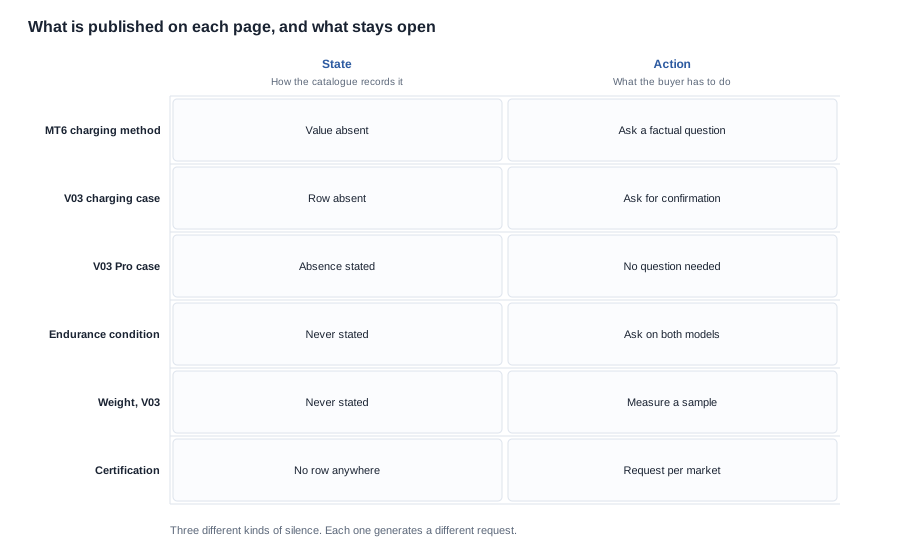
The first kind is a row that exists in the table structure but carries no value. The MT6's charging method is in this category. Across the eleven camera models, four — the MT6, the CY05 and the L1 Pro, and the CY03 — publish their cell, endurance, charge time and case capacity but carry no charging method or interface row at all. Nothing is claimed and nothing is denied. The only correct statement is that the interface has to come from the supplier as a factual question.
The second kind is a row that simply is not present on the page. The V03's charging case sits here: the catalogue publishes no charging-case row for the V03, the V06 or the S7. This is an unpopulated slot. It does not mean the product has no case, and it does not mean it has one. It means the page does not address it.
The third kind is a row that records an absence explicitly. The V03 Pro is published without a charging case, and that is a documented decision rather than a gap. Only one camera model is in this category.
The reason this matters is that the three states produce different procurement actions. An unpublished row needs a question. A missing row needs a confirmation request. An explicitly published absence needs no question at all — you already have the answer, and the work moves on to the configuration and the parcel. Teams that collapse these three states into "not published" end up asking questions whose answers they already hold, and, worse, they sometimes record the answer to one question as if it applied to another.
The endurance label difference that breaks spreadsheet extraction
The endurance comparison deserves a section of its own, because the two pages label that row differently and the difference is invisible until an extraction script meets it.
The MT6 carries about seven hours on a row labelled as endurance. The V03 carries five to eight hours — and the word used to introduce that duration on the V03's page is the same word other pages in this range use for charge time. The V03 page also carries a separate charging-time row, which is where its two hours-or-less figure sits. The same pattern appears on two other camera pages, the KY06 and the MT5.
In plain terms: the duration labelled as charge time on one page is the duration labelled as endurance on another, and both pages also carry a real charge-time row. If your evaluation sheet is populated by reading labels positionally, this comparison will import a charge-time value into an endurance column and an endurance value into a charge-time column, and the resulting table will look entirely plausible.
There is a second issue with this particular pair, which is the difference between a range and a point. Five to eight hours is a range with a lower bound and an upper bound; about seven hours is a point estimate. A range is a weaker claim because it accommodates more variation, and a point estimate reads as though it came from a defined condition. Neither page states the condition. No duty profile, starting state of charge, ambient temperature or unit count is published for either model, so the two figures cannot be reconciled from the catalogue — not because they conflict, but because they are not commensurable.
The handling that survives review is to record both figures with their original wording, record the label each came from, and mark the test condition as an open item in both rows. Comparing endurance across this range in more depth is covered in the AI camera glasses battery comparison, and the general method for keeping endurance figures comparable is treated in the battery life comparison method note.

A spec grid you can paste into an evaluation sheet
The grid below is arranged so that each row states what the catalogue publishes and what it does not, rather than what the buyer would like it to publish. Columns that would normally carry a verdict are replaced by the action the row generates.
| Row | MT6 | V03 | Action the row generates |
|---|---|---|---|
| Camera class | 8 MP | 8 MP | None, the rows agree |
| Frame cell | 265 mAh | 220 mAh | Record only |
| Endurance | About 7 h | 5 to 8 h | Ask the test condition |
| Charge time | 2 h or less | 2 h or less | Record as an upper bound |
| Charging method | No row | Magnetic | Ask the MT6 interface |
| Charging case | 1200 mAh, foldable | No row | Confirm case presence |
| Feature rows | Portable, ultralight, fold | None on the page | Ask for detail |
| Weight | 158 g, body only | Not published | Measure both, packed |
| Colours | Not published | Not published | Ask only if you merchandise |
| Bluetooth | Not published | Not published | Ask, if the channel needs it |
| Certification | No per-model row | No per-model row | Request per market |
Two observations follow from the shape of the grid. The rows that are identical are the rows that decide nothing, which is why this comparison cannot be settled on specifications. And the rows that differ are rows about documentation, not about performance — one page is more fully recorded than the other.
The published rows for each model are collected in the MT6 specification list and the V03 specification list. Where the MT6 sits against the wider range is covered in the MT6 how it compares note, and the neighbouring photochromic model is in the V03 Pro specification list.
Where this pair sits against the wider camera range
Because both models sit in the eight megapixel class, it is worth stating how much of the range they represent and where their neighbours are, so that a buyer who needs a different camera class is not delayed by this comparison.
Of the eleven camera models, eight are published in the eight megapixel class and three in the thirteen megapixel class. The eight megapixel group includes the V06 and the KY06, the MT6 and the V03, the CY05 and the CY03, and the MT5 and the V03 Pro. The thirteen megapixel group includes the L2 Utral and the S7, and the L1 Pro. If your requirement is a resolution class rather than a specific model, this pair is a comparison inside the larger group and the range-level view is the relevant one.
Within the camera range, the charging method splits into three states: magnetic on five pages, Type-C on two pages, and unpublished on four. The V03 is in the magnetic group. The MT6 is in the unpublished group. That is the single most useful thing this comparison tells you about accessory planning, because one model can have a documented charging dock named in a service procedure today and the other cannot.
The case data splits three ways, and it is worth restating because it is the most frequently miscounted fact in this range: five models publish a case capacity, two are described with a case whose capacity is not published, and four have no case row at all — the V06 and the V03, and the V03 Pro and the S7. The MT6 is in the first group. The V03 is in the third. If you are counting models for a retail bundle plan, those groups have to be counted separately, because they imply different things about what is in the box.
The selection question that follows from a range-level view is handled in the who needs V03 smart glasses piece, which works from the published structure rather than from a ranked recommendation, because this catalogue publishes no prices, no price tiers and no line-up ranking.
Acceptance steps: what to do with the answers once they arrive
Collecting answers is the easy half. The half that decides whether the comparison changes anything is what happens to them afterwards, and the sequence matters more than most teams expect.
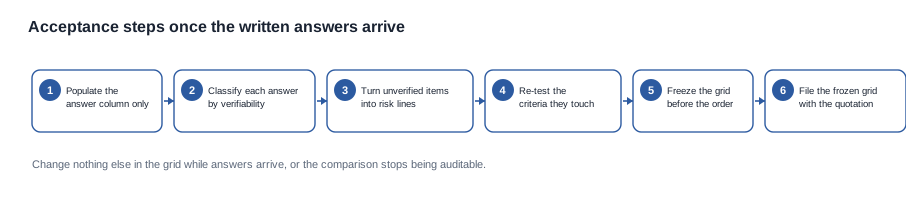
Step one: re-run the grid with the answer column populated, and change nothing else. Resist the temptation to adjust other rows while you are in there. A comparison that silently edits the camera class or the charge-time row while new information arrives is no longer a spec comparison, and nobody will be able to reconstruct what the evidence actually said.
Step two: classify each answer by quality, not by presence. An answer can be present and useless — a supplier who says the interface is standard, without naming it, has confirmed your assumption rather than your requirement. The useful classification is whether the answer is verifiable, meaning someone in your organisation could check it against a sample or a document. Sort the answers into verifiable, plausible and unverified, and treat the last two as still open.
Step three: convert every unverified answer into a risk line with an owner. The MT6's missing interface row, the V03's unpopulated case row, the unstated endurance condition on both — each becomes a line in a risk register with a named owner and a date. A risk register is a small document and it is the only artefact that survives a change of supplier contact.
Step four: re-test the criteria that the answers touch. If the endurance condition comes back identical for both models, the endurance row returns to the grid as comparable and can be weighted properly. If it comes back different, the row is dropped from the comparison entirely and the decision moves to the case, the interface and the measured parcel figures. Either outcome is useful; the mistake is leaving the row in the grid in an unresolved state.
Step five: freeze the comparison before the purchase order is raised. The purpose of freezing is not bureaucracy. It is that a quotation received after the answers arrive is often a different commercial offer, and without a frozen grid you cannot tell whether you are negotiating on price or quietly re-selecting on new information. Keep the frozen grid with the quotation file.
That sequence is what turns a spec comparison into a procurement decision, and it applies to every pair in this range where the published rows overlap.
Grouping the open rows by who can actually close them
A grid with eleven rows and eight open questions is unwieldy, and the fastest way to make it usable is to stop treating it as a specification exercise and start treating it as a supplier request. Every open row belongs to exactly one of four groups, and each group has a different owner and a different deadline.
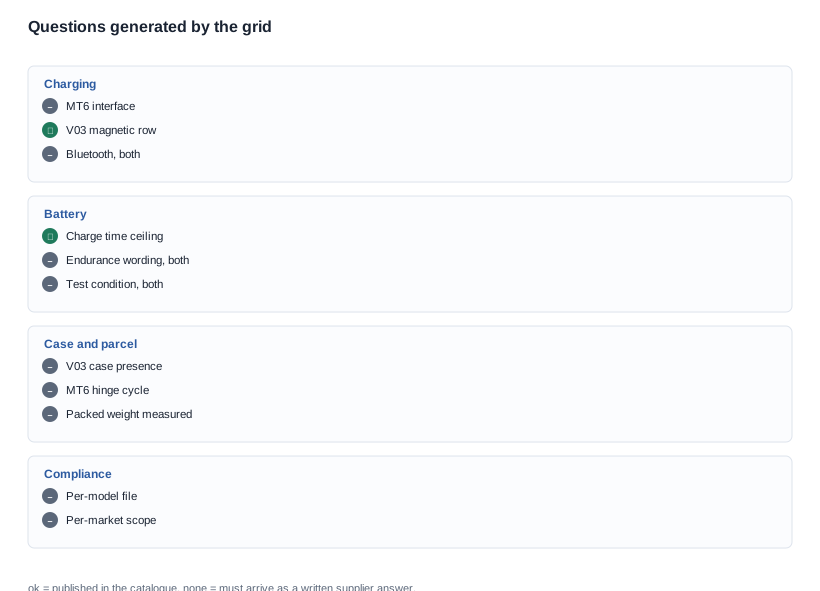
The supplier group covers everything the catalogue simply does not carry: the MT6's charging interface, the case presence on the V03, the endurance test condition on both models, the Bluetooth position, the touch configuration and the fold cycle figure. These share one property — they are answered by a person with access to the engineering file, and they cost nothing but a well-formed question. Put them in a single request, ask for written replies, and set a single date. Splitting them across three emails over six weeks reliably produces three partial answers.
The measurement group covers the packed unit weight and packed volume for both models in your shipping configuration, and any case dimensions you need for freight modelling. These cannot be answered from a document at all; they require a sample unit and a scale. The procurement criteria here are simple: decide whether the answer is worth a sample order on its own or only as part of a broader sample programme, and put the weighing protocol in writing before the unit arrives, because a measurement taken without a stated method is not comparable with the next one.
The regulatory group covers per-model certification documentation for each destination market. This catalogue publishes no per-model certification row, and its text contains no reference to CE, FCC or RoHS anywhere, so there is nothing in the documentation to interpret. The due diligence step is therefore not interpretation but procurement: identify the conformity files each market requires, request them per model, and record a clear answer for every model and market pair. Where a file cannot be produced, that is a decision to negotiate on before the bulk order rather than a surprise to absorb at the first inspection.
The internal group covers what only your organisation can settle: whether the channel needs colour variants, whether the retail story depends on a reserve battery, and whether the freight profile makes volumetric weight dominant. These rows have no external answer, and leaving them open is how a comparison stalls for a month while everyone waits for a supplier reply that was never the blocker.
How to evaluate a response when it comes back is the part teams skip. The criteria are verifiability, specificity and consistency with the published pages. An answer that contradicts a catalogue row is the most valuable one you can receive, because it tells you the documentation you are relying on is not the documentation you will be supplied, and that discovery is far cheaper during due diligence than after a shipment has landed.
Closing the gaps before you order
The grid generates a short list of questions, and the list is shorter than it looks because most rows generate the same question in different words.
- The MT6's charging interface. A single row, a single answer, and it determines whether you can write a service procedure today.
- The endurance test condition for both models, asked identically: duty profile, starting state, ambient temperature, unit count. Ask for the wording of the endurance row as well, so the label difference is documented rather than assumed.
- Case presence on the V03. The catalogue publishes no case row for it, so ask whether the configuration you would receive includes a case, and at what capacity if so.
- Measured packed unit weight and volume for both, in your shipping configuration. The published 158 grams covers the MT6 eyewear body only and excludes its foldable case, whose weight is not published.
- Whether the MT6's fold carries a cycle figure. A fold introduces a wear path that a rigid case does not have.
- Bluetooth version for both. None of the eleven camera models publishes one.
- Touch configuration for both. No model in the catalogue publishes a touch row at all.
- Per-model certification documentation for each destination market. There is no per-model certification row anywhere in this catalogue, and its text contains no reference to CE, FCC or RoHS. The export certification page is a company-level page of images showing ten patent certificates — eight appearance-design patents and two utility-model patents — which is an intellectual property statement rather than a market access statement.
Once those answers exist, the comparison stops being a reading exercise and becomes a commercial one: you can weigh a documented interface and a fold against an unpopulated case row, using figures that describe the products rather than the pages. Until then, the honest summary is that these two models are equal on every row that is published for both, and unequal only in how much each page records.
Related reading
- Published rows — MT6 specifications and features and V03 specifications and features
- Range-level battery grid — AI camera glasses battery comparison
- Range position — MT6 smart glasses how it compares
Send us the destination markets and the packaging configuration you need, and we will tell you which rows on this grid have to be closed by written answer before either model goes anywhere near a purchase order.


