

Confidentiality in an ODM programme has a specific shape that general guidance on non-disclosure agreements does not capture, because the shape is determined by what is genuinely sensitive in this product category. That is not a formula and it is not a recipe. It is the industrial design, the firmware and the application, the commercial terms, and the certification position — and those four behave differently from each other in ways that matter.
The practical consequence is that an agreement drafted around "all information disclosed in connection with the programme" tends to protect the first two and leave the third and fourth badly exposed, or protects the fourth so thoroughly that the buyer cannot run its own compliance file. Both outcomes are common, and both are avoidable at drafting time for the cost of one conversation.
Our published position shows what is at stake on our side. The published customisation record is counted per tier instead of published as a single list — seven entries in the camera tier, five in the audio tier, five in the sport tier, two in the children's tier — and it reaches the industrial design and the software together, which is to say the design and the software are the commercially sensitive material. The question worth putting to a supplier is which of those recorded entries an agreement would actually reach. The published colour options are three for the V03 Pro and four for the V06. On the certification side, no CE, FCC or RoHS text appears for the adult models and no certificate number is published for them, while the children's models carry no certification position published to us — which makes that document set simultaneously sensitive and something the buyer cannot sell without.
So odm development confidentiality is not a question about signing something. It is a question about which of these four categories the agreement actually reaches, and how long it lasts after the product is in the field.
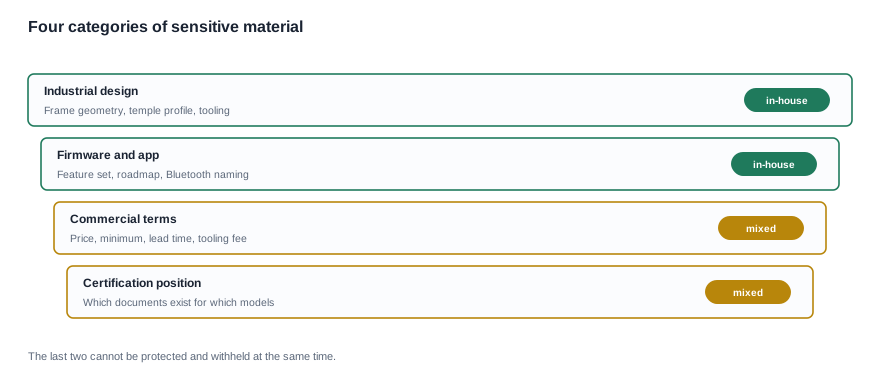
odm development confidentiality: four categories that behave differently
1. The industrial design. Frame geometry, temple profile, colourways, tooling. This is the most straightforwardly protectable in principle and the most straightforwardly breached in practice, because the design has to be seen by the tooling supplier, the painting line, the packaging supplier and the quality team. An agreement that binds only the two signing companies stops exactly where the information moves, and the information moves constantly.
2. The firmware and the application. The feature set, the roadmap, the feature decisions, the Bluetooth naming. Our published position is that which models are supported, whether processing happens on the device or in a service, whether a subscription is required and where data is stored are all Not published — which is precisely why they are the material a brand would not want a competitor to hold. The category is also the one with the longest life, because a firmware branch keeps producing sensitive detail long after the hardware programme closes.
3. The commercial terms. Unit prices, minimum order quantities, lead times, tooling charges. All Not published on our side and confirmed per enquiry, which is exactly the kind of information an agreement exists to cover. This is the easiest category to protect and the easiest to leak, because it travels verbally through every negotiation and is frequently repeated by a buyer's own commercial team to subcontractors who are not bound by anything.
4. The certification position. Which documents exist, for which models, on which model list. This is unusual because it is both sensitive and necessary. A buyer cannot import, list or defend a product without seeing the model list on the document, so an agreement that protects this material without releasing it to the buyer is a clause that will be broken within weeks — and a broken clause is worse than no clause, because it establishes that the agreement can be set aside.
The two rows at the bottom of that table are the ones worth dwelling on. A model list on a certificate and the certificate numbers themselves cannot be protected, because the whole point of them is that the buyer holds them and shows them. An experienced buyer will not accept an agreement that restricts this, and an inexperienced one sometimes does and then discovers the problem at customs clearance.
There is a further asymmetry in this category that general non-disclosure guidance rarely addresses, because it is created by the fact that the product is genuinely novel. A brand approaching an ODM with a fresh industrial design is describing something the supplier has not seen before, and that asymmetry works in the brand's favour for roughly as long as the design stays novel. Once the design language appears in a competitor's catalogue, the supplier's exposure has changed completely, because the supplier now has the earlier version and the buyer has the later one.
What this means practically is that the strongest protection for an industrial design in this category is not a confidentiality clause at all. It is speed: get to tooling, get to market, and accept that the design will be identifiable within a year or two. Clauses do not slow that down, and a supplier who suggests otherwise is either inexperienced or proposing something they cannot deliver. The clause is still worth signing — it covers the window between disclosure and launch, which is exactly the window in which a competing brand can order tooling from the same shop — but it should be presented for what it is.
The second asymmetry is the application side, and it cuts the other way. Firmware and application source do not become unnovel in the same way, because the code remains different even when the industrial design has been copied. That is what makes the second category the one worth protecting most rigorously and for longest, and it is also the category most often left out of an agreement drafted by a buyer who was thinking about the shape of the product rather than the structure of the software.
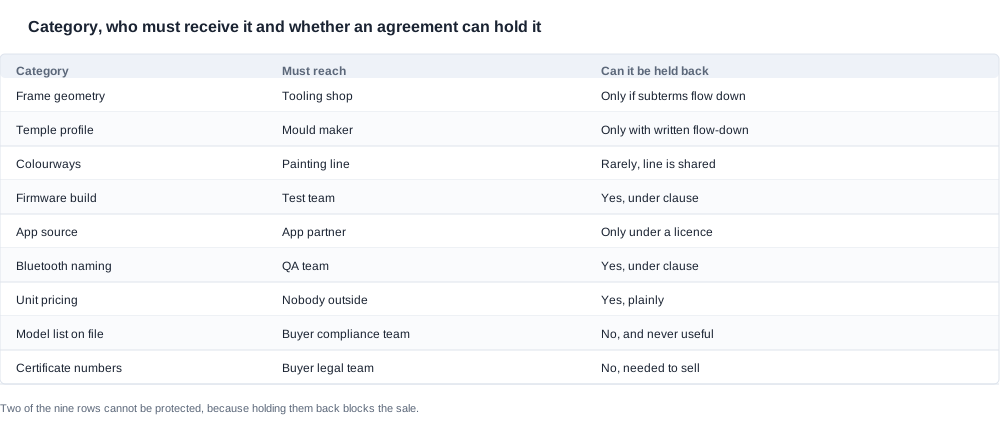

The clause that decides whether an agreement works
If you could audit one clause rather than the whole document, it should be the one dealing with permitted recipients and subcontractors. That clause determines whether the agreement has any effect in the places where exposure actually occurs, and it is usually the shortest paragraph in the document.
Whether it reaches the people who need to know. The design goes to the tooling shop. The firmware goes to the test team. The packaging artwork goes to the printer. The sample units go to a third-party laboratory. A model list goes to the buyer's legal function. Every one of those is outside the two signatories, and every one of them is a person who will see the material. An agreement that does not contemplate them is an agreement about a subset of reality.
The remedy is a flow-down obligation: the supplier binds its own subcontractors and laboratories to confidentiality terms no weaker than its own, and can show evidence that it has done so. How that evidence is produced varies — an audit right, a standard subterm sheet, a named list of approved providers — but the test is the same. You should be able to ask which providers are on the list and see the same list you would have needed before you committed.
Whether the definition is broad enough to be useful. A narrowly enumerated definition creates an argument about whether a given item was covered, and that argument happens at the worst possible moment. A broad definition with sensible and standard exclusions — already known, independently developed, lawfully received, public through no breach — is more workable in practice than a precise one, because precision invites the question "is this within scope" every single time something moves.
Whether the duration matches the life of the product. A model that stays in a range for four or five years keeps generating sensitive material long after a two-year agreement expires. The design is still on the tooling. The firmware branch is still being extended. The commercial terms are still being quoted to a distributor who is now also talking to somebody else. Confidentiality that expires with the contract leaves the most exposed period entirely uncovered.
Whether the exclusions and residuals are acceptable. The four standard exclusions are normal and should be left alone. A residuals clause, permitting the use of information retained in personnel's unaided memory, is a meaningful weakening and should be a negotiation point rather than an acceptance. In a category where the sensitive material is largely embodied in design geometry and software structure — the two things people remember most clearly — a residuals clause is close to a hole in the middle of the agreement.

That flow is the common failure sequence, and the important thing about it is that it runs entirely through entities that were never named in any clause. The discovery usually comes late — a second supplier quoting a suspiciously similar temple profile is how many programmes first learn that their tooling drawings travelled — and by then the commercial damage is difficult to prove and impossible to ignore.

A worked example: the design that left the building
A programme with a distinctive temple profile signed a two-year confidentiality agreement with one supplier. The agreement was competently drafted, broad in definition, with the standard exclusions and no residuals clause. It bound the two companies.
The design went to a tooling shop that had been approved through the buyer's own procurement process rather than through the supplier's, so it was never named in the agreement. The shop had worked on a comparable consumer product for a different brand eighteen months earlier. When a competing brand approached the shop directly for similar geometry, the shop had no obligation to decline, and did not.
Nobody in the programme did anything wrong. That is what makes it instructive. The agreement was satisfied in its own terms, the supplier had complied, and the exposure came from a party the agreement had never contemplated. The buyer's remedy against its supplier was weak, because the supplier could not have prevented what happened at a party it did not control.
The corrective action was structural and unglamorous: the programme added a provider register to the programme file, with each provider listed alongside the clause that binds it and the date the clause was signed. The register did not prevent anything by itself. It made the gap visible, and a visible gap gets closed in a way an invisible one does not.
There is a second lesson in the same case, which is about the return-and-destruction obligation. When the programme ended, copies of the design existed with the tooling shop, with the painting line, and with a quality team that had moved roles. An obligation to destroy covers documents the party holds directly; it does not reach files on a personal drive, photographs taken on a shop floor, or a CAD library nobody realised was a copy. That obligation is worth writing precisely rather than approximately, and worth asking how it will be evidenced.
The same programme also discovered, six months after signature, that the buyer had shared the design internally with a marketing agency and a localisation vendor without telling the supplier, and the supplier had shared the firmware branch with an application partner that the buyer did not know existed. Neither act was malicious. Both were ordinary commercial behaviour. What made it survivable was that neither party had behaved in a way the agreement clearly prohibited, which meant the discovery could not be escalated as a breach and had to be resolved as a change to working practice. Programmes that handle this well add an internal disclosure line to the agreement: named internal functions may receive the material, and they are told in writing what they may not do with it.
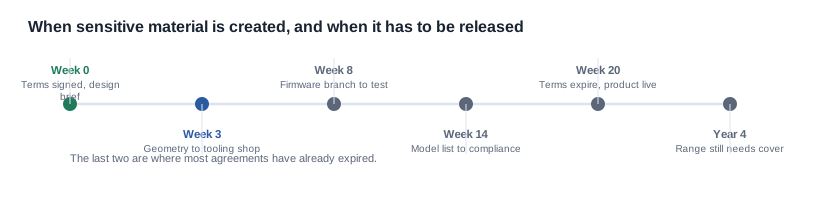
There is a third lesson about sequencing, and it is the cheapest of the three. The agreement was signed at week zero, before anything existed. By the time the design geometry was being drawn, both sides had already developed working habits around who saw what, and the agreement was fitted to those habits rather than to the programme. Signing later — once the design exists, once the provider list is real, once the laboratory is engaged — produces a shorter, more specific document that matches what actually happens. The conventional wisdom is to sign early; the practical result in this category is that signing early tends to produce a generic document, and a generic document protects very little.
That is not an argument against signing early. It is an argument for signing early and writing the provider register later, which is a two-page exercise that takes an afternoon and gives the agreement something to refer to.
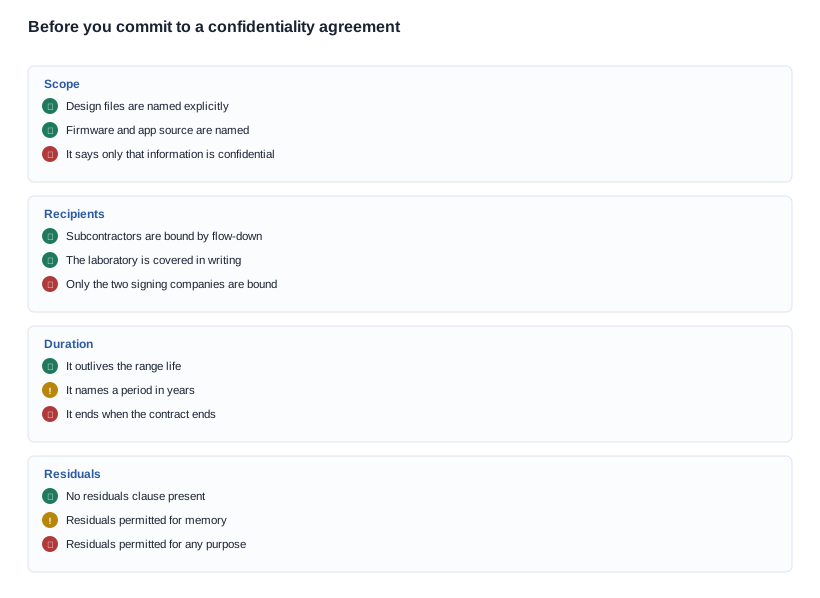
The checklist above is deliberately short, because long confidentiality checklists get completed once and then ignored. Four questions per heading is enough to catch the drafting errors that actually cause exposure, and every one of them can be answered by asking rather than by analysing.
For scope, the sharpest version of the question is: name the artefact, not the category. "Design files" is a category and produces an argument. "The CAD package, the 3D print files and the colour master files for model X" is an artefact and produces none. For recipients, the sharpest version is: list every party outside the two signatories who will touch material, including your own laboratory and your own packaging printer, and confirm each is bound. For duration, the sharpest version is: what is the expected life of the model in the range, and does the period exceed it. For residuals, the sharpest version is: delete the clause, and see what happens — the reaction is diagnostic.
A due diligence process that stops at "we have a mutual NDA" has checked the easiest item and skipped the three that determine whether it works. In practice the fastest way to tell whether a supplier takes this seriously is to send your own form and read what they redline. A supplier that returns it with the definition broadened, the subcontractors added and the duration extended is telling you something useful about how the programme will be run for the next two years. A supplier that returns it unchanged, without comment, is telling you something else.
What we can sign, and what we will not
We will sign an agreement covering a defined programme, and we will put in place the internal process that keeps the information inside the people who need it — including our subcontractors and our laboratory, which is where exposure actually happens rather than where anybody suspects it happens.
We will also say plainly what we cannot do. We cannot treat our published catalogue as confidential. What the catalogue already prints is public — the configuration set, the electrical rows, the colour options, the general technology descriptions — and an agreement asking us to treat published material as secret is signalling something about the supplier rather than about the buyer's protection. The genuinely sensitive material is the part that is not published, and an agreement should be aimed there.
We will not sign an agreement that prevents either party from describing the product in a form that can be defended in a regulatory or contractual dispute, and we will not agree to withhold documents the buyer needs for its own compliance file. Those two refusals are not stubbornness; they are recognition of the fact that a clause which will be broken inside three months transfers authority from a contract to a habit, and the buyer who discovers that mid-programme has lost more than the clause was worth.
There is also a point about ownership that gets confused with confidentiality. A design file can be confidential and still belong to you. A drawing can be protected and still be your property. The ownership discussion sets out the four artefacts and their owners, because getting this wrong is expensive and getting the confidentiality clause right does not fix it. The related protection discussion covers the other side of the same coin.
Before you commit to any agreement, the practical checklist is short: does the definition name design files, firmware and application source rather than only business discussion; are permitted recipients and the competitor carve-out what the business actually intends; is the return or destruction obligation stated and does it reach copies held by advisers; is there a residuals clause; and does the duration outlive the product. If you send your form, or tell us whether you would prefer ours, we will come back with what we can sign and the points we would want to discuss.
One closing point, because it is the one buyers ask about last and regret first. Confidentiality protects you from a supplier who competes with you. It does almost nothing about a distributor who sells your product and your competitor's, and it does nothing at all about the fact that a finished product on a shop shelf is public. Where a category has a short differentiation life and a long sales life, the commercial exposure is usually in the channel rather than in the design, and the agreement should be honest about that rather than pretending otherwise.
That observation has a corollary for the way you evaluate suppliers. A supplier who spends the first meeting discussing confidentiality is usually a supplier who has been asked about it badly by a previous buyer, and the conversation is worth having but it is not a signal of quality. The signal is what happens when you ask for something inconvenient: whether the provider register exists, whether the laboratory is covered, whether the duration was set against the range life rather than the contract life, whether the residuals clause was removed or defended. Red flags in this area are rarely obvious, and they show up as vagueness rather than as refusals.
The counter-pattern is worth naming because it is more costly. A supplier who responds to a narrow agreement by saying nothing needs changing has either not read it or has read it and does not intend to be bound by the parts that matter. Neither is a reason to walk away on its own. It is a reason to send your own form, watch which clause they redline, and judge the programme by the answer rather than by the assurance. That approach takes an hour, it is the single most diagnostic hour in a due diligence process, and it produces a better basis for a shortlist than any amount of reference-checking.
If none of that is the question you arrived with, the more common starting point is the ownership question, because in most programmes confidentiality is discussed before anyone has established who owns the tooling or the firmware — and an agreement that is perfectly drafted over material the buyer does not own is a very expensive way to protect nothing.
Related reading
Send your form or tell us whether you would prefer ours, and we will come back with what we can sign.


