

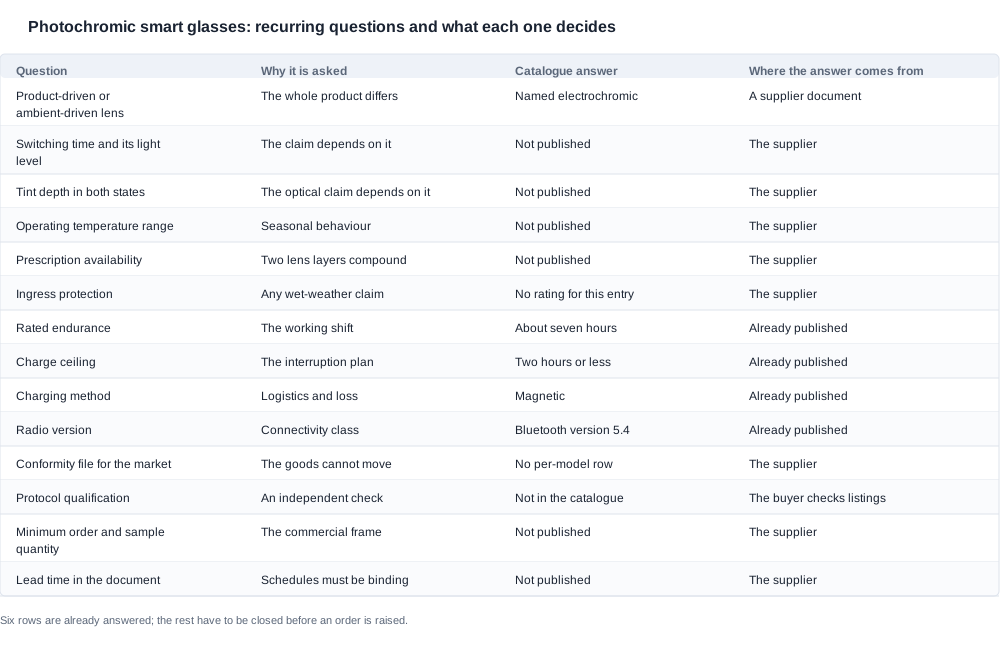
The common questions about photochromic smart glasses fall into two very different groups, and treating them the same way is what makes a buying conversation unproductive. Some of them have a published answer in our catalogue, and they should be answered in a sentence. The rest have no published answer at all, and the honest response to those is to explain what a good answer would contain and where it has to come from.
For this category the second group is the larger one. The catalogue publishes an AI electrochromic smart glasses entry with no model designation, and for that entry the record is: the cell is 100 mAh, the lead is magnetic, the charge ceiling is two hours, the rated endurance is roughly seven hours, and the radio is Bluetooth version 5.4. Nothing about the lens itself is published — no switching speed, no light level, no transmittance, no tint depth, no operating temperature range, no lens material, no weight and no ingress rating.
This article therefore organises the recurring questions by the reason they are asked, not by topic area. Every entry states what the catalogue says, what a usable answer contains, and what to do with a supplier who cannot produce one. The buying guide for this category sets out the full selection sequence, and the price comparison deals with what the commercial terms can and cannot be compared on.
Photochromic smart glasses: the questions that decide whether the order is worth raising
Before the individual questions, it is worth saying what a question is for in a procurement conversation, because the most common failure in this category is not a wrong answer. It is an answer that is technically true and commercially useless.
A question that helps a buyer is one where the answer changes a decision. It changes whether a sample order is raised, whether a market is entered, whether a listing can carry a performance statement, or what the acceptance criteria at incoming goods inspection will be. A question that does not help is one where any answer leads to the same next step, and those are the questions that consume an hour of a supplier's time and produce a warm relationship with no information in it.
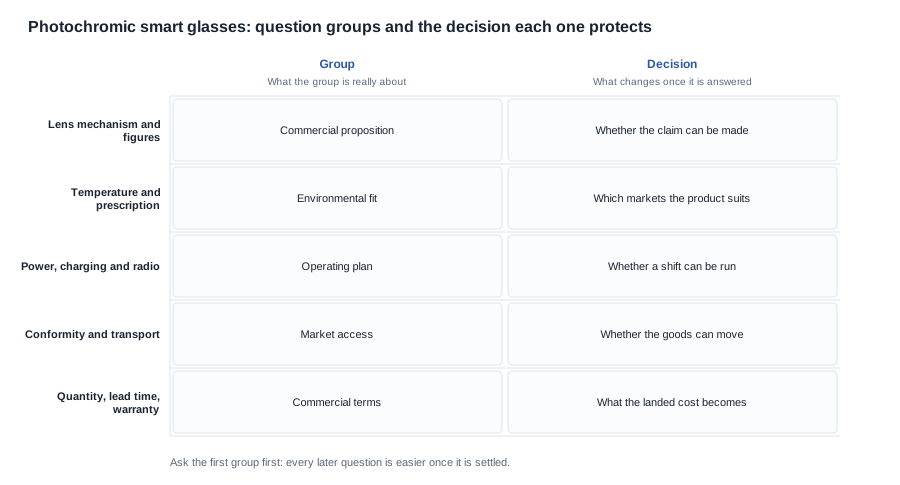
The recurring questions in this category cluster into four groups, and each group is asked for a different reason.
There is a fifth group that buyers rarely list because it does not sound like a question at all: the questions about how the answers will be recorded. Who holds the file, in what form, with what date on it, and what happens to the record when the person who collected it leaves. In a category where most of the information does not exist yet, the record is the asset. A conversation that produced a clear answer, and no answer that anybody wrote down, leaves a buyer exactly where it started the next time the same question is asked, and it usually is, because suppliers change and prices move. Writing "Not published" into your own purchase specification at the point where the supplier cannot answer is the cheapest and most durable move available, because it converts an unknown into an agreed gap that both parties have signed, rather than a private doubt that only one side knows about.
The first group is asked because the commercial proposition rests on it. These are the lens questions, and they are the ones that decide whether the product can be sold with the claim the buyer intends to make.
The second group is asked because the operational plan depends on it. These are the power and charging questions, and they are the ones that decide whether the product survives a working shift without a service interruption.
The third group is asked because the goods cannot move without them. These are the documentation questions, and they are the ones that decide whether the product can be imported and sold in a given market at all.
The fourth group is asked last and usually least carefully, and it is the group that decides the commercial terms: quantity, lead time, warranty, sample policy, packaging.
A buyer who asks the first group first, and who refuses to accept a description where a measurement is required, will spend less total time than one who works through the groups in the order they arrive in the supplier's brochure. That reordering is the main practical recommendation in this article.

What to ask about the lens, and what the answer is worth
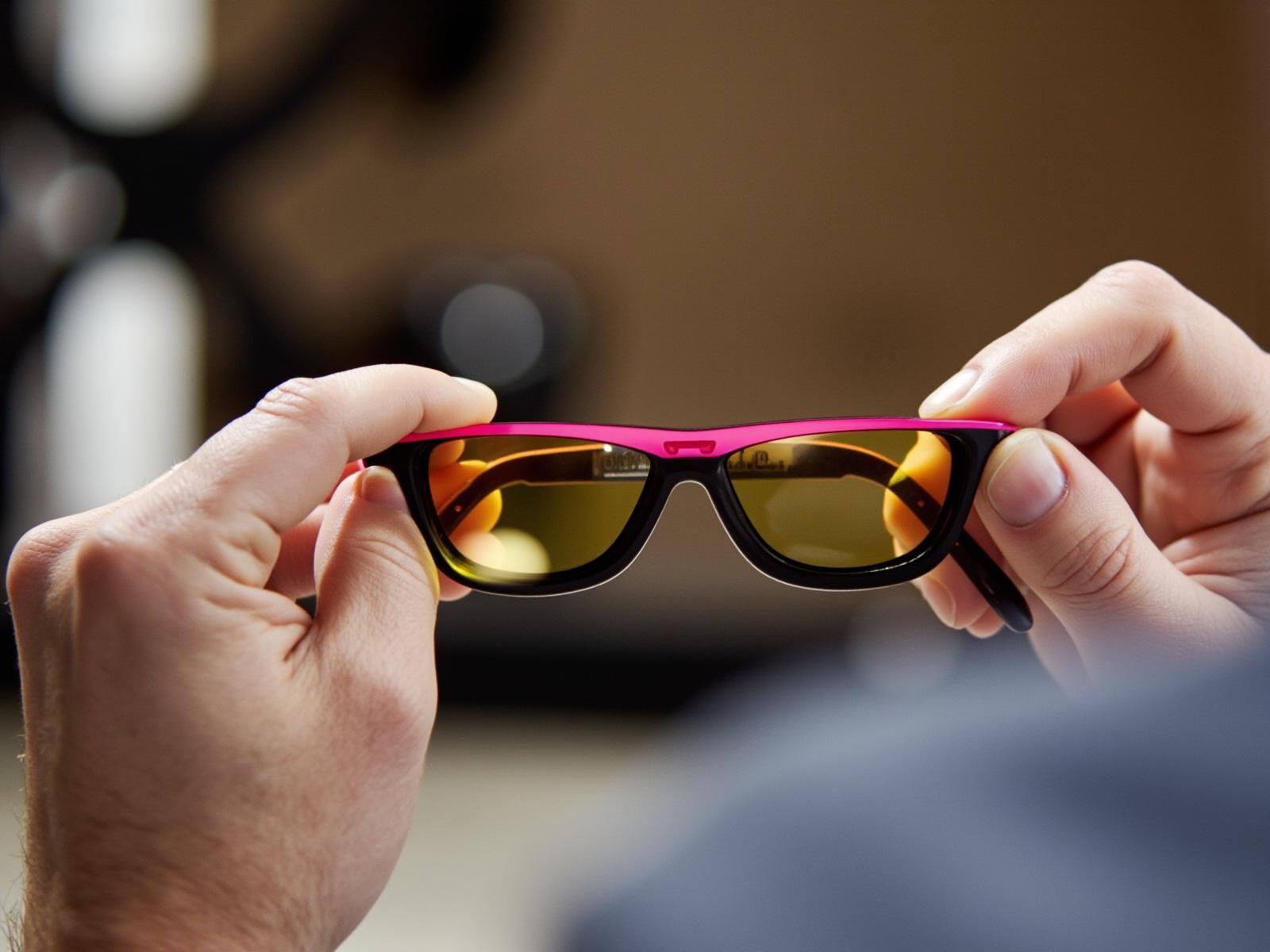
Is the lens driven by the product, or by the ambient light? The question is asked because the two mechanisms produce different products, not because the wording is ambiguous. A lens that changes in response to ambient ultraviolet is passive: it needs no power, no control path and no firmware. A lens that changes because the product commands it is an active feature that consumes charge and depends on a control path. Our own catalogue records this entry as an electrochromic line, so a supplier working from the same document should be able to produce one. An answer consisting of a photograph of a darkened lens is not an answer, and the transitions comparison explains why the same word is used for both mechanisms across the market.
It is worth being precise about what the answer should establish, because "electrochromic" alone leaves two questions open. The first is whether the lens follows the ambient condition automatically or is driven by a command, because a product that follows the environment behaves much like a passive lens from the user's point of view while remaining electrically driven in engineering terms. The second is what happens to the state when the product is switched off or runs out of charge. A buyer who knows only that the lens is electrochromic still cannot answer either, and both of them determine the questions that follow in this list.
How long does the lens take to change, and at what light level? The second half of the question is the one that matters. A transition time measured in full daylight says very little about the same lens in a vehicle, where the ultraviolet reaching the eye has been filtered by the glass. The published answer is that no switching speed is published for this entry, so the number has to come from the supplier, with its test condition attached. The response-time note covers the measurement side, and the rule to apply is simple: a time without a condition is not a specification.
How dark does the lens get, and how does it return? Two questions, two numbers, and they often move in opposite directions. A lens that darkens fast and releases slowly generates a different pattern of complaint from the opposite behaviour, and the clearing behaviour is the one that matters in the environments where the product is hardest to use. The catalogue publishes no tint depth for this entry, and a description such as deep or pleasant cannot be put on a purchase order, so the tint-depth note sets out what a re-orderable description has to contain.
Does the product behave differently in extreme temperatures? Asked because a lens specified for a temperate climate is a different product in a northern winter, and because the buyer usually learns about this after the first season rather than before it. No operating temperature range is published for this entry, and the mechanism involved is covered in the temperature note.
Can the same lens be supplied with a prescription? The honest answer is that the catalogue does not publish a prescription option for this entry, and the question is worth asking precisely because the two problems compound: a prescription is a lens specification, and so is the tint. The prescription lens options article sets out how the two layers interact and which of them a buyer has to specify separately.
Is the product protected against water and sweat? Nothing in the published record covers exposure to water or sweat for this entry. The rating that does exist in the range belongs to the V06 and the S7, so any splash-proof wording in a listing would be unsupported. A supplier who answers with a rating has answered about a different product, and a listing that carries a splash-proof claim is a claim the documentation does not support.
What to ask about power, charging and the working shift
How long does the battery last? The published answer is roughly seven hours, and the two words that matter in that answer are rated and roughly. A rated value is a figure published by the manufacturer, published here without a stated test condition, and it is a planning number rather than a guarantee. The question to add to it is what the supplier considers the reference condition, because that is what lets a buyer turn a rating into an operating plan.
How long does charging take? Two hours or less. The wording is a ceiling and it has to stay a ceiling in every document that repeats it, including the buyer's own purchase specification and the retail listing. The distinction between a two-hour ceiling and a strictly shorter two-hour promise is small on a page and large in a dispute, and it is the kind of detail that gets lost in translation, which is one more reason to keep the phrase intact wherever it is reproduced, in every document and every listing.
How is it charged? Magnetically, and this is the published field with the largest operational footprint. A magnetic charging method means a proprietary lead, a defined quantity in the warehouse, a replacement policy, and a loss rate that has to be budgeted, plus a field technician or a counter colleague holding a single cable. It also means the charging ecosystem is a line in the carton and in the service agreement rather than a detail of the device.
Which Bluetooth version? Version 5.4, published. This settles the radio generation and removes a class of connectivity question from the list. It does not settle audio behaviour, range, or the protocol qualification, which is a separate matter held by the Bluetooth SIG and checked in its own published listings rather than in any product document.
What happens when the battery is flat? This is the question most often skipped, and it is the one that generates the first support contact. If the lens is electrically driven, the state it holds when the cell runs out is a product behaviour that the catalogue does not describe. A buyer who has not asked has a blind spot in the after-sales argument.
What to ask about the paperwork that has to follow the goods
Is the product certified for my market? Our catalogue carries no per-model conformity row for this entry, and the company-level export-certification page contains images rather than text. Nowhere in the catalogue text do the three marking schemes that buyers ask about most appear - the European conformity mark, the US radio-equipment authorisation, or the restricted-substances declaration - and no model in the range carries a conformity row of its own. The file therefore comes from the supplier, and the order in which it is requested is covered in the document trail note.
What about the battery transport documentation? A 100 mAh lithium cell moves under transport rules whatever the destination, and the associated test documentation is a supplier document. It is worth asking for at the same time as the market-access file, because both are needed before the first shipment and neither is produced on demand.
Does the supplier hold a Bluetooth protocol qualification? This is a check the buyer performs rather than a document the supplier hands over: the product identifier declared in the SIG's own listings has to cover the design being bought. It costs one search and it catches a category of problem that no amount of paperwork from the supplier would reveal.
What do the ten certificates on the catalogue page actually cover? Eight patents on appearance design and two on a utility model. They are worth understanding because buyers sometimes offer them as conformity evidence, and they are not: a patent protects an invention, and it says nothing about radio behaviour, electrical safety or the substances in the product.
Is there an importer-side obligation we will inherit? The export considerations cover which party ends up responsible for the product in each destination market, and it is worth reading that article before the first shipment rather than after, because the answer determines whether the buyer's own name goes on the paperwork.
What to ask about the order, and which answers should stop it
What is the minimum order quantity, and what is the sample order quantity? Neither is published for this entry, and both belong in the quotation rather than in a conversation. A sample order is a small purchase that answers a large number of technical questions at a fraction of the cost of a production run, and a supplier that resists a sample is telling you something about how the product is validated.
What is the lead time, and is it stated in the document? A schedule given in a conversation cannot be relied on when the factory is busy. What to ask for is a schedule in the quotation, tied to a configuration, with the payment terms and the incoterm named alongside it.
What is the warranty position? Not published for this entry. The question worth asking is narrower than the general one: what is covered, for how long, and what has to be evidenced to make a claim. The service-life note covers the measurable aspects of service life, which is usually the substance of a claim.
What is the total cost of one unit into the destination market? Not the unit price of the device, and not the ex-works figure. The landed cost has to include the magnetic lead that has to be stocked, the packaging, the freight terms, the import duties and the documentation cost, and the price comparison for this category explains why two quotations in this category can differ without either being wrong.
The reason the total cost question matters more in this category than in most is that the accessory and documentation costs are not proportionally small. A magnetic lead is a bespoke part with a small minimum order quantity of its own, and the documentation set for the market is a fixed cost that does not scale down with volume the way the unit price does. At a low order quantity, those two items can carry a larger share of the total than the device itself, which means that the comparison between two suppliers is usually a comparison between two different cost structures rather than two different unit prices. Buyers who compare only the device price are comparing the smallest component of the quote.
Can the supplier change the configuration after the first order, and what does that cost? This is the question that protects a second order. A change to the lens, the charging lead or the cell configuration may require new documentation, new samples and a new acceptance cycle, and a supplier that treats such a change as a routine order variation is committing to work that the certification route does not allow. The answer to ask is not whether changes are possible but what the supplier's own process charges for them.
The answers below are the ones that should stop a purchase order rather than delay it, and they are worth collecting as a checklist before a bulk order is released.
- The supplier cannot state whether the lens is driven by the product itself or by ambient light.
- The lens figures arrive as adjectives rather than as numbers with test conditions.
- No model designation is issued, or a different one is issued for the same physical product.
- The conformity file arrives after the goods have already shipped.
- A water, sweat or rain claim appears in a listing without a published ingress rating.
- The charge time has been restated as a strictly shorter promise somewhere in the documentation.
- The only certificate offered is one of the ten patent certificates.
- No sample order is offered, or the sample is of a different configuration from the quotation.
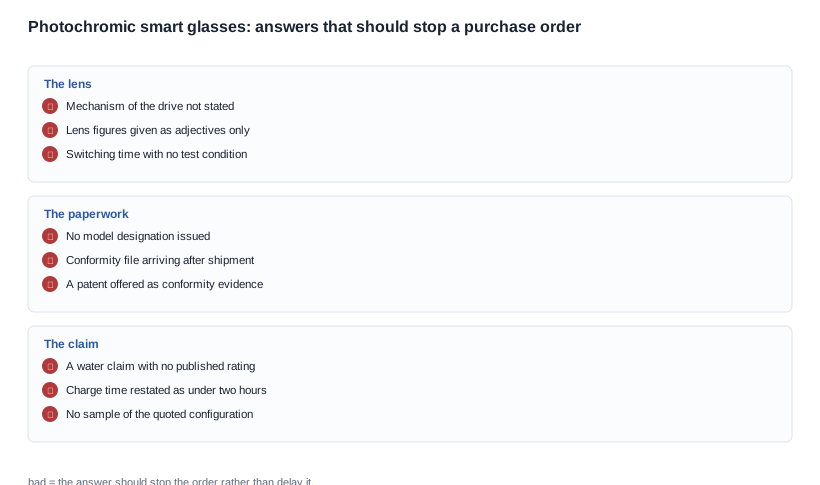
A supplier who answers all eight is rare, and the point of the list is not to find a supplier who passes it. It is to know in advance which of the eight will decide the outcome, so that the negotiation is about the one or two that actually matter for the market being entered, and not about the ones that will be the same whichever supplier is chosen. A shortlist built on that basis is shorter, cheaper to negotiate and far more likely to survive contact with an incoming inspection.
The catalogue's own position on this category is unchanged by anything above. What is published for the AI electrochromic smart glasses entry is the cell, the charging method, the charge ceiling, the rated endurance and the radio version, and nothing else. We will not quote a typical value from elsewhere in the industry to fill a gap, and we will not present a patent as evidence of conformity. What we can do is answer the published questions precisely, name the questions that have no published answer, and say which of them have to be closed before a purchase order is worth raising. If you have the list of questions your own customers ask, send it over, and we will mark each one as published, not published, or supplier-dependent, so that the photochromic smart glasses common questions you are dealing with are answered in the right order.


