

RoHS restricts specified substances in electrical and electronic equipment. REACH regulates chemical substances across the supply chain, and reaches your product through the articles inside it and through your role as an importer. They are separate regimes with separate evidence and separate signatories, and they are routinely discussed as though they were one. For a buyer placing a private-label smart glasses product on the EU market, both apply, and neither is satisfied by your supplier's declaration.
The thing that separates them is a single technical distinction, and once a buyer holds it, the whole category becomes straightforward. RoHS is assessed at the level of the homogeneous material — the plastic, the paint, the cable jacket, the printed marking. REACH is assessed at the level of the article — the finished product as placed on the market — and it asks different questions of that article, including whether a substance of very high concern is present above a threshold and whether information has to be passed downstream. Two different units of assessment mean two different declarations, two different signatories and two different sets of questions to put to a supplier.
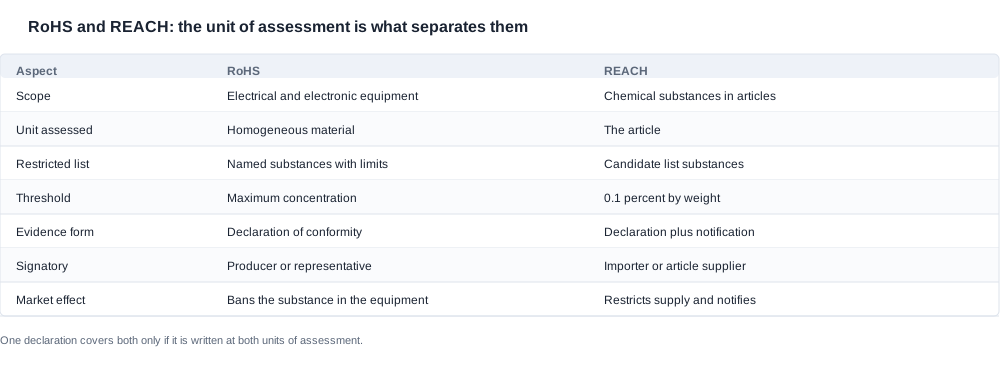
RoHS and REACH: the unit of assessment is the whole difference
What a chemistry buyer should settle before anything is quoted
Three conclusions will keep this category from consuming more time than it should. First, a general statement that a product is compliant with both regimes is worth nothing until the unit of assessment is stated, because a RoHS statement covering a component is not a RoHS declaration for a finished product, and a REACH statement about the product is not a RoHS statement about the materials inside it. Second, the declarations are not interchangeable between suppliers and should not be compared as though they were; a supplier whose file is written at the right level of detail will look more complete than a supplier whose file is written at a shallower level, and that difference is a scope difference rather than a quality one. Third, the chemistry evidence is multiplied by the number of configurations a buyer runs, and that multiplication is a commercial decision taken long before anybody thinks about chemistry.
The instruction that follows is practical. Before accepting any chemistry declaration, establish what it is written against — which materials, which colours, which configuration — and check that the answer is the configuration you are ordering. The questions to ask are short, and a supplier who cannot answer them has a file that describes a different product. Before you commit to a supplier, the red flags to watch for are a declaration covering a product rather than a material, a scope written as a product range, and a candidate list check with no date against it.
The reader of a chemistry file, and the exposure in it
The reader is a brand-side compliance lead, a procurement manager or an importer whose file has to survive a customer review, a marketplace check or an enquiry from a market surveillance authority. Some of them are opening a new programme and are assembling the file from scratch across a supply chain that nobody has audited. Others have a product in the channel and have been asked for the declarations behind it, and are discovering that the supplier's file is a two-page statement covering the whole range rather than the configuration that shipped.
What such a reader is managing is not a laboratory cost. It is the risk of a withdrawn batch, a relabelled product and a customer relationship that has to be repaired twice. Chemistry is unusually unforgiving in that respect, because the obligation runs with the article: a product already placed on the market with a substance present above the limit cannot be corrected by producing a declaration afterwards.
The second thing being managed is the multiplication, and it is the reason a buyer should treat configuration count as a risk item in its own right. Every new colourway, every new coating, every new packaging film and every new supplier of a component can create a new combination that the existing declarations do not cover. A programme with three colours and two cable suppliers has six combinations, and the buyer usually discovers that the declarations cover one of them.

What the two regimes actually regulate, and for which party
The two regimes side by side
The two regimes are similar in what they protect against and different in almost every operational respect. RoHS is a directive that restricts the use of named hazardous substances in electrical and electronic equipment, with maximum concentration values applied to homogeneous materials. It is enforced through a declaration of conformity that the producer draws up, based on technical documentation including a description of the components and the materials used in them, and it is attached to the product rather than to the party.
REACH is a regulation about chemical substances, and it reaches an electrical product through two routes. It restricts substances through its annexes, and it places obligations of information and notification on producers and importers where a substance of very high concern is present in an article above the applicable threshold — currently expressed as 0.1 percent by weight of the article. The relevant unit is therefore the article, and the question is not only whether a substance is present but what the party in the chain must communicate and to whom.
The two also differ in who signs. Under RoHS the declaration is the producer's, and it is made for the product. Under REACH the obligations fall on the party placing the article on the market, which for a private-label import is the importer. A buyer who has been told that the factory's RoHS declaration covers the REACH obligation has been told something that the structure of the two regimes does not support.
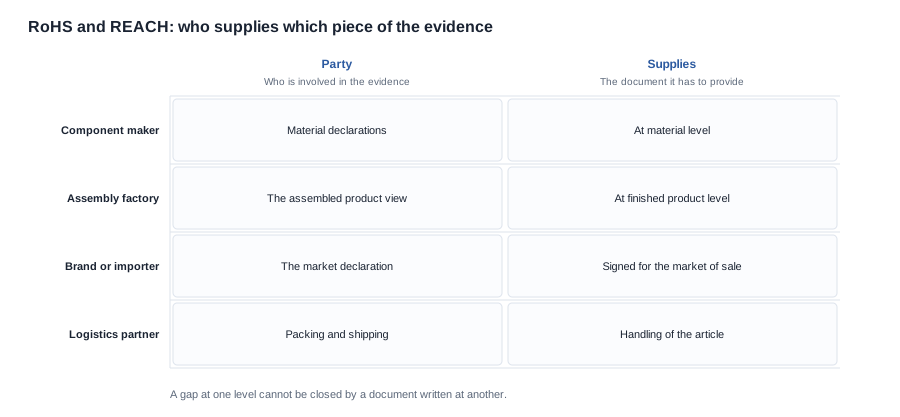
Building the evidence chain from a part to a finished product
The level-of-detail test, and what an unscoped answer looks like
Chemistry evidence is assessed at a stated level, so the table below leads with the level in every row. Each line carries how it is measured, the line it has to meet and the shape a weak answer takes, and it is written so a supplier can answer it without being asked a second question. A declaration that does not state its unit of assessment has answered none of the rows, however many pages it occupies.
| Line to test | How it is measured | The line it has to meet | How a weak answer shows up |
|---|---|---|---|
| Unit of assessment | Ask what each declaration is written against. | The RoHS material is broken down by homogeneous material. | A statement that the whole product is compliant. |
| Scope of the declaration | Ask which models, colours and configurations it covers. | The scope names the configurations being shipped. | A declaration covering the range, not the variant. |
| Restricted substances | Read the list of substances the declaration covers. | Every restricted substance for the equipment category is listed. | A partial list, or a list for another category. |
| Maximum concentration | Ask how the values were established. | A documented method is described, not just a number. | Values asserted with no method behind them. |
| Exemptions | Ask whether any exemption is relied on. | Any exemption is identified and applies to the product. | A blanket exemption cited without identifying it. |
| Coatings and inks | Ask for the declarations covering them. | Paints, inks, adhesives and laminates are included. | Only the base plastic covered. |
| Cables and accessories | Ask for the declarations covering them. | Every cable, adapter and battery is inside the scope. | Accessories shipped but outside the declaration. |
| Battery materials | Ask for the cell and battery declarations. | The cell chemistry and its materials are covered. | The cell treated as outside the product. |
| Candidate list substances | Ask whether the article was checked against the current list. | The check was made against a dated version of the list. | An assertion with no date against it. |
| Information passing downstream | Ask what information is passed to the next party. | The obligation is identified and the mechanism exists. | No provision for passing information on. |
| Article notification | Ask whether any substance exceeds the threshold. | The position is stated, with the notification where required. | Silent on the question. |
| Signatory and market | Read who signed and for which market. | The signatory is the party with the duty for that market. | A factory declaration signed for an importer's market. |
Two rows in that list are routinely compared as though they were the same evidence, and the comparison produces a false result. A declaration for a component and a declaration for the finished product are not comparable, because they cover different things and the second is built out of the first. And a RoHS declaration and a REACH article statement are not comparable either, because they are signed by different parties for different duties in different markets, and a supplier holding one is not thereby holding the other.
The evidence chain, from parts to product
The chain below is the order in which the evidence has to be assembled, and the order matters because a gap at one level cannot be closed by a document from another level.

-
Obtain the bill of materials for the exact configuration being ordered, down to the level of a homogeneous material.
-
Ask each component supplier for a declaration at material level, covering the restricted substances for the equipment category.
-
Collect the declarations for the parts a bill of materials often forgets — coatings, adhesives, printing inks, cables, connectors, adhesives in the hinge, and the battery.
-
Map the material declarations onto the assembled product, and record where a material cannot be broken down further.
-
Ask the article supplier whether any substance of very high concern is present above the threshold in the finished article, and what information is passed downstream.
-
Record which declarations cover which colourway and configuration, because this is where most chemistry files turn out to be narrower than they appeared.
A buyer who wants to know how to compare two suppliers on chemistry should start at step six. It is the step that reveals whether the two files cover the same thing, and it costs one question rather than a full audit.
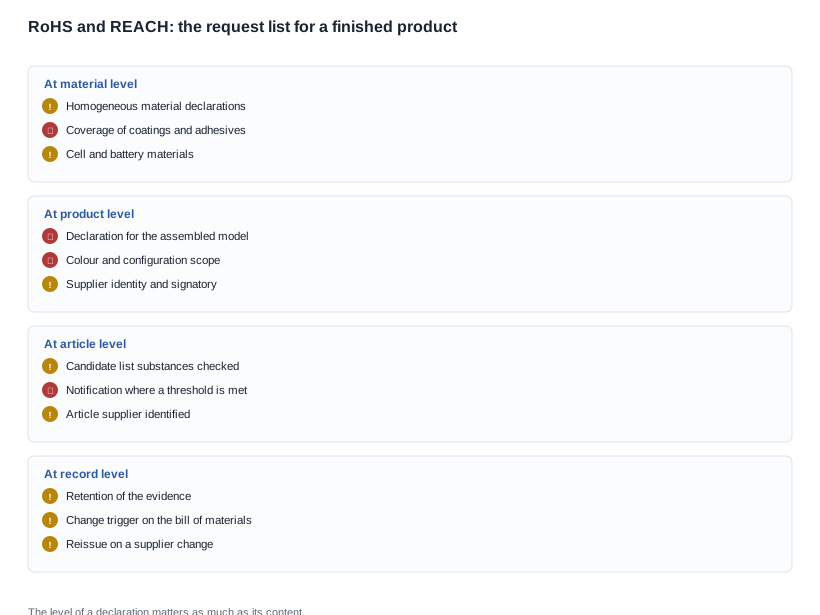
The request list above is grouped by the level at which the evidence has to exist. A gap at material level cannot be closed by a document written at product level, and a gap at article level is not closed by a RoHS declaration at all. That is why the groups are separate rather than one long list.

Where the chemistry evidence is thinnest in our own catalogue
Four ways a chemistry file turns out to be thinner than it looked
The declaration that covers the product, not the materials. A supplier produces a declaration naming the finished model and stating that the restricted substances are not present in it. The symptom is a file that cannot be mapped onto the product because no material breakdown exists. The cause is a declaration written at the wrong unit of assessment. The prevention is to require the homogeneous material breakdown as the deliverable rather than the product-level statement.
The colourway that was added later. The launch colour is covered and a second colour is introduced for a later season without an extension to the declarations. The symptom is a batch that cannot be released because the colour is outside the file. The cause is a colour decision taken in the commercial plan. The prevention is a controlled colour list on the specification, with the declaration named against each colour.
The coating that is not a material in the bill of materials. The plastic is declared and the paint, the soft-touch coating, the printing and the adhesive are not, because they are consumables in the production process rather than parts in the assembly. The symptom is a gap found by an inspector rather than by a buyer. The cause is a bill of materials assembled from the assembly drawing rather than from the process. The prevention is to ask the factory for the process consumables alongside the parts list.
The accessory that ships but is not declared. A charging case, a cable or a pouch is added to the box after the declarations were signed. The symptom is an article in the market that contains a part nobody has checked. The cause is an accessory decision taken at the packing stage. The prevention is to freeze the box contents with the declaration scope, exactly as it would be frozen with the transport file.
Accessories that ship without being declared are articles nobody has checked. They are reasons to ask for the material breakdown rather than the product statement.
Where our own published rows create chemistry work
Our catalogue is explicit about the configuration choices it offers, and each one is a chemistry declaration to be obtained rather than a chemistry fact to be read off. The V03 Pro is published with lens configurations and with colour options. The V06 is published with its own colour options and a removable inner frame. The photochromic entry is a lens treatment rather than a static lens. A charging case is published with the CY05 and the L2 Utral, the CY03 and the MT6, and the L1 Pro, and a case is a separate article in its own right.
The point is not that any of these contains a restricted substance. It is that each published option multiplies the combinations for which a declaration has to exist, and that the catalogue publishes nothing about materials, coatings or finishes. Our catalogue text contains no reference to RoHS, to REACH, to CE, to FCC or to the Radio Equipment Directive, and the export certification page it carries is a company-level page whose content is images rather than text — ten patent certificates, eight appearance-design patents and two utility-model patents. There is no per-model certification row and no material declaration anywhere in it.
A buyer who reads the colour options and asks for a declaration per combination is being precise, not difficult. The number of declarations a programme needs is a function of the published configuration, and the catalogue is the document that publishes it.

The commercial consequences, and the negotiating position
Where a chemistry obligation can move, and where it cannot
The commercial conversation here divides cleanly. What can be negotiated is the configuration set: which colours run, how many cable suppliers are carried, whether a case is included, whether the accessory bundle is standard or optional. Every one of those is a decision that reduces the number of chemistry combinations, and reducing combinations is worth more than arguing about the price of a declaration.
What cannot be negotiated is the material content of the product, the obligation of the party placing the article on the market, and the requirement to communicate information about substances of very high concern where the threshold is met. A supplier who offers to issue a declaration for a colourway they have not assessed is offering something that will fail later.
The scope question is where the buyer has leverage. A supplier who already holds material declarations for a given component will quote the incremental cost of covering a new colourway or a new supplier far more cheaply than a first declaration, because the expensive part is the analysis rather than the paperwork. A buyer who fixes the configuration set before the quotation gets that price.
The total cost of chemistry compliance in this category is therefore a function of configuration count, not of test count, and it is set by decisions taken at the specification stage. That is also why the cheapest moment to close a chemistry question is before the artwork is locked.
A European launch worked through, and the limit of what we publish
A chemistry programme, step by step
The example below is hypothetical, and is used to show how the two regimes separate in practice. No client is described and no figures are claimed; the model, the colours, the quantity and the markets are assumed for the purpose of the walkthrough.
The scenario. A buyer is placing a camera-equipped model on three European markets under its own brand, with three colourways and a charging case in the box. The buyer is the importer of record in each market.
Step one, the unit. The buyer establishes that the file has to exist at two levels: a material breakdown for the equipment, and an article-level position for the finished product. One declaration will not do both, and the buyer asks for both before asking for either.
Step two, the bill of materials. The buyer obtains the bill of materials for the configuration, and finds that the consumables — the coating, the printing, the hinge adhesive, the cable — are not in it. The request goes back for the process consumables alongside the parts.
Step three, the colours. The buyer maps the material declarations against the three published colourways and finds that two of the three are covered while the third is not, because it was introduced after the declarations were signed. The third colour either waits for an extension or is dropped from the launch.
Step four, the article position. The buyer asks whether any substance of very high concern is present above the threshold in the finished article, including the case, and establishes what information has to be passed downstream and to whom.
Step five, the signatory. The buyer checks who signed what. The producer's declaration covers the equipment; the article-level obligations belong to the importer, which is the buyer. The file is rebuilt with two signatories rather than one, which is the correct structure and is also the point most often missed.
The rows we publish, and the chemistry we do not
Declarations are only useful at the right level of detail, and that principle decides what we publish. The catalogue publishes the electrical and configuration rows — cell capacity, charging time, rated runtime, charging method, the Bluetooth version where a row exists, the pixel class, the IP54 marking on the V06 and the S7, the colour and lens options for the models that carry them, and the 158 g weight of the MT6 glasses body. It publishes no material declaration, no substance analysis, no homogeneous material breakdown and no certification status for any model, and the reason is the same reason we would refuse to publish a product-level chemistry statement for a single component. A declaration at the wrong level of detail cannot be used, and where the answer sits with a component supplier we will say so.
We publish no material declaration, no substance analysis, no homogeneous material breakdown and no certification status for any model, because the catalogue text contains no reference to RoHS, to REACH, to CE, to FCC or to the Radio Equipment Directive, and the company-level export certification page it carries is images rather than text. There is no per-model certification row anywhere in it, and a company-level page cannot be read across to a per-model conclusion about chemistry.
What we can do for a specific model is confirm which published rows and configuration options exist for it, so that a buyer can establish exactly which declarations have to be requested and how many combinations they produce. Where the answer sits with a component supplier, we will say so rather than filling the gap with a plausible statement. A buyer who builds a file on a general compliance statement finds the error when the inspector asks for the material breakdown.
The declaration request to send this week
If you are working on this now, the next step is short and specific. Send the model, the colourways, the accessories, the packaging and the target markets, and ask for the declarations written against that configuration rather than for the range. We will tell you which published options exist for the model, how many combinations they produce, and where each declaration has to come from.
The RoHS and REACH pillar holds the requirement set and the two routes side by side.
Tell us the model and the configuration, and we will tell you how many declarations the programme actually needs.


