

Smart glasses battery life smart glasses advanced considerations are the questions that only surface after the first programme has shipped, and they are the questions that decide whether the second programme costs less than the first. The published runtime figures are useful for a first buy and close to useless for a fleet decision, because every one of them carries no test condition.
The published position in our range is complete on the numbers and silent on everything that would let you predict the second year. Cell configurations run from 40 mAh on the A05 and the A06, through 55 mAh × 2 on the LC-105 pair, the G07 and the YK12, 70 mAh on the A07 and 70 mAh × 2 on the YKC02, 90 mAh × 2 on the K01 and the K02, 100 mAh on the D11, the D12, the ZH12, the AR entry and the light-responsive entry, 115 mAh on the D17, 200 mAh on the bone conduction entry, 220 mAh on the MT5 and the V03, and the V03 Pro, 260 mAh on the V06 and the KY06, and the S7, 265 mAh on the MT6, to 290 mAh on the CY03 and the L1 Pro, and the L2 Utral and the CY05. Cycle life, cell chemistry, low-temperature behaviour, ageing and the effect of a partial charge are not published for any model.
That gap is not an oversight in the catalogue; it is where this article lives. There are four dimensions behind the runtime figure that a fleet decision turns on, and three of them cannot be closed with a sample.
Smart glasses battery life: four dimensions a runtime figure does not settle
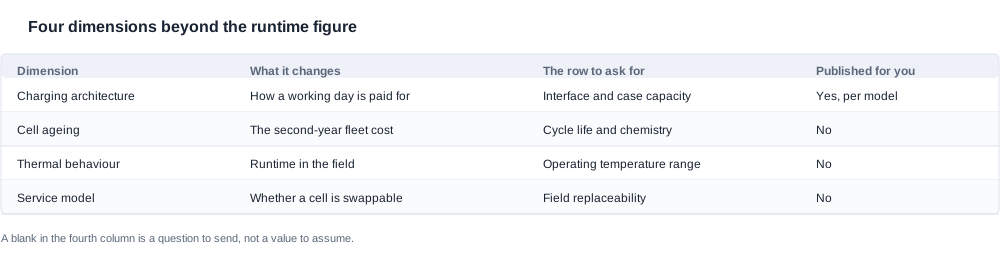
A runtime figure answers one question: how long the device lasts under a condition that nobody stated. Four further dimensions decide what a battery programme actually costs, and they behave in a way that makes them easy to defer and expensive to defer.
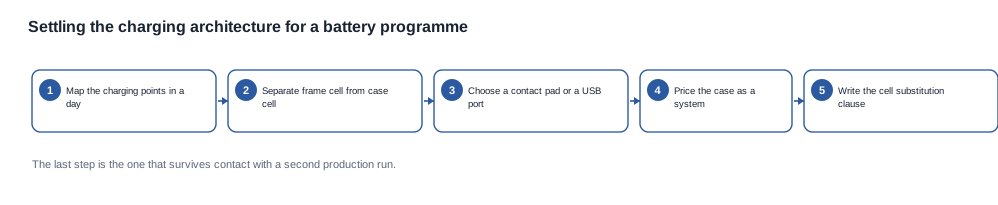
Charging architecture. How the device is replenished, where the energy sits, and what the customer has to own. A magnetic contact device and a Type C device are different products on the shelf, in the box and in the logistics plan, and a device that ships with a charging case is a two-cell system with two ageing curves rather than one.
Cell ageing. What a year of daily charging does to the capacity. This is the dimension that determines the second-year fleet cost, and it is invisible in every published figure because it is a property of the cell and the charging regime rather than of the device.
Thermal behaviour. How the capacity and the runtime respond to temperature. Cell behaviour is temperature dependent in both directions, and the environments where this matters most — a vehicle, a warehouse, a delivery round, a winter site — are exactly the environments where a published figure was measured under laboratory conditions.
Service model. Whether the cell is sealed, replaceable or swappable, and what that means for warranty cost, for the replacement channel and for the lifetime of a unit.
The four are not independent. The charging regime decides the ageing curve; the service model decides who owns the ageing cost; the thermal environment decides how hard the charging regime is. A buyer who treats them as four separate line items will produce four answers and no programme.

Charging architecture: what the interface and the case actually change
The catalogue publishes the charging method for most models, and the distribution itself is a procurement fact rather than a detail: magnetic charging covers the majority of the range, with Type C on the V03 Pro, the L2 Utral, the D11, the D12, the D17, the ZH12 and the bone conduction entry. Four camera models — the L1 Pro and the CY05, and the MT6 and the CY03 — publish a case capacity but no charging interface at all, so for those four the interface is a question to put to the factory rather than a line to read off the catalogue. The V03 Pro has no charging case at all.
The interface decides what goes in the box. A magnetic device needs a contact cable or a proprietary dock; a Type C device needs a standard cable that the customer may already own. The second case is cheaper to serve and simpler to explain, and it removes a class of complaint where a customer bought a third-party charger that did not work. The first case supports a retail story built around a branded dock and carries a packaging and fulfilment cost with it.
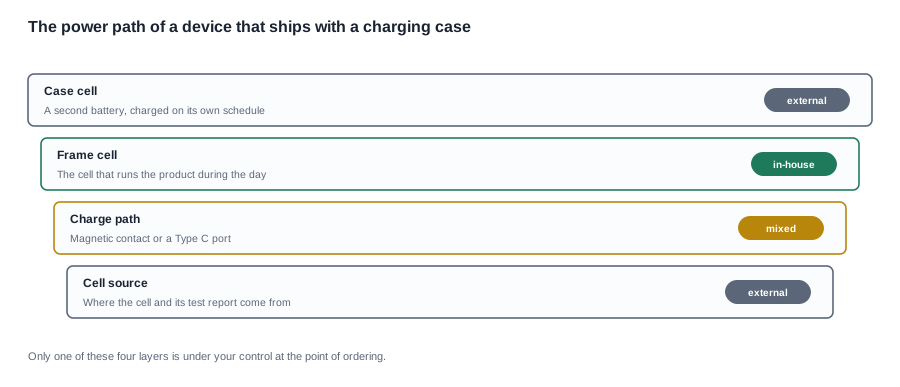
The case is a second battery, and it has to be treated as one. The published case capacities are 1400 mAh on the CY05 and the L1 Pro, and the CY03, 900 mAh or 1400 mAh on the L2 Utral, and 1200 mAh in the foldable case on the MT6. The KY06 and the MT5 also ship with a charging case whose capacity is not published. The charging case options piece covers the configurations in more detail, and the commercial point is that a case raises the achievable basket value while adding packaging volume, shipping weight and a second failure surface.
The two cells age separately and are charged differently. A device that is recharged from the case rather than from a wall experiences roughly twice the charge cycles a device on a desk experiences, and the case cell ages on its own schedule. For a fleet this is the difference between one ageing curve and two, and it is the reason a case-inclusive programme needs a baseline for the case as well as for the frame.
The interface propagates into four other departments. This is the part a product brief misses, because the charging method looks like a component decision and is really a commitment. It decides what is in the box, which changes the packaging and the fulfilment cost. It decides what a customer must keep, which changes the accessory strategy and the support volume. It decides what happens when a customer buys a third-party cable that does not fit, which changes the return rate and the listing copy. And it decides whether the product can be charged from a shared power bank at a site, which changes where the product can be deployed at all. A buyer who wants to know how to choose between a magnetic and a Type C configuration should make this list the basis of the comparison rather than the unit price.
Cell ageing and the second-year fleet cost
This is the dimension that turns a hardware purchase into an operating cost, and it is the one a first programme never budgets for because nothing in the quotation mentions it.
What is not published. No cycle life, no chemistry, no calendar ageing profile and no partial-charge behaviour appears for any model in the range. Those are the four numbers that decide what year two costs, and they are absent rather than approximate, which is at least honest.
Why the absence matters commercially. A cycle life figure is what converts a unit price into a per-year cost. Without it, the buyer has no basis for deciding whether a fleet should be replaced at eighteen months or at thirty-six, and the replacement decision is taken anyway — usually by whoever notices the returns first.
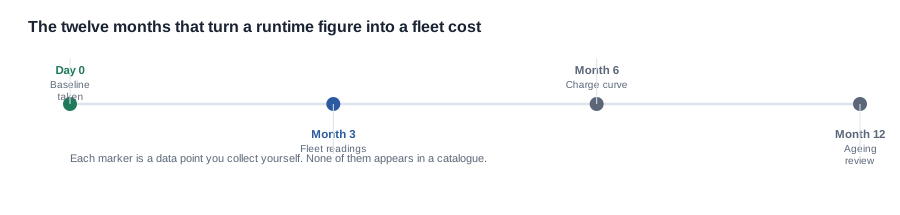
How to build the answer without the figure. You do not need the manufacturer's cycle life to get a usable ageing curve; you need your own, and it costs one year of ordinary operation to collect. Record, per unit, the runtime under a fixed protocol and the ambient temperature at the moment of measurement. Repeat at three months, six months and twelve months. The resulting curve is not comparable to anybody else's curve, which is precisely why it is worth more than a catalogue figure for making your own replacement decision.
The charging regime is a variable you control. A fleet charged from a case at a desk and a fleet charged from a wall overnight have different ageing profiles, and the difference is operational rather than technical. If the ageing behaviour of the cell is not published, then the charging regime becomes the only lever you hold, and it should be written into the operating procedure rather than left to habit.

Thermal behaviour and the environments that shorten a working day
The published runtime figures carry no temperature, and temperature is the variable most likely to move the number in the direction that matters to a customer. A unit measured in a temperate office and used in a vehicle in summer, or on a site in winter, is a different product.
The direction of the effect. Cell capacity and available power both fall at low temperature, and the effect on a small cell is proportionally larger than on a large one. The 40 mAh cells in the A05 and the A06 and the 55 mAh pairs in the LC-105, the G07 and the YK12 are the configurations where a cold environment will bite hardest relative to their published figures.
Where this shows up commercially. It shows up as returns concentrated in a season, in a geography or in a use case, and the concentration is what makes it diagnosable. A complaint pattern that only appears in one market is a temperature question before it is a defect question, and the diagnostic step is to ask the customer what the temperature was, which is a question a returns form can ask and which almost nobody asks.
What to ask the supplier. The operating temperature range for the cell, the behaviour at the low end of that range, and whether the published runtime figure was measured inside or outside it. If the answer is that the figure was measured at room temperature, that answer is worth having in writing, because it tells you exactly which claim you can and cannot make.
What to do with it in the specification. If your product ships into a cold market, the runtime requirement in your own specification should be written against the low end of the range rather than against the catalogue figure, and the difference between the two is the margin you are choosing to carry.
How to choose a margin without inventing a derating factor. There is a temptation to apply a percentage haircut to the published figure and treat the result as a specification. We do not publish such a factor and we would not apply one that we have not measured under your conditions, because a percentage applied to an unstated condition produces a number with two unstated conditions. The defensible construction is narrower: state the requirement in hours for a named environment, and let the supplier answer it in hours for that environment. If the supplier cannot, that is a finding about the configuration rather than about the arithmetic, and it is the answer you need before you commit.
Where the cold answer is cheapest to obtain. Two routes exist, and they cost very different amounts. Asking the cell supplier for the low-temperature discharge behaviour is a question with a short answer and no programme attached. Testing your own units requires a chamber, a protocol and weeks of time, and it is the only route that answers the question for the finished configuration. For a first order the question route is proportionate; for a fleet programme that will run for years, the test route is the one that produces a number you can put in a specification and defend.

Swappable, replaceable or sealed: the service model decision
The service model is a commercial decision dressed as a technical one, and it has three answers with three different balance sheets behind them.
Sealed. The cell is not designed to be removed by anyone other than the factory. The warranty is simple, the supply chain is simple, and the customer replaces the unit rather than the part. This is the most common arrangement in this range, and no replaceability information is published for any model in it.
Replaceable. The cell can be opened and exchanged by an authorised party. The warranty becomes a cell warranty, the replacement channel becomes a stock question, and the logistics plan has to handle a loose cell as a separate item, which brings the transport obligations that every lithium product carries. The transport compliance checklist covers the documentation side and the declaration of conformity covers the paperwork.
Swappable. A second cell is held in rotation, so the device is charged from one cell while the other is on the dock. This is the arrangement that produces an all-day product, and it is also the arrangement with the largest inventory requirement and the most complicated spare-parts policy. The swappable battery discussion is worth reading before a programme assumes any of the three.
Why it has to be decided at the order stage. The service model determines the tooling, the packaging, the parts supply, the warranty wording and the size of the spare-parts business. Changing it after launch means a new mould, a new spare-parts policy and a new warranty position, on top of everything else the upgrade requires. It is the cheapest decision in the whole battery programme to make early and the most expensive one to make late.
How to evaluate the three at procurement level. The comparison is not technical, because in all three cases the device does the same work. It is a question of which cost the brand intends to carry: with a sealed cell the brand carries the whole unit in the warranty and carries nothing in stock; with a replaceable cell the brand carries a small part and carries the logistics of a loose lithium item; with a swappable cell the brand carries inventory and a rotation policy and carries the highest customer satisfaction. A buyer should write down which of those three costs the programme is prepared to hold before asking a supplier to propose a service model, because the supplier will propose whichever one is easiest for them to build, and that is rarely the one the brand has budgeted for.
Which of these a sample can close, and the limit of our own catalogue
Buyers plan their evaluation budget around the sample, so it is worth being explicit about what a sample is capable of settling in this category.
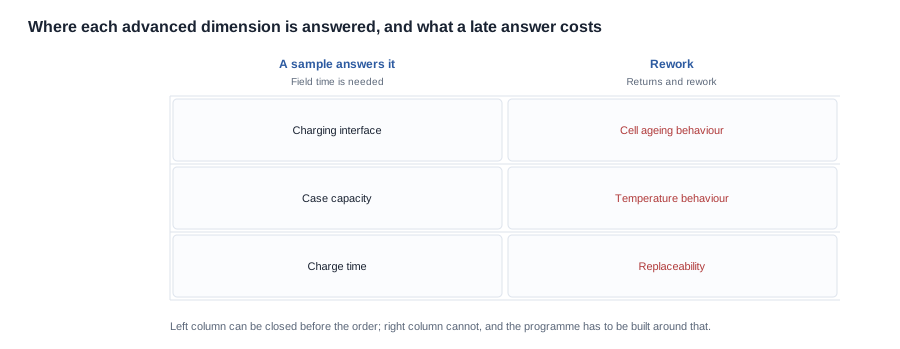
A sample closes the interface and the case. Whether the magnetic contact behaves, whether the Type C port seats correctly, how long a full charge actually takes on the unit in your hand, whether the case recharges the frame and how many times it can do so before it needs a wall. These are all observable in an afternoon, and they are the majority of what a sample is normally used for.
A sample partly closes the runtime. You can measure one unit under one workload at one temperature. That is enough to catch a specification that is wrong, and it is not enough to characterise a fleet. Treat the sample result as a boundary rather than as a figure.
A sample cannot close ageing, temperature behaviour or the service model. Ageing needs time. Temperature needs the environment. The service model is a decision, not a measurement. These three are the ones a programme has to be built around rather than tested into, which is why the prudent approach is to fix them in the specification as requirements and to verify them by inspection rather than by experiment.
For the platform-level starting points, the camera tier comparison and the audio tier comparison both collect the published rows into a single view, which is the right place to begin before any of the four dimensions above.
What our own catalogue cannot answer on any of the four
Concretely, we publish the cell configuration, the charge time, the interface, the case capacity and the runtime, and we do not publish a cycle life, a cell chemistry, a temperature behaviour or a test condition, because we do not hold them, and we will not supply a typical value to fill the gap.
We will also be direct that the published runtime is a mixed-use figure, and that a fleet decision needs a baseline you collect yourself in the first ninety days rather than a number we publish. What we will do is give you the published rows, agree the measurement protocol with you, and tell you plainly which of the advanced questions are answerable on a sample and which need a year of field data.
One point deserves adding for a buyer running a second programme rather than a first. The four dimensions above are not equally worth pursuing, and the order of effort follows the size of the fleet. A small first order can absorb an unknown ageing curve because the units involved are few and the replacement cost is trivial. A fleet of any size cannot, and the point at which the ageing question has to be answered moves earlier than most programmes expect. If your second order is materially larger than your first, the ageing baseline from the first programme is the single most valuable document you will own, which is a reason to collect it properly the first time rather than to treat it as an administrative exercise.
Send us the models, the duty cycle you intend and the environments the product will be used in, and we will tell you which of these four dimensions a sample can close and which have to be scheduled into the year.
Related reading
- The published power rows — battery life and power
- What a runtime figure does not tell you — how to compare battery life
- The shipping obligations a cell brings — battery transport compliance
- Which specifications to ask for first — battery key specifications
Tell us the models, the duty cycle and the environments, and we will say which of these questions a sample can close.


