This is a hypothetical case, not a client project. No customer, order, price or outcome below is real; every figure is either taken from the published catalogue or counted from it, and every commercial number is left as a quotation because a quotation is what a real order would produce. What the scenario is for is to show the shape of the decision: a brand that wants a cycling smart glasses line, the four forks it meets on the way, and how a shortlist of twenty-eight models becomes a shortlist of one by the end of the fourth month.
The scenario, stated plainly. Assume a mid-sized European cycling accessories brand that already sells helmets, eyewear and locks through a dealer network, and that wants to add a smart glasses line for the coming season. The line is sold to two audiences: dealers, who stock it as a product, and clubs, who buy in small batches for shared use. The brand's stated intent is a ride log — a first-person record of a route, reviewed later by a club committee or a dealer demo — rather than a live streaming or navigation product. The budget is a mid-market one, the brand is not a technology company, and the person running the purchase is a product manager with a marketing team attached and no in-house compliance function.
Everything that follows is the reasoning that scenario implies, applied to the published rows. The point of a case like this is not the outcome; the outcome is one model, and one model is easy. The point is the order of the reasoning.
Smart glasses for cycling: a hypothetical first season, walked through
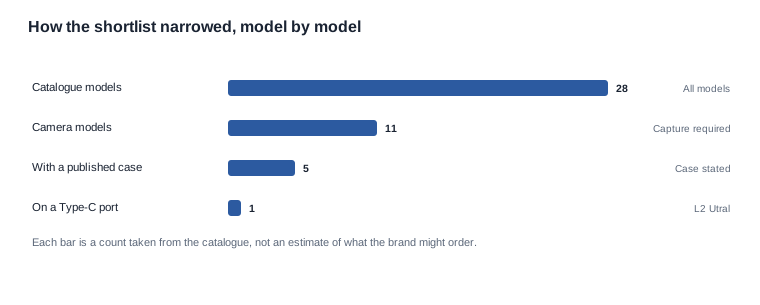
The bar chart is the clearest way to see the shape of the exercise. The catalogue publishes twenty-eight models. The scenario needs capture, which leaves the eleven camera models. The ride runs past a single session, which means a case in the configuration, and five camera models publish a case capacity. The club charges devices between sessions, which means a Type-C port, and exactly one model in the whole range publishes both a case capacity and a Type-C port.
That last fact is the one that changes the programme. The brand arrives at a single candidate — the L2 Utral — and that single candidate brings three consequences. It carries a 290 mAh cell, a rated runtime of roughly seven hours and a charge time of two hours or less. It publishes a case as 900 or 1400 mAh, so the case itself is a choice rather than a fixed part, and a choice the brand can make once and price once. It publishes a Type-C charging interface, which is the interface the brand wanted for the between-session top-up.
It also brings three problems. Its charging method is published as Type-C, but four camera models — the MT6, the CY03 and the L1 Pro, and the CY05 — publish no charging method at all, which is a reminder that the catalogue is not complete on this row. The brand wanted a 13 MP sensor and this model has one, which is the first time in the scenario that a specification and a preference happen to agree rather than conflict. And the model carries an IP54 marking only if the brand chooses the V06 or the S7 instead, which it does not, so the ingress claim in the listing is going to be a claim about a product with no published ingress rating at all.
The four forks, and what each one removed
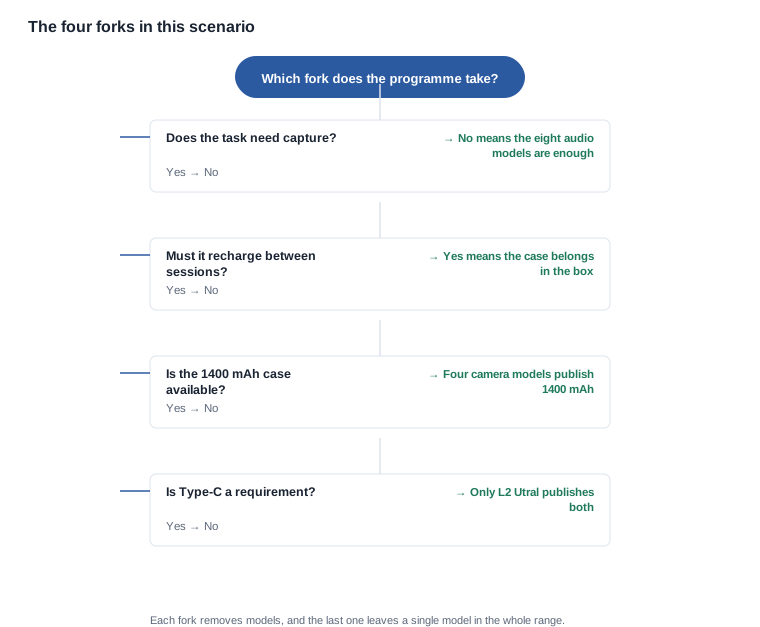
Fork one, does the task need capture? The scenario answers yes, and the answer is worth interrogating, because it is the fork that removed the most models and the fork a buyer is most likely to answer emotionally. The brand wants visibility in a crowded product category, and a camera is what a competitor's product page shows. But the stated task is a ride log read after the ride, and a log does not need a camera to be useful — it needs audio, a battery that lasts the ride, and a price the club can afford. If the answer to fork one is no, the shortlist becomes the eight audio models, the case question becomes irrelevant for most of them, and the budget changes shape entirely. The scenario keeps the camera because a club committee that never hears the route being described will not use the device twice, and a ride log that nobody reads is a return waiting for a reason.
Fork two, must the device recharge between sessions? A club day can be two sessions with a long break between them, and the brand's own dealer demo events are a full day with a travel gap. That makes the case a functional requirement rather than a premium accessory, which is a decision the case capacities make easy to reason about: the L1 Pro and the CY03, and the CY05 publish 1400 mAh, the MT6 publishes 1200 mAh in a foldable case, and the L2 Utral publishes 900 or 1400 mAh. The scenario takes 1400 mAh, because a club that runs out of charge at the second session will not run the programme at all.
Fork three, is the 1400 mAh case available on the model that survives? This is the fork that bites, and it is the fork nobody checks before they order. Four camera models publish a 1400 mAh case; the L2 Utral publishes 900 or 1400; the CY05 and the CY03, and the L1 Pro publish 1400. The KY06 and the MT5 are offered with a charging case whose capacity is not published at all, the catalogue publishes no case row for the V03 Pro and the V06, and the V03 or the S7, so whether a case travels with any of the four is an item to ask about. A buyer who has decided on 1400 mAh and has not checked which models publish it has already made a configuration error, and it is a configuration error that shows up as a parcel weight and a transit file.
Fork four, is Type-C a requirement? The scenario says yes, because a club charging a shared device between sessions wants to use the cables it already owns rather than a proprietary lead. The range publishes Type-C on seven models, and among the camera models with a published case only the L2 Utral is one of them. This is where the shortlist collapses.

The configuration that survived the forks
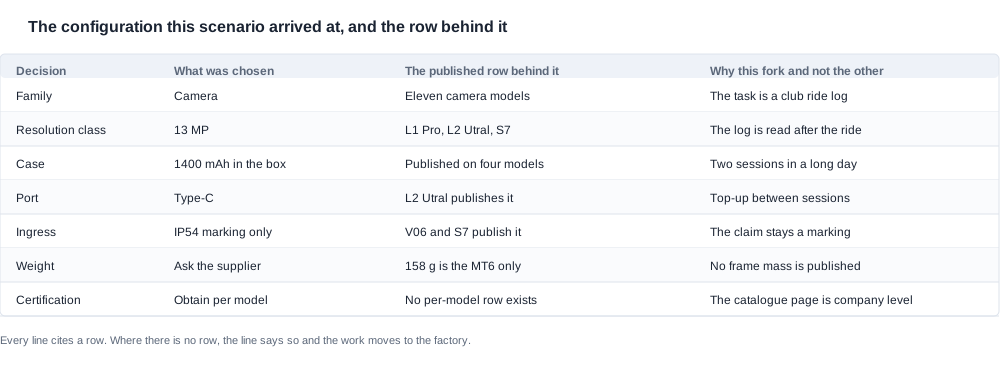
Every line in that table points at a published row, and the two lines that do not — the frame mass and the per-model certification scope — are marked as questions for the factory rather than as figures. That is the shape of a defensible configuration: what is published is stated, and what is not published is named as an open question with an owner.
The claim set is the part the scenario had to work hardest on. The brand wanted to say the device was built for the rain, and the L2 Utral publishes no ingress marking. Only the V06 and the S7 carry an IP54 catalogue marking, and even for those the marking covers splashing water and a dust protection level rather than immersion, with no third-party test report published behind it. The reading of the digits is at IP ratings. The scenario therefore writes a claim that can be defended: the device is specified for outdoor use with a published cell capacity, a published rated runtime, a published charge time and a published charging interface, and the rider is told the lens material and coating are not published so the supplied wipe is the only approved method.
The mass question was settled by asking rather than by estimating. The catalogue publishes one weight in the entire range, the MT6 glasses body at 158 g including the cell and the camera and excluding the foldable case, and that figure belongs to a different model. The brand does not publish a mass for the chosen model, so the scenario's product page does not state one, and the specification pack carries a request for the figure. The rule a buyer should hold to here is simple: a mass that is not published is a question, and a question that is answered with a typical value becomes a false statement on a product page.
The conformity scope was the item that took longest and was still not closed. The catalogue's export certification page is a company-level page, the catalogue text contains no CE, FCC or RoHS wording, and there is no per-model certification row, so the per-model scope against the Radio Equipment Directive (EU) 2014/53/EU has to be obtained in writing and then checked in the issuing body's public register. The document route is at certification checklist and the market entry points are at EU and UK.
The case configuration is the one line the scenario treats as a live decision rather than a settled one. The L2 Utral publishes 900 or 1400 mAh as a deliberate configuration choice, which means the brand is buying two products and selling one, and the split has to be decided before the artwork is frozen rather than after. The scenario's third mistake happens here, and it is a mistake of sequencing rather than of arithmetic: the brand priced the 1400 mAh case for the club channel and the 900 mAh case for the dealer channel, then discovered that the two configurations have different artwork, different parcel weights and different transit files, and that the dealer channel's smaller case was the one the artwork had to carry. The rule that came out of it is that a configuration choice which affects two channels has to be made once, globally, before either channel's artwork is approved — otherwise the brand ends up with two products and one print run, and the print run is the one that decides what ships.
What happened in each of the first six months
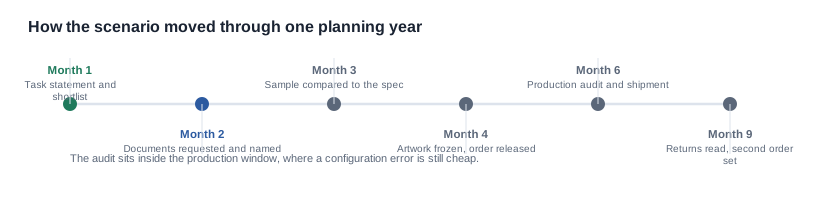
Month one. The task statement is written — a ride log for club use, read after the ride — and the shortlist is cut from twenty-eight to eleven on the strength of it. The scenario's first mistake happens here and is worth naming, because it is the one that costs the most: the brand asks for a quotation on the whole camera family before the case question is settled, and receives eleven prices for configurations the brand will never order. The correction is to ask for a quotation against a configuration, not against a family, and the quoted price that matters is the one for the L2 Utral with the 1400 mAh case.
Month two. The configuration string is issued and the documents are requested by name: the runtime condition, the case specification, the battery transport file for the configuration with the case in it, the per-model conformity position, the Bluetooth listing, and the material declaration. Six requests in one message. The battery transport requirement is at battery transport, and the case in the box is a second lithium cell, so the file has to cover it rather than just the glasses. The radio listing is checked in the public register, which is the step that costs nothing and catches the most.
Month three. The sample arrives and is compared against the written specification rather than admired. The comparison is done as a checklist: interface, case capacity, charge time, the model designation on the unit, and the insert. The scenario's second mistake happens here, and it is a small one that is worth naming because it is so common: the sample is compared against the specification, but not against a production unit, and the difference is only visible after the print run.
Month four. The artwork is frozen and signed, the insert is approved, the reason code list is closed with the channel, and the order is released. The artwork freeze is the point at which a change stops being free — after it, a change is a reprint, a new transit file, a new insert and a delay. The commercial structure of the order is at pricing and the clause language at contract terms.
Month five and month six. The production run is audited against the configuration string, which is the only moment at which a configuration error is still cheap to fix, and the first shipment is released with the conformity and transport file on file. The audit route and the production quality process are at factory audit and quality control.
The reading at the end of the season
At the end of the first season the scenario's buyer has two things to read: the returns, and the questions the dealers asked. The returns arrive as reason codes rather than as a count, because the reason code list was closed in month four and the channel was obliged to use it. The likely distribution, in a category like this, is a small number of causes rather than a long tail: a configuration mismatch where the case did not match the expectation, a lens complaint where the coating was assumed to be more durable than it is, and a charge complaint where the rider expected the magnetic dock to be in the box. Those three are all design-out items, and the design-out route is the accessory programme and the insert rather than a discount on the next order. The accessory side is at smart glasses for cycling accessories.
The second reading is more valuable and almost never done. The dealers' questions are the part of the first season that a brand can act on without any new information from the factory. A dealer who asks whether the case can be bought separately is telling the brand that its accessory line is missing a product. A dealer who asks about the ingress marking is telling the brand the claim is not doing its job. A club officer who asks whether a different model can be mixed into the same order is telling the brand the second configuration is worth pricing.
And the third reading is the one the brand has no habit of doing. The club officers in the scenario turn out to be a better source of product information than the dealers, because a club uses the device on a schedule rather than selling it on a shelf. The questions they ask in month one — can it be charged from the same cable as the club's other kit, does it survive a wet commute to the meeting point, can one unit be recorded in a case and another not — are the questions that determine whether a shared device is a shared device or a private one. A brand that reads those questions in month one has a second season's specification in hand before the second season is planned, and a brand that reads them in month nine has a second season's returns instead.
What the scenario then does is rebuild the budget against the new information. The second order is not the first order with a different quantity. It is the first order's configuration, adjusted by what the reason codes showed and what the dealers asked for — and the discipline is to make those adjustments explicitly, on the page, rather than letting them drift into a quotation that nobody can compare with the previous one. The cost model for that rebuild is at smart glasses for cycling budget considerations.
What this scenario does and does not prove
It does not prove that the L2 Utral is the right model for a cycling brand. It proves something narrower and more useful: that the published rows are sufficient to narrow a shortlist of twenty-eight models down to one without a single invented figure, provided the buyer is willing to leave the unpublished rows marked as unpublished and take them to the factory as questions.
It also does not price anything, and that is deliberate. The catalogue publishes no unit prices, no minimum order quantities, no lead times, no capacity and no failure rates, so a scenario that produced a total cost would be producing an invented number. The commercial structure of a first order is at pricing, the order terms at MOQ and the payment structure at payment terms.
Our position, and what we will do with a real version of this. We publish the rows the scenario leans on: the twenty-eight models, the three families, the cell capacities, the rated runtimes, the charge times and the resolution classes, the charging interface per model, the case capacities where they exist, the detachable inner frame on the V06 and the S7, the flexible temples and the photochromic lens on the V03 Pro, the remote control photo feature on the D17 and the ZH12, and the IP54 marking on the V06 and the S7. What we do not publish, and will not estimate: the lens material, the coating, the frame weight beyond the single 158 g figure for the MT6 glasses body, the runtime test condition, the field of view, the video specification, the per-model certification scope, or any price, capacity or failure rate. We publish no touch row for any model, so a temple control surface is a question for the supplier rather than a line on the sheet. We will not state that a model is tested to IP54, because no test report is published behind that marking.
Send us the real task statement, the audience, the markets and the volume, and we will run the same sequence against the published rows: the shortlist, the configuration, the open questions, the documents the supplier must issue, and the claims the listing can carry. The scenario entry point is smart glasses for cycling, the device families are at sport smart glasses and ai camera glasses, and how we work with sports and cycling brands is set out at sports and cycling brands overview and sports and cycling brands how we help.
Related reading
- How to enter the scenario — smart glasses for cycling
- The document pack behind this walk-through — smart glasses for cycling buying checklist
- The certification route — sports and cycling brands certification support
Send the task statement and the audience, and we will run the same sequence against the published rows.