

Smart glasses for office: not labels, but what a supplier commits to
A smart glasses for office quotation is written in a vocabulary that is stable in form and unstable in meaning, and a procurement team that knows the form without the meaning will negotiate on the wrong things. The same words turn up in a catalogue, a quotation, a compliance request and a service contract, and they mean something different in each. This glossary takes the terms an office buyer actually meets and gives each one three things: what the word commits a supplier to, what our catalogue does or does not say about it, and the question to attach to it when a quotation arrives.
The single most important habit the glossary supports is reading every term as a commitment rather than as a label. "IP54" is a label until somebody asks which two models carry it and on whose report. "Two hours or less" is a label until somebody asks what the charge starts from and what counts as finished. "290 mAh" is a label until somebody notices it is one cell in a pair and that the pair is not published as a total.
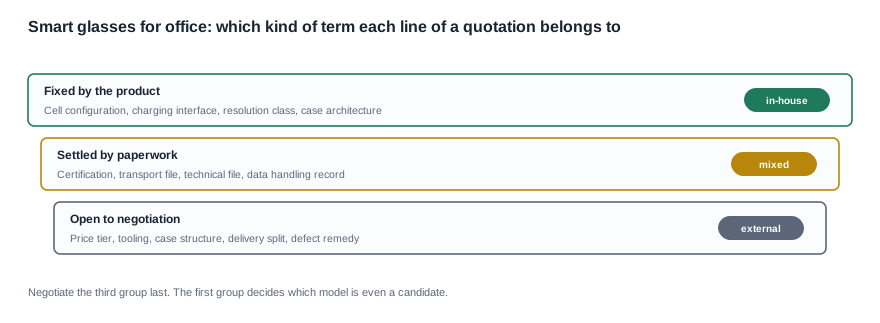
The second habit is separating the three kinds of term, because they are settled in three different places. Some terms are fixed by the product before any conversation starts — the cell configuration, the charging interface, the resolution class, the case architecture. Some terms are settled by paperwork, in a document that has to arrive and name the configuration. Some terms are settled by negotiation, and they are the ones a buyer can actually move. A quotation that has been read without this separation usually puts negotiation effort into the first group and leaves the third group alone.
The catalogue behind this glossary is a twenty-eight-model range organised in three named tiers and a small number of further rows. The tier names a buyer will hear are the camera tier, the audio tier and the sport tier, and they do not partition the range cleanly.
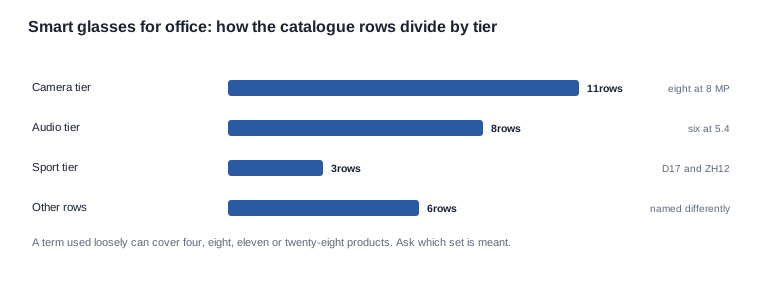
The chart above is worth holding on to when a supplier uses the word "audio glasses" or "sport glasses", because the audio tier is eight models, the camera tier is eleven and the sport tier is three, while six further catalogue rows — the AR row, the A05 and A06 children's protection rows, the A07 children's audio row, the photochromic row and the bone-conduction row — are named differently again. A term used loosely in a quotation can therefore cover four, eight, eleven or twenty-eight products, and the buyer has to ask which set is meant.
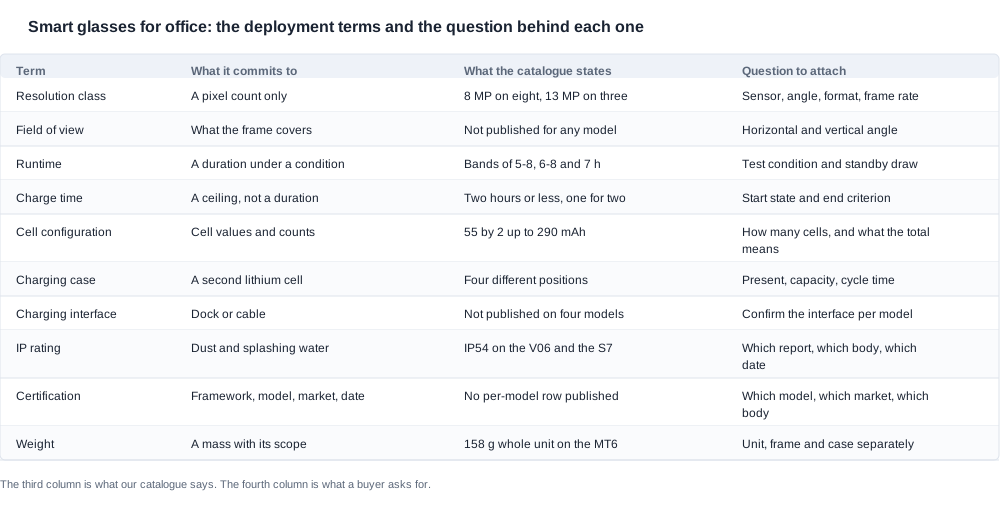
The table is the quick reference. The entries below it go further on the terms where the distinction changes what a buyer should do.

The imaging terms, and what each one actually commits to
Resolution class
What it commits to. A published pixel count for the camera module, and nothing else about the image. A resolution class is a specification of the sensor's output size, not of the photograph.
What the catalogue says. The camera tier publishes 8 MP on eight models — the MT5 and the V03 Pro, the CY05 and the V03, and the MT6 and the KY06, and the V06 and the CY03 — and 13 MP on three models — the L2 Utral and the S7, and the L1 Pro. Nothing else about imaging is published: no sensor model, no field of view, no video resolution, no frame rate, no stabilisation figure and no low-light performance.
The question to attach. Which sensor, what field of view, what video format and what frame rate does this resolution class sit inside, and can a sample be supplied to check the actual output rather than the specification.
Field of view
What it commits to. The angle the camera covers, and therefore whether a written note, a whiteboard, a machine panel or a person's face is in the frame. It is the single most consequential unpublished row in the camera tier.
What the catalogue says. Nothing. No field of view is published for any model, camera or otherwise.
The question to attach. The horizontal and vertical angle in degrees, per model, and what the frame looks like at the short end of the range rather than at the ideal distance.
Runtime and charge time
What it commits to. Runtime commits to a duration of use under a stated condition. Charge time commits to a duration of charging under a stated condition. Both are ceilings in this catalogue rather than measurements, and a ceiling is a weaker commitment than it looks.
What the catalogue says. Every model publishes a runtime, and every model publishes a charge time. The camera tier publishes 5~8 h for the S7 and the V06, and the V03 Pro and the V03, 6~8 h for the KY06 and the MT5, and about seven hours for the L1 Pro and the L2 Utral, and the CY05 and the CY03, and the MT6. The audio tier publishes about eight hours on the K01, the K02 and the LC-105 pair, about seven hours on the D11 and the D12, and about six hours on the G07 and the YK12. On charge time, twenty-six of the twenty-eight models publish a charge time of two hours or less, and only the D17 and the ZH12 publish about one hour. What is not published for any model is the runtime test condition, the standby draw, the cycle life rating, the charge start state and the charge end criterion.
The question to attach. What the runtime was measured at, what the charge starts from and what counts as fully charged, and how the figure changes over a year of daily use.
The power terms, and the distinctions that change a quotation
Cell configuration
What it commits to. The catalogue publishes cell values and cell counts, not totals. A configuration written as two cells of 55 mAh is a statement about two cells, and the 110 mAh it implies is a derived figure that the catalogue has not published.
What the catalogue says. The audio tier publishes 55 mAh × 2 on the YK12 and the LC-105-2, and the G07 and the LC-105-1, 90 mAh × 2 on the K01 and the K02, and a single 100 mAh cell on the D11 and the D12. The camera tier publishes 220 mAh on the V03 Pro and the V03, and the MT5, 260 mAh on the V06 and the S7, and the KY06, 265 mAh on the MT6 and 290 mAh on the CY03 and the L1 Pro, and the L2 Utral and the CY05. The sport tier publishes 70 mAh × 2 on the YKC02, 115 mAh on the D17 and 100 mAh on the ZH12. Elsewhere the range publishes 40 mAh on the A05 and the A06, 70 mAh on the A07, 200 mAh on the bone-conduction row and 100 mAh on the AR and photochromic rows.
The question to attach. How many cells, of what value, in what configuration, and whether the quoted price and the quoted weight refer to the cell total or to a single cell.
Charging case
What it commits to. A case is a second lithium cell, a second object to issue, a second object to lose, and a second cell to declare in the transport documentation. A case capacity commits to the capacity of that second cell, not to how long the case takes to refill.
What the catalogue says. Four different positions across the eleven camera models, and the distinctions between them are real. Five models publish a case capacity: 1400 mAh on the CY03 and the L1 Pro, and the CY05, 900/1400 mAh on the L2 Utral, and on the MT6 a 1200 mAh foldable case. Two models indicate a case with no published capacity, the KY06 and the MT5. Three models publish no case row at all, the V06 and the V03, and the S7. And one model, the V03 Pro, has no charging-case row. No case cycle time is published for any model.
The question to attach. Does this model ship with a case, what is the capacity, how long does the case take to refill, and does the transport file cover the case as well as the glasses.
Charging interface
What it commits to. Whether the unit needs a dock or a cable, and therefore whether the charging point is an installed asset or a consumable. It is the term that decides the shape of the whole kit.
What the catalogue says. Magnetic charging is published on the V06 and the MT5, and the V03 and the KY06, and the S7 among the camera models, and on the YK12 and the K02, the LC-105-2 and the LC-105-1, and the G07 and the K01 among the audio models. Type-C is published on the V03 Pro and the L2 Utral among the camera models, and on the D11, the D12, the D17 and the ZH12 among the others. Four camera models publish no charging interface row at all — the CY03 and the MT6, and the CY05 and the L1 Pro — and each of those four does publish a charging case capacity.
The question to attach. For the models with no published row, confirm the interface in writing before any dock is procured, and for the rest confirm whether the dock is supplied, documented and replaceable.

The compliance terms, and where the catalogue boundary sits
IP rating
What it commits to. A dust protection level and a protection against splashing water. It does not commit to immersion, to a sustained downpour, to a sealed enclosure or to a warranty against water damage, and it is not the same thing as a third-party test report.
What the catalogue says. The IP54 marking is published on two camera models only: the V06 and the S7. It is published as a catalogue attribute, and no third-party test report behind it is published. No rating at all is published for the audio tier or for the other camera models.
The question to attach. Which test report, from which body, on which date, and for which model designation. Where there is no report, the wording in any downstream document has to stay inside what the catalogue attribute supports.
Certification and conformity
What it commits to. A specific framework, a specific model, a specific market and a specific date. In the European market the framework for the radio path is the Radio Equipment Directive (EU) 2014/53/EU. The EMC directive (EU) 2014/32/EU covers electromagnetic compatibility rather than the radio path, and the two are confused often enough that a buyer who does not name the right one will receive a document that does not cover the part of the product the radio occupies.
What the catalogue says. The catalogue carries a company-level export certification page whose content is images rather than text. That page shows ten patent certificates — eight appearance-design patents and two utility-model patents. The catalogue text contains no reference to CE, FCC or RoHS anywhere, and there is no per-model certification row, so a certification claim cannot be made from the catalogue and a per-model position has to be requested in writing.
The question to attach. Which framework, which model designation, which market, issued by which body on which date, and whether the technical file covers the configuration as shipped rather than as described in the range.
Weight
What it commits to. A mass for a named object, with its scope stated. A weight without a scope is a number that will be quoted back in a different context.
What the catalogue says. One weight is published in the whole range: 158 g for the MT6, which is the glasses body including its 265 mAh cell and its camera, and excluding the foldable charging case. The case weight is not published, and no unit weight is published for any other model, so no frame weight is published anywhere.
The question to attach. The weight of the unit as shipped, the weight of the frame alone if that figure is different, and the weight of the case if a case is supplied.
AI feature
What it commits to. That a capability is present. It does not commit to where the processing happens, whether it works without a connection, where the data goes, how long it is retained, or how it is updated.
What the catalogue says. Twenty of the twenty-eight catalogue rows carry an AI feature entry. The implementation details, the offline behaviour, the storage location, the data-handling model and the update mechanism are not published for any of them.
The question to attach. What happens without a connection, where the data is processed and stored, what is retained and for how long, and what an internal security review needs in order to sign the deployment off.

The commercial terms, and the question each one is hiding
Minimum order quantity, tooling and NRE
What it commits to. A quantity at which a price applies, a one-time cost that is spread across the volume, and the distinction between a cost that amortises and a cost that does not. Tooling spreads across a second run; certification attaches to the product and the market and does not amortise at all. A quotation that folds tooling into the unit price has removed the number a buyer needs to forecast a second order.
The question to attach. What the price tier is at each quantity, what the tooling covers, whether it is owned by the buyer, and what the certification cost and lead time are quoted as.
Landed cost
What it commits to. A number that includes everything the buyer's organisation will actually spend. A unit price comparison that excludes the charging point, the hygiene consumable, the case and the loss rate is a comparison of two numbers that are not the same thing.
The question to attach. The unit price, the tooling and certification lines, the freight and the duty treatment, the charging hardware, the consumable rate, and the spare ratio, each separated.
Warranty and the denominator
What it commits to. A remedy, and a rate. The rate is meaningless without the denominator, and there are two available denominators: units issued and units returned. The second one is flattering by construction, and a clause that names it is worth less than a clause that names the first.
The question to attach. Against how many units is the rate calculated, who maintains the issued count, and what the remedy is when a unit fails inside the period.
Delivery terms and title
What it commits to. Who carries the risk at each point of the journey, when ownership transfers, and which party is responsible for the paperwork that the destination market asks for. These are the terms that decide whether an inspection failure is the buyer's problem or the supplier's, and they are almost never discussed until something has gone wrong.
What the catalogue says. Nothing, because delivery terms are not a product attribute. Unit prices, minimum order quantities and production lead times for this range are confirmed per enquiry rather than published as fixed numbers, and the delivery structure follows from the configuration, the case architecture and the destination market rather than from the product.
The question to attach. Which delivery term applies, where title and risk pass, who lodges the transport file, and what happens to a shipment that fails the receiving inspection — whether it is replaced, reworked or returned against a stated procedure.
Sample order and evaluation unit
What it commits to. A unit that lets a buyer observe the published rows rather than read them. It is the cheapest instrument in the category, because it converts an unresolved specification gap into a measurement, and a measurement settles an argument that a document never will.
What the catalogue says. That samples are available, and that the fields of view, video output, frame weight and runtime condition that a sample would reveal are not published for any model. The MT6 at 158 g is the only unit in the range whose weight is published, and it is the glasses body including its 265 mAh cell and its camera, excluding the foldable case, so even the one published figure is a whole-unit figure rather than a frame figure.
The question to attach. What the sample configuration is, whether it is the production configuration, what the sample cost is, how long it takes, and which of the unpublished rows the buyer intends to measure on it.
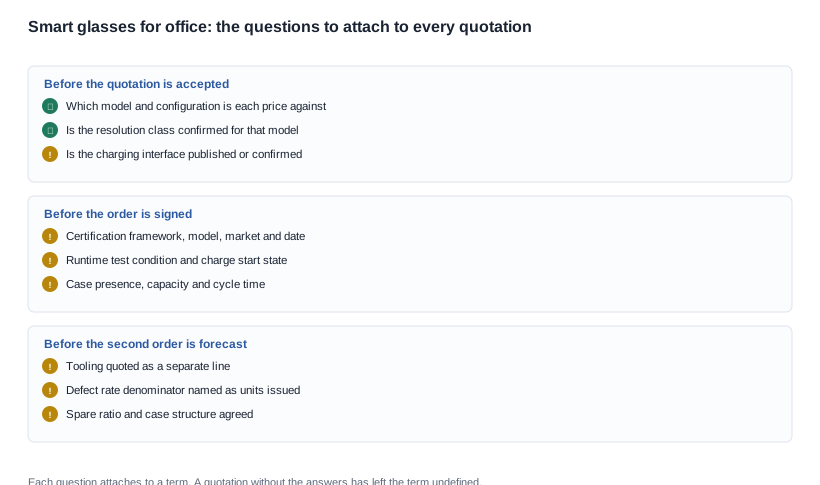
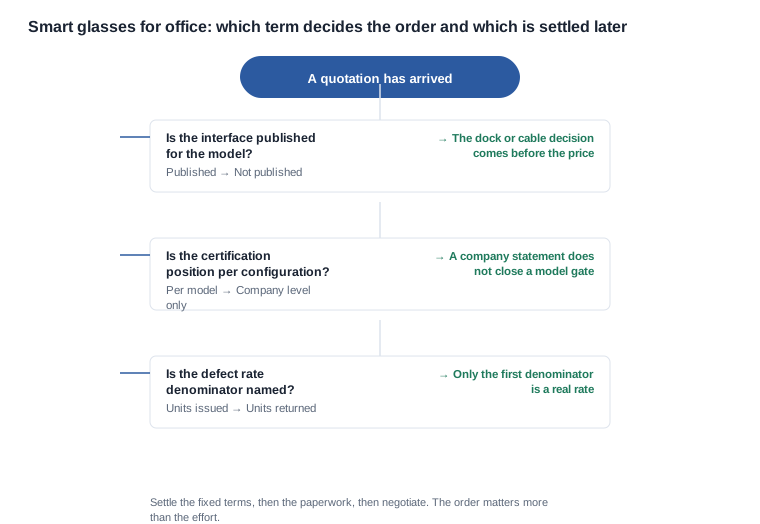
The two charts above are the glossary in operational form. The checklist is the set of questions to attach to a quotation, and the decision diagram is the order in which the terms have to be settled: the fixed terms first, because they decide which model is even a candidate, then the paperwork terms, and only then the negotiable ones. A buyer who negotiates the negotiable terms first and settles the fixed ones afterwards has negotiated a number for a product that has not been chosen.
The glossary rows we publish, and the quotation to send us next
We publish the rows a buyer can order from, and we will not fill the gaps with industry averages. For the camera tier that means the resolution class, the cell capacity, the charge time, the rated runtime, the charging interface where it is published, the case capacity where it is published, the structural features that are published, the colour counts, and the IP54 marking on the V06 and the S7 stated as a catalogue attribute. For the audio tier that means the Bluetooth version, the cell configuration, the charge time, the rated runtime, the charging mode, the absence of any published touch row, the surround sound published on the YK12 and the ultra-slim detachable temples published on the G07. For the sport tier that means the Bluetooth version, the cell configuration, the charge time, the rated runtime, the charging mode, the remote control capture and the surround sound published on the D17 and the ZH12.
Some of the terms in this glossary have no entry, and their absence is the point. We do not publish and will not estimate the frame material, the lens material, the coating, the hinge specification, the unit weight beyond the single 158 g whole-unit figure for the MT6, the field of view, the video specification, the storage and overwrite behaviour, the operating temperature range, the cycle life rating, the runtime test condition or the standby draw. Those are the terms a buyer has to define with the supplier rather than look up, which is why each one carries a question in this glossary instead of a figure. Two further terms have no entry for a different reason: we do not state that the range is certified to CE, FCC or RoHS, because the catalogue text contains no reference to those standards and there is no per-model certification row, and we do not extend the IP54 marking beyond the two models that carry it. A glossary that filled those gaps with typical values would be a glossary a buyer could not safely order from, because the value would be the one that had to be unlearned later.
Send us the quotation, the model designations on it and the terms you are unsure about, and we will tell you which of them are fixed by the product, which are published for that configuration, and which are open until a document arrives. The published rows behind these terms are at battery life and camera imaging, the hardware that the interface terms decide is set out in the office gear checklist, the year-on-year behaviour of a deployed fleet is in long-term use over a year, and the scenario entry point is smart glasses for office.
Related reading
- The opening point of the scenario — smart glasses for office
- The rows in the catalogue — battery life and camera imaging
- The kit these terms decide — the office gear checklist
- What a first order produces — what to expect from an office deployment
Send us the quotation and the model designations, and we will tell you which terms are fixed, which are published for that configuration, and which are open.


