

The mistakes that cost buyers in smart glasses for office use are almost all expectations that came from a different product category. An office buyer is usually comparing these glasses against a headset, a pair of speakers, or a phone, and the comparison is where the trouble starts. The published data for the range is clear enough to make a sound choice, and it also makes clear which expectations the hardware will not meet.
The category error has a cost structure that a buyer should understand before the sample arrives. A mistake about a feature produces a return. A mistake about a category produces a rollout that stalls: the devices are issued, the staff use them for a fortnight, the organisation decides the product is not what it was expected to be, and the devices end up on a desk collecting dust. That is the expensive outcome, and it is invisible in the quotation.
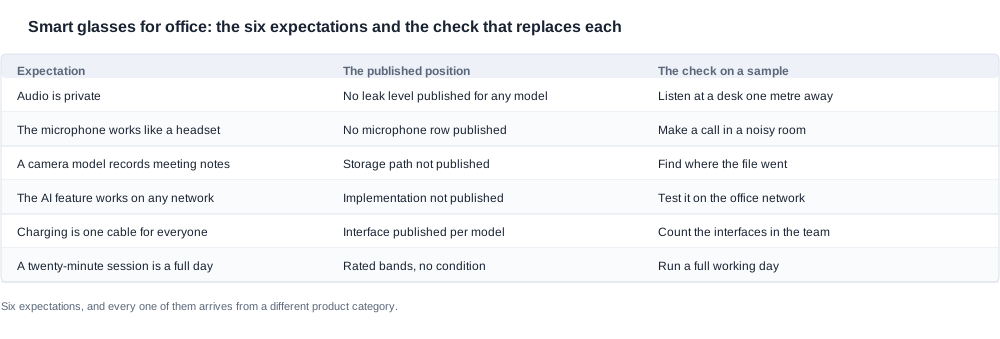
Smart glasses for office: the six expectations and the check for each
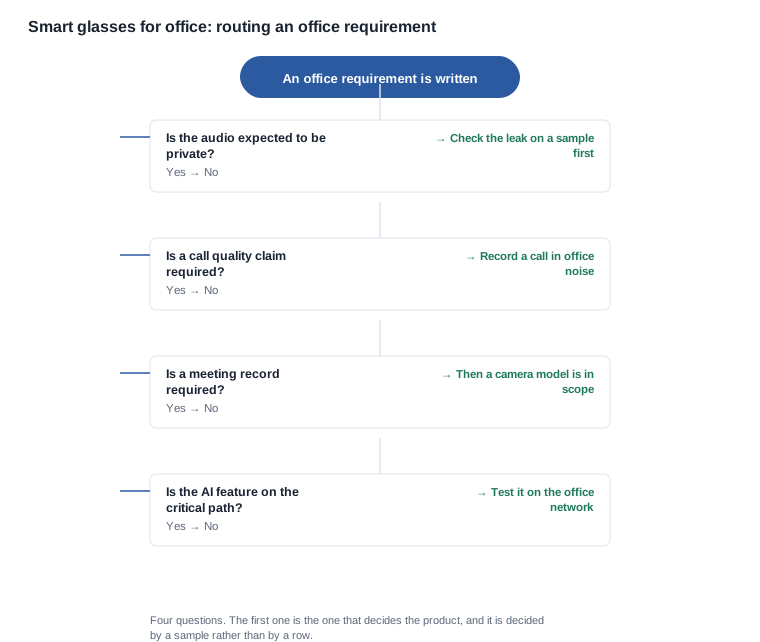
| Expectation | The published position | The check on a sample |
|---|---|---|
| Audio is private | No leak level published for any model | Listen at a desk one metre away |
| The microphone works like a headset | No microphone row published | Make a call in a noisy room |
| A camera model records meeting notes | Storage path not published | Find where the file went |
| The AI feature works on any network | Implementation not published | Test it on the office network |
| Charging is one cable for everyone | Interface published per model | Count the interfaces in the team |
| A twenty-minute session is a full day | Rated bands, no condition | Run a full working day |
Why the published rows are not enough. The range publishes more than enough to select a model: the radios are Bluetooth 5.3 on the K01 and the K02 and 5.4 on the other models that publish a radio row, the cell capacities run from 55 mAh per cell on the LC-105 pair, the G07 and the YK12 through 90 mAh per cell on the K01 and the K02 and 100 mAh on the D11, the D12 and the ZH12, reaching 115 mAh on the D17, the charge times are published for every model, and the rated runtimes sit between about 6 h and about 8 h. What none of that tells a buyer is how the product behaves in a room, on a call, on an office network, or across a working day. Those four are the office's actual requirements, and none of them has a published row.
The buyer in this scenario. A procurement lead or an office manager who has a budget for a fleet and a policy to write. The exposure is not a refund; it is a policy that has to be withdrawn, which in most organisations is a visible, upward-facing event, and which is what makes this category's mistakes more expensive than their price suggests.
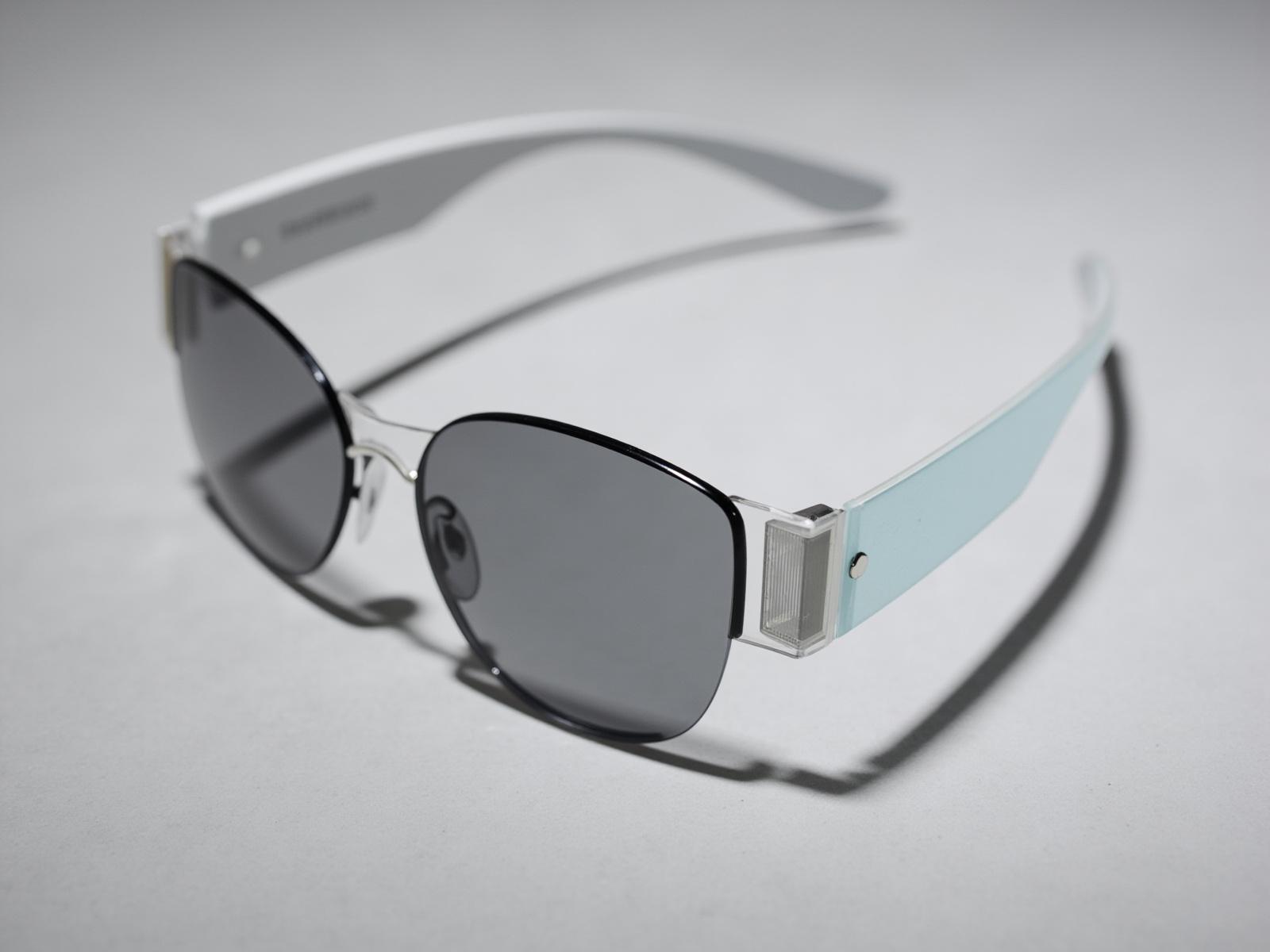
Open-ear audio broadcasts, and no leak level is published
The open-ear structure in this category exists so that the wearer can hear the world, and the consequence is that the wearer broadcasts. Nothing in our published material states a leak level, so the claim cannot be made in either direction — and the expectation that arrives from earphones is that it is private.
What the published position actually is. The audio models publish their interface, their cell capacity and count, their charge time, their rated runtime and their Bluetooth version. The D11 publishes surround sound as a feature, and the YK12 publishes surround sound with a slim temple. No leak level, no isolation figure and no privacy rating is published for any model, and no test report is published behind any of the features. A buyer who wants to write a privacy policy about the office has to produce a measurement, and it has to be their own.
The check, and it is a five-minute check. Listen at a desk one metre away. Then in a quiet meeting room. Then in a corridor. The three are different measurements because the room surfaces are different, and the corridor is usually the one that decides whether the product is acceptable on an open floor at all. Record all three, because a leaked conversation in a meeting room is a different incident from a leaked notification in a corridor, and they call for different words in the policy.
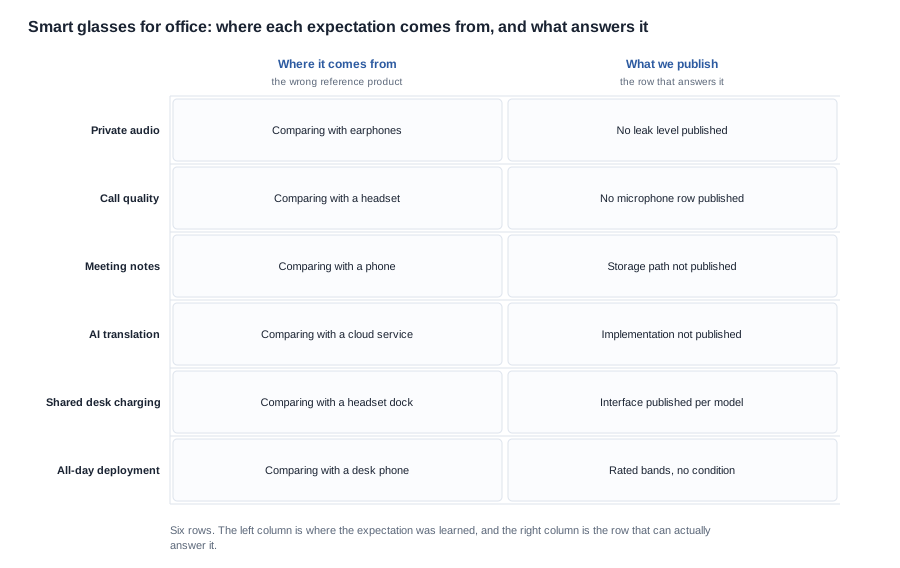
The policy line that has to be written either way. Not "private audio" and not "not private audio" — the published material supports neither statement. What it supports is a behavioural rule: the device is not a private listening device, conversations in the room are audible to people nearby, and the policy applies to every device issued. That is a harder line to write than a product claim, and it is the one an office can defend after the fact.
Why this is the decision that gates the whole scenario. A buyer who discovers the leak after a rollout has to withdraw devices that staff have already been given, which is a visible event. A buyer who discovers it on a sample has written a policy instead. That is the entire difference between the two outcomes, and it costs one afternoon to find out which one it is.
A microphone is not a headset microphone
Microphone quality, pickup distance and response are not published for any model in the range, and the expectation that a headset microphone is the benchmark is the source of the trouble. A headset microphone is engineered for speech in a quiet room and positioned close to the mouth. An open-ear device on a temple is neither of those things, and the gap between the two is what a buyer discovers when a colleague says the call sounded distant.
What to test. Three calls, and all three should be recorded so that they can be compared later rather than remembered. A call in a quiet room, a call with ordinary office background noise, and a call while walking to another room. The second one is the one that matters, because office background noise is broadband and continuous, and a device that handles a quiet room will disappoint in an open floor.
The wind question, in a different setting. Wind noise in a building is not the same problem as wind noise outdoors, because indoors the dominant noise is not wind but the room. It is worth asking the supplier for the microphone specification and, if none exists, recording that as the answer, because a buyer who has a recorded answer can write a procurement requirement and a buyer who has an unanswered question cannot.
What the office can publish internally. A one-line rule: calls from this device are acceptable in a quiet room and in moderate background noise, and the team's own experience in a noisy room is the measurement that governs it. That line is derived from the channel's own recordings, it is defensible, and it costs nothing to produce. The microphone question and the call quality question are the honest treatments of the same subject, and the leakage answer covers the acoustics on the output side.

A camera in a meeting room needs a storage answer
The camera models carry an AI voice assistant as a listed key technology, and the storage path, the video format and the field of view are not published for any of them. A buyer who lists a camera model for meeting notes has implied a recording capability, and the storage capacity question is the one that catches people, because "records meeting notes" implies storage.
The distinction that has to be settled first. There are two different products hiding inside "records meeting notes". One is a device with a microphone that a user decides to activate, producing a note or a summary. The other is a device that records a meeting continuously, which is a different legal category entirely and in most jurisdictions needs a specific legal position before it is deployed. The catalogue publishes the camera class, the resolution class and the assistant as a listed capability, and it publishes nothing about the storage path, the file format, the field of view or the transfer method. So the question of which of the two products is being bought has to be answered by the buyer, in writing, before the model is chosen.
The check. Find where the file went. Record something on a sample, then look for it — in the device, on the paired handset, in an account, or nowhere findable. That single test answers the question that no catalogue row answers, and it is the difference between a device that produces meeting notes and one that produces an argument about data handling.
What to ask the supplier. Where the file lives, how it leaves the device, whether the path depends on a paired handset, what the practical limit is on a single recording, and what happens to the file when the device is reset or returned. Five questions, all answerable in writing, and every one of them relevant to an office where devices are issued and returned.
What to write in the policy. A camera model in an office needs three rules that a consumer listing never needs: where the file goes, how long it is kept, and who may access it. A channel that has written those three rules can deploy a camera model. A channel that has not will get the question from its own compliance function, and the answer will arrive after the rollout.
The AI feature is a network dependency, and a policy question
The K01 publishes AI translation and the assistant is listed across the range, but the model behind it, the language list, whether it works offline and where the data is processed are not published. The internet dependency answer is the one to read before writing it into a policy, and the failure mode is not the interesting part — the interesting part is that a feature described as an assistant turns out to be a network service, and a network service in an office has a different approval path than a device.
Why the office has to decide this before the sample. Three reasons, and the third is the decisive one. A feature that needs a connection cannot be relied on in a basement, a plant room or a site with restricted connectivity, so it cannot be part of a critical workflow. It processes speech, so a deployment that sends meeting audio to a service needs a data-handling position, and that position is the organisation's legal function's call, not the supplier's. And the language list is not published, so a buyer cannot know in advance whether the languages its staff need are covered.
The check. Turn the office network off — or use a network the office does not control — and see what still works. Then turn it on and see what the feature actually does. Record both, and the result is a policy line: the assistant is available on this network and not on that one, and here is the evidence.

What we will and will not say about it. We will say that the assistant is a listed capability across the range and that the K01 publishes AI translation. We will not name the model behind it, the language list, the subscription position, the data location or the offline behaviour, because we do not publish them and we will not supply a typical value for a capability that a buyer may have to justify to a legal function. A buyer who needs that answer should ask for it in writing before the sample order, and the answer is more useful to them than to us.
Interface, session length and the fleet rollout
Two of the six expectations are logistics, and they are the two that decide whether a rollout is administrable. Both are visible in the published rows, which is why a buyer who reads the catalogue carefully can avoid them entirely.
The interface, and the drawer of cables. The charging interface is published per model, and it splits the range cleanly. Type-C is published on the D17 and the D11, the ZH12 and the D12, and the L2 Utral and the V03 Pro; magnetic charging is published on the K01, the K02, the D11's siblings and most of the rest, including the audio class, the sport class and the camera models the S7 and the V06, V03 and the MT5, and the KY06. Four camera models — the MT6 and the CY05, and the L1 Pro and the CY03 — have no published charging method row at all, although all four publish a charging case capacity. So the count of interfaces in an office is a real number to calculate before the order, not a detail to discover in week one.
The charge time, stated as a ceiling. Every model in the range publishes a charge time of two hours or less, with roughly one hour published on the D17 and the ZH12. The wording matters in a procurement document: two hours or less is a ceiling and is not the same assertion as under two hours, and a requirement written as under two hours has set a standard the published row does not meet.
The session length, and what a working day actually costs. The published rated runtimes for the office-relevant models are about 8 h on the K01, the K02 and the LC-105 pair, about 7 h on the D11, the D12 and the D17, and about 6 h on the G07 and the YK12. Those are rated figures quoted without a test condition, and a working day is a mixture — calls, writing, and a device that is on for all of it. So a requirement written as "around 8 hours" is a requirement that will be met on a quiet day and missed on a busy one, and the fix is the same as in every other scenario: name the workload.
The rollout, in six steps. Write the job to be done in one sentence, per team. Check the published rows for the models in scope. Run the four sample checks and record the results. Write the policy — audio, capture, network, sharing. Decide the charging point and the interface per team. Then roll out a pilot group and review it after one cycle, which is the step that catches the expectation that survived the sample programme.
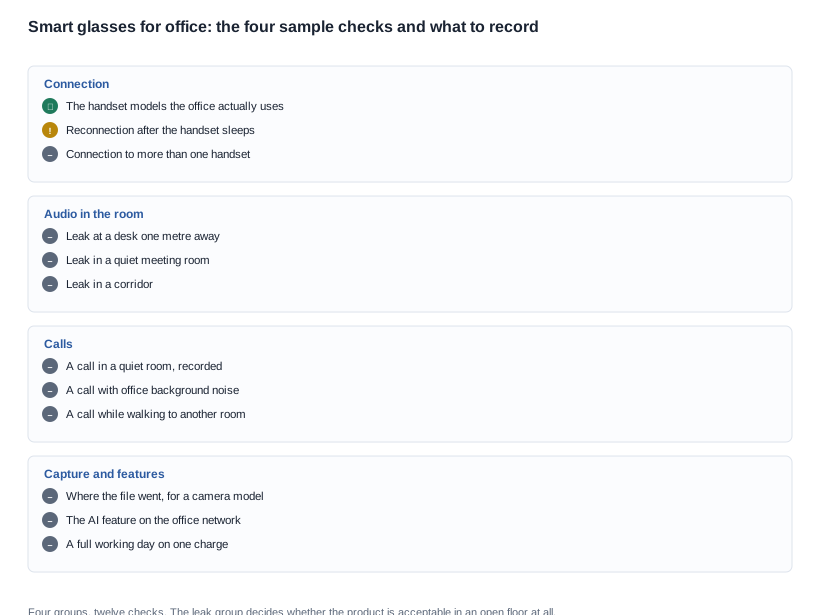
The four sample checks, in the order they should be run. The order matters because each one can disqualify a model, and the cheapest disqualification is the one that takes a minute:
- Connection — bind to the handset models the office actually uses, including the corporate handset rather than a personal one, and confirm what happens after the handset sleeps.
- Audio in the room — the leak at a desk one metre away, then in a quiet meeting room, then in a corridor. Three recordings, and the corridor decides the open-floor question.
- Calls — a recorded call in a quiet room, a recorded call with office background noise, and a recorded call while walking to another room.
- Capture and features — where the file went on a camera model, the AI feature on the office network, and one full working day on a single charge.
The criteria that decide which model an office takes. Four, and they are worth setting before the samples arrive rather than after. The published rows that cover the job. The number of rows the policy has to be written around, because every unpublished row becomes a rule somebody has to write. Whether the interface is consistent with the rest of the fleet, because a mixed fleet is a logistics problem before it is a productivity one. And whether the model is in a configuration the organisation can buy again in a year, because a device that cannot be re-ordered at the same specification is a device that will be replaced rather than replenished.
The commercial terms of an office fleet. The minimum order quantity tiers and whether a pilot quantity can be bought separately from the run quantity, because the pilot group in step six is cheaper as a separate order. The price tier per configuration, the payment terms and the deposit, the lead time the factory can commit to, and the tooling and new tooling expense for a branded package or a charging dock. Two of those matter more here than the unit price: the warranty, because an office device is issued and returned and a policy written for a retail product will not survive that cycle, and the returns terms, because a fleet that ends a contract returns a hundred devices at once and the condition they come back in has to be defined.
How to evaluate a supplier's answers. Four criteria, and they are the same criteria that apply to the sample programme: does the answer name the model and the configuration, does it give a method and a condition rather than a single number, does it say what is not published as explicitly as what is, and can it be checked outside the supplier's own documents. A supplier that answers all four is a supplier whose file can be put into a procurement file, and a supplier that answers none of them has told the buyer something useful for nothing.
Our position, and where it stops. We publish the radio versions, the cell capacities and cell counts, the rated runtimes, the charging interfaces, the published the charge times and the case capacities where they are published, structural features, the colour counts, and the AI capabilities that are listed. We do not publish a leak level, a microphone specification, a storage path, a video format, a field of view, a transfer method, the AI implementation or the unit weight beyond the single whole-unit figure of 158 g for the MT6, and we will not supply a typical value for any of them. We will not state that any product in our range is tested to IP54, because no test report is published behind that marking, and we will not describe a camera model as a meeting recorder.
What to send us next. Send the teams involved, the handsets in use, the office network situation and the expected fleet size, and we will return the published rows that cover each model, the four sample checks in a form your procurement file can carry, and the policy points that the published rows leave open. The office application page carries the wider framework, the testing protocol covers the sample work in detail, and the office case study covers two outcomes end to end.


