
Outdoor procurement questions arrive in a predictable order, and they are almost never the ones a product page answers. They start with the weather, move to the device, then to the order itself, and finish with the trip. The answers below are grouped by the decision each question unblocks, and each one says plainly whether the published documentation settles it, whether it has to be closed with a request, or whether it has to be closed with a sample.
That third category is the one buyers under-budget for. A category answer in this range is unusually thin — there is no per-model certification row, no operating temperature range, no field of view, no lens material and no published weight for almost every model — so the honest answer to a surprising number of questions is a procedure rather than a specification. That is a legitimate answer and it is a buyable one.
Smart glasses for outdoor: the questions that arrive in order
The order the questions arrive in
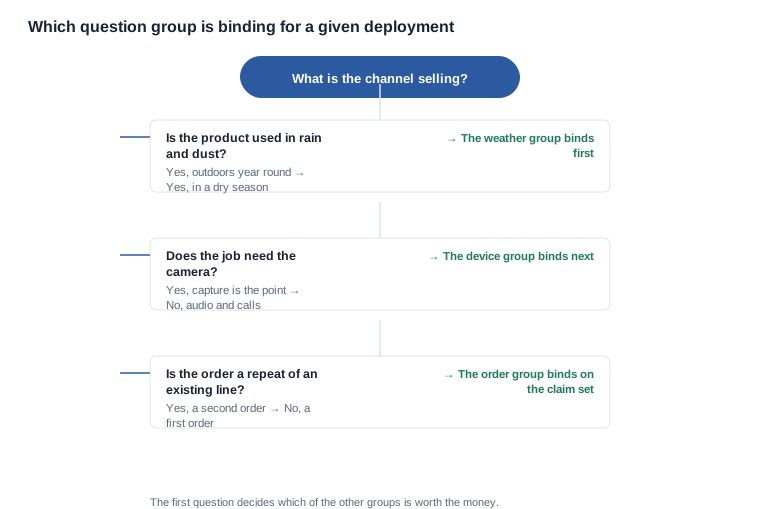
The sequence below is the working order for an outdoor evaluation, and it is the order in which the answers are cheapest to produce. The questions that come first are the ones the documentation settles. The questions in the middle are the ones that need a written request. The questions at the end are the ones that need units on the ground, and they are the ones that cost the most to get wrong.
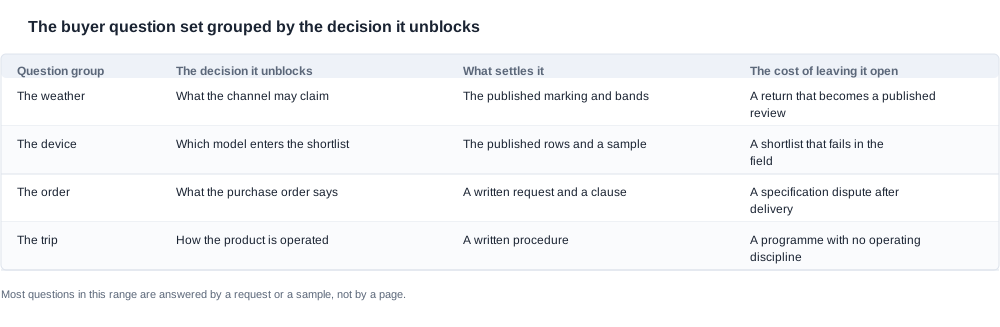
| Question group | The decision it unblocks | What settles it | The cost of leaving it open |
|---|---|---|---|
| The weather decides | What the channel may claim | The published marking and the published bands | A return that becomes a published review |
| The device decides | Which model enters the shortlist | The published rows and a sample | A shortlist that fails in the field |
| The order decides | What the purchase order says | A written request and a contract clause | A specification dispute after delivery |
| The trip decides | How the product is operated | A written procedure | A programme with no operating discipline |
The two kinds of answer, and why the difference matters
There are two kinds of answer in this category and they are worth separating before the questions start. A published answer comes from a catalogue row and costs nothing; it is available to every buyer in the market equally, which is exactly why it cannot be a competitive advantage on its own. A requested answer comes from the factory for a named model and a named configuration, and it is the thing that a supplier evaluation is actually made of.
The failure mode is to build a shortlist on published answers and then discover that the requested answers are unavailable for the two models that scored best. That is a specification problem, and it is much cheaper to find out before the sample order than after the pilot.
Questions the weather decides
"Will it survive the rain?"
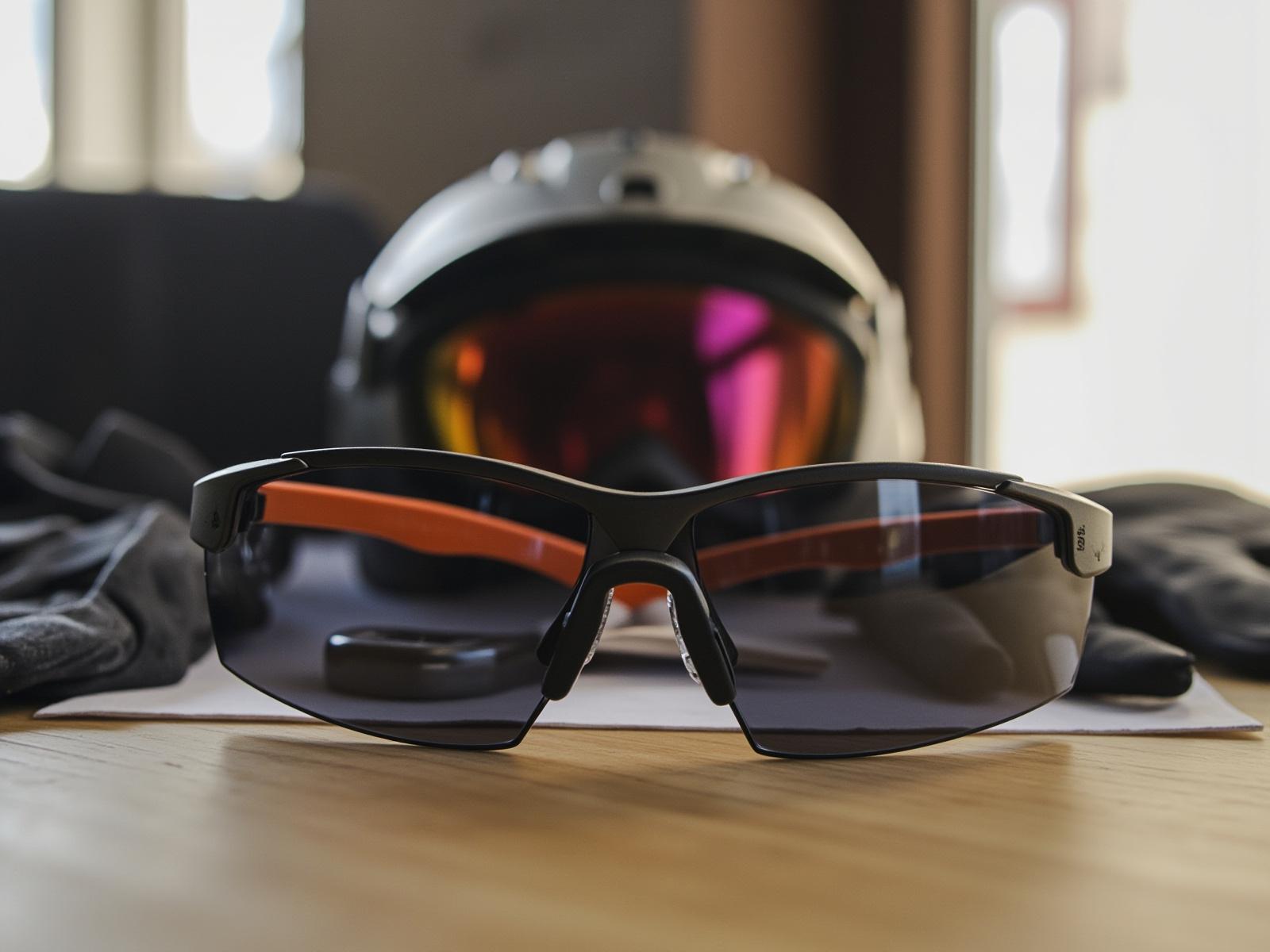
Two models in the catalogue carry the IP54 marking: the V06 and the S7. Nothing else does. Read as a pair, the 5 is a dust-protection level and the 4 is the limit on water — splashing in from any direction, and no further. On that reading the marking does not mean immersion, does not mean a shower rating and does not mean a sustained downpour.
The evidence behind it matters as much as the digits. The marking is a catalogue attribute and no third-party test report is published for it on either model. A buyer who needs the marking in a tender document has to request the report, and if there is no report for that configuration the honest description is "marked IP54 in the catalogue" rather than "IP54 rated". The digit reading is at what the second digit means and the wider position is at IP ratings explained.
"What about heat and cold?"
Temperature is where a lithium cell behaves least like a datasheet. No operating temperature range is published for any model in the catalogue, and no cell behaviour at temperature is published either — no low-temperature discharge curve, no thermal limit, no charging restriction outside a stated range.
What the catalogue does publish is the endurance band and the charge time. Every catalogue entry publishes a charge time, and all but two of them publish two hours or less; the D17 and the ZH12 publish about one hour. The endurance bands across the outdoor candidates are five to eight hours on the V06 and the S7, six to eight hours on the KY06 and the MT5, and about seven hours on the CY05 and the L2 Utral, and the L1 Pro and the MT6, and the CY03.
So the answer is that the endurance figure is a laboratory figure, and a winter deployment has to be tested in the actual cold. The practical effect of a cold cell is a shorter run and a slower charge, both of which are recoverable in a schedule and not in a specification. The measurement route is at how to measure results outdoors.
"Is it safe to leave in a vehicle?"
No, and the reason is the cell rather than the enclosure. A device stored overnight in a parked vehicle in summer, or in winter, is a cell held at an extreme temperature, and the effect is the same as the cold case above with more margin. Store it indoors, away from direct sun, and check it when it comes back.
The ingress marking does not cover this. It covers water ingress into the enclosure and it says nothing about a cell held at a temperature, so a buyer who expects the marking to cover vehicle storage has misread it. This is the same rule a school follows over a summer break, and for the same reason: the damage happens while the device is not in use and it appears as a device that will not hold a charge on the first day back.
Questions the device decides
"Is it heavy?"
The catalogue publishes a unit weight for exactly one model: the MT6 at 158 g, covering the eyewear including its battery and camera and excluding the foldable charging case, whose capacity is published at 1200 mAh and whose own weight is not published. For every other model in the range, no weight is published at all — and the range includes the sport and audio entries where a running or cycling channel will feel the difference most.
The substitution is a sample, and the sample has to be worn for a full session in the conditions rather than held. A buyer who needs a weight figure for a specification should request it in writing for the named model; a buyer who needs to know whether the product will be kept on for four hours should test it.
"Will the lens be comfortable in bright sun?"
Two entries in the catalogue touch on light change and neither publishes a performance figure. On one of them — the V03 Pro — the published lens configuration is photochromic, the temples are flexible, the charging port is Type C and three colour options are listed. On the other — the separate electrochromic entry — the published rows are a Bluetooth 5.4 radio, a 100 mAh cell, a charge time of no more than two hours, a rated run of about seven hours and magnetic charging, and it carries no model designation.
The response time, the depth of change, the light-transmission range and the temperature range over which the change operates are not published, and the word "pending" would be wrong here as well — they are simply not in the documentation. For an outdoor buyer this matters more than it does indoors, because the conditions move: a lens that darkens quickly in full sun and slowly in the shade is uncomfortable in a way that a constant tinted lens is not.
There is one way to find out and it takes ten minutes: put a sample in a window, take it from shade into full sun and back, and record what it does. The care instruction that goes with the wording is at the outdoor lens routine, because the lens material and the coating are not published either.
"Can it record outdoors at night?"
The published camera figures are resolutions. The V06 publishes 8 MP, the S7 publishes 13 MP, and across the camera family the resolution class runs from 8 MP to 13 MP with no sensor part number, no aperture, no field of view, no video resolution, no frame rate and no low-light behaviour attached to any of them.
Resolution does not describe low-light performance, so a buyer planning night use is choosing without the data that would inform the choice. The answer is a sample taken at the actual site at the actual hour, pointing at the actual subjects while moving, because a device that produces usable night footage and one that produces a black rectangle are identical on the datasheet.
"Is it safe to leave in a pack?"
The inner frame published as detachable on the V06 and the S7 is a genuine advantage for packing, because the fit can be adjusted and the frame can be protected independently of the body. The rest is a materials question — a sleeve rather than a bare pocket — and the scratch risk on a lens is the same as it is everywhere else in the category.
One thing to check before a deployment rather than after: the marking covers water ingress into the enclosure, and it says nothing about a lens that has been scratched, because a scratched lens scatters light regardless of the enclosure rating.
Questions the order decides
"Which model for which job?"
The published rows make the shortlist, and the shortlist is narrow once the resolution class is set. For an outdoor camera-led line the two models with the ingress marking are the V06 at 8 MP and the S7 at 13 MP, both on a 260 mAh cell with a five-to-eight-hour band and magnetic charging, both publishing a detachable inner frame and an ergonomic frame. For an audio-led line the three sport models publish their radio version, cell configuration, rated-use figure and interface, with a remote shutter on the D17 and the ZH12 and a charge time of about one hour on the same two.
The question that does not have a published answer is which of those two camera models a channel should carry, and the answer is not the pixel count. Field of view, frame rate, low-light behaviour and unit weight are all unpublished, so the choice between them is decided on the criteria the pilot produces. The model side of that is at comparing models for outdoor use.
"What does it cost at my volume?"
The catalogue does not publish prices, and a buyer who asks for a unit price without a specification gets a range rather than a quotation. The cost of a unit in this category is driven by three things a buyer can control: the cell configuration, the case arrangement and the branding and packaging, and the first two are published rows rather than variables. The cell configurations run from two cells of 55 mAh through 90 mAh × 2 and 70 mAh × 2 to single cells of 100 mAh, 115 mAh and 220 mAh to 290 mAh, and the cases are published at 1400 mAh, 900 and 1400 mAh and a 1200 mAh foldable.
The three numbers that decide whether a price is a good one are the unit price at the requested quantity tier, the landed cost after freight and duty, and the tooling or moulding charge amortised over the first order. All three belong in the request rather than in the product page, and the commercial structure is at pricing and MOQ.
"What certification evidence comes with it?"
On compliance, what the catalogue publishes is one company-level export certification sheet, and the sheet is made of images rather than extractable text: ten patent certificates in total, eight of them appearance-design patents and two of them utility-model patents. Nothing in the catalogue text names a CE, FCC or RoHS marking, and no model carries a certification row anywhere in the material.
That means the conformity documentation for a specific model, in a specific configuration, for a specific market is something a buyer requests rather than something a buyer reads. A buyer entering the European market will ask for the Radio Equipment Directive (EU) 2014/53/EU conformity documentation and the Bluetooth qualification evidence; a buyer shipping cells will ask for the battery transport file and the cell test summary. The request list is at the certification checklist, the radio route is at the RED directive, and the transport requirement is at battery transport.
"What is the lead time?"
Lead time is a function of the build slot and the freight route rather than of the model, and it is not published for any configuration. What a buyer can do is make the request complete, because an incomplete request is the most common cause of a missed build slot: the slot is allocated, the documentation arrives late, and the units ship without the evidence that the order assumed.
The related figure is the one that is published for every entry: the charge time. It is a small number, but it is the one that tells a buyer how long a unit needs out of service, and on a model with a published case capacity it is the number that decides whether a channel needs a spare stock at all.
Questions the trip decides
"What happens if the unit is lost or damaged on site?"
That is a policy question rather than a technical one, and it has to be settled in the contract rather than assumed. Four things decide it: what the remedy is, what evidence is required to claim, who pays the freight in each direction, and what happens to a unit that arrives with the accessories missing. The clause language is at contract terms and the commercial terms are at payment terms.
One published fact shapes the answer. The detachable inner frame on the V06 and the S7 means a damaged unit on those two models can be rebuilt rather than written off, and the charging cases published at 1400 mAh, 900 and 1400 mAh and a 1200 mAh foldable are spare parts in their own right. The models with no published replaceable component are the ones where the policy has to carry the whole cost.
"Can one model cover both the camera and the audio use?"
No, and the catalogue is clear about why. The camera entries publish a resolution class and a battery of 220 mAh to 290 mAh with a runtime band; the audio and sport entries publish a radio version, a cell configuration of 55 mAh × 2 to 90 mAh × 2 and a runtime of about six to eight hours, with no camera row at all. A single model that does both is not a configuration the catalogue publishes.
The commercial consequence is that a channel covering both jobs is carrying two platforms, and the platform boundary is where the tooling, the packaging and the spare-parts list double. That is the point at which the total cost of the second platform should be compared against the cost of running two single-purpose lines.
"What is the operating routine?"
Short, and it is the same for every model in the range. The charging interface is rubbed down before use and the frame is checked for seating. The unit is charged at a named point in the day rather than whenever there is a moment. And the contact is cleared when the charge becomes intermittent, before the fault is reported rather than after.
Those four actions resolve most of the contacts a support desk receives, and they belong in the customer-facing instruction rather than in a service manual, because a service manual is read after the failure. The pre-trip format is at the outdoor checklist, and the routine that prevents the most faults is at the outdoor maintenance routine.

The question that answers itself
The last question in the sequence is the one buyers ask least often and should ask first: what is the channel actually selling? A trail camera, a site documentation tool, a hands-free audio line for a running club and a first-person video product are four different products, and the catalogue's published rows support all four. The rows that matter differ, the claims that can be made differ, the questions above resolve differently, and the answer to that question determines most of the rest.
What we can answer, and what we cannot
Stated plainly: the published rows and the requested documents together answer most of an outdoor procurement question, and the honest way to present that is as two lists rather than one. The first list runs from the per-model cell capacities to the charge times and the rated-use bands, then to the charging interfaces where the catalogue states them, the radio versions it names, the remote shutter fitted to the D17 and the ZH12, the detachable inner frames plus the ergonomic frame on the V06 and the S7, the colour options on the V06, the ingress marking carried by the two models that hold it, the lens configurations, the case capacities where they are published, and the one 158 g whole-unit weight figure in the range, for the MT6.
We mark as not published the unit weight of every model except that one, the cell behaviour at temperature, the operating temperature range, the sensor part numbers, the field of view, the video specifications, the photochromic and electrochromic response figures, the ingress test report numbers, the lens materials and coatings, and any per-model certification number. We will not describe a model as waterproof, shockproof, wind-resistant or low-light capable, because none of those is documented in our material and all four are exactly what an outdoor customer will test in the first week.
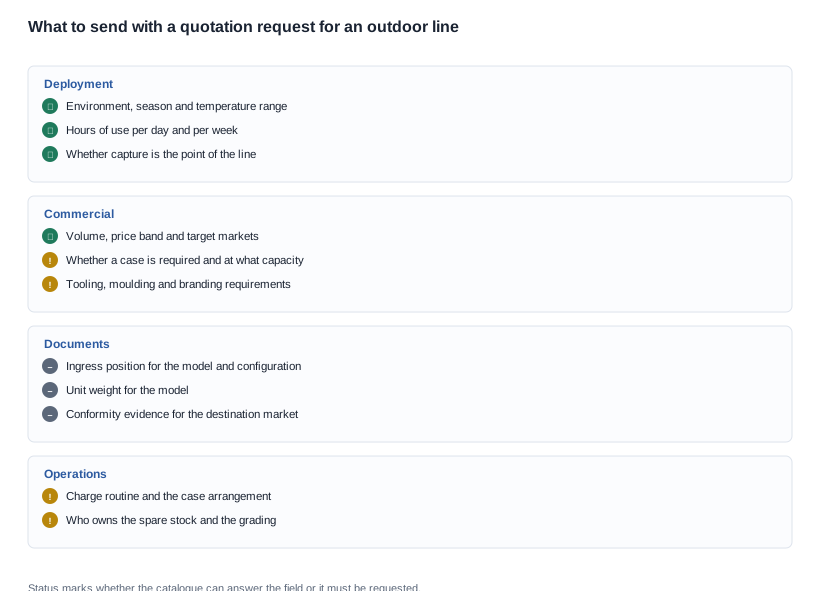
Send us the environment, the temperature range, the hours of use, the volume, the price band and the target markets, and we will narrow the catalogue to the models that fit the published constraints, tell you which of the unpublished variables you will have to close with your own test, and return the request list for the documents that belong in the contract. The product families are at sport smart glasses and AI camera glasses; the scenario entry point is outdoor.
The three answers worth having in writing
Before the sample order, three answers are worth having on paper rather than in a conversation. The first is the ingress position for the model and configuration being ordered, because it decides what the listing may say. The second is the unit weight for that model, because the catalogue publishes one figure across the whole range and it is not the model most buyers are thinking about. The third is the conformity documentation for the destination market, because the catalogue contains no per-model certification row and the request is the only route to one.
Those three answers together are usually enough to establish whether the shortlist is real. The rest of the questions on this page are answered by the pilot, and the pilot route is at the outdoor real-world evaluation.
Related reading
- The entry point for this scenario — outdoor
- The family in question — sport smart glasses
- The camera range — AI camera glasses
- The pilot that closes the open questions — outdoor real-world evaluation
Send the environment, the volume, the price band and the markets, and we will return the published rows that apply and the request list for everything else.


